Are Eggs Healthy?
Nov 10, 2022
Are Eggs Bad for Your Heart? What the Research Actually Shows
One of the most common question I receive during my lectures at medical conferences and on my social media posts is, "Are eggs healthy if you have heart disease?" Or is it safe to eat eggs?
Egg consumption and cardiovascular health have long been a topic of debate, with some studies suggesting that high levels of egg intake may increase the risk of heart disease, while others have found no association or even a protective effect.
When you look at the totality of evidence, yes, increasing egg consumption (dietary cholesterol), does increase cardiovascular event rates, heart attacks, strokes, and all-cause mortality.
We used to think that dietary cholesterol intake did not matter, it turns out that it does matter, especially at extreme of intake and is a linear relationship with cardiovascular events and death rates.
The Question Everyone Asks (And Gets Different Answers)
You ask your cardiologist: "Are eggs bad for my heart?"
Your doctor says: "They're fine, just don't overdo it."
Your friend sends you a study: "Eggs increase mortality 8%."
Your mom says: "I've eaten three eggs a day for 50 years and my cholesterol is perfect."
You're left confused because all of these things are true, but they sound contradictory.
The reason isn't that the science is wrong. It's that the evidence is genuinely complex. Some studies show eggs harm your heart. Others show they don't. Both are using real data. Both are published in top journals. And I'm going to explain exactly why they disagree.
Research on Egg Consumption
Let's review the current evidence on the relationship between egg consumption and cardiovascular health, and discuss the potential mechanisms by which eggs may affect cardiovascular risk.
Generally speaking, eggs are a nutrient-dense food that are high in protein, vitamins, and minerals, and contain antioxidants such as lutein and zeaxanthin. However, eggs are also high in dietary cholesterol and saturated fat, with one large egg containing about 186 mg of cholesterol and 1.6g of saturated fat. We used to believe that dietary cholesterol was the main determinant of cholesterol levels in the bloodstream, and that reducing dietary cholesterol intake was an important strategy for reducing the risk of cardiovascular disease. This is obviously not the case.
Most of your cholesterol comes from your own cells making cholesterol. Every cell in your body makes cholesterol. They just make too much.
The Studies That Say Eggs Are Bad (And Why They're Convincing)
The Zhong Study (JAMA, 2019): The Big One
This study followed 29,615 US adults for an average of 17.5 years and found that each additional half-egg per day was associated with:
6% higher risk of cardiovascular disease. 8% higher risk of all-cause mortality.
These were dose-response relationships, meaning the more eggs people ate, the higher their risk climbed. The study was massive, the follow-up was long, and the results were consistent.
Here's the critical detail: When researchers adjusted the data for dietary cholesterol content, these associations disappeared.
Translation: The harm from eggs appears to come from the cholesterol in eggs, not from eggs themselves.
The Zhuang Study (PLoS Medicine, 2021): Even Larger
521,120 US participants. 16-year follow-up. 129,328 deaths.
Each additional half-egg per day was associated with:
7% higher all-cause mortality. 7% higher cardiovascular mortality. 7% higher cancer mortality.
Again, mediation analysis showed that roughly 63% of this risk was attributable to cholesterol content. Replacing half an egg with egg whites, fish, poultry, or nuts was associated with lower mortality.
The Zhao Study (Circulation, 2022): 31-Year Follow-Up
27,078 men followed for 31 years (the longest follow-up in any egg study). Each additional 50-gram egg per day was associated with:
6% higher overall mortality. 9% higher cardiovascular mortality.
The accompanying meta-analysis of 3.6 million participants confirmed the association was strongest in US cohorts, weaker in European cohorts, and absent in Asian cohorts.
The Meta-Analyses: Dose-Response Confirmed
Multiple meta-analyses pooling hundreds of studies consistently found that each additional egg per day increased mortality risk by 6-8%.
The evidence for harm is real. It's not fabricated. It's published in top-tier journals. It's based on hundreds of thousands of people.
So why do some studies show no harm?
Infographic Summary:
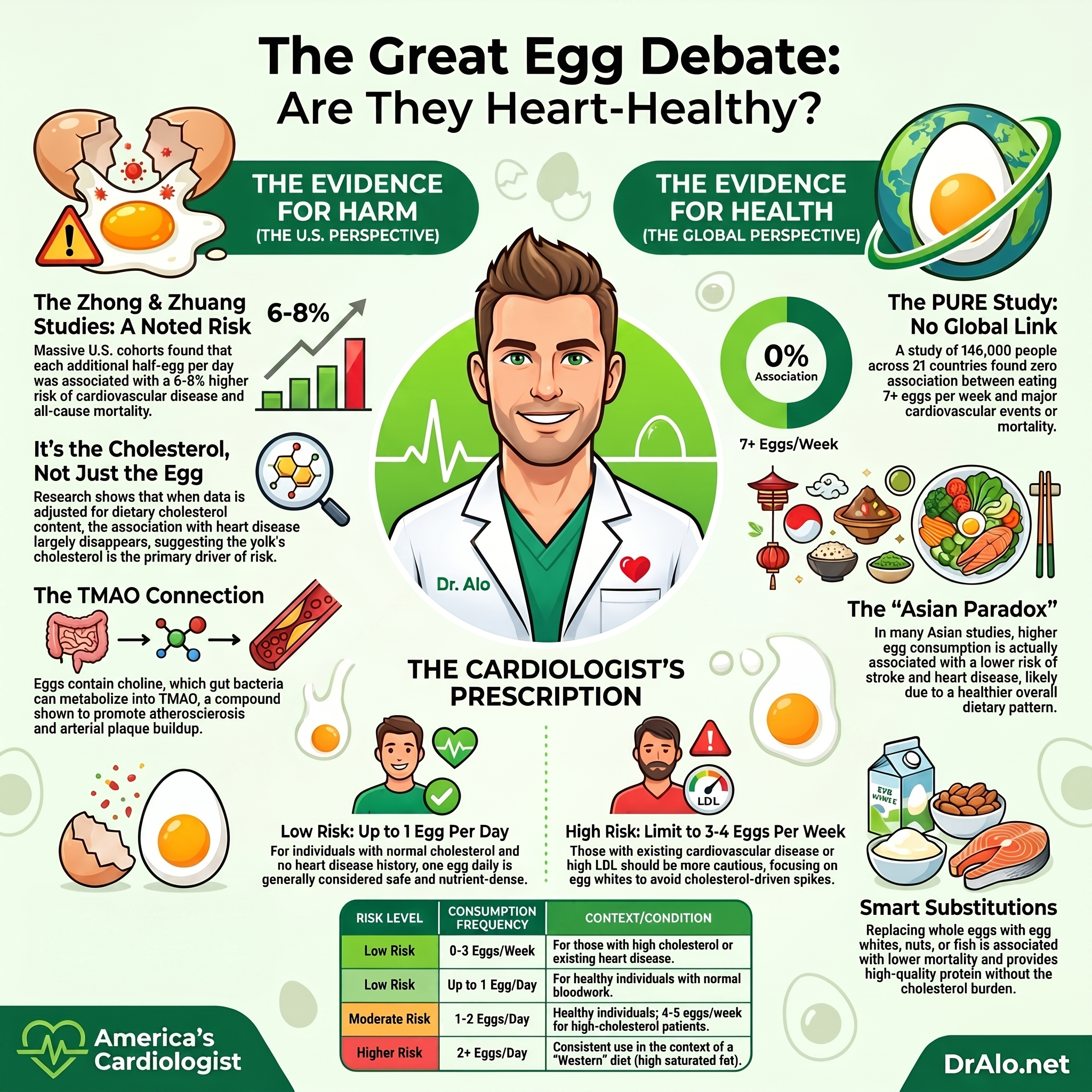
Dietary Cholesterol Intake and CVD Risk?
Recent research has shown that the relationship between dietary cholesterol and blood cholesterol levels is complex and may be influenced by other factors such as the type of fats consumed and the presence of other nutrients in the diet.
We have since learned that dietary cholesterol matters in the extremes of consumption. If you are eating over 400mg and even up to 1000mg per day, then yes, your blood cholesterol will increase. but for the average American who consumes 200-300mg per day, dietary cholesterol does not affect circulating cholesterol very much.
The data on dietary cholesterol has gone back and forth, the latest research and data shows that high levels of cholesterol intake do in fact increase cardiovascular risk and mortality.
A meta analysis published in Circulation (the American Heart association's top peer reviewed journal) titled Associations of Dietary Cholesterol, Serum Cholesterol, and Egg Consumption With Overall and Cause-Specific Mortality: Systematic Review and Updated Meta-Analysis published in May of 2022 looking at 27,000 participants for 31 years, concluded that...
Conclusions: In this prospective cohort study and updated meta-analysis, greater dietary cholesterol and egg consumption were associated with increased risk of overall and CVD-related mortality. Our findings support restricted consumption of dietary cholesterol as a means to improve long-term health and longevity.
https://pubmed.ncbi.nlm.nih.gov/35360933/

As you can see above, as dietary cholesterol goes above 400mg daily and approaches 1000mg daily, you see increases in incidence of CVD and all cause mortality.

As you can see above, as the number of eggs increases, incident CVD and all cause mortality all increase. The lowest CVD and all cause mortality rates are 1 egg per day or less.
For more from that research paper:
https://pubmed.ncbi.nlm.nih.gov/30874756/
Another large prospective cohort study, the Nurses' Health Study, followed over 117,000 women for up to 14 years and found no association between egg intake and the risk of coronary heart disease or stroke.
Similarly, a meta-analysis of 17 studies comprising over 250,000 participants found no association between egg intake and the risk of coronary heart disease, stroke, or total cardiovascular disease. Great news, right?
So What's the Real Answer? (My Cardiologist Take)
Here's what I tell my patients:
Eggs are not inherently bad for your heart. But the cholesterol in eggs might be bad if you're cholesterol-sensitive or if you're eating them as part of a generally poor diet.
Let me break down the safe approach:
If You Have Normal Cholesterol and No Heart Disease History
You can probably eat eggs regularly. Up to one per day is safe. Some people can tolerate more. The evidence of harm is primarily in people who are eating 2-3+ eggs daily in the context of a Western diet.
How do you know if eggs are affecting you? Check your cholesterol levels. Get bloodwork done. If your LDL is creeping up with higher egg consumption, pull back. If your cholesterol stays stable, you're probably fine.
If You Have High Cholesterol or Cardiovascular Disease
Be more cautious. Limit eggs to 3-4 per week. Focus on egg whites or egg substitutes when possible. This is where the Zhuang study data applies most directly.
Your goal is to keep LDL cholesterol as low as possible (ideally below 70 if you have established disease). If eggs are pushing you above that target, reduce them.
You can buy "Egg Beaters" which is eggs without cholesterol.
If You're Asian or Eat an Otherwise Healthy Diet
The international evidence suggests eggs are probably fine in limited amounts. You can eat them more liberally because they're part of a dietary context that's generally protective.
The Real Variable: Your Overall Diet
An egg eaten as part of a breakfast with whole grains, vegetables, and omega-3 fats? Different risk than an egg eaten with bacon, white toast, and sugary coffee.
An egg as a protein source for lunch with salad and olive oil? Different risk than an egg as part of fast food fried chicken sandwich.
The egg alone isn't the story. The dietary context is.
The Egg White Question (Can You Just Eat the Whites?)
Yes. All the cholesterol is in the yolk. The white is pure protein. If you like eggs but want to minimize cholesterol, egg white omelets are fine.
But the yolk also contains lutein, zeaxanthin, and choline, compounds with health benefits. It's not that the yolk is pure poison. It's that the yolk's benefits come bundled with cholesterol.
The question is whether the benefits outweigh the cholesterol burden for you specifically.
The Replacement Question (What Should You Eat Instead?)
If you're limiting eggs due to cholesterol concerns, what's the alternative protein?
The Zhuang study found that replacing half an egg with the following was associated with lower mortality:
Egg whites or egg substitutes (no cholesterol). Poultry (white meat chicken or turkey, lower saturated fat than eggs). Fish (omega-3 fats, protective effects). Dairy (low-fat options). Nuts and legumes (unsaturated fats, fiber).
So if you're eating 2 eggs for breakfast, you could eat 1 egg + a serving of fish, or 1 egg + nuts, or egg white omelet with vegetables.
To Egg or Not To Egg?
What I normally tell my patient is that if you really love eggs, then 1 per day is probably fine. If you have high cholesterol and established heart disease, you may not to eat only egg whites.
It's still important to consider the overall quality of the diet and the impact of other nutrients on cardiovascular health, especially saturated fat intake. The current evidence suggests that low to moderate egg intake, as part of a balanced diet, is not associated with an increased risk of cardiovascular disease. This doesn't mean you should be eating 5-10 eggs per day. I see too many influencers showing their breakfast, and it's like 15 eggs for breakfast. That is extreme and will certainly increase your risk.
Interestingly, studies have also shown that substituting whole eggs for egg whites or egg substitutes did show a reduction in mortality.
If you have significant risk factors and or a history of heart disease, you may want to consider limiting egg intake to 0-1 per day based on other studies and the totality data.
As with any dietary decisions, it is important to speak with your doctor, cardiologist or registered dietitian for personalized nutrition advice.
The Bottom Line
The evidence that eggs harm your heart is real, but it depends on so many factors.
Eggs appear to increase cardiovascular mortality in people who:
Eat them frequently (2+ per day). Have high cholesterol or existing heart disease. Are older adults (60+). Eat them in the context of a generally poor diet high in other sources of cholesterol and saturated fat.
Eggs appear to be neutral or protective in people who:
Eat them in moderation (up to 0- 1 per day). Have normal cholesterol levels. Are younger. Eat them as part of an overall healthy diet with lots of vegetables, whole grains, and healthy fats.
The honest answer: It depends on you.
Your genes, your cholesterol levels, your age, your overall diet, whether you're a cholesterol responder—these all matter. One egg is not universally safe or universally dangerous.
Here's my recommendation: Know your cholesterol levels. Eat eggs in moderation. If your cholesterol is creeping up, reduce them. If your cholesterol is stable and you love eggs, you can eat them regularly without guilt.
And stop arguing with your family at breakfast about whether eggs are healthy. You're probably all right, depending on your individual circumstances.
Questions About Your Specific Situation?
Egg safety is personal. What's fine for your neighbor with great genes and a perfect diet might not be fine for you if you have familial hypercholesterolemia or a history of heart attacks.
The Heart 2 Heart VIP Community is where we talk about these nuances. Your cholesterol numbers. Your family history. Your overall diet. Your individual risk factors. You can share your bloodwork, get physician-level guidance, and have real conversations about what you should actually be eating.
Not generic advice. Not social media arguments. Just evidence-based answers tailored to your actual health profile.
💪🏻🩺🫀
Dr. Alo
References
Related Food & Diet Posts
Explore other food myths and what works:
- Are Seed Oils Bad For You? – Understanding healthy fats
- Red Meat Healthy? Latest Science – The research on protein sources
- Is The Carnivore Diet Safe? – Examining extreme approaches
- Mediterranean Diet: The Evidence – The research-backed approach
- Dr. Alo's Dietary Guidelines – The complete framework
Grab my Actual Weight Loss book for more leading edge weight loss and heart health advice!
Grab my Mediterranean Diet Calorie Based Weight Loss Cookbook!
Still Have Questions? Stop Googling and Ask Dr. Alo.
You’ve read the science, but applying it to your own life can be confusing. I created the Dr. Alo VIP Private Community to be a sanctuary away from social media noise.
Inside, you get:
-
Direct Access: I answer member questions personally 24/7/365.
-
Weekly Live Streams: Deep dives into your specific health challenges.
-
Vetted Science: No fads, just evidence-based cardiology and weight loss.
Don't leave your heart health to chance. Get the guidance you deserve. All this for less than 0.01% the cost of health insurance! You can cancel at anytime!
[👉 Join the Dr. Alo VIP Community Today]
Cardiology & Obesity Medicine