
HDL Is Not Protective
Jan 17, 2025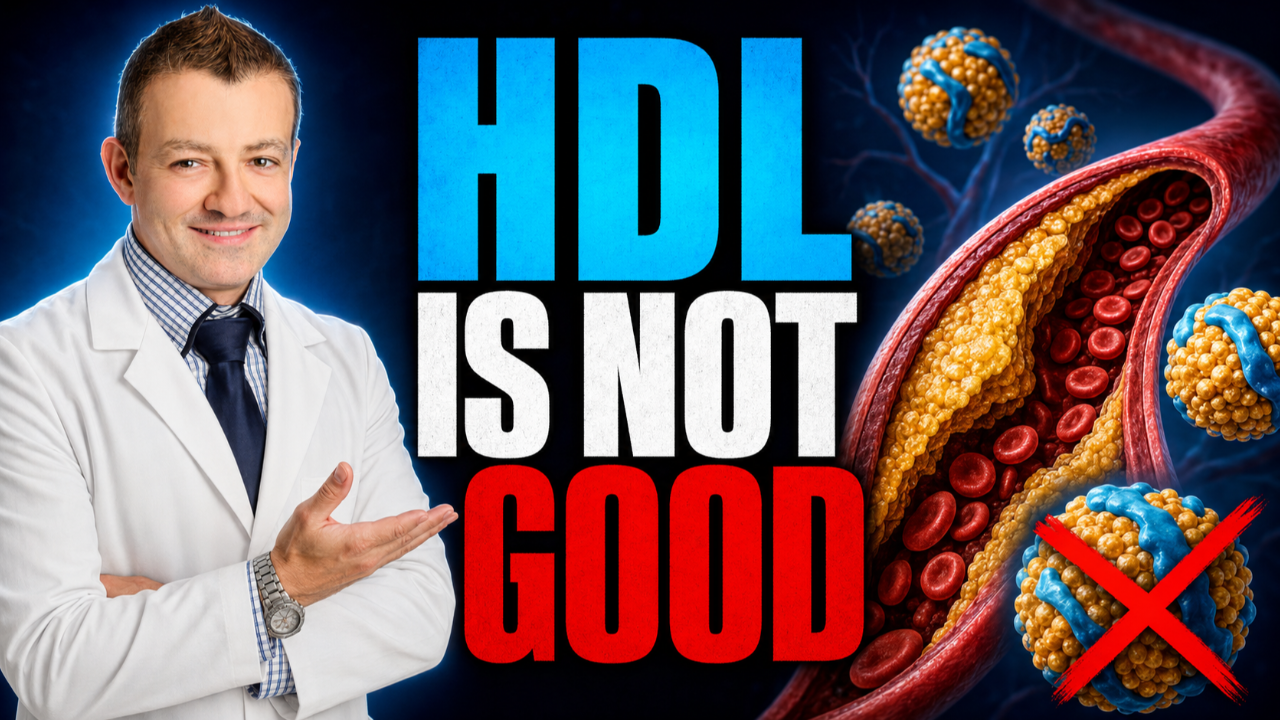
HDL Cholesterol Is Not Protective Or Is It?
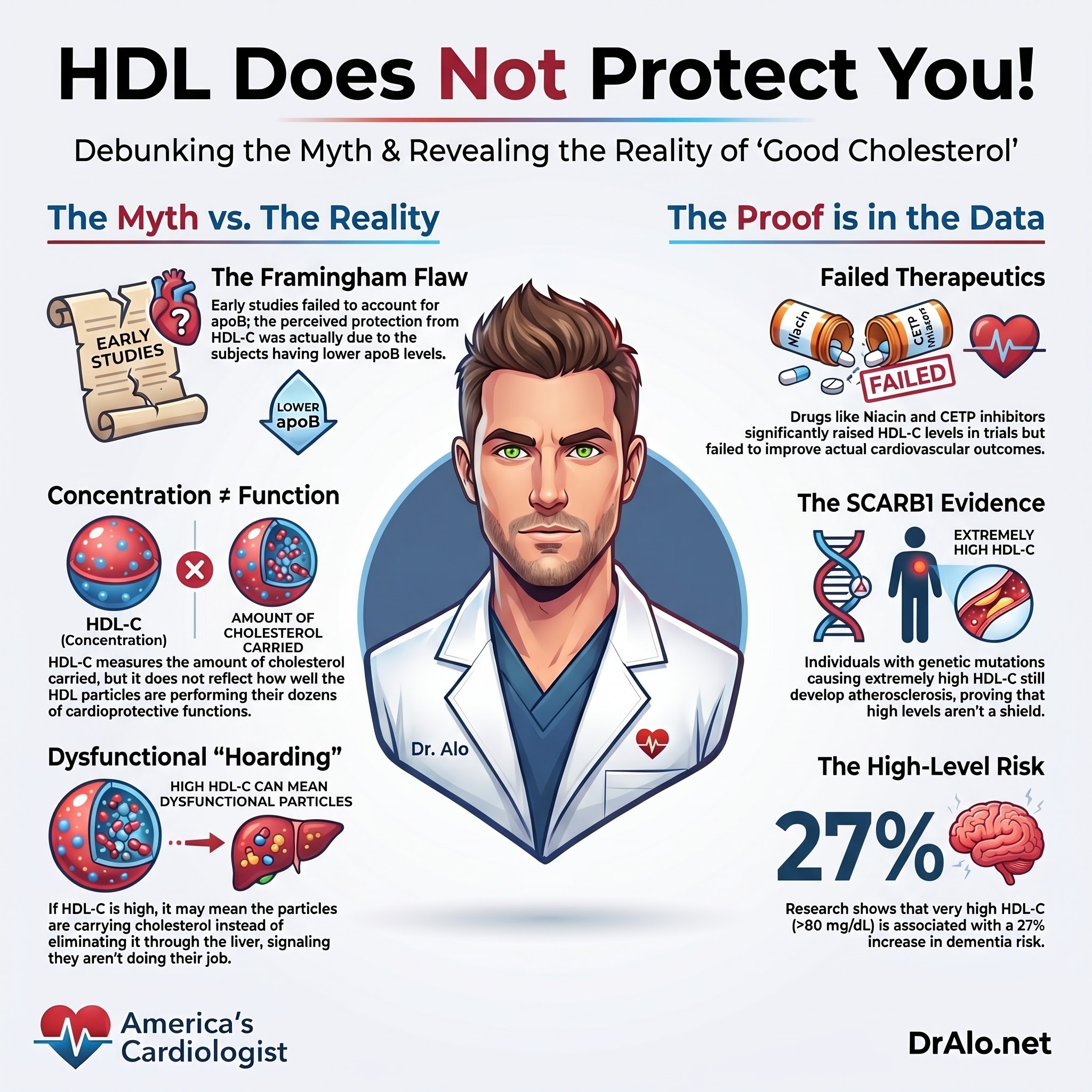
Another common misconception that needs to go away is that “HDL cholesterol is protective”. While HDL particles are involved in removing cholesterol from our arteries, the levels of HDL-C are not related to, nor indicative of any of the numerous functions, many cardioprotective, that HDL particles perform. The earlier studies that suggested HDL-C was a biomarker of CV protection were never adjusted for apoB.
High HDL does not counteract or offset high LDL. This is another misconception. Clinicians need to update their understanding of HDL and LDL.
So, where did this come from?
When the original Framingham studies were done, they noticed that people with higher levels of HDL-C had less heart disease. They forgot to note that people with the highest HDL-C also had much lower LDL-C or apoB. Like all the early observational studies, that time and again, showed low HDL-C was associated with increased CV risk, none were adjusted for apoB.
The protective effect was due to the lower apoB levels and had nothing to do with HDL-C levels.
Infographic Summary:
What Is HDL Cholesterol?
HDL complexity revolves around the fact that HDL particles are part of the innate immune system and perform dozens of functions which may or may not be related to the cardiovascular system. None of these functional properties of HDL particles have any relationship to the amount of cholesterol the HDL particles collectively carry.
One important aspect of HDL particles is to delipidate cholesterol from arterial wall foam cells in a process called macrophage reverse cholesterol transport. This important efflux of cholesterol has no effect on HDL-C. Efflux is the removal (exiting) of cholesterol from your arterial wall.

It is now also recognized that HDL particles can acquire molecules that render the HDL nonfunctional or dysfunctional (may cause harm).
The bottom line is that HDL particle functionality or dysfunctionality is not related to the HDL-C concentration. Thus, no one should be using HDL-C to make any statements regarding the cardiovascular system.
HDL-C has never been a goal of therapy in any historical guidelines nor current guidelines.
Think about it. If an HDL particle’s role is to collect cholesterol from your arteries and eliminate it by returning it to the liver (delipidating), but it is high, that means your HDL particles are carrying around more cholesterol and not eliminating it. Why would HDL-C be going up? They are not doing their job. They are dysfunctional.
Furthermore, plenty of therapeutics have been used in the past to raise HDL-C. This did not improve outcomes. Niacin for example, significantly raised HDL-C levels. Patients had no improvement in outcomes. Four different CETP medications raised HDL-C even higher than niacin, yet large clinical outcomes trials did not show improvement in outcomes.
People with a genetic mutation of the SCARB1 receptor have genetically very high HDL-C. Guess what? They still have atherosclerosis. It’s not protective.

The few HDL particles that carry apoE are not atherogenic. Likewise, the few that carry apoC-III are more atherogenic.
HDL particles handoff their cholesterol payload to LDL particles and most of the cholesterol that returns to the liver for elimination is returned via the indirect transport method using LDL particles.
There is also evidence that excessively high HDL-C maybe be associated with increased CV risk and that it may be a U shaped or J shaped curve. A U-shaped curve usually means that very low levels are harmful and very high levels are harmful. This is still under investigation, but an article is being published on this topic at:
https://academic.oup.com/jcem/advance-article-abstract/doi/10.1210/clinem/dgad406/7223406
High HDL-C (> 80 mg/dL) appears to be associated with a 27% increase in dementia. So, while it’s no longer considered protective, it may also be dysfunctional and lead to worse outcomes.
Study:
https://www.thelancet.com/journals/lanwpc/article/PIIS2666-6065(23)00281-X/fulltext
Further reading:
https://www.nih.gov/news-events/nih-research-matters/when-hdl-cholesterol-doesnt-protect-against-heart-disease
https://pubmed.ncbi.nlm.nih.gov/29596577/
https://pubmed.ncbi.nlm.nih.gov/27651445/
Did You Like This Article?
This post is a chapter from my new Cholesterol Book. If you want updates on when that book will be ready for purchase, click on my updates link and sign up to receive updates:
Still Have Questions? Stop Googling and Ask Dr. Alo.
You’ve read the science, but applying it to your own life can be confusing. I created the Dr. Alo VIP Private Community to be a sanctuary away from social media noise.
Inside, you get:
-
Direct Access: I answer member questions personally 24/7/365.
-
Weekly Live Streams: Deep dives into your specific health challenges.
-
Vetted Science: No fads, just evidence-based cardiology and weight loss.
Don't leave your heart health to chance. Get the guidance you deserve. All this for less than 0.01% the cost of health insurance! You can cancel at anytime!
[👉 Join the Dr. Alo VIP Community Today]
Cardiology & Obesity Medicine