Atorvastatin Side Effects: What Is Normal and What Is Not
Oct 27, 2026Atorvastatin (Lipitor) is one of the most prescribed medicines in the world, and "atorvastatin side effects" and "Lipitor side effects" are among the things people search for most. I understand why. You take a pill every day for years, you read a long list of possible problems, and the first time your legs ache you wonder if the pill is the reason. So here are the real numbers, in plain English.
The short version:
- Muscle aches: real, but far less often than people think. In large blinded trials, more than 90% of the muscle complaints from people on a statin were not due to the statin.
- Liver blood tests: a small rise can happen, mostly at higher doses, without more liver disease.
- Blood sugar: a small upward shift, concentrated in people already close to the diabetes line.
- Memory, mood, sleep: blinded trials do not support a link, and some antibiotics and antifungals are the interactions to watch.
I do not recommend that you stop your statin on your own unless your symptoms are severe, and I will tell you exactly what severe means below.
Muscle Pain on Atorvastatin: Trials Versus Real Life
The best evidence on muscle pain is a 2022 Lancet analysis from the Cholesterol Treatment Trialists' Collaboration, which pooled 19 double-blind trials of a statin versus placebo: 123,940 people followed for about 4 years. Muscle pain or weakness was reported by 27.1% of people on a statin and 26.6% of people on placebo. About one in four people had muscle symptoms, and it was almost the same on a sugar pill.
The statin did add a little, and only early. In year one there were about 11 extra reports for every 1,000 people treated, and the authors calculated that only about 1 in 15 muscle reports from statin users was actually due to the statin. After the first year there was no significant excess. Dose played a role: regimens that included atorvastatin 40 to 80 mg had a rate ratio of 1.08 versus placebo, compared with 1.03 for moderate or lower intensity regimens.

Figure: muscle pain or weakness, statin vs placebo, in 19 double-blind trials. Redrawn from Cholesterol Treatment Trialists' Collaboration. Lancet. 2022;400(10355):832-845.
How to read it: the two bars are nearly the same height, 27.1% on a statin and 26.6% on placebo. The navy tiles show where the small difference lives: only about 1 in 15 muscle reports from statin users was really the statin, the extra reports came in the first year, and high-intensity doses added a little more.
Why does the clinic look worse than the trials? The 2018 AHA/ACC guideline puts muscle symptoms at 1% to 5% in randomized trials but 5% to 10% in everyday practice, and an AHA statement says roughly 10% of US patients stop a statin over subjective complaints. Part of that gap is the nocebo effect.
The Nocebo Effect: Expecting Side Effects Can Create Them
The nocebo effect is the opposite of the placebo effect. When you expect a pill to cause a problem, you notice normal aches and blame the pill. Two atorvastatin studies show it clearly.
In ASCOT-LLA, about 10,000 people with high blood pressure were randomly assigned to atorvastatin 10 mg or placebo, without knowing which. Muscle-related side effects were reported at the same rate: 2.03% per year on atorvastatin and 2.00% on placebo. The trial was stopped early because atorvastatin so clearly worked, and everyone was offered it openly. In that unblinded phase, people taking atorvastatin reported muscle side effects at 1.26% per year versus 1.00% in people not taking it, a 41% higher rate. Same drug, same dose, similar patients. What changed was that everyone knew.
In the SAMSON trial (New England Journal of Medicine, 2020), 60 people who had stopped statins over side effects got 4 months of atorvastatin 20 mg, 4 months of placebo, and 4 months of no tablets, in random order, and scored symptoms daily from 0 to 100. The average score was 8.0 with no tablets, 15.4 on placebo, and 16.3 on atorvastatin, and the last two were not statistically different. The authors estimated that 90% of the symptom burden of the statin was also produced by placebo. SAMSON was small and used a revised analysis for the 90% figure, so I treat it as an illustration. But it fits the bigger studies.

Figure: the nocebo effect in ASCOT-LLA and SAMSON. Sources: Gupta A, et al. Lancet. 2017;389:2473-81; Wood FA, et al. N Engl J Med. 2020;383:2182-4.
How to read it: on the left, the same atorvastatin 10 mg produced equal muscle complaints while nobody knew who was on it (2.03% vs 2.00% a year), and more complaints once everyone knew (1.26% vs 1.00%). On the right, people who had quit statins scored their symptoms almost as high on a placebo as on the statin, and far higher than on no tablet at all.
Your pain is not imaginary. It just is not always caused by the pill. If you stop a pill that was not the culprit, you lose the protection and may keep the pain.
What Is Normal and What Is Not
Common, and usually not the statin. Mild aches, a little stomach upset, a headache, or tiredness in the first weeks of any new pill. These happen on placebo too. In the 2026 Cholesterol Treatment Trialists' analysis of 66 effects listed on statin labels, nausea, headache, fatigue, and weight gain were not shown to be caused by statins. Mention it at your next visit and see whether it fades.
Worth a call to your doctor. Persistent aching that bothers you. The 2018 guideline says a statin is more likely the cause when the aching is on both sides, sits in big muscles near the trunk such as the thighs, hips, and shoulders, begins weeks to months after starting or raising the dose, and fades after stopping. Risk is higher with older age, female sex, low body weight, Asian ancestry, an underactive thyroid, kidney or liver disease, heavy alcohol use, and interacting drugs.
Not normal. Get help now. Severe muscle pain with real weakness, such as trouble getting out of a chair. Dark, tea-colored urine. Yellowing of the skin or eyes. These can signal serious muscle or liver injury. The extreme form of muscle injury, rhabdomyolysis, is defined as a CK more than 10 times normal with kidney injury, and it needs immediate medical attention. It is exceedingly rare: about 3.4 cases per 100,000 person-years in one systematic review, and usually in people with several risk factors or an interacting drug.
Liver Tests: Dose Matters, Routine Monitoring Does Not
Atorvastatin can raise liver enzymes, and the effect depends on dose. In the TNT trial, 10,001 people with stable coronary disease took atorvastatin 10 mg or 80 mg for a median of 4.9 years. Persistent liver enzyme elevations occurred in 0.2% of people on 10 mg and 1.2% on 80 mg. The same trial shows why people take the higher dose anyway: major cardiovascular events were 8.7% on 80 mg versus 10.9% on 10 mg. It is a trade, which is why I look for the lowest dose that gets you to goal.

Figure: liver enzyme rises and major cardiovascular events with atorvastatin 10 mg vs 80 mg. Redrawn from LaRosa JC, et al. N Engl J Med. 2005;352:1425-35 (TNT).
How to read it: the left panel is the cost of the higher dose, persistent liver enzyme rises in 1.2% instead of 0.2%. The right panel is the benefit, major cardiovascular events in 8.7% instead of 10.9%. That trade is why the goal is the lowest dose that gets your LDL where it needs to be.
The 2026 pooled analysis found abnormal liver transaminases in 0.30% per year on a statin versus 0.22% on placebo (rate ratio 1.41), and the intensity-comparison trials supported a dose effect. The Oxford team that ran it reported no increase in hepatitis or liver failure. The 2018 guideline says to check liver enzymes at baseline and afterward only if symptoms suggest liver trouble, and that CK and transaminases should not be routinely measured.
Atorvastatin and Blood Sugar
Statins nudge blood sugar up. A meta-analysis of 13 trials and 91,140 people found a 9% higher risk of new diabetes, about one extra case for every 255 people treated for 4 years. Dose matters here too. A 2024 individual-patient analysis found a 36% increase in new diabetes with high intensity statins versus 10% with low or moderate intensity, though the authors note part of that gap reflects how often HbA1c was measured. In a 2011 JAMA meta-analysis, intensive-dose statins caused about 2 extra cases of diabetes per 1,000 patient-years but prevented 6.5 cardiovascular events.
Who gets it? In the 2024 analysis, among people with a baseline blood sugar measurement, about 62% of new diagnoses were in people already in the top quarter of baseline values. The JUPITER trial shows the pattern. It gave 17,603 people rosuvastatin 20 mg or placebo. In those with at least one of four diabetes risk factors (metabolic syndrome, impaired fasting glucose, BMI of 30 or higher, HbA1c above 6%), diabetes rose 28% but major cardiovascular events fell 39%: 134 events or deaths avoided for every 54 new cases of diabetes. In those with none, there was no increase in diabetes (hazard ratio 0.99, wide interval 0.45 to 2.21) and events fell 52%.

Figure: new diabetes and major cardiovascular events with rosuvastatin in JUPITER, by diabetes risk factors. Redrawn from Ridker PM, et al. Lancet. 2012;380:565-71.
How to read it: the top row is people who already had at least one diabetes risk factor. Diabetes rose 28%, but heart attacks, strokes and deaths fell 39%, 134 events or deaths avoided for every 54 new diabetes cases. The bottom row is people with no risk factors: no rise in diabetes, and 52% fewer events.
I am not saying nobody far from diabetes can ever get a diagnosis. I am saying the signal sits mostly in people who were already prediabetic or on the brink. For them it is a reason to work on weight, food, and exercise and to talk about dose, not a reason to quit. The 2018 guideline says diabetes risk should not be a reason to avoid or stop a statin. More in my article on whether statins cause diabetes.
Memory and Brain Fog
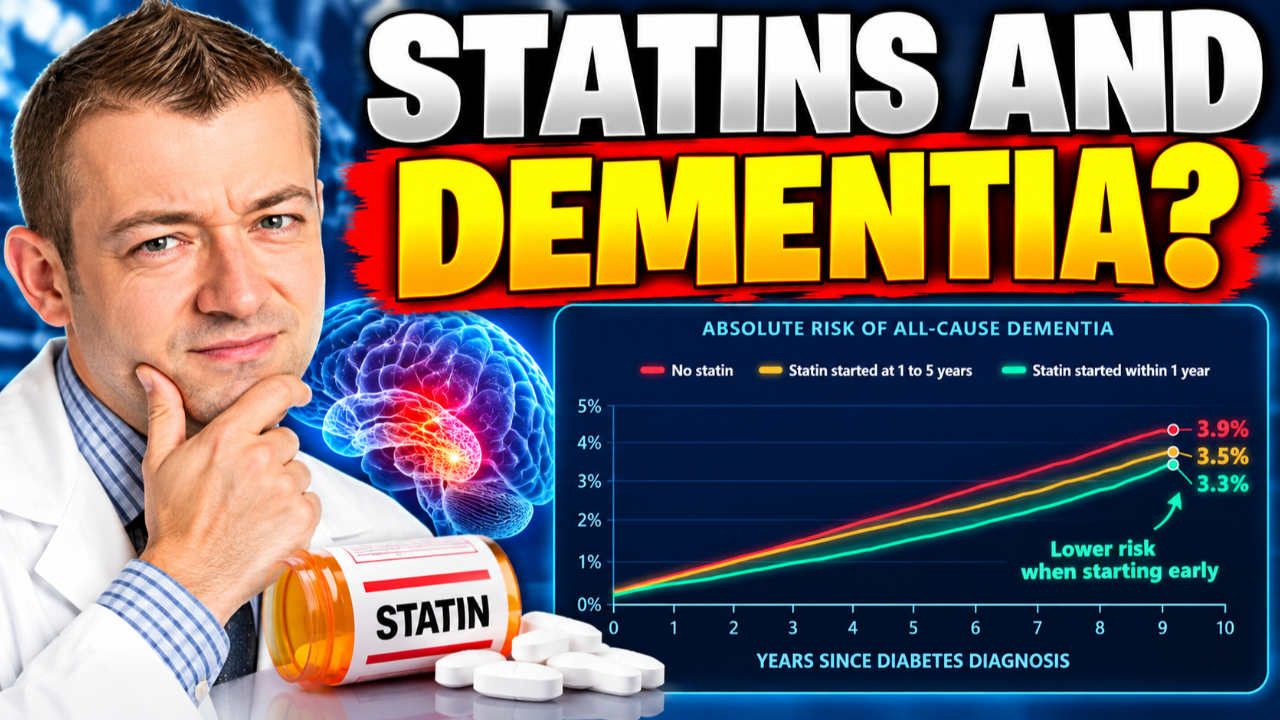
The blinded data are reassuring. In the 2026 analysis, reports of cognitive or memory impairment were 0.2% per year on statins and 0.2% on placebo, and the authors concluded that blinded trials do not support a causal link with cognitive impairment, depression, sleep disturbance, or peripheral neuropathy. A 2021 review of 24 studies and more than 1.4 million people age 60 and older found no evidence of adverse cognitive effects, though high doses have been studied less. A Danish study of 132,585 people with new type 2 diabetes even linked early statin use to a 15% lower relative risk of dementia. That is observational, and I break it down in my article on statins and dementia in type 2 diabetes.
Still, some patients describe brain fog. I take that seriously. If it started after atorvastatin and nothing else explains it, I would rather switch you than argue about it.
Atorvastatin Drug Interactions and Grapefruit
This is where atorvastatin needs more respect than rosuvastatin. Atorvastatin is broken down in part by an enzyme called CYP3A4. It depends on it less than simvastatin or lovastatin do, but enough that medicines that block the enzyme can raise your level and your risk of muscle toxicity. In one systematic review, 60% of rhabdomyolysis cases on simvastatin, lovastatin, or atorvastatin involved CYP3A4 blockers, especially erythromycin and azole antifungals.
In an Ontario study of adults over 65 on a statin (73% atorvastatin), clarithromycin or erythromycin was linked to more hospitalizations for rhabdomyolysis than azithromycin (relative risk 2.17), and more acute kidney injury (relative risk 1.78). The added absolute risk of rhabdomyolysis was small, 0.02%, but one question to your pharmacist can prevent it. For heart medicines, the 2016 AHA statement recommends a lower atorvastatin dose cap with cyclosporine and similar drugs, and close monitoring with colchicine.
Grapefruit is the one everyone has heard of. In 12 healthy volunteers, 200 mL of double-strength grapefruit juice three times a day raised atorvastatin exposure about 2.5-fold (total active drug effect rose less, 1.3 to 1.5 fold), and the authors advised avoiding large amounts. That is a lot of concentrated juice, but I tell people on atorvastatin to keep it small and occasional or skip it. Rosuvastatin relies on a different enzyme pathway, CYP2C9, which is one reason I start with it. Give your doctor and pharmacist a full list of your medicines and supplements.
If You Think Atorvastatin Is Bothering You
- Do not stop on your own, unless symptoms are severe. Stopping has a cost. Among 674,900 Danish adults who started a statin, early discontinuation was associated with a 26% higher risk of heart attack and an 18% higher risk of cardiovascular death. That is observational, but it points one way.
- Call your doctor with a timeline. When you started, your dose, when symptoms began, where they are, and anything new, such as a medicine, a workout program, or an illness.
- Let your doctor look for other causes. Interacting medicines, an underactive thyroid, kidney or liver problems, alcohol, and vitamin D. People with statin-related muscle pain had lower vitamin D levels in a meta-analysis of 7 studies, but that is an association, and the authors said trials are needed to show whether supplements help. For real weakness, your doctor can check a CK.
- Then fix it, step by step. Under your doctor's direction, the 2018 guideline supports pausing the statin until symptoms settle, then trying again with a lower dose or a different statin.
Many people do fine on a second try. In a Boston study, 6,579 patients with a statin-related event were rechallenged, and 92.2% were still on a statin 12 months after the event. If a statin alone will not work, the European Atherosclerosis Society recommends the maximally tolerated dose plus non-statin cholesterol medicines, rather than giving up on your LDL.
That is where ezetimibe earns its place. In the open-label RACING trial of 3,780 people with heart disease, rosuvastatin 10 mg plus ezetimibe was as good at preventing events as rosuvastatin 20 mg alone, 9.1% versus 9.9%, and fewer people had to stop or cut back the medicine for side effects, 4.8% versus 8.2%. The idea is the same for atorvastatin: a moderate statin dose plus ezetimibe instead of a bigger dose of one drug.
How I Approach Atorvastatin
I start most people on rosuvastatin, and sometimes I'll use atorvastatin instead when someone does not tolerate rosuvastatin. Both are excellent. I compare them in my article on rosuvastatin versus atorvastatin and explain my approach in my article on which statin you should take. I took Lipitor 10 mg myself before rosuvastatin came out. If you are on atorvastatin and doing well, there is no reason to change. In ASCOT-LLA, atorvastatin 10 mg cut nonfatal heart attacks and fatal coronary disease by 36%.
If you have symptoms, I check whether the problem is really the statin, whether the dose is too high, and whether there is an interaction. Then I usually lower the dose and add ezetimibe, or I switch to rosuvastatin. I also want your LDL, and ideally your apoB, measured before and after any change. For the bigger picture across all statins, see my article on statin side effects.
Frequently Asked Questions
What is the best time of day to take atorvastatin?
Any time you will remember. Atorvastatin has a long half-life, and the AHA statement on statin interactions notes it can be dosed at any time of day. A 2017 meta-analysis found evening dosing helped short-acting statins more; for long-acting statins the LDL difference was about 2.5 mg/dL, and the authors advised the time that best helps you stay consistent.
Does atorvastatin cause hair loss or weight gain?
The large blinded-trial analysis found no meaningful excess of weight gain. Hair loss has appeared in isolated case reports, including one with atorvastatin in 2002, but a case report cannot show cause, and I know of no randomized evidence. If your hair is thinning, tell your doctor so other causes, such as the thyroid, can be checked.
Can I stop atorvastatin if I am worried about side effects?
Please call your doctor first. Stopping without guidance is far riskier than working with your doctor to fix the problem. The exception is severe symptoms: real muscle weakness, dark urine, or yellow skin or eyes. Then get medical help right away.
Which has fewer side effects, atorvastatin or rosuvastatin?
Both are well tolerated and each has trade-offs. Rosuvastatin has fewer drug interactions, which is why I start with it. The differences are small, and dose matters for both.
The Bottom Line
Atorvastatin is a proven, life-saving drug, and its real side effects are small and specific. Muscle symptoms are common, but in blinded trials more than 90% were not due to the statin. Liver blood tests can rise, mostly at higher doses, and routine monitoring is not recommended. Blood sugar nudges up, mostly in people already close to diabetes. The evidence does not support memory loss, and the interactions to respect are some antibiotics, some antifungals, and grapefruit.
If you have symptoms, do not stop on your own unless they are severe. Call your doctor and look for the fix: a lower dose, ezetimibe, a different statin, or a check for interacting medicines and other causes. This is general education, not a prescription, so please work out your drug and dose with your own doctor.
Still have questions? Stop Googling and ask Dr. Alo.
You've read the science, but applying it to your own life can be confusing. That's exactly what the Heart 2 Heart VIP Community is for. You can ask me questions directly, join live video calls where we talk through scenarios like this one, and get physician-level guidance based on your actual situation.
Join here: https://dralo.net/community 💪🏻🩺🫀
Dr. Alo
References
- Cholesterol Treatment Trialists' (CTT) Collaboration. Effect of statin therapy on muscle symptoms: an individual participant data meta-analysis of large-scale, randomised, double-blind trials. Lancet. 2022;400(10355):832-845. doi:10.1016/S0140-6736(22)01545-8
- Grundy SM, Stone NJ, Bailey AL, et al. 2018 AHA/ACC/AACVPR/AAPA/ABC/ACPM/ADA/AGS/APhA/ASPC/NLA/PCNA guideline on the management of blood cholesterol. Circulation. 2019;139(25):e1082-e1143. doi:10.1161/CIR.0000000000000625
- Newman CB, Preiss D, Tobert JA, et al. Statin safety and associated adverse events: a scientific statement from the American Heart Association. Arterioscler Thromb Vasc Biol. 2019;39(2):e38-e81. doi:10.1161/ATV.0000000000000073
- Gupta A, Thompson D, Whitehouse A, et al. Adverse events associated with unblinded, but not with blinded, statin therapy in the Anglo-Scandinavian Cardiac Outcomes Trial-Lipid-Lowering Arm (ASCOT-LLA). Lancet. 2017;389(10088):2473-2481. doi:10.1016/S0140-6736(17)31075-9
- Wood FA, Howard JP, Finegold JA, et al. N-of-1 trial of a statin, placebo, or no treatment to assess side effects (SAMSON). N Engl J Med. 2020;383(22):2182-2184. doi:10.1056/NEJMc2031173
- Reith C, Blackwell L, Emberson JR, et al; Cholesterol Treatment Trialists' (CTT) Collaboration. Assessment of adverse effects attributed to statin therapy in product labels: a meta-analysis of double-blind randomised controlled trials. Lancet. 2026;407(10529):689-703. doi:10.1016/S0140-6736(25)01578-8
- Law M, Rudnicka AR. Statin safety: a systematic review. Am J Cardiol. 2006;97(8A):52C-60C. doi:10.1016/j.amjcard.2005.12.010
- LaRosa JC, Grundy SM, Waters DD, et al. Intensive lipid lowering with atorvastatin in patients with stable coronary disease (TNT). N Engl J Med. 2005;352(14):1425-1435. doi:10.1056/NEJMoa050461
- Sattar N, Preiss D, Murray HM, et al. Statins and risk of incident diabetes: a collaborative meta-analysis of randomised statin trials. Lancet. 2010;375(9716):735-742. doi:10.1016/S0140-6736(09)61965-6
- Cholesterol Treatment Trialists' (CTT) Collaboration. Effects of statin therapy on diagnoses of new-onset diabetes and worsening glycaemia in large-scale randomised blinded statin trials: an individual participant data meta-analysis. Lancet Diabetes Endocrinol. 2024;12(5):306-319. doi:10.1016/S2213-8587(24)00040-8
- Preiss D, Seshasai SRK, Welsh P, et al. Risk of incident diabetes with intensive-dose compared with moderate-dose statin therapy: a meta-analysis. JAMA. 2011;305(24):2556-2564. doi:10.1001/jama.2011.860
- Ridker PM, Pradhan A, MacFadyen JG, Libby P, Glynn RJ. Cardiovascular benefits and diabetes risks of statin therapy in primary prevention: an analysis from the JUPITER trial. Lancet. 2012;380(9841):565-571. doi:10.1016/S0140-6736(12)61190-8
- Adhikari A, Tripathy S, Chuzi S, Peterson J, Stone NJ. Association between statin use and cognitive function: a systematic review of randomized clinical trials and observational studies. J Clin Lipidol. 2021;15(1):22-32.e12. doi:10.1016/j.jacl.2020.10.007
- Ternhamar T, Johansen MO, Nordestgaard BG, Afzal S. Association between timing of statin treatment after diabetes diagnosis and risk of dementia: a nationwide observational study. Lancet Reg Health Eur. 2026;69:101814. doi:10.1016/j.lanepe.2026.101814
- Patel AM, Shariff S, Bailey DG, et al. Statin toxicity from macrolide antibiotic coprescription: a population-based cohort study. Ann Intern Med. 2013;158(12):869-876. doi:10.7326/0003-4819-158-12-201306180-00004
- Wiggins BS, Saseen JJ, Page RL, et al. Recommendations for management of clinically significant drug-drug interactions with statins and select agents used in patients with cardiovascular disease. Circulation. 2016;134(21):e468-e495. doi:10.1161/CIR.0000000000000456
- Lilja JJ, Kivisto KT, Neuvonen PJ. Grapefruit juice increases serum concentrations of atorvastatin and has no effect on pravastatin. Clin Pharmacol Ther. 1999;66(2):118-127. doi:10.1053/cp.1999.v66.100453001
- Nielsen SF, Nordestgaard BG. Negative statin-related news stories decrease statin persistence and increase myocardial infarction and cardiovascular mortality: a nationwide prospective cohort study. Eur Heart J. 2016;37(11):908-916. doi:10.1093/eurheartj/ehv641
- Michalska-Kasiczak M, Sahebkar A, Mikhailidis DP, et al. Analysis of vitamin D levels in patients with and without statin-associated myalgia: a systematic review and meta-analysis of 7 studies with 2420 patients. Int J Cardiol. 2015;178:111-116. doi:10.1016/j.ijcard.2014.10.118
- Zhang H, Plutzky J, Skentzos S, et al. Discontinuation of statins in routine care settings: a cohort study. Ann Intern Med. 2013;158(7):526-534. doi:10.7326/0003-4819-158-7-201304020-00004
- Stroes ES, Thompson PD, Corsini A, et al. Statin-associated muscle symptoms: impact on statin therapy. European Atherosclerosis Society Consensus Panel statement on assessment, aetiology and management. Eur Heart J. 2015;36(17):1012-1022. doi:10.1093/eurheartj/ehv043
- Kim BK, Hong SJ, Lee YJ, et al. Long-term efficacy and safety of moderate-intensity statin with ezetimibe combination therapy versus high-intensity statin monotherapy in patients with atherosclerotic cardiovascular disease (RACING). Lancet. 2022;400(10349):380-390. doi:10.1016/S0140-6736(22)00916-3
- Sever PS, Dahlof B, Poulter NR, et al. Prevention of coronary and stroke events with atorvastatin in hypertensive patients who have average or lower-than-average cholesterol concentrations (ASCOT-LLA). Lancet. 2003;361(9364):1149-1158. doi:10.1016/S0140-6736(03)12948-0
- Awad K, Serban MC, Penson P, et al. Effects of morning vs evening statin administration on lipid profile: a systematic review and meta-analysis. J Clin Lipidol. 2017;11(4):972-985.e9. doi:10.1016/j.jacl.2017.06.001
- Segal AS. Alopecia associated with atorvastatin. Am J Med. 2002;113(2):171. doi:10.1016/s0002-9343(02)01135-x
Still Have Questions? Stop Googling and Ask Dr. Alo.
You’ve read the science, but applying it to your own life can be confusing. I created the Dr. Alo VIP Private Community to be a sanctuary away from social media noise.
Inside, you get:
-
Direct Access: I answer member questions personally 24/7/365.
-
Weekly Live Streams: Deep dives into your specific health challenges.
-
Vetted Science: No fads, just evidence-based cardiology and weight loss.
Don't leave your heart health to chance. Get the guidance you deserve. All this for less than 0.01% the cost of health insurance! You can cancel at anytime!
[👉 Join the Dr. Alo VIP Community Today]
Cardiology & Obesity Medicine