
Statins and Dementia in Type 2 Diabetes: Starting Early Was Associated With 15% Lower Risk
Oct 05, 2026
Statins and Dementia in Type 2 Diabetes: Starting Early Was Associated With 15% Lower Risk
If you have spent any time on the wellness side of the internet, you have been told that statins rot your brain. That they cause dementia. That the cholesterol in your neurons is being stripped away by a drug your doctor pushed on you for a lab number that does not matter.
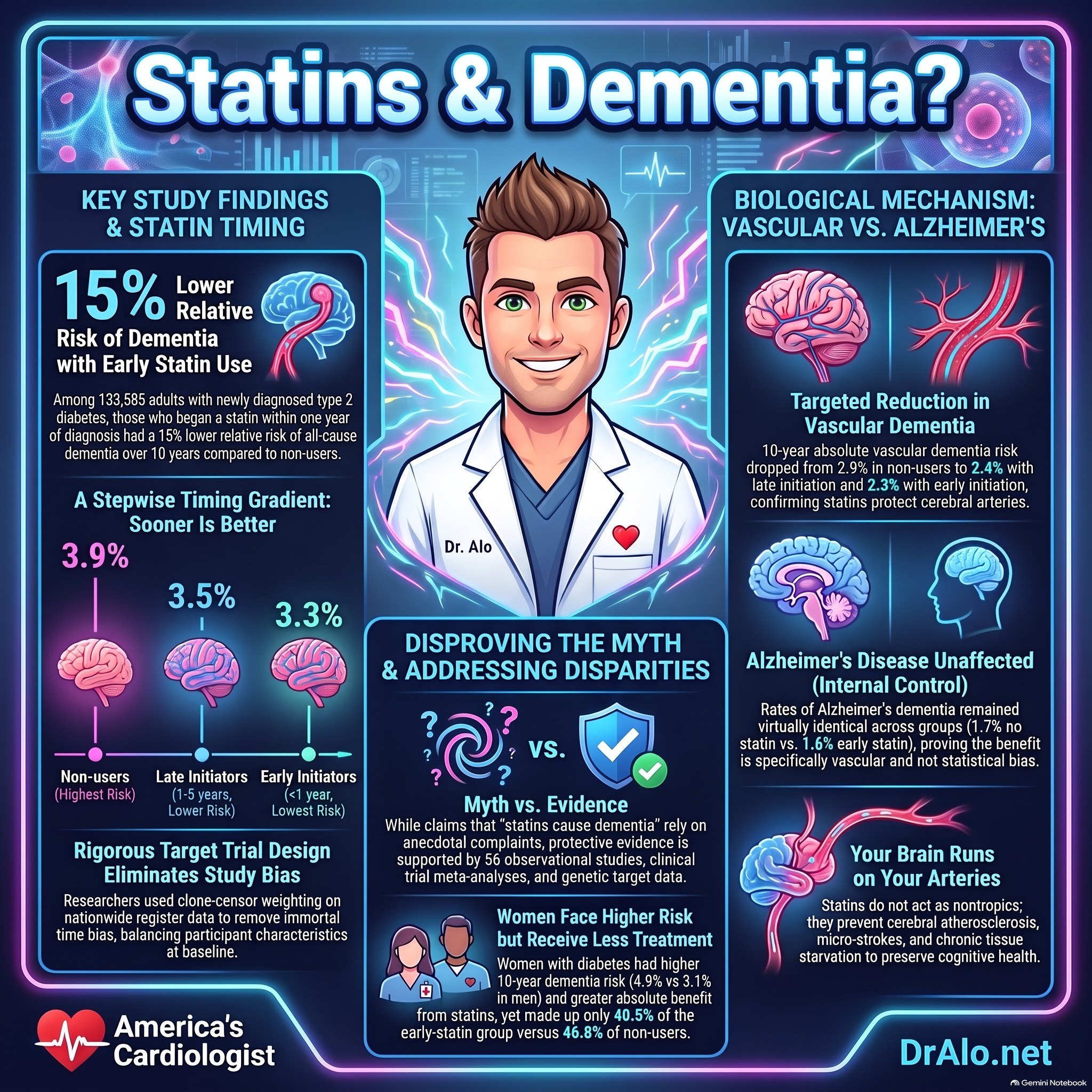
A new Danish study just followed 132,585 people with newly diagnosed type 2 diabetes for a median of seven years and found the opposite. The people who started a statin within one year of their diabetes diagnosis had a 15% lower relative risk of dementia at 10 years than the people who never started one.
Not higher. Lower. And the earlier they started, the lower it went.
Let me walk through this one carefully, because the design is genuinely clever, the finding is important, and the limitations are real. I am going to give you all three.
What the Study Actually Did
This is from the Copenhagen group, published in The Lancet Regional Health - Europe in 2026. The senior authors include Børge Nordestgaard, who has produced more of the foundational lipoprotein epidemiology of the last two decades than almost anyone alive.
They used Denmark's national health registers, which are the closest thing in the world to a complete population laboratory. Every Danish resident has a civil registration number linking their diagnoses, hospital contacts, prescriptions, lab results, education, and income into a single traceable record with essentially no loss to follow-up.
From 370,386 people diagnosed with diabetes between 2006 and 2019, they identified 132,585 statin-naive adults over age 40 with incident type 2 diabetes. Anyone with dementia before the diabetes diagnosis was excluded. Anyone with type 1 or gestational diabetes was excluded.
Then they split follow-up into three strategies based on when statin therapy started after the diabetes diagnosis:
- No statin within 5 years (the reference group)
- Late statin, started between 1 and 5 years
- Early statin, started within 1 year
The primary outcome was 10-year risk of all-cause dementia, with death treated as a competing risk.
Infographic Summary:
The Design Trick That Makes This Study Worth Reading
Here is the part most summaries will skip, and it is the reason this paper is better than the usual "statin users had less dementia" observational noise.
There is a notorious trap in this kind of research called immortal time bias. If you follow people from diabetes diagnosis and then sort them by whether they filled a statin prescription in the first year, everyone in the statin group had to survive and stay dementia-free long enough to fill that prescription. That waiting period is "immortal" time during which the outcome literally could not happen, and it biases the result in favor of the drug before you have analyzed anything.
This study used a clone-censor weighting design to emulate a target trial. In plain language: every single person was triplicated at the moment of diabetes diagnosis, with one copy assigned to each of the three strategies. As follow-up proceeded, each copy was censored the moment that person's actual behavior diverged from the strategy that copy was assigned to. If someone started a statin at three months, the "no statin" and "late statin" copies were censored right there, and only the "early statin" copy continued.
Because that censoring is informative, they then applied stabilized inverse probability weights, adjusting for age, sex, descent, education, income, medication use, comorbidity, and time-varying LDL cholesterol. After cloning and weighting, the covariates were balanced at baseline and stayed balanced across five years.
The authors are explicit that this does not turn observational data into a randomized trial. But it does remove one of the biggest structural biases in the literature, and that is not nothing.
What They Found
Over a median 7.1 years of follow-up, 3,592 people (2.7%) developed dementia. Of those, 2,532 had vascular-related dementia and 1,571 had Alzheimer's dementia, with some overlap.
The 10-year absolute risks of all-cause dementia were:
- 3.9% with no statin initiation
- 3.5% with late statin initiation (1 to 5 years)
- 3.3% with early statin initiation (within 1 year)
Compared with never starting, early statin initiation was associated with a 15% lower relative risk at 10 years, 95% CI 9% to 21%. Late initiation was associated with a 10% lower relative risk, 95% CI 3% to 15%.
In absolute terms, that is 0.59 percentage points lower for early initiation and 0.38 points lower for late. The p-value for the curve comparisons over 10 years was under 0.001.
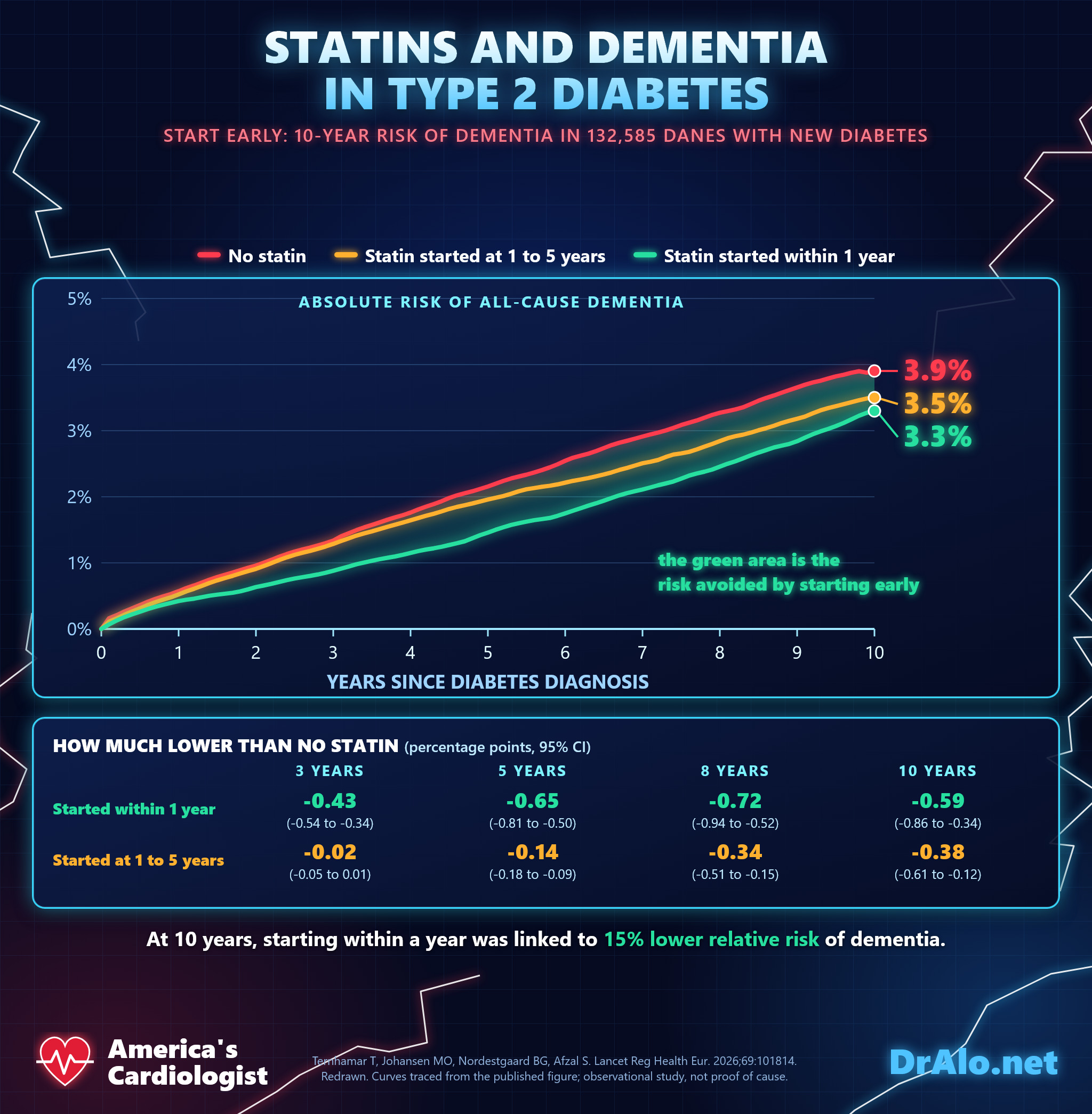
Figure: cumulative incidence of all-cause dementia after a type 2 diabetes diagnosis, by statin timing (death treated as a competing risk). Redrawn from Fig. 1 of Ternhamar T, Johansen MØ, Nordestgaard BG, Afzal S. Lancet Reg Health Eur. 2026;69:101814. The curves were traced from the published figure; the 10-year values and the risk differences in the table are the paper's own.
Here is how to read it. The red line is people who never started a statin in the first five years. The orange line is people who started late, between one and five years. The green line is people who started within the first year. All three climb, because the risk of dementia keeps adding up with time. What matters is the gap between them. The green line stays lowest the whole way, and the shaded green area between the red and green lines is the dementia risk that was avoided by starting early. By year 10 the lines end at 3.9%, 3.5%, and 3.3%.
The table underneath shows how much lower each group was than the no-statin group, in percentage points, with the 95% confidence interval. The early group was already 0.43 points lower at 3 years and 0.59 points lower at 10 years. The late group had almost no difference at 3 years, then pulled away over time. That fits what you would expect from a drug working on arteries: it takes years to change the outcome, and starting earlier gives it a head start.
I want you to notice the ordering, because it is the most interesting thing here. No statin was worst. Late statin was better. Early statin was best. That stepwise gradient held at 3, 5, 8, and 10 years, in both sexes, above and below the median age of 60, and in both Danish and non-Danish descent groups. It survived multiple imputation for missing data. It survived redefining "early" as within two years and the reference as no statin within six years. It survived excluding dementia events occurring within a year of statin initiation, which was their check for reverse causation.
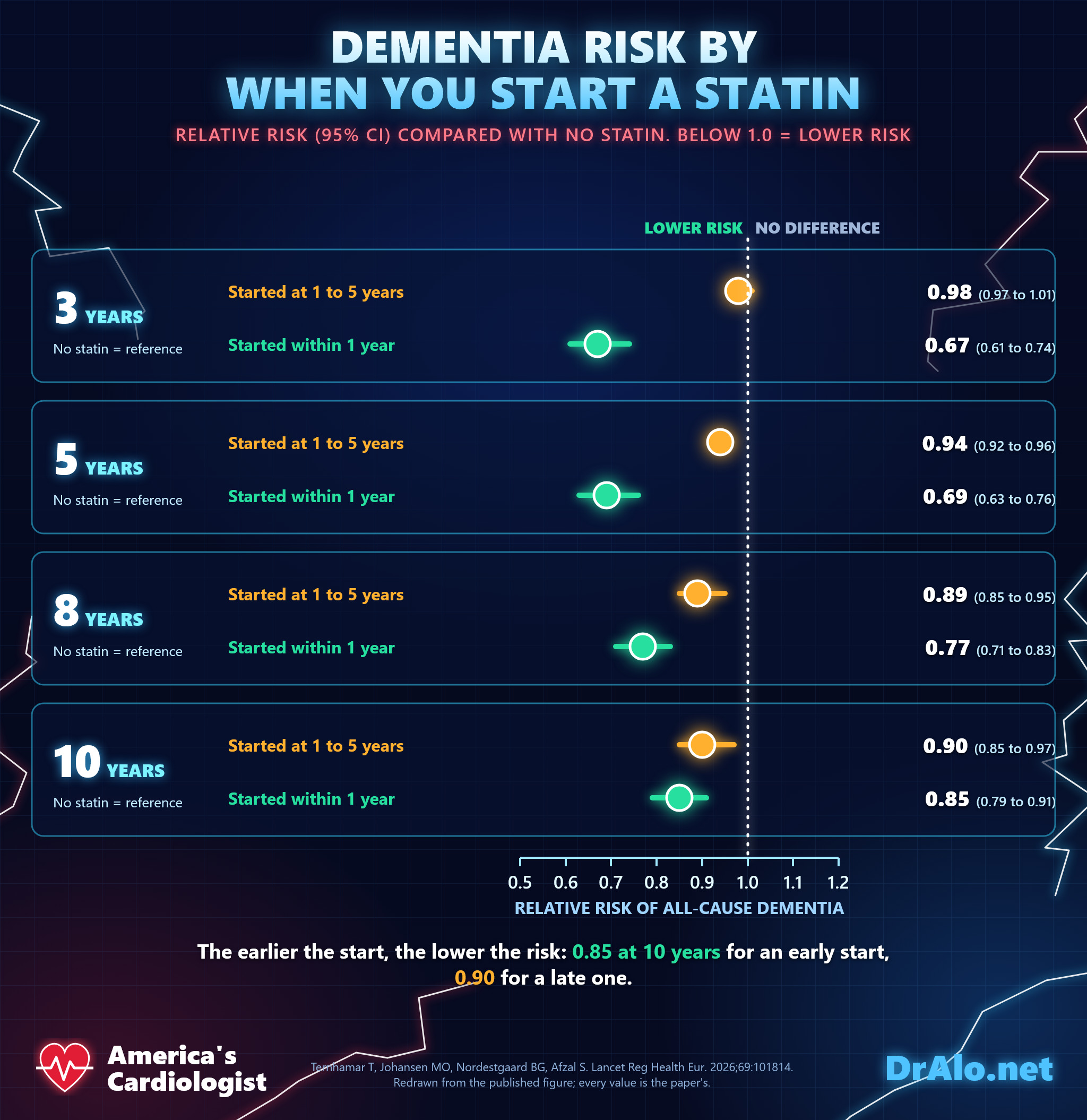
Figure: relative risk (95% CI) of all-cause dementia at 3, 5, 8, and 10 years, compared with no statin. Redrawn from Fig. 2 of Ternhamar T, Johansen MØ, Nordestgaard BG, Afzal S. Lancet Reg Health Eur. 2026;69:101814. Every value is the paper's.
This second chart shows that same gradient another way. A relative risk of 1.0 means the same risk as never starting a statin, and anything below 1.0 means lower risk. Each dot is the estimate and the line through it is the 95% confidence interval. At every time point, the green dot (early start) sits to the left of the orange dot (late start), which sits to the left of the 1.0 line. At 10 years the early group was at 0.85 and the late group at 0.90, which is the 15% and 10% lower relative risk from the headline. You can also see the relative advantage shrink as the years go on, from 0.67 at 3 years to 0.85 at 10 years for the early group, while the order never changes.
A dose-response relationship with the timing of exposure is exactly what you would expect if the effect were real, and it is much harder to explain away than a simple user versus non-user comparison.
The Negative Control Is the Most Convincing Part
This is the finding that moved me most, and it will get almost no coverage because it requires two paragraphs to explain.
The investigators prespecified Alzheimer's dementia as an internal negative control. The logic: Mendelian randomization work on cholesterol-lowering drug targets, drawing on roughly a million individuals, shows that genetic inhibition of HMG-CoA reductase (the enzyme statins block) reduces vascular-related dementia and ischemic heart disease, but has a negligible effect on Alzheimer's disease.
So if statins are truly working through a vascular mechanism, you should see the signal in vascular dementia and not in Alzheimer's. If instead the whole thing is confounding, meaning healthier and more engaged people both take statins and get less dementia, you would expect the association to smear across both subtypes roughly equally.
Here is what happened. For vascular-related dementia, the 10-year absolute risks were 2.9% with no statin, 2.4% with late statin, and 2.3% with early statin. Same clean stepwise gradient as the primary outcome.
For Alzheimer's dementia, the risks were 1.7%, 1.5%, and 1.6%. No clear pattern. No gradient.
The signal showed up precisely where the biology predicted it should and vanished precisely where the biology predicted it should not. That is a much stronger internal validity check than any amount of statistical adjustment, and it is the kind of design detail that separates a paper worth taking seriously from one worth ignoring.
Women Were Being Undertreated. Again.
The sex-stratified data deserve their own paragraph.
Ten-year dementia risk in women was 4.9% with no statin, 4.3% with late statin, and 4.1% with early statin. In men it was 3.1%, 2.9%, and 2.7%. So women in this cohort had substantially higher absolute dementia risk and a larger absolute benefit associated with early treatment.
And yet the paper notes that women appeared less likely to initiate statins after their diabetes diagnosis. In the baseline table, women made up 46.8% of the no-statin group but only 40.5% of the early-statin group.
Higher risk, larger absolute benefit, lower treatment rates. I have written about this pattern in cardiovascular disease repeatedly and it keeps showing up in every dataset I read.
What This Does to the "Statins Cause Dementia" Claim
Let me be precise, because precision is what this topic lacks.
This study does not prove statins prevent dementia. It is observational. What it does is add a large, well-designed dataset to a body of evidence that has been pointing in one consistent direction for years while the internet has been shouting the opposite.
Consider what is already on the table. A 2025 meta-analysis of 55 observational studies found statin use at baseline associated with lower risk of all-cause dementia, with a hazard ratio of 0.86. A 2022 meta-analysis found the same. The Cholesterol Treatment Trialists' Collaboration, pooling adverse events from placebo-controlled randomized trials, found no statistically significant difference in dementia development with statin therapy, with a rate ratio of 0.93 and a confidence interval from 0.77 to 1.11. The Mendelian randomization data on HMG-CoA reductase inhibition point toward lower vascular dementia risk.
And the 2024 Lancet Commission on dementia added elevated LDL cholesterol from midlife as a modifiable dementia risk factor for the first time. Because of how common hypercholesterolemia is, the Commission estimated that treating elevated LDL has the potential to prevent the largest number of dementia cases of any single factor on their list.
Notice how differently the two claims are supported. "Statins cause dementia" rests largely on case reports, anecdote, and a misreading of the transient cognitive complaints that appear in postmarketing reports. "Statins are associated with less dementia, particularly vascular dementia" now rests on 55 observational studies, a randomized trial meta-analysis showing no harm signal, genetic data on the drug target, and a 132,585 person target trial emulation with a working negative control.
Those are not the same quality of evidence. They are not close.
The Limitation I Am Not Going to Hide From You
The authors name their own biggest problem in the discussion, and I respect them for it: confounding by indication.
Look at the baseline table honestly. The no-statin group was about four years older at diabetes diagnosis, had lower income, and had lower LDL cholesterol. The mean LDL was 2.8 mmol/L in the no-statin group versus 3.6 in the early-statin group. Those are exactly the factors that drive a clinician's decision to prescribe or not prescribe. Clone-censor weighting handles immortal time bias. It does not remove confounding by indication.
There are other real limits. Dementia was captured from ICD codes in hospital registers, and a great deal of dementia is diagnosed in general practice and coded as age-related cognitive decline, so the registry sees the tip of the iceberg. The positive predictive value of a registered dementia diagnosis in Danish registers is 86%, which is good but not perfect. Blood pressure and smoking were not directly available, so antihypertensive use and COPD history were used as proxies. Statin use was not modeled as time-varying, meaning continued exposure is assumed even if someone stopped. Dementia rates were only about 0.5% per year. Some individuals carried codes for both Alzheimer's and vascular dementia, which muddies the subtype analysis.
And the natural history of dementia unfolds over 10 to 20 years, while median follow-up here was 7.1 years.
The authors' own conclusion is that trial evidence is needed to confirm this. They also point out, fairly, that the definitive trial is unlikely to ever be run, because randomizing people with type 2 diabetes to no statin for a decade would be unethical given their cardiovascular risk.
Who Funded This, and Who Wrote It
I always look, and you should too.
The study was funded by the Danish Cardiovascular Academy, which is itself funded by the Novo Nordisk Foundation, along with the Danish Heart Foundation and several Danish charitable funds. The funders had no role in design, analysis, or the decision to publish.
On disclosures: two of the four authors report no conflicts. Nordestgaard reports research grants and consulting fees from a long list of pharmaceutical companies including Amgen, AstraZeneca, Novartis, Sanofi, and Merck, speaker honoraria, advisory board participation on two randomized trials, and a leadership role as president of the European Atherosclerosis Society.
That is a substantial set of ties and you deserve to know about it. It does not invalidate a nationwide register analysis with a prespecified negative control, and the funding came from Danish foundations rather than a statin manufacturer. But transparency runs in both directions, and I am not going to demand disclosure from the supplement industry while glossing over it here.
What I Would Actually Do With This
If you have type 2 diabetes and you are not on lipid-lowering therapy, have the conversation now rather than in three years. The cardiovascular case was already overwhelming. This adds a plausible cognitive dimension, and the timing gradient in this study suggests the window matters.
Stop treating "statins cause dementia" as an open question. The randomized trial data show no harm signal. The observational data lean protective. The genetic data on the drug target lean protective for vascular dementia. If someone is telling you otherwise, ask them what evidence they are working from.
Understand the mechanism being proposed. Nobody is claiming statins are a nootropic. The proposed pathway is vascular: less atherosclerosis in the cerebral circulation, fewer small strokes, less chronic hypoperfusion, less white matter injury. That is why the signal shows up in vascular dementia and not in Alzheimer's. Your brain is downstream of your arteries.
Do not read this as "the pill fixes it." Type 2 diabetes carries elevated dementia risk through glycemic control, blood pressure, obesity, physical inactivity, hearing loss, sleep, and a dozen other channels the Lancet Commission catalogued. A statin is one lever among many, and the absolute risk difference here was about six-tenths of a percentage point over a decade. Real, meaningful at population scale, and not a substitute for everything else.
If you are a woman with type 2 diabetes, ask specifically whether your lipid management is being handled as aggressively as it would be for a man with your numbers. The data keep saying it is not.
The Bottom Line
In 132,585 statin-naive Danes who developed type 2 diabetes, starting a statin within one year of diagnosis was associated with a 15% lower 10-year relative risk of dementia compared with never starting, and starting late was in between. The signal was concentrated in vascular dementia, exactly where the drug's mechanism predicts it should be, and absent in Alzheimer's, exactly where the mechanism predicts it should be absent.
It is observational. Confounding by indication cannot be ruled out. It needs trial confirmation that will probably never come.
But if you have been holding off on treating your cholesterol because you were worried a statin would take your memory, the evidence has been pointing the other way for a while now, and this study points there harder than most.
Frequently Asked Questions
Do statins cause dementia or memory loss?
The randomized trial evidence shows no significant increase in dementia with statin therapy, with a pooled rate ratio of 0.93 in the Cholesterol Treatment Trialists' meta-analysis of adverse events. Observational studies consistently show lower dementia risk in statin users. This Danish study found lower risk with earlier initiation. Transient subjective memory complaints are reported by some individuals, but they have not translated into a measurable increase in diagnosed dementia in trial data.
Does high cholesterol increase dementia risk?
The 2024 Lancet Commission on dementia added elevated LDL cholesterol from midlife as a modifiable dementia risk factor for the first time. A meta-analysis of cohort studies found that each 1 mmol/L increase in midlife LDL was associated with roughly an 8% higher risk of all-cause dementia.
Why does timing of statin initiation matter?
In this study the gradient was consistent: no statin carried the highest dementia risk, late initiation was lower, and initiation within one year of diabetes diagnosis was lowest. The proposed reason is that atherosclerosis in the cerebral circulation accumulates over years, so intervening earlier means less cumulative vascular injury by the time dementia would otherwise develop.
Does this apply to people without diabetes?
This study only enrolled people with incident type 2 diabetes, a group with faster progression of both dementia and atherosclerotic cardiovascular disease. The findings should not be extrapolated directly to a general population without diabetes. The authors specifically call for similar long-term studies in non-diabetic populations.
Does this prove statins prevent dementia?
No. It is an observational study using a target trial emulation design. It handles immortal time bias well but cannot eliminate confounding by indication. The authors state plainly that randomized trial evidence is needed to confirm the findings.
Want Help Making Sense of Your Own Numbers?
Papers like this are exactly what we break down together inside my Heart 2 Heart VIP Community. No hype, no supplement pitches, just the actual data and what it means for the decisions in front of you. Come join us at dralo.net/community.
Your brain runs on the same arteries as your heart. Treat them like it.
References
Ternhamar T, Johansen MØ, Nordestgaard BG, Afzal S. Association between timing of statin treatment after diabetes diagnosis and risk of dementia: a nationwide observational study. Lancet Reg Health Eur. 2026. https://doi.org/10.1016/j.lanepe.2026.101814
Livingston G, Huntley J, Liu KY, et al. Dementia prevention, intervention, and care: 2024 report of the Lancet standing Commission. Lancet. 2024;404:572-628. https://doi.org/10.1016/S0140-6736(24)01296-0
Nordestgaard LT, Hanson A, Sanderson E, et al. Cholesterol-lowering drug targets reduce risk of dementia: Mendelian randomization and meta-analyses of 1 million individuals. Alzheimers Dement. 2025;21:e70638.
Westphal Filho FL, Moss Lopes PR, Menegaz De Almeida A, et al. Statin use and dementia risk: a systematic review and updated meta-analysis. Alzheimers Dement (TRCI). 2025;11:e70039.
Olmastroni E, Molari G, De Beni N, et al. Statin use and risk of dementia or Alzheimer's disease: a systematic review and meta-analysis of observational studies. Eur J Prev Cardiol. 2022;29:804-814.
Reith C, Blackwell L, Emberson JR, et al. Assessment of adverse effects attributed to statin therapy in product labels: a meta-analysis of double-blind randomised controlled trials. Lancet. 2026;407:689-703.
Wee J, Sukudom S, Bhat S, et al. The relationship between midlife dyslipidemia and lifetime incidence of dementia: a systematic review and meta-analysis of cohort studies. Alzheimers Dement. 2023;15:e12395.
Borén J, Chapman MJ, Krauss RM, et al. Low-density lipoproteins cause atherosclerotic cardiovascular disease: a consensus statement from the European Atherosclerosis Society Consensus Panel. Eur Heart J. 2020;41:2313-2330. https://doi.org/10.1093/eurheartj/ehz962
Heart Protection Study Collaborative Group. MRC/BHF Heart Protection Study of cholesterol lowering with simvastatin in 20,536 high-risk individuals: a randomised placebo-controlled trial. Lancet. 2002;360:7-22. https://doi.org/10.1016/S0140-6736(02)09327-3
Trompet S, van Vliet P, de Craen AJM, et al. Pravastatin and cognitive function in the elderly: results of the PROSPER study. J Neurol. 2010;257:85-90.
Still Have Questions? Stop Googling and Ask Dr. Alo.
You’ve read the science, but applying it to your own life can be confusing. I created the Dr. Alo VIP Private Community to be a sanctuary away from social media noise.
Inside, you get:
-
Direct Access: I answer member questions personally 24/7/365.
-
Weekly Live Streams: Deep dives into your specific health challenges.
-
Vetted Science: No fads, just evidence-based cardiology and weight loss.
Don't leave your heart health to chance. Get the guidance you deserve. All this for less than 0.01% the cost of health insurance! You can cancel at anytime!
[👉 Join the Dr. Alo VIP Community Today]
Cardiology & Obesity Medicine