Did the Lp(a)HORIZON Trial Fail? What I Still Think About Lp(a)
Oct 27, 2026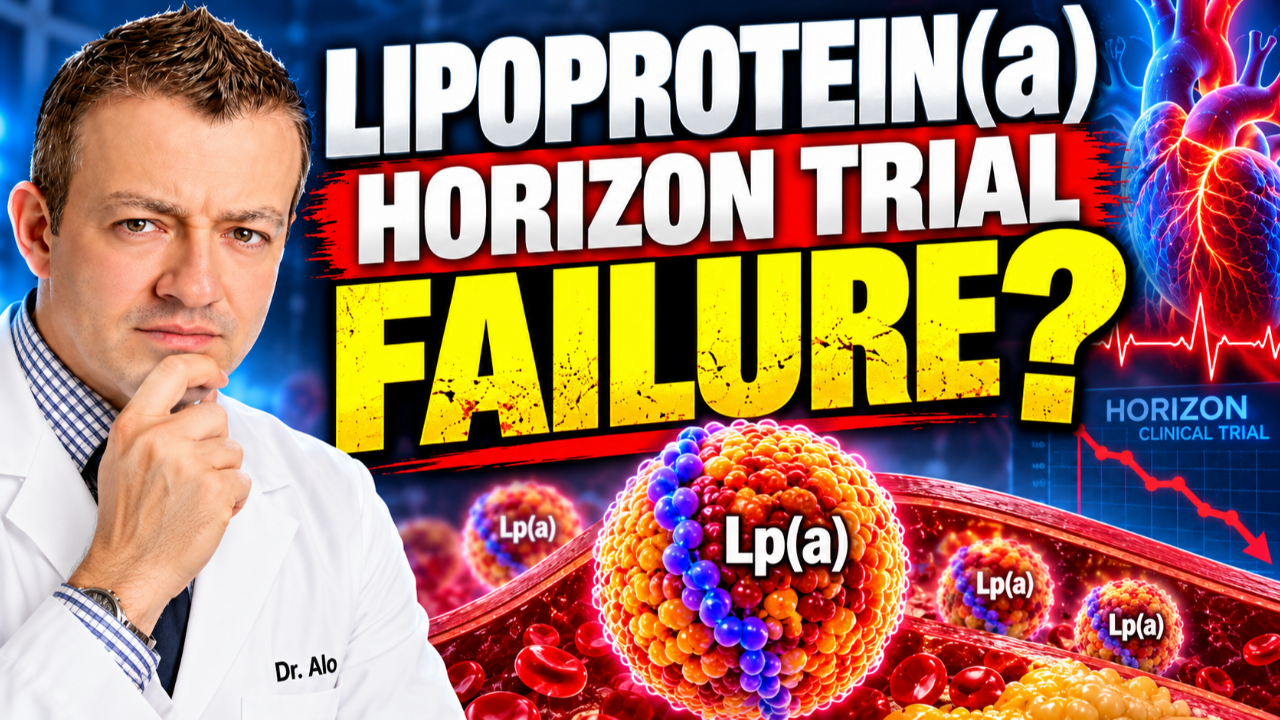
Does Lipoprotein a Still Matter After HORIZON Trial Failure?
On September 4, 2026, Novartis announced that Lp(a)HORIZON, the first large outcomes trial of a drug built specifically to lower lipoprotein(a), did not meet its primary endpoint. Since then, patients and people in my community keep asking me: "Does this mean Lp(a) doesn't matter anymore?"
No. Let me explain what the trial did, why I think it came up negative, and what I still tell people with a high Lp(a).
As a board-certified cardiologist who wrote a textbook on lipids and cholesterol, this topic is close to my heart. A recent opinion piece by Professor Eric Kilpatrick in The Journal of Applied Laboratory Medicine lays out the possible reasons for the result clearly, and cardiologist Dr. Gregory Katz wrote a thoughtful piece on his Substack as well. I will walk you through the key points from both, with my own take. One caveat up front: the full results have not been published yet, so nobody can say for certain why the trial missed.
Infographic Summary:
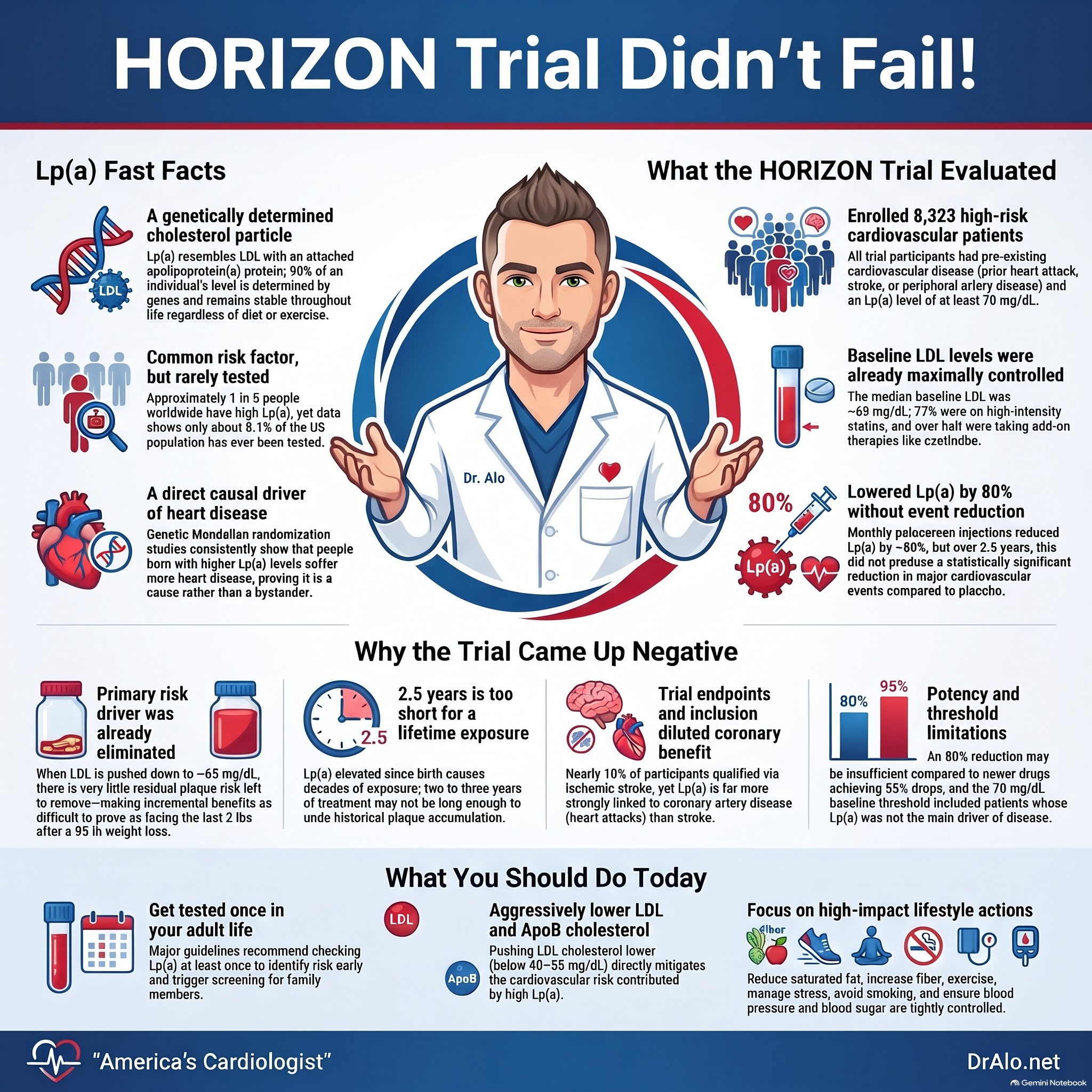
First, a quick refresher on Lp(a)
Lipoprotein(a), or Lp(a), is a cholesterol-carrying particle that looks a lot like LDL, with an extra protein attached called apolipoprotein(a). What makes it unusual:
- It is mostly genetic. About 90 percent of your level is determined by your genes, and it stays fairly stable throughout life. Diet and lifestyle barely move it.
- It is common. Roughly 1 in 5 people worldwide have an elevated level.
- It is very likely causal. Genetic (Mendelian randomization) studies have consistently shown that people who are born with higher Lp(a) have more heart disease, pointing to Lp(a) as a cause, not a bystander.
That is why US and European guidelines now recommend measuring Lp(a) at least once in every adult's life, to help judge cardiovascular risk and, if it is high, to prompt testing of family members.
A new class of injectable drugs (antisense oligonucleotides and small interfering RNA) blocks the liver from making apolipoprotein(a) and can lower Lp(a) dramatically. Pelacarsen, a monthly injection, is the first to report outcome results.
What the Lp(a)HORIZON trial did
- Who: 8,323 people who already had cardiovascular disease, meaning a prior heart attack, a prior ischemic stroke, or symptomatic peripheral artery disease.
- Lp(a) level: everyone had an Lp(a) of at least 70 mg/dL (about 149 nmol/L). The typical (median) patient was around 108 mg/dL.
- Already very well treated: the median LDL cholesterol at the start was about 65 mg/dL. About 77 percent were on a high-intensity statin, more than half were also on ezetimibe or a similar add-on, and about 1 in 10 were on a PCSK9 inhibitor.
- Treatment: monthly pelacarsen or placebo, assigned 1 to 1, double blind. The goal was to lower Lp(a) by about 80 percent.
- Length: the trial was designed to follow patients for more than two and a half years, and it was powered to detect a 20 percent reduction in events.
- What counted as an event: cardiovascular death, nonfatal heart attack, nonfatal stroke, or urgent hospitalization for a coronary procedure. This was measured in everyone, and separately in the people with an Lp(a) of 90 mg/dL or higher.
The result: Lp(a) went down with pelacarsen, but the trial did not show a statistically significant reduction in heart attacks, strokes, and cardiovascular deaths compared with placebo. The full data have not been presented yet, so we do not know whether there was a small benefit that just missed the mark or no signal at all.
Why I think the trial came up negative
1. These patients were already extremely well controlled
This is the biggest point for me. LDL was already down around 65 mg/dL, most patients were on strong statins plus add-on therapy, and blood pressure was largely at target. When you have already lowered the single biggest driver of plaque, there is simply less risk left over to remove. Dr. Katz makes the same point: our standard treatments are now so good that the low-hanging fruit has been picked, and showing a benefit on top of them is hard.
Imagine you used to weigh 235 lbs. and now you weigh 140 lbs. It was very easy to lose the first 60 to 80 lbs. but now that you weigh 140, trying to get to 138.2 is very, very difficult. That's the same thing with lipoprotein(a), LDL cholesterol, and risk factors. These people's risk factors are already maximally controlled. To show an incremental benefit is very, very difficult when everything else is so well controlled.
This is also very reassuring because it shows us that if we get LDL cholesterol under very good control then it is less likely that lipoprotein(a) will be as problematic.
In my clinic if you have lipoprotein(a) that is elevated, we aim for an LDL cholesterol below 55 mg/dL but usually below 40 mg/dL, depending on whether or not you've already had a cardiovascular event or what your other risk factors are.
Kilpatrick points to data showing exactly this. In people without heart disease, every 50 nmol/L increase in Lp(a) raised risk by about 10 percent. In people who already had heart disease, the same increase raised risk by only about 5 percent. Good control of everything else may shrink the extra risk Lp(a) adds, leaving less for an Lp(a) drug to show.
2. A few years is a short time to undo a lifetime of exposure
Your Lp(a) has been high since you were born. Even with LDL lowering, which we know works, it typically takes a year to several years for fewer events to show up. It is very difficult to show a difference between two groups in a few years when both are this well treated. Kilpatrick notes that we cannot assume lowering Lp(a) late in life cuts risk over a typical trial period. Dr. Katz agrees the treatment may have started too late or not run long enough.
3. Stroke patients and stroke endpoints may have diluted the effect
Lp(a) appears to be more closely tied to coronary artery disease (heart attacks) than to ischemic stroke. In Lp(a)HORIZON, 9.8 percent of patients qualified because of a prior ischemic stroke, and stroke counted as an event. Both choices could have watered down any benefit. By contrast, the OCEAN(a) trial of a different drug, olpasiran, enrolls only people with prior coronary disease and focuses its main outcome on coronary events.
4. The patients had high Lp(a), but not necessarily the highest
To be clear, 70 mg/dL is not a normal Lp(a). Everyone in this trial had a truly elevated level. But as Dr. Katz points out, the 70 mg/dL cutoff is elevated without being at the very high end, so some patients may not have had levels high enough for Lp(a) to be the main driver of their disease. Risk keeps climbing as Lp(a) climbs, and roughly 1 in 5 patients were between 70 and 90 mg/dL, closer to the lower edge of the elevated range. That is why the trial also analyzed the 90 mg/dL and higher group as a separate primary endpoint; we need the full results to see how that group did.
5. Maybe the drug was not strong enough
Pelacarsen lowers Lp(a) by about 80 percent. Dr. Katz notes that some of the newer Lp(a) drugs in development lower it closer to 95 percent. Kilpatrick makes a similar point: two of the three Lp(a) outcome trials still coming use drugs that lower Lp(a) more than pelacarsen does. It is possible that a deeper drop is needed to see a clear benefit, especially when LDL cholesterol is so well controlled and so low
6. Other drugs that lower Lp(a) have taught us a mixed lesson
Some older drugs also lower Lp(a), though much less than the new injectables: (These are not guideline-approved nor indicated for lowering lipoprotein(a))
- CETP inhibitors lower it by about 46 percent, but they did not deliver meaningful benefit and some had safety problems.
- Niacin lowers it by about 37 percent, but it failed to improve outcomes and was withdrawn as a cholesterol drug.
- PCSK9 inhibitors lower it by about 29 percent, and they do reduce heart attacks and strokes. However, a pooled analysis of alirocumab trials found that the Lp(a) reduction was not linked to fewer events once you accounted for the LDL reduction.
Meanwhile, the drugs with the best evidence for preventing heart attacks, statins, ezetimibe, and bempedoic acid, barely change Lp(a) at all. The lesson I take from this: lowering LDL and ApoB is proven. Lowering Lp(a) by itself is still the open question. Again it's very reassuring to know that lowering LDL cholesterol by any means to very low levels seems to mitigate the risk of having elevated lipoprotein(a).
7. Not every promising marker becomes a treatment target
We have seen this before. Raising HDL with CETP inhibitors, by 30 to 133 percent, did very little for outcomes. Lowering homocysteine with B vitamins also failed, even though homocysteine once looked very convincing.
There is an important difference, and Dr. Katz says it well: unlike HDL, genetic studies strongly suggest that Lp(a) itself causes heart disease, so Lp(a) is not just HDL all over again. But he also reminds us that Lp(a) works through several pathways at once. It promotes plaque, it makes blood more likely to clot, and it carries oxidized fats. A single blood level does not capture all of that, and lowering the number may not undo all of it. That is exactly why we run trials instead of assuming.
What about the lab test itself?
Lp(a) can be reported in mg/dL or nmol/L, and the trial enrolled using mg/dL. A reanalysis found 97 percent agreement between the two at the trial cutoff, so units probably were not a big factor.
What I still think about Lp(a)
Here is where I stand:
- Lp(a) is still a genetic, causal risk factor. One negative trial of one drug in one population does not erase decades of genetic and population data.
- Get it checked once. Guidelines recommend it, and yet Kilpatrick cites data showing only about 0.1 percent of a US population had been tested. Most people with high Lp(a) have no idea.
- If yours is high, be more aggressive with everything else. That means getting your LDL cholesterol and ApoB lower, often to below 40 mg/dL range for LDL or lower depending on your situation, and controlling blood pressure, blood sugar, and weight. A high Lp(a) is a reason to start or intensify proven treatments, not a reason to give up.
- Use it to push proven treatments. Dr. Katz still checks Lp(a) too, and uses it to tip decisions toward treatments we already know work, especially in people with a strong family history. That matches how I use it. He describes the new Lp(a) drugs as "hypotheses we're waiting to test rigorously," not treatments we are simply waiting on, and that is the right mindset.
- Tell your family. Because it is inherited, your parents, siblings, and children should be tested too.
- The question of whether lowering Lp(a) itself prevents events is not settled. Three more secondary prevention trials are expected to report in the next five years, and two of them use drugs that lower Lp(a) more than pelacarsen. People without existing heart disease may benefit the most, given their steeper risk gradient, but outcome data for that group are not expected until at least 2031.
What you can do today
Most of what lowers your risk when Lp(a) is high has nothing to do with Lp(a) itself. In order of impact:
Reduce your saturated fat intake, increase your fiber intake, and take your medications if you need them.
Then: do cardio, lift weights, reduce stress, and improve your sleep. And don't smoke.
These will not change your Lp(a) number much, but they lower your overall risk, and that is the whole point.
Frequently asked questions
Does this trial mean Lp(a) is not a risk factor?
No. The trial tested whether one drug that lowers Lp(a) reduces events in people who already have heart disease and are very well treated. It did not test whether Lp(a) causes heart disease. The genetic and population evidence that high Lp(a) raises risk is unchanged.
Should I still get my Lp(a) tested?
Yes. Testing once in adulthood is still recommended. It helps your doctor decide how aggressively to treat your LDL and other risk factors, and it can identify relatives who are at risk.
My Lp(a) is high but my LDL is already low. Anything else?
Look at your whole picture with your doctor: ApoB, blood pressure, blood sugar, and family history. Many people with high Lp(a) benefit from pushing LDL and ApoB even lower.
Can I get pelacarsen?
Pelacarsen is an investigational drug and is not approved. There is currently no approved treatment that targets Lp(a) specifically.
References
- Kilpatrick ES. Possible Reasons Why the Lp(a)HORIZON Lipoprotein(a)-Lowering Trial Failed to Demonstrate Improved Clinical Outcomes: Implications for Laboratory Medicine. J Appl Lab Med. 2026;jfag172. https://doi.org/10.1093/jalm/jfag172 (open access, CC BY 4.0)
- Novartis. Novartis announces Lp(a)HORIZON Phase III topline results for pelacarsen in patients with elevated Lp(a) and established cardiovascular disease (CVD). September 4, 2026. novartis.com
- Katz G. The Lp(a) Drug Failed. Why Were We So Sure It Would Work? Greg Katz, MD (Substack). September 11, 2026. gregorykatz.substack.com
- Cho L, Nicholls SJ, Nordestgaard BG, et al. Design and Rationale of Lp(a)HORIZON Trial: Assessing the Effect of Lipoprotein(a) Lowering With Pelacarsen on Major Cardiovascular Events in Patients With CVD and Elevated Lp(a). Am Heart J. 2025;287:1-9. https://doi.org/10.1016/j.ahj.2025.03.019
This article is for education and is not personal medical advice. Talk with your own doctor about your Lp(a), cholesterol, and treatment plan.
Go deeper inside the community
Articles like this one cover the general case. The questions that actually decide what you should do next are usually about your own numbers, and those are the ones worth asking somewhere you can get an answer. Dr. Alo's private community is where the lab patterns, the case examples, and the follow-up questions live, alongside people working through the same things.
Still Have Questions? Stop Googling and Ask Dr. Alo.
You’ve read the science, but applying it to your own life can be confusing. I created the Dr. Alo VIP Private Community to be a sanctuary away from social media noise.
Inside, you get:
-
Direct Access: I answer member questions personally 24/7/365.
-
Weekly Live Streams: Deep dives into your specific health challenges.
-
Vetted Science: No fads, just evidence-based cardiology and weight loss.
Don't leave your heart health to chance. Get the guidance you deserve. All this for less than 0.01% the cost of health insurance! You can cancel at anytime!
[👉 Join the Dr. Alo VIP Community Today]
Cardiology & Obesity Medicine