
Why Women Are Undertreated for Heart Disease: What the Research Actually Shows
Oct 07, 2026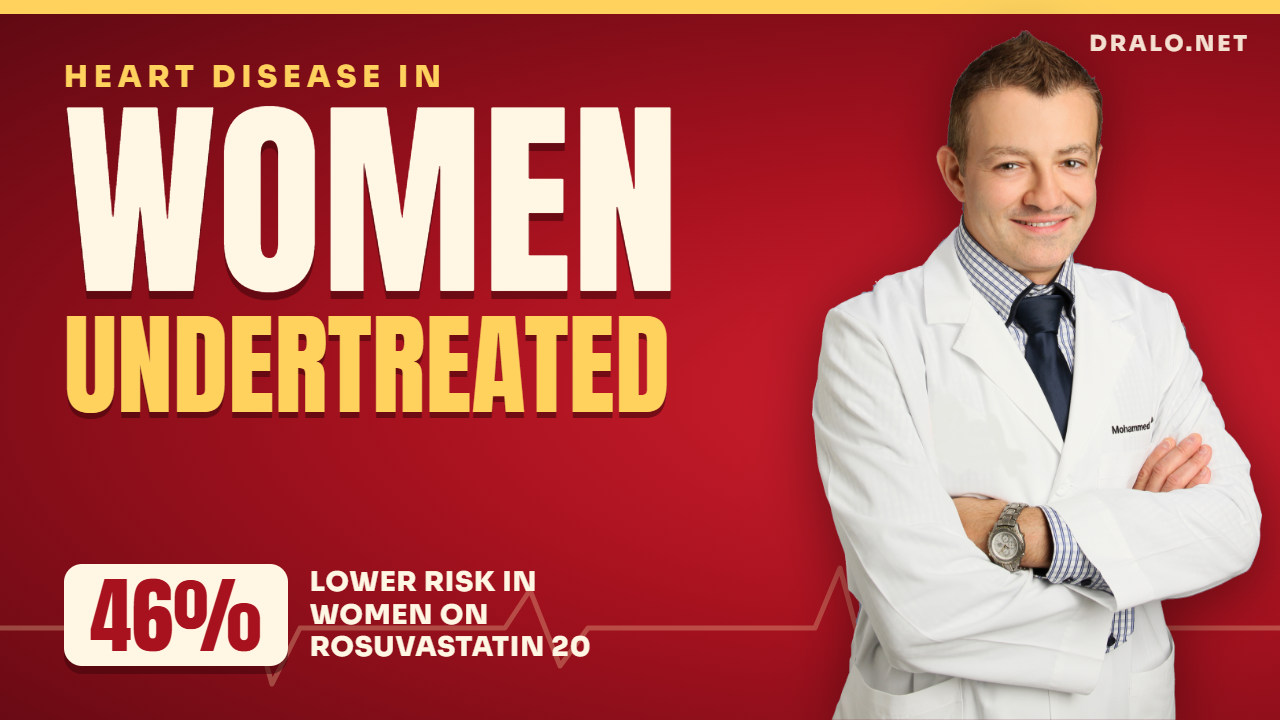
Why Are Women Under Treated In Heart Disease?
Women have been undertreated for heart disease, and not in some vague, hand-wavy way. There is real research behind it, with real numbers, and I think every woman deserves to see that research laid out plainly instead of hearing it as a slogan. So this article is going to be different from the usual. I am going to walk you through the actual studies, who was in them, what they found, and why it matters. No fluff.
We Did Not Believe Them
Let me own this plainly, because it is true: we did not believe them. For a long time, a woman could walk into a clinic with classic warning signs and leave with a diagnosis of anxiety, stress, or "it's probably hormones." Heart disease was seen as a man's disease, so it was not on our radar when a woman sat in front of us. We gaslit women, and for far too long, the medical community treated that as acceptable practice. That is not an exaggeration. That is a pattern that shows up in the research.
A 2021 publication on missed and delayed diagnosis of heart disease in women laid this out in detail. It came out of a meeting between patients and experts, organized by WomenHeart together with the Society to Improve Diagnosis in Medicine. The women in that meeting were WomenHeart Champions, meaning women already living with heart disease, and they described a strikingly consistent pattern: years of being told their test results were "normal," being told it was all in their head, and being misdiagnosed with asthma or anxiety before anyone looked seriously at their heart.
The article included a table of the specific barriers that keep showing up. Symptoms get attributed to a non-cardiac cause, often anxiety. There is implicit bias based on a patient's sex, gender, age, race, ethnicity, or even appearance. Cardiovascular research has historically underrepresented women, which means the guidelines doctors are trained on are built on incomplete evidence. And medical training itself does not adequately cover how heart disease can look different in women compared with men.
The same paper noted something that should alarm anyone paying attention: the long decline in cardiovascular deaths has plateaued, and it has actually gone up again in younger women. About one third of cardiovascular events in women happen before age 65, which breaks the old assumption that this is strictly an older woman's problem. The authors called for destigmatizing women who show up with shortness of breath or chest discomfort, instead of assuming it is stress. I could not agree more.
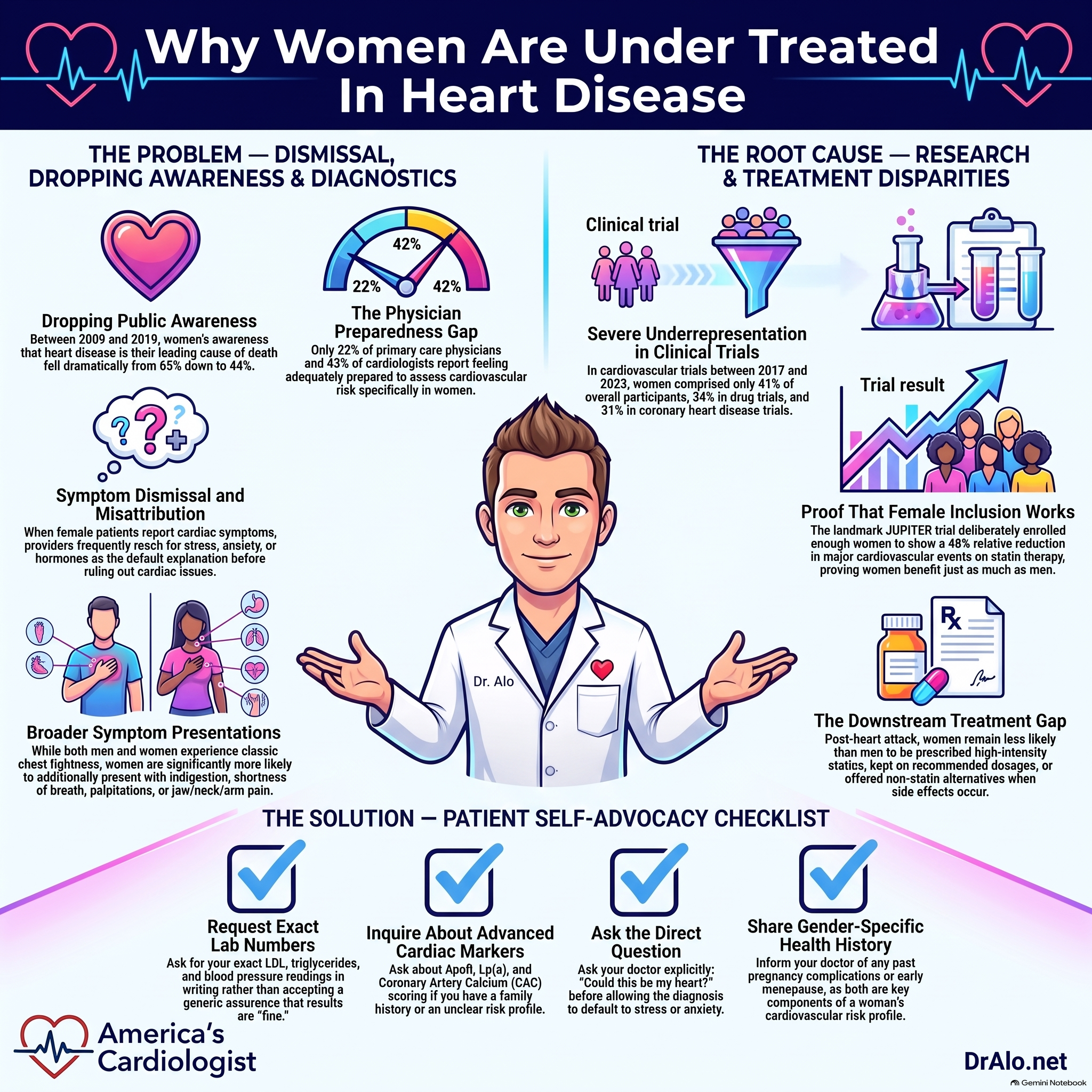
Infographic Summary:
What the VIRGO Study Showed
If you want to see the undertreatment pattern in hard numbers, look at the VIRGO study, published by Lichtman and colleagues in Circulation in 2018. This study enrolled 2,009 women and 976 men, all between 18 and 55 years old, all hospitalized for a heart attack, across 103 hospitals in the United States. These were young heart attack patients, which already breaks the stereotype that heart attacks only happen to older men.
Chest pain was the leading symptom for almost everyone: 87.0 percent of women and 89.5 percent of men reported it. So the old idea that women do not get chest pain is simply not supported here. What was different is that women were more likely to have three or more symptoms happening at the same time, 61.9 percent compared with 54.8 percent of men.
One finding stands out to me. Among women having the most severe type of heart attack, called an ST-elevation heart attack, women were more likely than men to show up without chest pain at all. The odds ratio was 1.51, with a 95 percent confidence interval of 1.03 to 2.22. An odds ratio above 1 means the event, in this case showing up without chest pain, was more likely in women than men, and the confidence interval tells us the result is statistically reliable, not just a fluke of the sample.
Here is the part that really gets me. Women were more likely to interpret their own symptoms as stress or anxiety, 20.9 percent compared with 11.8 percent of men. And nearly 30 percent of women, versus 22.1 percent of men, had already sought medical care for similar symptoms before they ended up hospitalized for the heart attack. Worse, 53 percent of women said their provider did not think their symptoms were heart-related, compared with 37 percent of men. A Yale emergency medicine co-author on the study pointed out that these young women already had multiple cardiac risk factors well before their heart attack happened, meaning the warning signs were there to be caught. We had chances. We missed them.
Women Are Losing Awareness, and Doctors Do Not Feel Prepared
It gets worse before it gets better. A national survey led by Cushman and published in Circulation in 2021 found that women's awareness that heart disease is the leading cause of death in women actually fell, from 65 percent in 2009 down to 44 percent in 2019. This drop showed up across all women, and most notably in women between 25 and 64, which is exactly the age range where early warning and prevention matter most. Public health messaging had made real progress in the 2000s, and somewhere along the way, that progress reversed. If a woman does not know heart disease is her top risk, she is less likely to push back when a doctor brushes off her symptoms.
And it is not only patients who are underprepared. Bairey Merz and colleagues, publishing in JACC in 2017 through the Women's Heart Alliance, surveyed physicians directly and found that only 22 percent of primary care doctors and 42 percent of cardiologists felt adequately prepared to assess cardiovascular risk in women. Read that again. Fewer than half of cardiologists, the specialists whose entire job is heart disease, felt confident assessing risk in half the population. That is not a patient problem. That is a training problem, and it is on us.
Women Are Missing From the Trials
The 2025 Review of Cardiovascular Trials
Here is where the problem goes deeper than any one doctor's bias. A systematic review (a study that pools and analyzes many other studies together) published in JAMA Network Open in 2025, led by Rivera and colleagues including Gulati, looked at 1,079 cardiovascular trials registered between 2017 and 2023, covering 1,396,104 participants in total. Of those participants, 571,641 were women, or 41.0 percent. That sounds almost reasonable until you break it down by disease.
The ratio of women to men enrolled was low across the board: 0.39 for coronary heart disease, 0.32 for acute coronary syndrome (a sudden, severe reduction in blood flow to the heart), 0.51 for heart failure, and 0.5 for arrhythmia. These ratios were higher in obesity and pulmonary hypertension trials, and higher in lifestyle intervention trials than in drug trials. The researchers also calculated something called a participation-to-prevalence ratio, which simply compares a woman's share of a trial with her actual share of that disease in the real world. For coronary heart disease it was 0.66, for acute coronary syndrome 0.79, and for stroke 0.74. A ratio under 1 means women are underrepresented relative to how common the disease actually is in women.
Women made up only 34.2 percent of drug trial participants overall, 30.8 percent in coronary heart disease trials, and 37.1 percent in dyslipidemia (abnormal cholesterol) trials. And here is a detail that says a lot: industry-sponsored trials enrolled 37.3 percent women, while trials sponsored by research institutions enrolled 50.0 percent. The authors concluded plainly that these gaps limit how well the results generalize to women, meaning the findings may not apply as reliably to women as they do to men, and that this perpetuates inequities in evidence-based care.
The Spiering Analysis of Trial Acronyms
A related 2024 analysis by Spiering and colleagues looked at 148 randomized cardiovascular trials that had catchy acronyms, and checked whether a trial's acronym having a more "masculine" or "feminine" feel to it predicted how many women were enrolled. It did not; the prevalence ratio was 1.01, essentially no effect. What did matter was more troubling: in 62 percent of these trials, women were underrepresented relative to their actual share of the disease, and this did not improve over time. Trials with a woman as first or last author were more likely to have adequate representation of women, with a prevalence ratio of 1.22 (95 percent confidence interval 1.07 to 1.38), and trials that recruited patients in outpatient settings also did better, with a ratio of 1.15 (1.02 to 1.29).
Why does any of this matter to you? Because clinical guidelines, the rules doctors follow for diagnosing and treating heart disease, are built on these trials. When a trial has too few women, the guideline built from it is making its best guess about how that treatment applies to women, not giving a solid answer.
Why JUPITER Mattered
Now let me show you what it looks like when a trial actually includes enough women to tell us something real. The JUPITER trial, led by Ridker and published in the New England Journal of Medicine in 2008, tested rosuvastatin 20 milligrams against a placebo in apparently healthy men and women who had elevated hsCRP (a blood marker of inflammation) and LDL cholesterol under 130. This was a primary prevention trial, meaning everyone in it was trying to prevent a first heart attack or stroke, not treat one that had already happened. It enrolled 17,802 people, and it was stopped early, at a median follow-up of just 1.9 years, because of overwhelming benefit. Overall, major cardiovascular events dropped by 44 percent.
What happened when researchers looked specifically at the women in JUPITER? Mora and colleagues answered that in a 2010 Circulation paper, analyzing 6,801 women aged 60 and older. The hazard ratio, which compares the rate of events over time between two groups, was 0.54, with a 95 percent confidence interval of 0.37 to 0.80 and a P value of 0.002 (meaning this result was very unlikely to be due to chance). That translates to a 46 percent relative risk reduction in major cardiovascular events for women on the statin. For comparison, men had a hazard ratio of 0.58 (0.45 to 0.73), a 42 percent reduction. Women benefited at least as much as men. That single fact should have ended any lingering idea that statins are somehow a "man's drug."
The absolute numbers tell the same story from a different angle. Among women, the event rate was 0.57 per 100 person-years on rosuvastatin versus 1.04 per 100 person-years on placebo. Among men, it was 0.88 versus 1.54. These absolute rates matter because a relative reduction alone can sound bigger or smaller than it really is. Here, the real-world drop in events for women was clear and meaningful.
The same paper went further and pooled 13,154 women from multiple primary prevention trials in a meta-analysis (a combined statistical look across several separate studies). Across these trials, statins cut cardiovascular events by about a third, with a relative risk of 0.63 (95 percent confidence interval 0.49 to 0.82). I want to be honest with you about one part of this, because I think you deserve honesty more than you deserve a clean story: the effect on total mortality, meaning deaths from any cause, was smaller and did not reach statistical significance, with a relative risk of 0.78 (0.53 to 1.15). That does not undo the strong result on cardiovascular events. It just means we should not overstate the mortality benefit, and I would rather tell you that plainly than oversell it.
The Treatment Gap That Followed
Who Gets the Strong Dose
So we know statins work in women. The next question is whether women actually get prescribed them the way men do. Peters and colleagues answered that in JACC in 2018: after a heart attack, women were less likely than men to fill a prescription for a high-intensity statin (the strongest dose category, used to aggressively lower cholesterol after a cardiac event), and this held true in every subgroup the researchers looked at. There was no evidence this gap narrowed between 2007 and 2015, and the gap was largest in the youngest and oldest patients, and in those without other health conditions. In other words, the gap was worst in exactly the patients who might otherwise look "low priority" to a rushed clinician.
The PALM Registry
Nanna and colleagues, publishing in Circulation Cardiovascular Quality and Outcomes in 2019, used data from the PALM registry, which tracked 5,693 outpatients, 43 percent of them women, who were all eligible for statin treatment under current guidelines. The differences were stark. Women were prescribed any statin 67.0 percent of the time, versus 78.4 percent for men. Women received the guideline-recommended intensity of statin 36.7 percent of the time, versus 45.2 percent for men. Women reported never having been offered a statin at all 18.6 percent of the time, compared with 13.5 percent of men. Women declined a statin more often, 3.6 percent versus 2.0 percent, and discontinued one more often, 10.9 percent versus 6.1 percent, often because of a side effect, 7.9 percent versus 3.6 percent.
Underneath these numbers were differences in belief: only 47.9 percent of women believed statins were safe, compared with 55.2 percent of men, and 68.0 percent believed they were effective, compared with 73.2 percent of men. After adjusting for other differences between patients (meaning the researchers tried to isolate the effect of being a woman specifically), the gap in being prescribed any statin remained, with an adjusted odds ratio of 0.70 (95 percent confidence interval 0.61 to 0.81), and the gap in getting the right intensity remained too, at 0.82 (0.73 to 0.92). This held true whether the goal was primary prevention, preventing a first event, or secondary prevention, treating someone who already had one. The authors' conclusion was direct: women are being offered statins less often, while also declining and stopping them more often than men.
Why Women Stop Their Statins
That second part, women stopping statins more often, is not a mystery once you see the Karalis USAGE survey, published in the Journal of Clinical Lipidology in 2016. Women were more likely than men to stop or switch a statin, mainly because of new or worsening muscle symptoms. More women said their doctor never gave them clear information about their actual heart disease risk in the first place. Women were more likely to cycle through three or more different statins, yet less likely to be offered a non-statin medication to lower LDL cholesterol instead. And more women reported being dissatisfied with how their treatment was explained to them.
Put these three studies together and you see a complete, ugly cycle. Women are offered statins less. When they take them, they are not always told clearly what the medication is for or what to expect. When side effects show up, they get less support and fewer alternatives, so they stop more often. And then, if anyone bothers to measure it, it can look like women are simply "less compliant," when the real story is that we set them up to fail at several points along the way.
What You Can Do
I cannot fix the trial enrollment numbers for you, and I cannot rewrite the training every doctor received. But I can tell you how to protect yourself inside this flawed system, right now.
- Ask for your numbers in writing. Your blood pressure, your cholesterol panel, your blood sugar. Do not accept "you're fine" as an answer. Get the actual numbers.
- Ask about ApoB and Lp(a). These are additional blood markers related to cholesterol that can reveal risk even when a standard cholesterol panel looks normal. Lp(a) in particular is largely genetic and is not routinely checked unless you ask.
- Ask about a coronary calcium score if you have risk factors. This is a quick scan that looks for calcium buildup in the arteries of your heart, and it can catch disease before symptoms ever show up.
- Ask directly, "could this be my heart?" Say those words out loud if you have chest discomfort, shortness of breath, unusual fatigue, or symptoms that do not add up. Make the provider rule out your heart before accepting anxiety or stress as the answer.
- Tell your doctor about pregnancy complications and early menopause. Conditions like preeclampsia or gestational diabetes during pregnancy, and menopause that happens earlier than average, are both linked to higher heart disease risk later in life. Many women are never asked about this history in a cardiac context.
- Get a second opinion if you feel dismissed. You are allowed to do this. You do not need permission, and you do not owe anyone an apology for wanting a second set of eyes on your symptoms.
We Must Treat Women Better
Women are the majority! Not the minority!
I am not writing this to attack any doctor, hospital, or organization. Most of us went into medicine wanting to help people, and the gaps I described above came from a system that trained us poorly and researched women too little, not from individual bad intentions. But I do think we, as a profession, have to own this plainly. We did not listen closely enough. We did not study women thoroughly enough. And even now, with good evidence in hand, we are not always translating it into equal treatment at the prescription pad. That has to change, and it starts with telling the truth about where we stand.
Thankfully most of this has been corrected now and women are equally represented in studies and are studied just as rigorously as men are
If you want help tracking your own numbers, understanding your risk, and asking your doctor the right questions, the free Dr. Alo app is a good place to start. Full references for every study mentioned above are listed below this article.
References
- Johnson HM, Gorre CE, Friedrich-Karnik A, Gulati M. Addressing the bias in cardiovascular care: missed and delayed diagnosis of cardiovascular disease in women. Am J Prev Cardiol. 2021;8:100299. doi:10.1016/j.ajpc.2021.100299
- Lichtman JH, Leifheit EC, Safdar B, Bao H, Krumholz HM, Lorenze NP, Daneshvar M, Spertus JA, D'Onofrio G. Sex differences in the presentation and perception of symptoms among young patients with myocardial infarction: evidence from the VIRGO study. Circulation. 2018;137(8):781. doi:10.1161/CIRCULATIONAHA.117.031650
- Cushman M, Shay CM, Howard VJ, et al. Ten-year differences in women's awareness related to coronary heart disease: results of the 2019 American Heart Association national survey. Circulation. 2021;143(7):e239-e248. doi:10.1161/CIR.0000000000000907
- Bairey Merz CN, Andersen H, Sprague E, et al. Knowledge, attitudes, and beliefs regarding cardiovascular disease in women: the Women's Heart Alliance. J Am Coll Cardiol. 2017;70(2):123-132. doi:10.1016/j.jacc.2017.05.024
- Rivera FB, Magalong JV, Bantayan NRB, Tesoro N, Milan MJ, Purewal V, et al., Gulati M. Participation of women in cardiovascular trials from 2017 to 2023: a systematic review. JAMA Netw Open. 2025;8(8):e2529104. doi:10.1001/jamanetworkopen.2025.29104
- Spiering AE, van Ommen AMLN, Roeters van Lennep JE, Appelman Y, Reue K, Onland-Moret NC, den Ruijter HM. Underrepresentation of women in cardiovascular disease clinical trials: what's in a name? Int J Cardiol Heart Vasc. 2024;55:101547. doi:10.1016/j.ijcha.2024.101547
- Ridker PM, Danielson E, Fonseca FAH, et al. Rosuvastatin to prevent vascular events in men and women with elevated C-reactive protein (the JUPITER trial). N Engl J Med. 2008;359(21):2195-2207. doi:10.1056/NEJMoa0807646
- Mora S, Glynn RJ, Hsia J, MacFadyen JG, Genest J, Ridker PM. Statins for the primary prevention of cardiovascular events in women with elevated high-sensitivity C-reactive protein or dyslipidemia: results from the Justification for the Use of Statins in Prevention: An Intervention Trial Evaluating Rosuvastatin (JUPITER) and meta-analysis of women from primary prevention trials. Circulation. 2010;121(9):1069-1077. doi:10.1161/CIRCULATIONAHA.109.906479
- Peters SAE, Colantonio LD, Zhao H, Bittner V, Dai Y, et al. Sex differences in high-intensity statin use following myocardial infarction in the United States. J Am Coll Cardiol. 2018;71(16):1729-1737. doi:10.1016/j.jacc.2018.02.032
- Nanna MG, Wang TY, Xiang Q, Goldberg AC, Robinson JG, Roger VL, Virani SS, Wilson PWF, Louie MJ, Koren A, Li Z, Peterson ED, Navar AM. Sex differences in the use of statins in community practice: Patient and Provider Assessment of Lipid Management Registry. Circ Cardiovasc Qual Outcomes. 2019;12(8):e005562. doi:10.1161/CIRCOUTCOMES.118.005562
- Karalis DG, Wild RA, Maki KC, Gaskins R, Jacobson TA, Sponseller CA, Cohen JD. Gender differences in side effects and attitudes regarding statin use in the Understanding Statin Use in America and Gaps in Patient Education (USAGE) study. J Clin Lipidol. 2016;10(4):833-841. doi:10.1016/j.jacl.2016.02.016
Still Have Questions? Stop Googling and Ask Dr. Alo.
You’ve read the science, but applying it to your own life can be confusing. I created the Dr. Alo VIP Private Community to be a sanctuary away from social media noise.
Inside, you get:
-
Direct Access: I answer member questions personally 24/7/365.
-
Weekly Live Streams: Deep dives into your specific health challenges.
-
Vetted Science: No fads, just evidence-based cardiology and weight loss.
Don't leave your heart health to chance. Get the guidance you deserve. All this for less than 0.01% the cost of health insurance! You can cancel at anytime!
[👉 Join the Dr. Alo VIP Community Today]
Cardiology & Obesity Medicine