Can Fruits and Vegetables Help Prevent Prediabetes? What 20 Studies Show
Oct 27, 2026
Does Eating Fruit Give You Diabetes?
"Dr. Alo, my A1c came back 5.9. Should I stop eating fruit? It's full of sugar."
I hear some version of this almost every week. Someone gets told they have prediabetes, and the first thing they cut is the bowl of berries on the counter. The cookies stay. The fruit goes.
A brand-new review, published in April 2026 in the journal Nutrients, pulled together every study it could find on fruit, vegetables and prediabetes. It is the first meta-analysis to look at this exact question. The headline is good news for your fruit bowl. But the fine print matters just as much, and I want to walk you through both, with the charts redrawn so they actually make sense.
Key takeaways
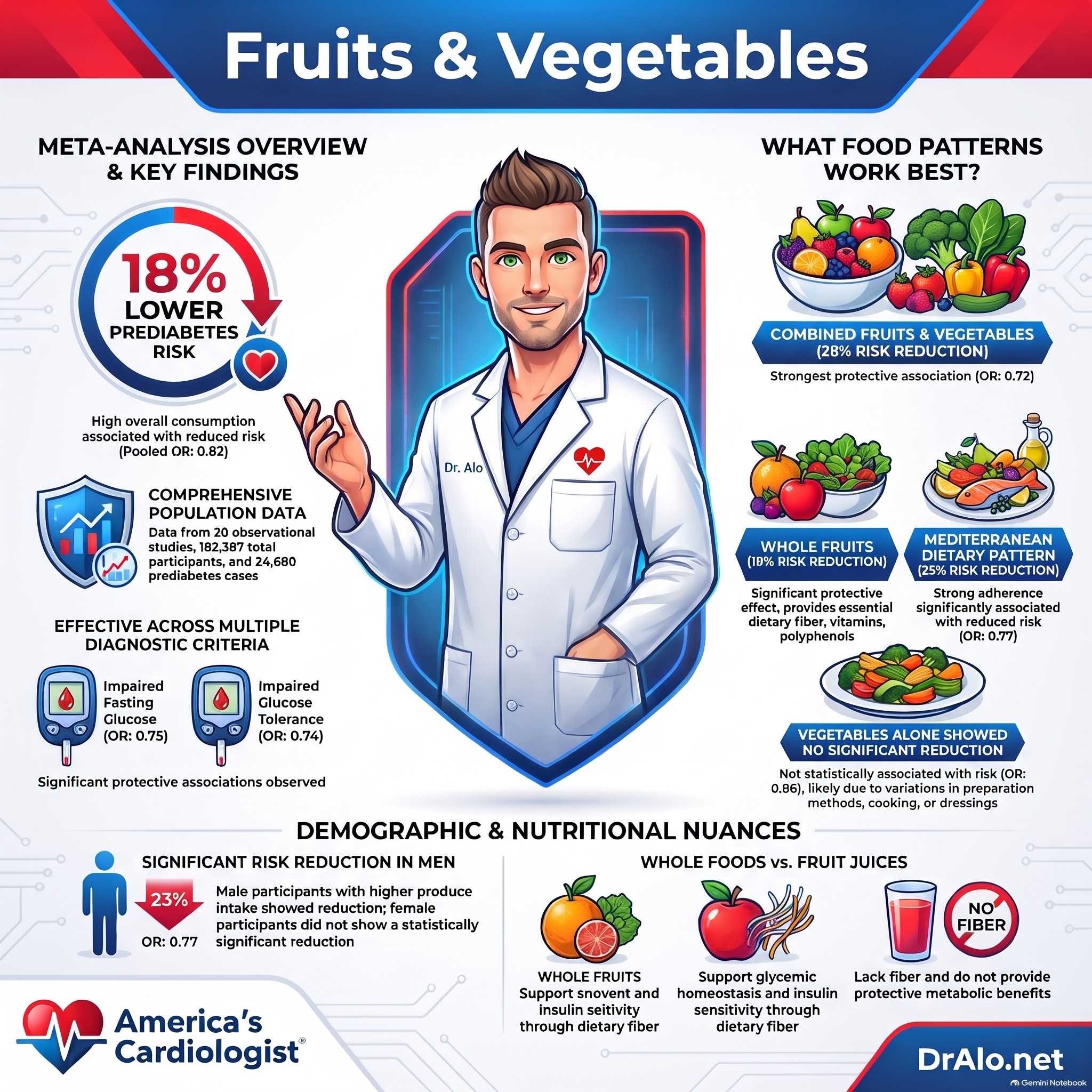
- Across 20 studies and 182,387 adults, people who ate the most fruit and vegetables had 18% lower odds of prediabetes than people who ate the least.
- Fruit on its own was linked to lower odds. So were eating patterns built around fruit, vegetables and legumes, which showed the biggest drop.
- Vegetables alone did not reach statistical significance in this analysis. That is not a reason to skip them. It is a sign that how they are prepared, and what else is on the plate, probably matters.
- Most of the evidence comes from "snapshot" studies. The 3 studies that followed people forward over time did not show a clear benefit, so this is a strong clue, not proof.
- Whole fruit is not the problem in prediabetes. Fruit juice is a different story.
Infographic Summary:
First, what is prediabetes?
Prediabetes means your blood sugar is higher than normal but not yet in the diabetes range. Your doctor usually finds it with one of three tests: an A1c of 5.7% to 6.4%, a fasting glucose of 100 to 125 mg/dL, or a 2-hour glucose tolerance test between 140 and 199 mg/dL.
More than 1 in 3 American adults has prediabetes, and most of them have no idea. I care about this as a cardiologist because the damage to blood vessels does not wait for the official diabetes diagnosis. And here is the part I want you to remember: prediabetes is the stage where lifestyle changes work best. In the landmark Diabetes Prevention Program, a lifestyle program of healthier eating, about 150 minutes a week of activity and modest weight loss cut the chance of developing type 2 diabetes by 58%.
So the question of what to put on your plate is not a small one.
What the researchers did

Two researchers in Korea, Seung-Hee Hong and Yun-Jung Bae, searched three major medical databases through January 2026. They found 5,535 records, removed the duplicates, screened out the ones that did not fit, read 102 in full, and ended up with 20 studies that met their rules.
Together those studies included 182,387 adults, and 24,660 of them had prediabetes. The studies came from Spain, the UK, China, Iran, Germany, Laos, Eswatini, Yemen, the Netherlands, Taiwan, Sweden and the United States.
A meta-analysis is simply a study of studies. Instead of trusting one paper, you combine many of them so the signal is harder to miss. In each study, the researchers compared the people who ate the most fruit and vegetables with the people who ate the least.
The result is reported as an odds ratio. You don't need to be a statistician to read it. An odds ratio of 1.0 means no difference. Below 1.0 means lower odds. The combined answer here was 0.82, which means 18% lower odds of having prediabetes in the people eating the most produce.
Every study, on one chart

Figure: odds of prediabetes, highest vs lowest fruit and vegetable intake, for each of the 20 studies and all of them combined. Redrawn from Hong S-H, Bae Y-J. Nutrients. 2026;18(9):1391 (Table 1 and Figure 2).
This is called a forest plot, and once you know how to read it, you'll see them everywhere in medicine.
- Each row is one study. The square is that study's result. The line through it is the margin of error.
- The dashed line is 1.0, no difference. Anything to the left, in the pink zone, means more fruit and vegetables went with lower odds of prediabetes.
- Bigger squares are more precise studies, usually the bigger ones.
- The pink diamond at the bottom is all 20 combined: 0.82, with a range of 0.74 to 0.91. The whole diamond sits left of the line, so the result is statistically significant.
Look at how scattered the squares are, though. A couple of studies show huge effects (Gbadamosi 2020 at 0.05 and Bagheri 2016 at 0.16), while one large study from China, Xia 2021, actually went the other way at 1.46. The researchers measured how much the studies disagreed with each other, and it was a lot (a number called I squared, 91.9%, where anything over 50% is considered high). When they removed the most extreme studies one at a time, the answer barely moved, which is reassuring. But this much disagreement tells you that "fruit and vegetables" meant different things in different countries, measured different ways.
The fine print: snapshot vs follow-up studies

Figure: combined odds ratios by study design. Redrawn from Hong S-H, Bae Y-J. Nutrients. 2026;18(9):1391 (Figure 3 and Table 3).
This is the chart I most want you to understand, because it is where a lot of nutrition headlines go wrong.
Sixteen of the 20 studies were cross-sectional. I call these snapshot studies. They ask about your diet and check your blood sugar at the same point in time. In those studies, more fruit and vegetables went with 19% lower odds of prediabetes (odds ratio 0.81).
The problem with a snapshot is that it cannot tell you which came first. Picture someone who was just told their sugar is creeping up. A lot of my patients respond by eating more salads right away. In a snapshot study, that person shows up as "high vegetable intake, has prediabetes," which can blur or even flip the real relationship. Researchers call this reverse causation.
Only 3 studies followed people forward over time, which is the stronger design. Combined, they showed an odds ratio of 0.97, with a range of 0.92 to 1.02. That range crosses 1.0, so there was no clear difference. The authors were honest about this. They point out that 3 studies is very little to go on, and they say the overall finding should not be read as proof that fruit and vegetables cause less prediabetes.
So where does that leave us? With a consistent signal that people who eat more produce tend to have healthier blood sugar, and a real need for better long-term studies. I'd rather give you that honest picture than oversell it.
Fruit, vegetables, or the whole pattern?

Figure: subgroup results shown as percent lower odds of prediabetes (1 minus the odds ratio) with 95% confidence ranges. Redrawn from Hong S-H, Bae Y-J. Nutrients. 2026;18(9):1391 (Table 3).
The researchers also split the studies up to see what kind of eating mattered most. I turned the odds ratios into a simpler number: the percent lower odds. A pink bar means the result was statistically significant. A grey bar means the whisker crosses zero, so it could be no effect at all.
- Fruit-vegetable eating patterns: 50% lower odds (4 studies). These were overall ways of eating built around fruit, vegetables and, in some, legumes. The biggest effect, but from only 4 studies.
- Fruit and vegetables together: 28% lower odds (10 studies).
- Mediterranean diet: 23% lower odds (5 studies). Right on the edge, with the upper end of the range touching 1.0.
- Fruit: 18% lower odds (9 studies). Yes, fruit. The food people with prediabetes are most afraid of.
- Vegetables alone: 14%, not significant (8 studies).
Why would vegetables alone fall short? The authors offer a sensible explanation. Vegetables can be eaten raw, boiled, fried, pickled, or drowned in a creamy dressing, and a simple "how many vegetables did you eat" question cannot tell the difference. Earlier research has linked raw vegetables and salads more strongly to lower diabetes risk, possibly because of more fiber and a lower glycemic load for the meal. Fried potatoes count as a vegetable in a lot of surveys. Your body knows better.
The researchers also found a difference between men and women. Men eating the most produce had 23% lower odds of prediabetes (4 studies), while in women the result was not significant (3 studies). Men tend to carry more visceral fat, the deep belly fat that drives insulin resistance, and food choices can differ between men and women too. But 3 or 4 studies is a thin slice of evidence. Ladies, please do not read this as "fruit and vegetables don't work for women." It means we don't have enough data yet to say.
The myth I want to bury: "Fruit has sugar, so I should avoid it"
The authors of this paper call this out directly. Some people with high blood sugar avoid fruit because it is sweet, and they end up missing its benefits.
Whole fruit comes packaged with fiber, water, and a long list of plant compounds called polyphenols. That package slows how fast the sugar reaches your blood. It also helps with fullness, weight, inflammation and your gut bacteria, all of which feed into how well insulin works.
Fruit juice is a different animal. Strip away the fiber, and you are drinking sugar water with vitamins. In a 2025 analysis of long-term studies, each extra daily serving of fruit juice was linked to about a 5% higher risk of type 2 diabetes, and reviews of 100% fruit juice have not found it protective. That is exactly why this new meta-analysis left juice out on purpose.
Here's what I tell my patients: eat your fruit, don't drink it.
What I tell my patients with prediabetes
- Keep the whole fruit. Berries, apples, pears, oranges, cherries, kiwi. Pair it with a handful of nuts or some Greek yogurt if you want even less of a sugar spike.
- Skip the juice and the smoothies that hide 4 pieces of fruit in one cup.
- Think pattern, not single foods. The biggest effect in this study came from whole eating patterns built around fruit, vegetables and legumes. Fill half your plate with produce, and add beans, lentils or chickpeas several times a week.
- Prepare vegetables in ways that help. Raw, roasted, steamed or sautéed in a little olive oil beats fried or smothered in creamy dressing.
- Chase the fiber. Fiber is one of my top heart habits for a reason. It helps blood sugar and LDL cholesterol at the same time.
- Don't stop there. Activity, sleep, weight and cutting back on saturated fat and refined carbs all matter. And if your doctor recommends a medication, food is a partner to it, not a replacement.
- Know your numbers. Recheck your A1c or fasting glucose as your doctor advises, so you can see whether what you're doing is working.
Frequently asked questions
Can fruits and vegetables reverse prediabetes?
This study can't answer that. It shows that people who eat more produce are less likely to have prediabetes, but it was not designed to test reversing it. What we do know from the Diabetes Prevention Program is that an overall lifestyle program can cut the chance of progressing to diabetes by more than half, and a produce-rich diet is a big part of that.
Is fruit bad if I have prediabetes?
No. Whole fruit was linked to lower odds of prediabetes in this analysis. Juice is the one to limit.
Which is better, fruit or vegetables?
You don't have to choose. The strongest results came from eating both, as part of an overall pattern that includes legumes.
Does the Mediterranean diet help with prediabetes?
In this analysis, 5 studies of the Mediterranean diet showed 23% lower odds, right at the edge of statistical significance. It is also one of the best-studied heart healthy ways of eating, so it is a very reasonable choice.
Does this prove fruit and vegetables prevent prediabetes?
Not yet. Most of the studies were snapshots in time, and the 3 studies that followed people forward did not show a clear difference. The authors are calling for more long-term studies, and so am I.
The bottom line
The first meta-analysis on this question found that people who eat the most fruit and vegetables have about 18% lower odds of prediabetes. Fruit on its own was linked to lower odds, and whole eating patterns rich in fruit, vegetables and legumes looked even better. The evidence still leans on snapshot studies, so treat this as a strong, sensible clue rather than a guarantee.
If you have prediabetes, don't be afraid of the fruit bowl. Be afraid of the juice box, the drive-through and the couch. Eat your fruit, fill half your plate with produce, and keep an eye on your numbers.
Still have questions? Stop Googling and ask Dr. Alo.
You've read the science, but applying it to your own life can be confusing. That's exactly what the Heart 2 Heart VIP Community is for. You can ask me questions directly, join live video calls where we talk through your labs and situations like this one, and get physician-level guidance based on your actual numbers.
Join here: https://dralo.net/community 💪🏻🩺🫀
Dr. Alo
References
- Hong S-H, Bae Y-J. Effects of Dietary Fruit and Vegetable Consumption on Prediabetes: A Systematic Review and Meta-Analysis. Nutrients. 2026;18(9):1391. doi:10.3390/nu18091391.
- Knowler WC, Barrett-Connor E, Fowler SE, et al. Reduction in the incidence of type 2 diabetes with lifestyle intervention or metformin. New England Journal of Medicine. 2002;346(6):393-403. doi:10.1056/NEJMoa012512.
- Centers for Disease Control and Prevention. National Diabetes Statistics Report. Atlanta, GA: U.S. Department of Health and Human Services.
- U.S. Preventive Services Task Force; Davidson KW, Barry MJ, Mangione CM, et al. Screening for prediabetes and type 2 diabetes: U.S. Preventive Services Task Force recommendation statement. JAMA. 2021;326(8):736-743.
- Della Corte KA, Bosler T, McClure C, et al. Dietary sugar intake and incident type 2 diabetes risk: A systematic review and dose-response meta-analysis of prospective cohort studies. Advances in Nutrition. 2025;16:100413.
- Lee CW, Myung SK. Consumption of fruit juice and risk of type 2 diabetes mellitus: A systematic review and meta-analysis of prospective cohort studies. American Journal of Medicine. 2025;138:1428-1437.
- Halvorsen RE, Elvestad M, Molin M, Aune D. Fruit and vegetable consumption and the risk of type 2 diabetes: A systematic review and dose-response meta-analysis of prospective studies. BMJ Nutrition, Prevention and Health. 2021;4:519-531.
- Williams DE, Wareham NJ, Cox BD, et al. Frequent salad vegetable consumption is associated with a reduction in the risk of diabetes mellitus. Journal of Clinical Epidemiology. 1999;52(4):329-335.
- Mauvais-Jarvis F. Sex differences in metabolic homeostasis, diabetes, and obesity. Biology of Sex Differences. 2015;6:14.
Still Have Questions? Stop Googling and Ask Dr. Alo.
You’ve read the science, but applying it to your own life can be confusing. I created the Dr. Alo VIP Private Community to be a sanctuary away from social media noise.
Inside, you get:
-
Direct Access: I answer member questions personally 24/7/365.
-
Weekly Live Streams: Deep dives into your specific health challenges.
-
Vetted Science: No fads, just evidence-based cardiology and weight loss.
Don't leave your heart health to chance. Get the guidance you deserve. All this for less than 0.01% the cost of health insurance! You can cancel at anytime!
[👉 Join the Dr. Alo VIP Community Today]
Cardiology & Obesity Medicine