
Which Statin Should I Take? How a Cardiologist Chooses Your Statin
Oct 09, 2026
Which Statin Should You Start?
"Which statin should I take?" might be the question I hear most often in clinic. People have heard of Lipitor, Crestor, Zocor, and a half dozen others, and they want to know whether it matters. It does. So let me tell you exactly how I do it, in plain English, and what the research says about why.
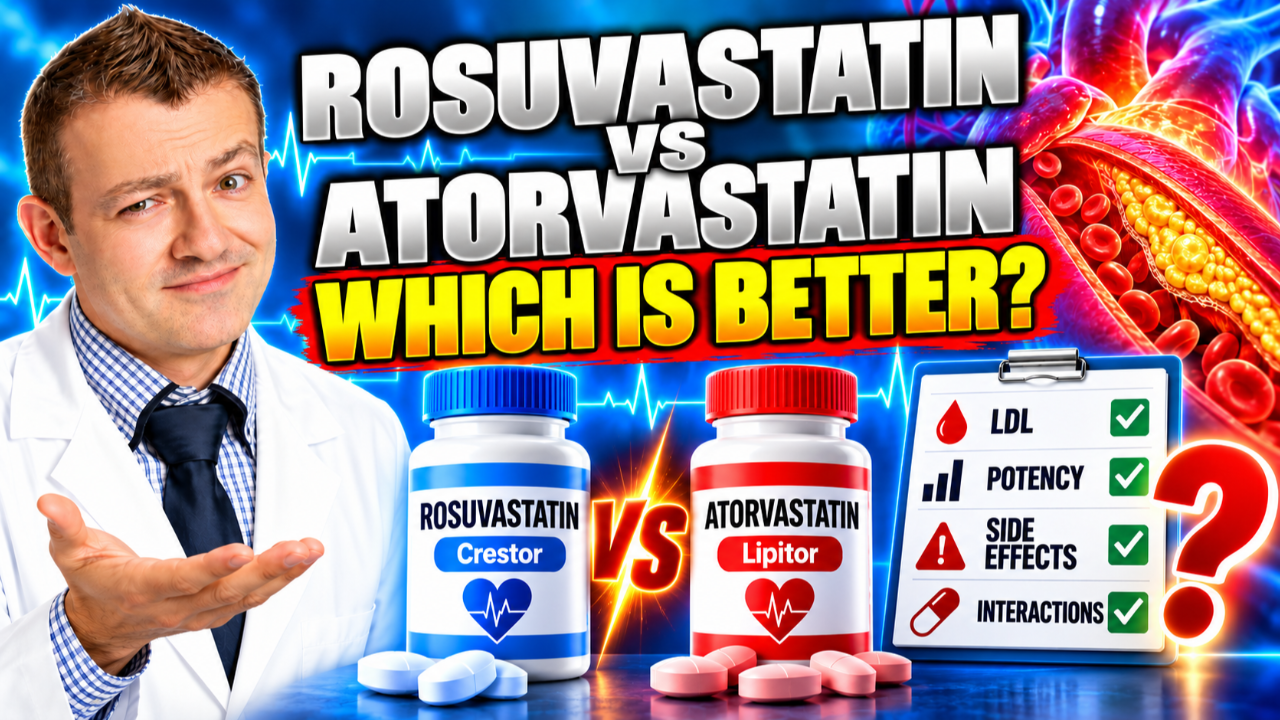
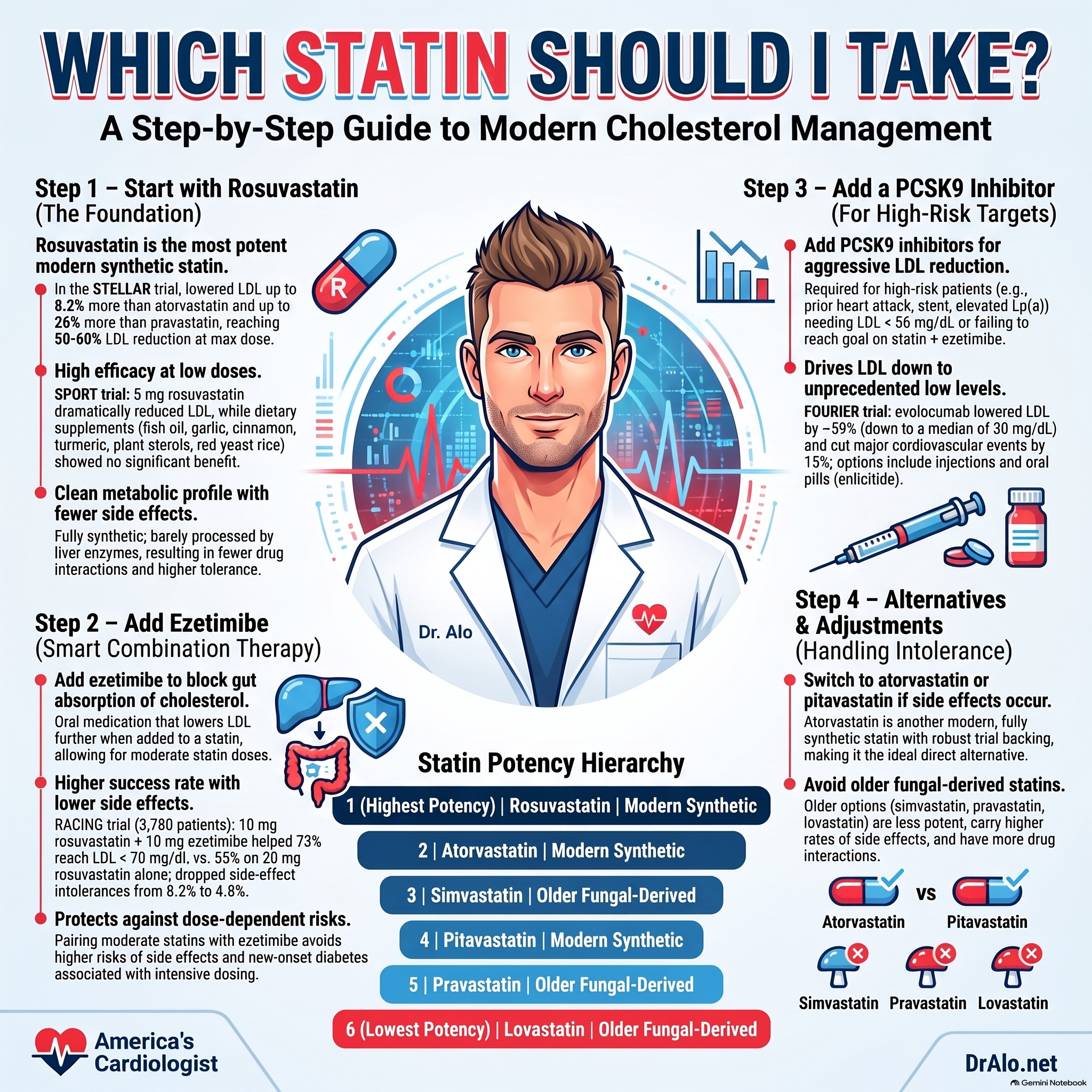
The short version is this. I start with a modern statin, and for most people that means rosuvastatin. If we need to go lower, I add ezetimibe. If we need to go lower still, I add a PCSK9 medicine. And if someone has side effects on rosuvastatin, sometimes I'll use atorvastatin instead. For nearly everyone, those two statins are all you will ever need.
My Approach in Four Steps
- Start with rosuvastatin. It is the most potent statin, the most well tolerated in my practice, has the least side effects, and it has the fewest drug interactions.
- Add ezetimibe. This lowers LDL further, and it lets me use a lower dose of the statin.
- Add a PCSK9 inhibitor when your LDL needs to go even lower. These come as an injection, and now as a pill.
- Switch to atorvastatin if rosuvastatin causes side effects or other problems. This can be used as an alternative. It is also a modern, synthetic statin, like rosuvastatin.
How far down the ladder you go depends on one thing: how low your cholesterol needs to be. A person with a high risk of heart disease needs a much lower LDL than someone with no risk factors. I wrote about those targets in my article on the new cholesterol guidelines. For anyone who has already had a heart attack or a stent, the goal is an LDL under 55 mg/dL, and a statin alone often does not get you there.
Infographic Summary:
Why I Start With Rosuvastatin
There are many reasons.
It is the most potent. The STELLAR trial compared rosuvastatin head to head with atorvastatin, simvastatin, and pravastatin across their full dose ranges in 2,431 adults. Across doses, rosuvastatin lowered LDL cholesterol by 8.2% more than atorvastatin, 12% to 18% more than simvastatin, and 26% more than pravastatin. It also raised HDL more than the other statins. At its highest dose, rosuvastatin can lower LDL by 50 to 60 percent depending on the person.
It works at low doses. In the SPORT trial, just 5 mg of rosuvastatin dramatically lowered LDL compared with placebo, while fish oil, cinnamon, garlic, turmeric, plant sterols, and red yeast rice did nothing significant. A small dose of the right statin does a lot.
It is clean. In my experience, rosuvastatin causes the fewest side effects and the fewest interactions with other medicines, and it is the statin my patients tolerate best. Part of the reason is that it is a modern, fully synthetic statin that is barely processed by the liver enzymes that handle most other drugs. Because every statin handles drugs a little differently, a 2012 review in Expert Opinion on Drug Safety stressed that the differences between statins should be considered whenever a person takes other medicines.
Rosuvastatin also has a track record of results. In the JUPITER trial, 20 mg of rosuvastatin reduced cardiovascular events in people with high inflammation. If you want the full story on how rosuvastatin changed what we thought was possible, I covered it in my article on statins in primary and secondary prevention.
Further, rosuvastatin is a synthetic statin. There are only three synthetic statins on the market, which are rosuvastatin, atorvastatin, and pitavastatin. Atorvastatin and rosuvastatin are far more potent and we use them much more frequently. Pitavastatin is a much weaker statin, just a little bit more potent than pravastatin. And since pitavastatin is not generic, it's difficult to get approved and quite expensive
- Rosuvastatin
- Atorvastatin
- Simvastatin
- Pitavastatin
- Pravastatin
- Lovastatin
- Fluvastatin
Why I Add Ezetimibe
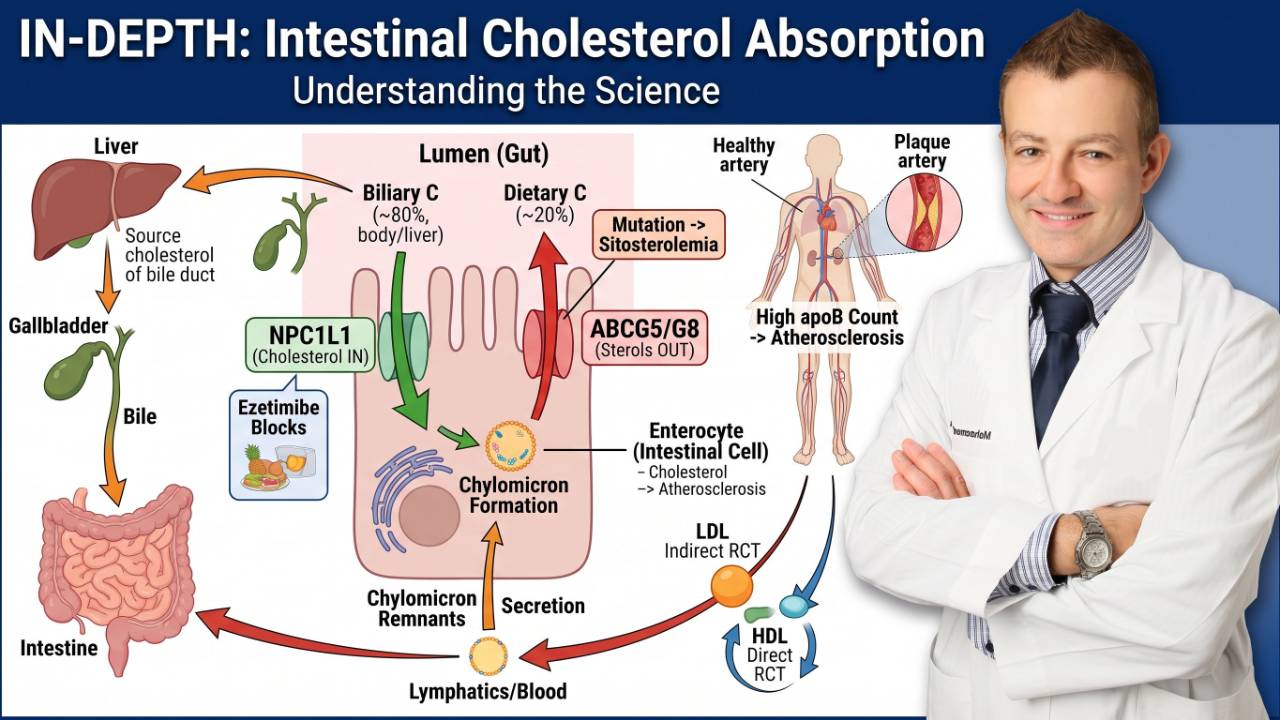
Ezetimibe is a small, cheap pill that blocks cholesterol absorption in the gut. Added to a statin, it lowers LDL further. The IMPROVE-IT trial followed 18,144 people after a heart attack or unstable angina. Adding ezetimibe to a statin brought the average LDL down to 53.7 mg/dL, compared with 69.5 mg/dL on the statin alone, and fewer people had cardiovascular events.
The reason I love this pairing is that it lets me use a lower dose of the statin. That matters for two reasons. First, higher statin doses cause more side effects and more intolerance. Second, the risk of new diabetes with statins goes up with the dose. A 2011 meta-analysis in JAMA of 32,752 people found about 2 extra cases of diabetes per 1,000 patient-years with intensive-dose statins compared with moderate-dose statins.
The RACING trial tested this idea directly in 3,780 people with heart disease. One group took rosuvastatin 10 mg plus ezetimibe 10 mg. The other took rosuvastatin 20 mg alone. After 3 years:
- Heart events were the same, 9.1% with the combination and 9.9% with the higher dose statin alone, so the combination was non-inferior.
- More people reached an LDL under 70 mg/dL with the combination, 73% compared with 55% at one year.
- Fewer people had to stop or cut back the medicine because of side effects, 4.8% compared with 8.2%.
That is exactly how I practice. A moderate dose of rosuvastatin plus ezetimibe gets most people to their target with fewer problems. In my own writing I have called rosuvastatin and ezetimibe the two old, cheap drugs that get most people to target.
What Do I Take?
Personally I take 10 mg of rosuvastatin and 10 mg of ezetimibe. I've been on lipid-lowering therapy since age 24. I first started out on Lipitor because rosuvastatin had not come out yet. I was on Lipitor 10 mg and then when rosuvastatin came out, which is Crestor, I started taking 5 mg of rosuvastatin, which got my LDL into the 75 to 85 range.
More recently I started taking ezetimibe 10 mg on top of rosuvastatin 10 mg. This got my LDL numbers down into the 41 mg/dL range, sometimes 44 mg/dL. I feel this is an acceptable number for someone who is quite low risk.
I found out recently that I have a slightly elevated lipoprotein(a) at about 31 to 32 mg/dL, so hopefully this will keep me at a very low risk
When I Add a PCSK9 Inhibitor
Some people need to go even lower. If you have had a heart attack, if you have a very high Lp(a), or if your LDL stays above goal on a statin and ezetimibe, I add a PCSK9 inhibitor. In the FOURIER trial of 27,564 people with heart disease, evolocumab (Repatha) lowered LDL by about 59 percent, from a median of 92 mg/dL to 30 mg/dL, and reduced the risk of the main cardiovascular endpoint by 15 percent when added to a statin.
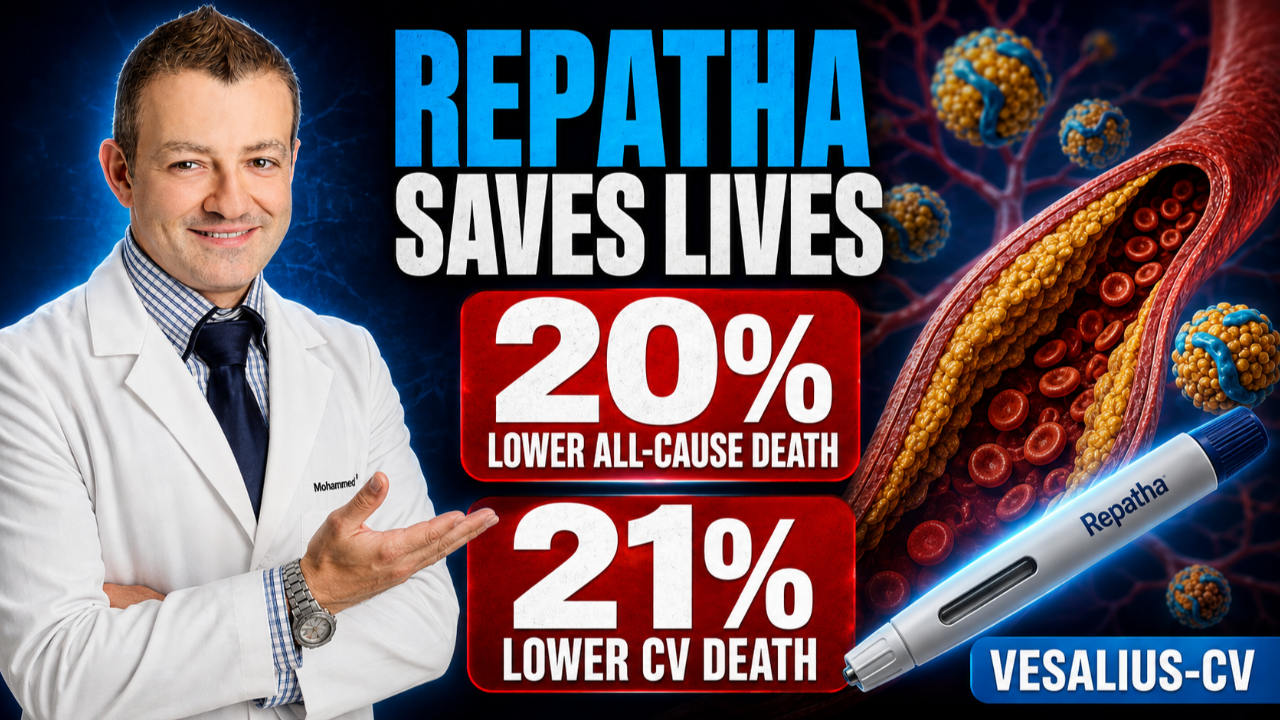
The newer VESALIUS-CV trial went further and tested evolocumab in people who had never had a heart attack or stroke. You can read my breakdown of that trial in my article on VESALIUS-CV, and my article on Repatha for primary prevention.
The choice used to be injections only. Now there is a pill too, called Lipfendra (enlicitide), the first oral PCSK9 inhibitor. I explain who it fits in my article on the oral PCSK9 pill.
So the combination I reach for most often, depending on how low your cholesterol needs to be, is a statin, ezetimibe, and a PCSK9 inhibitor. Used together, these three can drive LDL down to levels that were not possible a generation ago.
When I Use Atorvastatin Instead
Occasionally, a person has side effects or other problems with rosuvastatin. When that happens, sometimes I'll use atorvastatin instead. It is the other modern, fully synthetic statin, and together with rosuvastatin it covers nearly everyone.
Atorvastatin has some of the deepest outcome evidence of any statin:
- TNT: in 10,001 people with stable coronary disease, atorvastatin 80 mg brought the average LDL to 77 mg/dL, compared with 101 mg/dL on atorvastatin 10 mg, and fewer people had a major cardiovascular event, 8.7% compared with 10.9% over a median of 4.9 years.
- PROVE-IT TIMI 22: after a heart attack or unstable angina, atorvastatin 80 mg (average LDL 62 mg/dL) reduced the main combined endpoint by 16 percent compared with pravastatin 40 mg (average LDL 95 mg/dL).
- SPARCL: in 4,731 people who had a stroke or mini-stroke, atorvastatin 80 mg lowered the risk of another stroke, 11.2% compared with 13.1% on placebo.
- ASCOT-LLA: in 10,305 people with high blood pressure and average cholesterol, just 10 mg of atorvastatin lowered the risk of a nonfatal heart attack or fatal coronary disease by 36 percent. The trial was stopped early, after about 3 years, because the benefit was so clear.
- CARDS: in 2,838 people with type 2 diabetes, 10 mg of atorvastatin led to 83 major cardiovascular events compared with 127 on placebo, and the trial was stopped 2 years early for benefit.
The TNT trial also reminds us why I like lower doses with ezetimibe. Persistent liver enzyme elevations were seen in 0.2% of people on atorvastatin 10 mg and 1.2% on 80 mg. Dose matters.
Before I switch, I always check a few other things first. Is the problem really the statin? Is the dose too high? Is there a drug interaction, or low vitamin D? Sometimes lowering the dose and adding ezetimibe fixes the problem without changing the statin at all. I covered all of this in my article on statin side effects. Please do not stop your statin on your own. Stopping without guidance is far riskier than working with your doctor to fix the problem.
What About the Older Statins and Atorvastatin?
Lovastatin, pravastatin, and simvastatin are the older statins. They come from natural compounds made by fungi, and simvastatin and pravastatin are modified versions of them. They are not synthetic, and they were true pioneers. Simvastatin was the drug in the famous 4S trial, which first showed that lowering cholesterol saves lives.
But I do not reach for them today. In my experience they cause slightly more side effects, and in the STELLAR trial they lowered LDL less than rosuvastatin at comparable doses. Pravastatin 40 mg also lost the head to head match against atorvastatin 80 mg in PROVE-IT. When a more potent and better tolerated option exists, there is little reason to choose them.
Atorvastatin is a strong, fully synthetic statin as well, and it is a reasonable choice. You will not be making a mistake if that is the one you take. I simply prefer to keep my list short. Rosuvastatin first, sometimes atorvastatin instead, and nearly everyone is covered.
Dose: Start Low, Then Adjust
I rarely start at the top dose. A common starting plan is a moderate dose of rosuvastatin, often 5 to 10 mg, together with ezetimibe 10 mg, then recheck your labs a few weeks later and adjust. The RACING trial used exactly that pairing, rosuvastatin 10 mg plus ezetimibe 10 mg.
One important point for my South Asian and East Asian patients. A 2005 study published in Clinical Pharmacology and Therapeutics found that people of Asian ancestry have meaningfully higher blood levels of rosuvastatin than white people taking the same dose. That is one more reason to start low in this group, and to rely on ezetimibe for the extra lowering.
Get your numbers measured. I want to see your LDL, and ideally your apoB, before and after any change.
What About Statins Causing Diabetes
First we must be clear that no one developed new diabetes that was not already diabetic, prediabetic, or on the brink of diabetes. This is clear in all of the studies.
Unfortunately too many online influencers that want to misinform the public will leave this information out to try and scare people from taking these life-saving medications and try to convince you to buy their unproven, unregulated supplements instead.
In LODESTAR, more people on rosuvastatin started diabetes medicine, 7.2% compared with 5.3%, and had cataract surgery, 2.5% compared with 1.5%. A large study of two databases, one from China and one from the UK, found slightly lower death, heart event, and liver problem rates with rosuvastatin, but a higher rate of new type 2 diabetes in the UK data. The differences were small, and the authors noted that other explanations could not be ruled out.
This is one more reason that we try to use the lowest dose that does the job and add ezetimibe rather than pushing the statin dose up. It's important to note that nobody developed new diabetes. These were people that were already on the brink of diabetes, already had prediabetes. They are the only ones where a diabetes signal was noted. Anyone with no diabetes whatsoever did not develop diabetes.
So which one? Both are excellent drugs. Atorvastatin has the longer outcomes track record. I start with rosuvastatin because it lowers LDL more per milligram, and in my experience it is the best tolerated with the fewest interactions. If someone does not do well on rosuvastatin, atorvastatin is a very good alternative.
The Bottom Line
Here is my whole approach on one page. Start with rosuvastatin. Add ezetimibe to get a stronger effect at a lower statin dose. Add a PCSK9 inhibitor when your cholesterol needs to go even lower. And if rosuvastatin does not suit you, sometimes I'll use atorvastatin instead. These two statins are all most people will ever need, and the older statins have little to offer by comparison.
This is general education, not a prescription. The right drug, dose, and target depend on your history, your other medicines, and your risk, so please work them out with your own doctor.
Still have questions? Stop Googling and ask Dr. Alo.
You've read the science, but applying it to your own life can be confusing. That's exactly what the Heart 2 Heart VIP Community is for. You can ask me questions directly, join live video calls where we talk through scenarios like this one, and get physician-level guidance based on your actual situation.
Join here: https://dralo.net/community 💪🏻🩺🫀
Dr. Alo
References
- Jones PH, Davidson MH, Stein EA, et al. Comparison of the efficacy and safety of rosuvastatin versus atorvastatin, simvastatin, and pravastatin across doses (STELLAR trial). Am J Cardiol. 2003;92(2):152-160. doi:10.1016/S0002-9149(03)00530-7
- Laffin LJ, Bruemmer D, Garcia M, et al. Comparative effects of low-dose rosuvastatin, placebo, and dietary supplements on lipids and inflammatory biomarkers (SPORT). J Am Coll Cardiol. 2023;81(1):1-12. doi:10.1016/j.jacc.2022.10.013
- Ridker PM, Danielson E, Fonseca FAH, et al. Rosuvastatin to prevent vascular events in men and women with elevated C-reactive protein (JUPITER). N Engl J Med. 2008;359:2195-2207. doi:10.1056/NEJMoa0807646
- Bellosta S, Corsini A. Statin drug interactions and related adverse reactions. Expert Opin Drug Saf. 2012;11(6):933-946. doi:10.1517/14740338.2012.712959
- Cannon CP, Blazing MA, Giugliano RP, et al. Ezetimibe added to statin therapy after acute coronary syndromes (IMPROVE-IT). N Engl J Med. 2015;372(25):2387-2397. doi:10.1056/NEJMoa1410489
- Preiss D, Seshasai SRK, Welsh P, et al. Risk of incident diabetes with intensive-dose compared with moderate-dose statin therapy: a meta-analysis. JAMA. 2011;305(24):2556-2564. doi:10.1001/jama.2011.860
- Kim BK, Hong SJ, Lee YJ, et al. Long-term efficacy and safety of moderate-intensity statin with ezetimibe combination therapy versus high-intensity statin monotherapy in patients with atherosclerotic cardiovascular disease (RACING). Lancet. 2022;400(10349):380-390. doi:10.1016/S0140-6736(22)00916-3
- Sabatine MS, Giugliano RP, Keech AC, et al. Evolocumab and clinical outcomes in patients with cardiovascular disease (FOURIER). N Engl J Med. 2017;376(18):1713-1722. doi:10.1056/NEJMoa1615664
- Bohula EA, Marston NA, Bhatia AK, et al. Evolocumab in patients without a previous myocardial infarction or stroke (VESALIUS-CV). N Engl J Med. 2026;394:117-127. doi:10.1056/NEJMoa2514428
- LaRosa JC, Grundy SM, Waters DD, et al. Intensive lipid lowering with atorvastatin in patients with stable coronary disease (TNT). N Engl J Med. 2005;352(14):1425-1435. doi:10.1056/NEJMoa050461
- Cannon CP, Braunwald E, McCabe CH, et al. Intensive versus moderate lipid lowering with statins after acute coronary syndromes (PROVE IT-TIMI 22). N Engl J Med. 2004;350(15):1495-1504. doi:10.1056/NEJMoa040583
- Amarenco P, Bogousslavsky J, Callahan A, et al. High-dose atorvastatin after stroke or transient ischemic attack (SPARCL). N Engl J Med. 2006;355(6):549-559. doi:10.1056/NEJMoa061894
- Sever PS, Dahlof B, Poulter NR, et al. Prevention of coronary and stroke events with atorvastatin in hypertensive patients who have average or lower-than-average cholesterol concentrations (ASCOT-LLA). Lancet. 2003;361(9364):1149-1158. doi:10.1016/S0140-6736(03)12948-0
- Colhoun HM, Betteridge DJ, Durrington PN, et al. Primary prevention of cardiovascular disease with atorvastatin in type 2 diabetes in the Collaborative Atorvastatin Diabetes Study (CARDS). Lancet. 2004;364(9435):685-696. doi:10.1016/S0140-6736(04)16895-5
- Lee E, Ryan S, Birmingham B, et al. Rosuvastatin pharmacokinetics and pharmacogenetics in white and Asian subjects residing in the same environment. Clin Pharmacol Ther. 2005;78(4):330-341. doi:10.1016/j.clpt.2005.06.013
- Blumenthal RS, Morris PB, Gaudino M, et al. 2026 ACC/AHA/AACVPR/ABC/ACPM/ADA/AGS/APhA/ASPC/NLA/PCNA guideline on the management of dyslipidemia. J Am Coll Cardiol. 2026;87(19):2624-2757. doi:10.1016/j.jacc.2025.11.016
- Adams SP, Sekhon SS, Wright JM. Lipid-lowering efficacy of rosuvastatin. Cochrane Database Syst Rev. 2014. doi:10.1002/14651858.CD010254.pub2
- Lee YJ, Hong SJ, Kang WC, et al. Rosuvastatin versus atorvastatin treatment in adults with coronary artery disease: secondary analysis of the randomised LODESTAR trial. BMJ. 2023;383:e075837. doi:10.1136/bmj-2023-075837
- Stein B, Ward T, Hale G, Lyver E. Safety of high-intensity statins in the veteran population: atorvastatin 40 to 80 mg compared with rosuvastatin 20 to 40 mg. Ann Pharmacother. 2020;54(5):405-413. doi:10.1177/1060028019888487
- Zhou S, Chen R, Liu J, et al. Comparative effectiveness and safety of atorvastatin versus rosuvastatin: a multi-database cohort study. Ann Intern Med. 2024;177(12):1641-1651. doi:10.7326/M24-0178
Still Have Questions? Stop Googling and Ask Dr. Alo.
You’ve read the science, but applying it to your own life can be confusing. I created the Dr. Alo VIP Private Community to be a sanctuary away from social media noise.
Inside, you get:
-
Direct Access: I answer member questions personally 24/7/365.
-
Weekly Live Streams: Deep dives into your specific health challenges.
-
Vetted Science: No fads, just evidence-based cardiology and weight loss.
Don't leave your heart health to chance. Get the guidance you deserve. All this for less than 0.01% the cost of health insurance! You can cancel at anytime!
[👉 Join the Dr. Alo VIP Community Today]
Cardiology & Obesity Medicine