
After a Stent or Heart Attack: What a Cardiologist Wants You To Do in the First Year
Oct 08, 2026
The First Year After A Heart Stent Playbook
If you or someone you love just had a stent placed, the first year matters more than almost any other stretch of your heart health. I see people walk out of the hospital relieved, and they should be. The blocked artery was opened. But a stent is not the end of the story. It is the start of the part that you control. So let me walk you through exactly what I want my patients to do in that first year, and what the research says about why.
Three things matter most. Take your antiplatelet medicines without missing a dose. Get every risk factor under real control. And know the warning signs of a clotted stent, because that is an emergency. Everything else in this article builds on those three.
A Stent Fixes One Blockage. It Does Not Fix the Disease
Here is the most important idea to hold onto. A stent is a small mesh tube that props open one narrowing in one artery. That is a great repair for that spot. But the process that clogged the artery, the buildup of plaque from cholesterol, high blood pressure, high blood sugar, and smoking, is still running in every other artery in your body.
A 2025 review in JACC Advances on managing patients after a stent describes it the same way. Long term care rests on three pillars: change your lifestyle and bring down your risk factors, take the medicines that prevent another event, and be watched for the stent narrowing again. I will go through each one.

That chart is worth a close look. On the left, the lifestyle and risk factor pillar: weight, cholesterol, diabetes, blood pressure, diet, smoking, physical activity, and even mental well-being. In the middle, the medicines, which are a balancing act between the risk of a clot and the risk of bleeding. On the right, monitoring. Notice what is crossed out: routine surveillance, meaning scheduled tests when you feel fine. Testing is for people who develop symptoms. I will come back to each of these.
Rule One: Never Stop Your Antiplatelet Medicines on Your Own
If you remember only one thing from this article, remember this. Do not stop your blood thinning pills early. Not because you feel fine, not because a bruise scares you, and not because the refill is a hassle.
After a stent you will usually be on two medicines together. This is called dual antiplatelet therapy. One is a low dose aspirin, usually 75 to 100 mg a day, and aspirin is generally continued indefinitely. The other belongs to a group called P2Y12 inhibitors, which includes clopidogrel, ticagrelor, and prasugrel. Together they keep platelets from sticking to the new metal and forming a clot.
Why do I push this so hard? Because stopping these medicines too early is the strongest risk factor for stent thrombosis that you can actually control. That is when a clot suddenly forms inside the stent and shuts it. A 2019 review in Nature Reviews Cardiology on the predictors of stent thrombosis makes this point clearly. Stent thrombosis usually shows up as a heart attack, and it carries a death rate that has been reported anywhere from 15 to 45 percent. That is a frightening number, and it is the reason I am so firm.
The risk is highest in the first 30 days, but it does not vanish after that. If you ever run out of the medicine, miss several doses, or are told by someone other than your cardiologist to stop it, call the cardiology office the same day.
How Long Will You Be on Both Medicines?
The length of time depends on two things: why you got the stent, and how likely you are to bleed or to clot. After a stent placed for a heart attack or unstable angina, which doctors call acute coronary syndrome, the usual plan is about 12 months of the second medicine. After a stent placed for stable blockages, 6 months is often enough. Those are the standard starting points in the American and European guidelines, including the 2016 American focused update on the duration of dual antiplatelet therapy, a 2018 comparison of the American and European guidelines, and a 2026 scientific statement from the American College of Cardiology on antiplatelet therapy.
But your cardiologist does not have to use the standard time for everyone. Here is how the decision is often made.

Start at the top. If your stent was for stable disease, the standard is 6 months, and it drops to 3 months if your bleeding risk score is high. If your stent was for a heart attack or unstable angina, the standard is 12 months, and it drops to 6 months if the bleeding risk score is high. That bleeding score is called the PRECISE-DAPT score, and a score of 25 or more counts as high. It is built from five things: your age, whether you have bled before, your white blood cell count, your hemoglobin, and how well your kidneys work.
After 12 months, if you have not had a major clot or bleeding problem, a second score called the DAPT score helps decide whether to stop the second medicine or keep going. It adds points for smoking, diabetes, a prior stent or heart attack, a heart attack at the time of the stent, a small stent under 3 millimeters, a stent in a vein bypass graft, a paclitaxel coated stent, and weak heart pumping. It takes points away for older age. A score below 2 favors stopping the second medicine, and a score of 2 or higher favors continuing it.
These scores are tools for your cardiologist. Please do not work out your own score and decide to stop on your own.
The European guidelines show the same idea on a timeline.

If you do not have a high bleeding risk, the standard is 12 months of aspirin plus a second drug. Prasugrel is the preferred choice, ticagrelor is another good option, and clopidogrel is second line. After 12 months, most people continue on a single antiplatelet drug for the long term, usually aspirin. If your risk of another clot is high, your cardiologist may keep a second drug going, or in selected people add a low dose of a different blood thinner called rivaroxaban.
If you do have a high bleeding risk, the combination can be much shorter, as little as 1 to 3 months, followed by a single antiplatelet drug for the long term. Some people stop the aspirin and stay on the second drug alone, and some stay on aspirin alone. That is a physician decision, made with your whole history in front of them. It is not something to guess at on your own.
If you notice bleeding, such as black stools, blood in your urine, bleeding that will not stop, or easy bruising, tell your doctor. Do not solve the problem by stopping the pill yourself.
Surgery, Dental Work, and Other Procedures
This is where people get into trouble. A surgeon or a dentist may tell you to hold your blood thinners before a procedure. That sounds reasonable, but if you are in the first year after a stent, stopping can let the stent clot.
So the rule is simple. Any plan to pause these medicines, for surgery, dental work, or bleeding, has to be discussed with your cardiologist first. If a procedure can wait until the high risk window has passed, that is often the safest choice. If it cannot wait, your cardiologist and the surgeon should agree on a plan together.
Why Stents Clot: What Your Cardiologist Looks At
Stent thrombosis is not only about missed pills. How well the stent was placed matters too, and cardiologists have specific measurements they look for, especially when they use imaging inside the artery, such as intravascular ultrasound or optical coherence tomography. This chart from a 2019 review in Nature Reviews Cardiology lays them out.

Here is the plain English version. In the early period, the main problems are a stent that did not open all the way, a tear in the artery wall at the edge of the stent, and a stent that does not cover the whole diseased stretch of artery. These are best prevented during the procedure by using imaging to look for hard calcium, preparing the lesion well, and opening the stent with high pressure balloons when needed.
Later on, other problems show up. The stent struts may not touch the artery wall, which is called malapposition, and the fix is to open the stent more fully and extend the dual antiplatelet therapy. Some metal struts take a long time to be covered by the artery lining, and when many of them are still uncovered, the answer is again longer dual antiplatelet therapy. And new plaque can build up inside the stent itself, called neoatherosclerosis, which is treated with lipid lowering therapy. That is one more reason your cholesterol matters so much after a stent, which I will explain next.
You do not need to memorize these numbers. The point is that a stent that is placed well, checked with imaging when needed, and protected with the right medicines is far less likely to clot. If you want to know how yours looks, ask your cardiologist whether imaging was used during your procedure.
Know the Warning Signs of a Clotted Stent
I want you to know these signs well, because speed saves hearts.
Chest pain or pressure that feels like the symptoms you had before the stent, especially if it is severe or happens at rest, can signal stent thrombosis. Shortness of breath, fainting, or sweating along with chest discomfort are also red flags. All of these are even more concerning if they happen after you missed a dose of your antiplatelet medicine.
If this happens, call 911. Do not drive yourself, and do not wait to see whether it passes. A clotted stent is a medical emergency.
Your Cholesterol Matters More Than Ever
This is the part I care about most as a preventive cardiologist. Take the statin you were prescribed. The stent opened one artery, but your cholesterol decides what happens in all the others.
Once you have had a heart attack or a stent for blockages, you have established heart disease. For people in that group, the target I write about and use in practice is an LDL cholesterol under 55 mg/dL. In the new cholesterol guidelines, patients at the very highest risk have a goal of LDL under 55 and non-HDL cholesterol under 85, and the guidelines call for adding ezetimibe, a PCSK9 medicine, or both when a statin alone does not get you there. If you have had repeat events or a high lipoprotein(a), I would argue for going even lower.
That is why I want you to get a full lipid panel, ideally with apoB, soon after your stent and again a few weeks after any medicine change. If you are not at goal on a high dose statin, ask about ezetimibe, and ask about the PCSK9 options, which now include an oral pill called Lipfendra (enlicitide). If you cannot take statins, bring that up too. There are good alternatives.
Blood Pressure, Blood Sugar, Weight, and Food
Take your blood pressure medicines and your diabetes medicines if you have been prescribed them, and get your numbers to target. The JACC Advances review and the 2024 European guidelines on chronic coronary syndromes are very consistent here. Blood pressure, blood sugar, and cholesterol all have to be controlled together.
Eat a healthy diet. If you can, ask for a referral to a dietitian. Weight management matters as well. You do not need a perfect diet. You need a steady one that you can keep up for years.
Stop Smoking Completely
Of everything on this list, quitting smoking is one of the highest impact things you can do. The guidelines recommend using both medication and counseling, and they recommend starting while you are still in the hospital, when your motivation is at its peak. If you smoked before your stent, this is the moment. Ask your care team for help the day you go home, and do not wait.
Getting Back to Normal Activity
People always ask me when they can lift, drive, and exercise again. Here is the general timeline from the JACC Advances review.
For the first 2 to 3 days, avoid heavy lifting and straining that stresses the spot where the catheter went in, whether that was your wrist or your groin. After that, most people return to their regular activity in about 1 to 2 weeks if the stent was placed without a heart attack. If you had a heart attack, expect closer to 6 weeks.
Once your cardiology team clears you, the goal is at least 150 minutes a week of moderate activity, plus resistance training on at least 2 days a week. Move your body, and build up gradually. Your care team may adjust this for your situation, so ask before you go back to heavy training.
Cardiac Rehab: Please Do Not Skip It
Cardiac rehabilitation is one of the most underused treatments in all of cardiology. The 2021 American revascularization guideline backs it strongly: it reduces readmissions, repeat events, and deaths. A supervised program teaches you how hard to exercise, watches your heart while you do it, and keeps you accountable. If getting to a center is hard, home based programs are an effective alternative. Ask for the referral before you leave the hospital.
Follow-Up Visits: What to Expect
You should expect at least one clinical review a year, usually with an ECG and blood tests that include your lipids, kidney function, and blood sugar. If you are higher risk, for example if your heart pumping function is reduced, you have diabetes, you have blockages in several arteries, or not every blockage could be opened, you should be seen sooner and more often.
One more point that surprises people. In someone with no symptoms, routine stress testing is not recommended. So do not be surprised if your cardiologist does not order a stress test when you feel fine. Testing is meant for when something changes, such as chest pain, new shortness of breath, or a drop in how much you can do. Both the European guidelines and a multidisciplinary consensus document on follow up after a stent say this. If you notice anything new, tell your cardiologist and do not wait for the next scheduled visit.
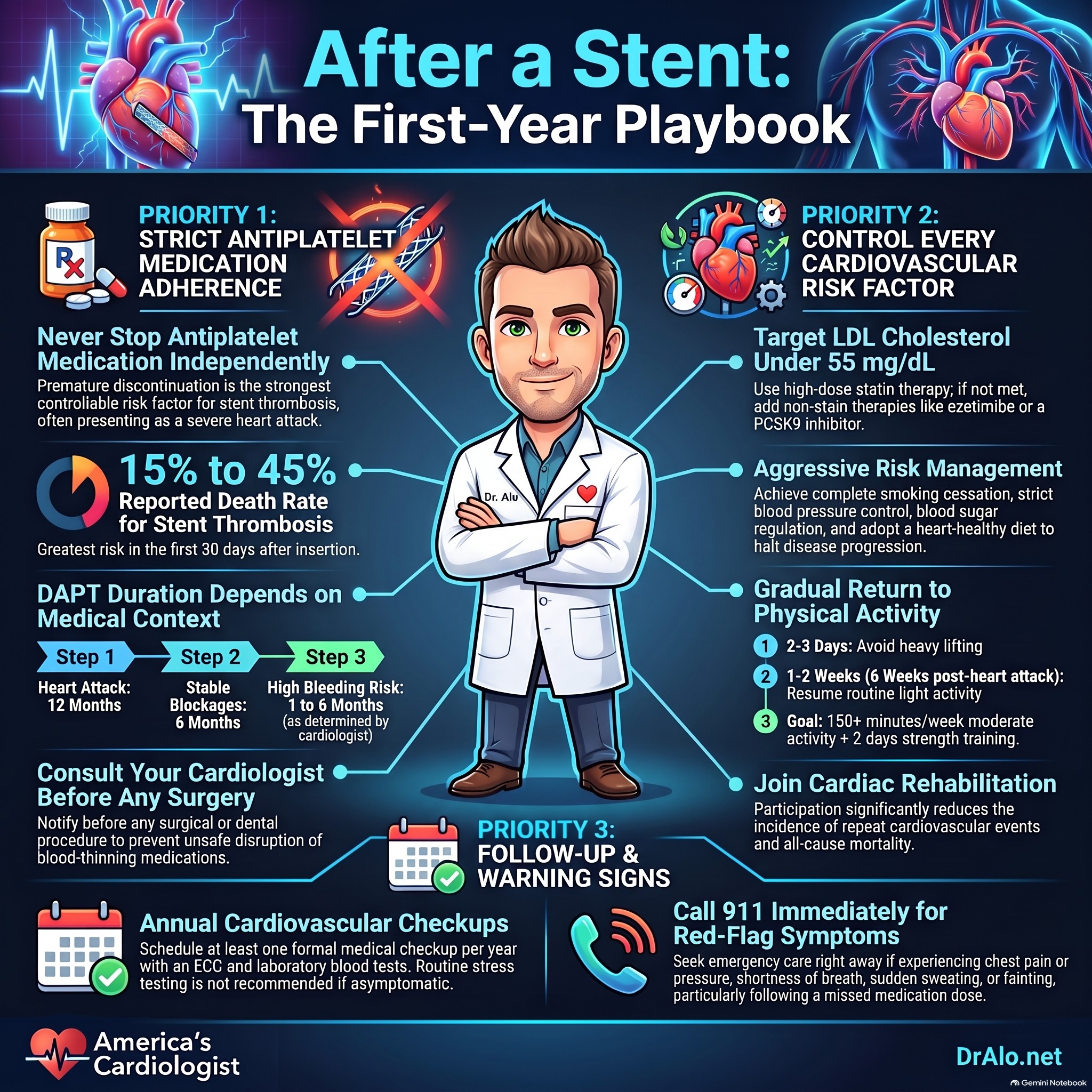
Infographic Summary:
The Bottom Line
A stent gives you a second chance, and what you do with it matters. Take both antiplatelet medicines exactly as prescribed, and never stop them without talking to your cardiologist. Bring your LDL cholesterol down to goal, and control your blood pressure and blood sugar. Quit smoking. Go to cardiac rehab, return to activity at the right pace, and keep your follow-up visits. And know that chest pain, shortness of breath, or fainting, especially after a missed dose, means calling 911 right away.
None of this is complicated, but it takes consistency. If you have questions about your own situation, bring them to your cardiologist, because the right plan depends on your stent, your history, and your risks. This article is general education and does not replace that conversation. The research I drew from is listed below.
Still have questions? Stop Googling and ask Dr. Alo.
You've read the science, but applying it to your own life can be confusing. That's exactly what the Heart 2 Heart VIP Community is for. You can ask me questions directly, join live video calls where we talk through scenarios like this one, and get physician-level guidance based on your actual situation.
Join here: https://dralo.net/community 💪🏻🩺🫀
Dr. Alo
References
- Gori T, Polimeni A, Indolfi C, et al. Predictors of stent thrombosis and their implications for clinical practice. Nat Rev Cardiol. 2019. doi:10.1038/s41569-018-0118-5
- Hanna E. Percutaneous coronary interventions and complications, intra-aortic balloon pump, ventricular assist devices, and fractional flow reserve. In: Practical Cardiovascular Medicine. 2nd ed. 2022. doi:10.1002/9781119832737.ch38
- Brilakis ES, Patel VG, Banerjee S. Medical management after coronary stent implantation: a review. JAMA. 2013. doi:10.1001/jama.2013.7086
- Capodanno D, Alfonso F, Levine GN, Valgimigli M, Angiolillo DJ. ACC/AHA versus ESC guidelines on dual antiplatelet therapy: JACC guideline comparison. J Am Coll Cardiol. 2018. PMID 30522654
- Kumbhani DJ, Gibson CM, Kinlay S, et al. Antiplatelet therapy in the management of atherosclerotic cardiovascular disease: 2026 ACC scientific statement. J Am Coll Cardiol. 2026.
- Levine GN, Bates ER, Bittl JA, et al. 2016 ACC/AHA guideline focused update on duration of dual antiplatelet therapy in patients with coronary artery disease. J Am Coll Cardiol. 2016.
- Wennberg E, Abualsaud AO, Eisenberg MJ. Patient management following percutaneous coronary intervention. JACC Adv. 2025. PMID 39801818
- Lawton JS, Tamis-Holland JE, Bangalore S, et al. 2021 ACC/AHA/SCAI guideline for coronary artery revascularization. J Am Coll Cardiol. 2022.
- Vrints C, Andreotti F, Koskinas KC, et al. 2024 ESC guidelines for the management of chronic coronary syndromes. Eur Heart J. 2024. doi:10.1093/eurheartj/ehae177
- Rossini R, Oltrona Visconti L, Musumeci G, et al. A multidisciplinary consensus document on follow-up strategies for patients treated with percutaneous coronary intervention. Catheter Cardiovasc Interv. 2015. doi:10.1002/ccd.25724
- Capodanno D, Angiolillo DJ. Timing, selection, modulation, and duration of P2Y12 inhibitors for patients with acute coronary syndromes undergoing PCI. JACC Cardiovasc Interv. 2023. PMID 36599574
- Torrado J, Buckley L, Duran A, et al. Restenosis, stent thrombosis, and bleeding complications: navigating between Scylla and Charybdis. J Am Coll Cardiol. 2018. PMID 29650125
Still Have Questions? Stop Googling and Ask Dr. Alo.
You’ve read the science, but applying it to your own life can be confusing. I created the Dr. Alo VIP Private Community to be a sanctuary away from social media noise.
Inside, you get:
-
Direct Access: I answer member questions personally 24/7/365.
-
Weekly Live Streams: Deep dives into your specific health challenges.
-
Vetted Science: No fads, just evidence-based cardiology and weight loss.
Don't leave your heart health to chance. Get the guidance you deserve. All this for less than 0.01% the cost of health insurance! You can cancel at anytime!
[👉 Join the Dr. Alo VIP Community Today]
Cardiology & Obesity Medicine