You Don't Need Insulin Resistance to Have Heart Disease
Nov 01, 2026
This article is adapted from my longer post, Is Diabetes Genetic? What Can You Do About It?
Another myth circulating is that the only way to end up with ASCVD is to have insulin resistance. This is probably the easiest myth to dismiss. As you may have noticed in the previous chapter or blog posts, insulin resistance was not present in those who developed ASCVD.
Starting from the simplest explanation, teenagers with familial hypercholesterolemia do not have insulin resistance. They are lean, healthy, active, eat well-balanced, healthy diets, and many of them are athletes.
Secondly, the incidence of type 2 diabetes in the US and worldwide is about 9.3% of the population. This is not a very high number.
But let’s look at the data.
Researchers set out to answer this exact question. They evaluated children with familial hypercholesterolemia. These are kids with genetically incredibly high cholesterol. They have LDL-C over 190 mg/dL. One in about 200 to 300 people have this form of elevated cholesterol. It’s called FH (familial hypercholesterolemia). See the posts on that for more.
In a 2018 study, they included children ages 4-18 who had FH. They used fancy testing to test for insulin resistance long before it actually manifests. They used HOMA-IR (Homeostatic Model Assessment) by performing oral glucose tolerance test (OGTT). The BMI of these young participants was 20 kg/m2 (not overweight). Their conclusion was, “No relationship was identified between lipid profiles and insulin resistance”.
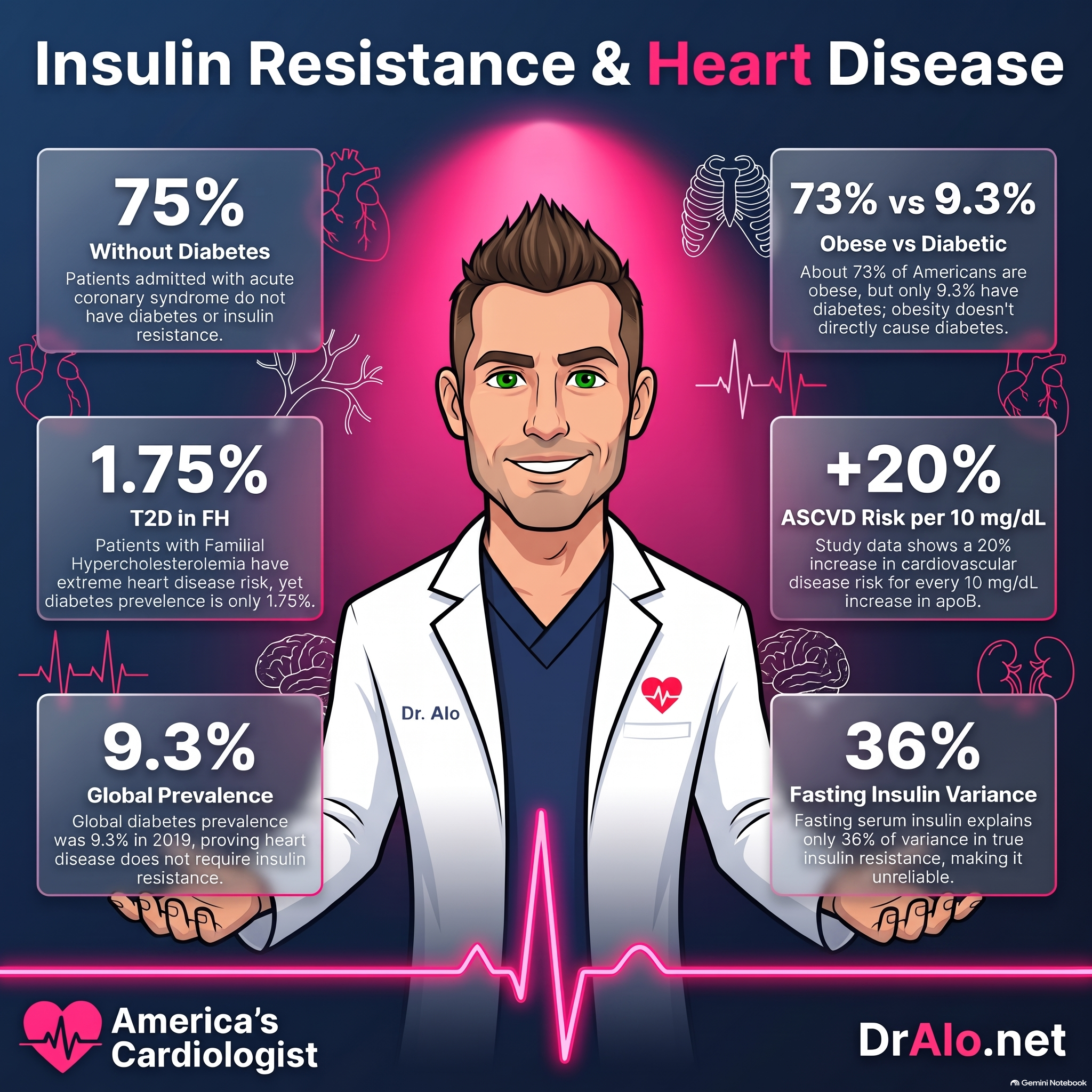
Infographic Summary:
However, they did find that the participants that had insulin resistance had higher concentrations of apoB. Which is why we harp on apoB measurement so much. Because that is the causative agent. We know that insulin resistance can increase plasma residence time of lipoproteins, which is why apoB (LDL-C) is elevated.
You can read the study at:
https://www.degruyter.com/document/doi/10.1515/jpem-2018-0337/html
You may argue that that was a small study, the sample size was low, or that in the end they still concluded that people with FH had slightly more insulin resistance than not. Understood. What if we looked at a huge population, not just 77 kids?
Another study looked at 63,000 individuals with FH and found that the prevalence of diabetes was only 1.75%. So, despite having a much lower incidence of IR, these FH patients still had high levels of ASCVD. They actually had less insulin resistance than the general population.
https://jamanetwork.com/journals/jama/fullarticle/2190985

Figure: Type 2 diabetes in people with DNA-confirmed familial hypercholesterolemia vs unaffected relatives, and by mutation type. Redrawn from Besseling, JAMA 2015 (abstract).
How to read it:
- Left: 2.93% of relatives without FH had type 2 diabetes vs 1.75% of people with FH (1.44% after adjusting for age, weight and other factors).
- Right: the more severe the LDL receptor problem, the less diabetes: 1.91% with APOB mutations down to 1.12% with receptor-negative mutations.
- These people have very high LDL from birth and early heart disease, yet less diabetes. Heart disease does not need diabetes or insulin resistance to happen.
Another study found that having FH actually protected people from developing diabetes. So, despite low IR, they still had very high levels of ASCVD.
https://www.ncbi.nlm.nih.gov/pmc/articles/PMC9002616/
One important point, patients with FH have larger, more buoyant, LDL particles (often erroneously and sophomorically referred to as “large and fluffy”) and have the worst form of atherosclerosis with the shortest lifespans. See my other blog posts on particle size and density.
How can it be insulin resistance when only about 9% of the world’s population has diabetes, yet most people have heart disease and die of heart disease? The cholesterol disputers have no answer to this.
In case you are questioning these numbers, the global prevalence of diabetes in 2019 was 9.3% of the population, or about 463 million people worldwide. It is expected to rise to 578 million by 2030, which is 10.2% of the population. In another report, based on CDC data, the prevalence of diabetes was a bit higher at 11.6%.
https://pubmed.ncbi.nlm.nih.gov/31518657/
https://www.cdc.gov/diabetes/data/statistics-report/index.html
Does Obesity Cause Diabetes?
One point that is important to point out at this juncture is that obesity does not cause diabetes. Diabetes is a genetic disorder that can be worsened by obesity. We have gone over the genetics of diabetes earlier. You cannot give yourself diabetes by overconsuming calories and becoming obese. That’s not how it works.
Think about it in simple logical terms. We know that 73% of the US population is obese. Yet only 9.3% (depending on the study) have diabetes. There are plenty of overweight patients that weigh over 300 or 400 pounds that have A1c levels that make most people jealous.
This means that a majority of obese individuals are “metabolically healthy” with insulin sensitivity similar to normal weight individuals.
The prevalence of metabolic syndrome in the US is around 15-31% of the population (depending on study) and this does impart a twofold increase in cardiovascular disease. Without question. That’s not the issue here. But 31% is not 73%. Not all overweight and obese individuals end up with diabetes.
In the US, about 40% of the population is considered obese and only 30% of obese patients have metabolic syndrome in case you were curious.
https://link.springer.com/chapter/10.1007/978-3-319-48382-5_1
https://www.cdc.gov/nchs/fastats/obesity-overweight.htm
What about people that have very high insulin levels due to insulinomas? These are insulin secreting tumors. These individuals have very high levels of insulin, with no evidence of increased atherosclerosis. You could argue that having insulin secreting tumors is not the same thing as having high insulin levels due to insulin resistance. True, but both result in very high insulin levels.
Here are those studies:
https://pubmed.ncbi.nlm.nih.gov/23908245/
https://pubmed.ncbi.nlm.nih.gov/21430026
https://pubmed.ncbi.nlm.nih.gov/8144864/
The final nail in the coffin? Only 25-30% of patients admitted to the hospital with acute coronary syndrome (heart attacks), actually had diagnosed diabetes. So, 75% of heart attack and stroke patients do not have diabetes nor insulin resistance at all.
Study:
https://pubmed.ncbi.nlm.nih.gov/35245735/
Again, this all points to the conclusion that you need to have the underlying elevated LDL-C first. If you have elevated apoB, then everything else falls into place. Without apoB, there is no ASCVD.
Young And Full Of Disease
In July of 2024 an article was published in the Journal of the American College of Cardiology that wanted to answer this exact question. Can young people without any of the traditional risk factors still get heart disease? And what causes it?
They looked at adults aged 40 to 65 that had a 10 year risk score of less than 5%, meaning their risk for ASCVD is very low when looking at the traditional risk factors, age, weight, BMI, diabetes, smoking, kidney function, metabolic parameters, and other metrics. By all objective measures, these were people with a very low risk of heart disease.
They even looked at the presence of calcium or soft plaque in the heart.
They found that most had plaque and it was worse and more prevalent the higher the LDL-C or apoB. The graphics from this paper are quite impressive and I highly recommend you take a look in the supplemental guide.
They also found that for every 10 mg/dL increase in LDL-C or apoB, you had a 13% and 20% increase in ASCVD, respectively. As an example, nearly 70% of men with an apoB over 120 mg/dL had ASCVD. The number was 60% for LDL-C over 160 mg/dL.
They concluded,
“Among healthy asymptomatic middle-aged adults without traditional ASCVD risk factors in the U.S., coronary atherosclerosis on CCTA is common even at lower serum levels of LDL-C, non-HDL-C, and apoB. Coronary atherosclerosis is more prevalent at higher levels of serum lipoproteins for both men and women, and high-risk plaque features are present but relatively infrequent in low-risk adults. These findings emphasize the importance of lipid-lowering strategies to prevent the development and progression of atherosclerosis in adults regardless of risk factors”.
Study:
https://www.jacc.org/doi/10.1016/j.jacadv.2024.101049
Fasting Insulin and Insulin Resistance Are Not Reliable
Another issue that comes up frequently among the Medfluencer crowd is that cholesterol doesn’t matter if you don’t have insulin resistance. Or they will claim that the “root cause” of all cholesterol problems is insulin resistance and not actually LDL-C. If you have made it this far, you know this is nonsense at this point.
They say that a fasting insulin level is the best way to determine if insulin resistance is present. The only problem is that fasting insulin has been unreliable over the years and has not been recommended by endocrinologists nor the American Diabetes Association to be useful in predicting insulin resistance.
The gold standard test of insulin resistance in people who are euglycemic (normal blood sugars and not known to have insulin resistance) is a test called a clamp study.
Don’t listen to me here is what the experts have said,
“Prospective mortality studies have shown insulin measures do not predict cardiovascular mortality when metabolic syndrome characteristics, such as lipids, are taken into account. Furthermore, the relationship between clamp insulin resistance and fasting serum insulin level is weak: fasting serum insulin level explains only 36% of variance in insulin resistance, even less when glucose metabolism is impaired. Measurement of serum insulin levels has been described as “fraught with errors and inconsistencies”; a clinician who ordered this inappropriate test would be overwhelmed by poor 120-minute reproducibility, among other problems. By analogy, fasting serum insulin level is a capricious little beast subject to intra-individual variation on any couple of days, and substantial inter-assay and inter-laboratory variations; interpreting fasting serum insulin levels may be considered like wrestling a column of smoke”.
You can read the article at:
https://www.mja.com.au/journal/2006/185/3/insulin-levels-insulin-resistance-phantom-metabolic-opera
Another very well-done study concluded that,
“Fasting insulin sensitivity indices are modest predictors of insulin sensitivity measured by euglycemic clamp, and do not perform better than clinical surrogates in this population”.
You can read that study:
https://bmcendocrdisord.biomedcentral.com/articles/10.1186/1472-6823-14-65
The longest and most well written article on how you should test for diabetes or insulin resistance was just published the American Diabetes Association in July of 2023 and can be found at:
From that link, you can download the 49-page PDF and I highly encourage you to read it.
Diabetes Bottom Line
Type 2 diabetes is not simply a consequence of poor choices. It is a complex, polygenic disease with heritability rivaling that of many conditions traditionally thought of as "genetic." The interplay between hundreds of genetic variants and environmental exposures determines who ultimately develops the disease, and understanding that interplay is opening the door to precision medicine approaches that could transform how type 2 diabetes is prevented and managed.
Still have questions? Stop Googling and ask Dr. Alo.
You've read the science, but applying it to your own life can be confusing. That's exactly what the Heart 2 Heart VIP Community is for. You can ask me questions directly, join live video calls where we talk through your labs and situations like this one, and get physician-level guidance based on your actual numbers.
Join here: https://dralo.net/community 💪🏻🩺🫀
Dr. Alo
More References
- Type 2 Diabetes: Principles of Pathogenesis and Therapy. Stumvoll M, Goldstein BJ, van Haeften TW. Lancet (London, England). 2005 Apr 9-15;365(9467):1333-46. doi:10.1016/S0140-6736(05)61032-X.
- Genetic predisposition in type 2 diabetes: A promising approach toward a personalized management of diabetes. Sirdah MM, Reading NS. Clinical Genetics. 2020;98(6):525-547. doi:10.1111/cge.13772.
- The Architecture of Risk for Type 2 Diabetes: Understanding Asia in the Context of Global Findings. Abdullah N, Attia J, Oldmeadow C, Scott RJ, Holliday EG. International Journal of Endocrinology. 2014;2014:593982. doi:10.1155/2014/593982.
- Dissection of Type 2 Diabetes: A Genetic Perspective. Bonnefond A, Florez JC, Loos RJF, Froguel P. The Lancet. Diabetes & Endocrinology. 2025;13(2):149-164. doi:10.1016/S2213-8587(24)00339-5.
- Heritability of Type II (Non-Insulin-Dependent) Diabetes Mellitus and Abnormal Glucose Tolerance--a Population-Based Twin Study. Poulsen P, Kyvik KO, Vaag A, Beck-Nielsen H. Diabetologia. 1999;42(2):139-45. doi:10.1007/s001250051131.
- Current Insights and Emerging Trends in Early-Onset Type 2 Diabetes. Misra S, Ke C, Srinivasan S, et al. The Lancet. Diabetes & Endocrinology. 2023;11(10):768-782. doi:10.1016/S2213-8587(23)00225-5.
- Genetics of Type 2 Diabetes: Implications From Large-Scale Studies. DeForest N, Majithia AR. Current Diabetes Reports. 2022;22(5):227-235. doi:10.1007/s11892-022-01462-3.
- Multi-Ancestry Genetic Study of Type 2 Diabetes Highlights the Power of Diverse Populations for Discovery and Translation. Mahajan A, Spracklen CN, Zhang W, et al. Nature Genetics. 2022;54(5):560-572. doi:10.1038/s41588-022-01058-3.
- Type 2 Diabetes Across Generations: From Pathophysiology to Prevention and Management. Nolan CJ, Damm P, Prentki M. Lancet (London, England). 2011;378(9786):169-81. doi:10.1016/S0140-6736(11)60614-4.
- Clinical Risk Factors, DNA Variants, and the Development of Type 2 Diabetes. Lyssenko V, Jonsson A, Almgren P, et al. The New England Journal of Medicine. 2008;359(21):2220-32. doi:10.1056/NEJMoa0801869.
Still Have Questions? Stop Googling and Ask Dr. Alo.
You’ve read the science, but applying it to your own life can be confusing. I created the Dr. Alo VIP Private Community to be a sanctuary away from social media noise.
Inside, you get:
-
Direct Access: I answer member questions personally 24/7/365.
-
Weekly Live Streams: Deep dives into your specific health challenges.
-
Vetted Science: No fads, just evidence-based cardiology and weight loss.
Don't leave your heart health to chance. Get the guidance you deserve. All this for less than 0.01% the cost of health insurance! You can cancel at anytime!
[👉 Join the Dr. Alo VIP Community Today]
Cardiology & Obesity Medicine