Costochondritis Symptoms or Heart Attack? How to Tell
Oct 27, 2026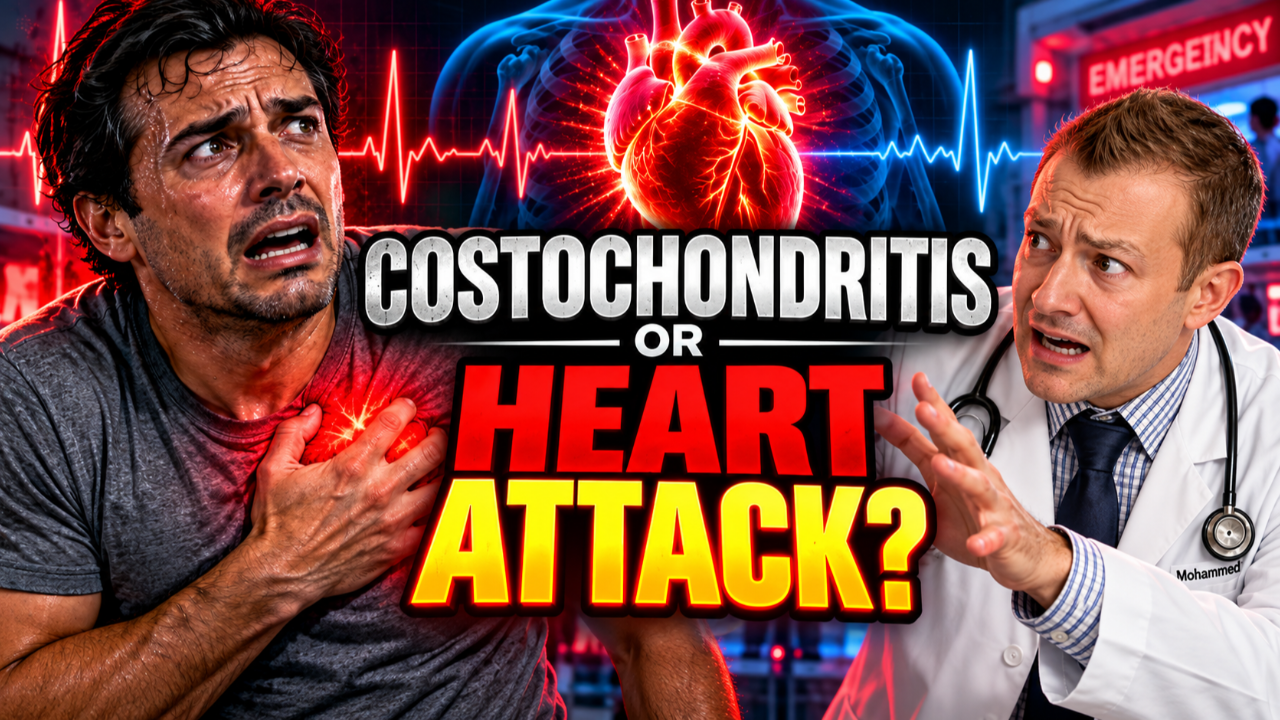
Is It Costochondritis or a Heart Attack?
Your chest hurts. You press on the sore spot, and it hurts more. Most people take that as good news, and often it is. Costochondritis, an inflammation where your ribs meet the cartilage that joins them to your breastbone, is a common cause of chest pain, and it often sends people to the doctor frightened about their heart. But pain you can reproduce with your fingers is a clue, not a test. Let me show you what the research says.
Here is the short version. In family practice, chest wall pain is far more common than heart pain. Reproducing the pain by pressing makes a heart attack less likely, but it does not rule one out. If your pain comes with the red flags below, call 911. And even when it is probably costochondritis, new chest pain deserves a proper check.
What Costochondritis Is, and What Tietze Syndrome Adds

Costochondritis is inflammation of the costochondral junctions, where each rib joins its cartilage, or of the joints where that cartilage meets the breastbone. A 2021 evidence review in American Family Physician says it is most common in adults between 40 and 50 years of age, with a slight lean toward women. Researchers have called it poorly understood. It could be the same arthritis process that we feel in our knees and joints and other areas of our body where cartilage meets bone tissue.
Tietze syndrome is a close cousin. The difference is visible swelling at the sore joint. It usually affects one side, most often the second rib, and it is often set off by an infection or an injury. Both are usually self-limited, according to the American Family Physician reviews.
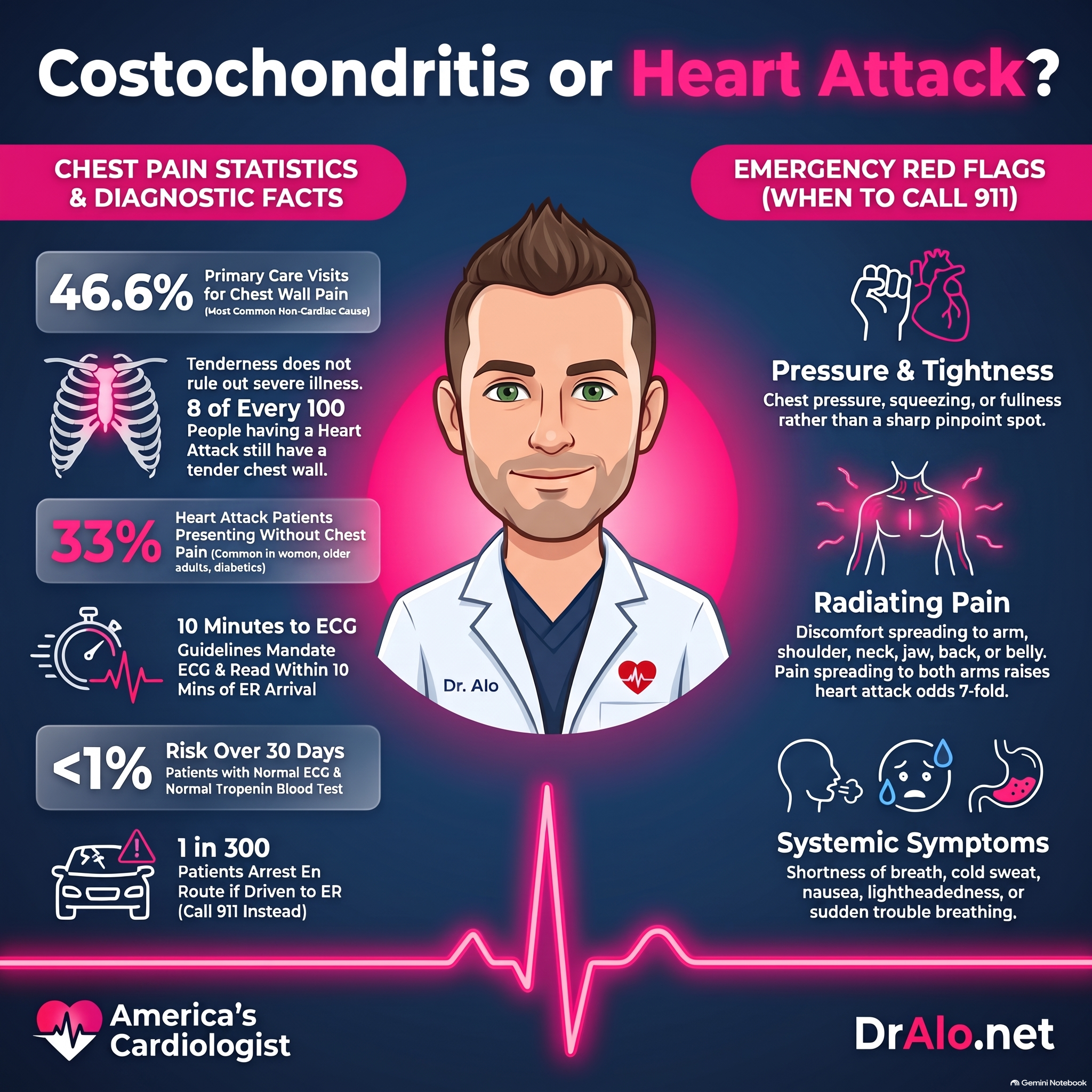
Infographic Summary:
What Costochondritis Feels Like
The typical pattern is pain beside the breastbone, often on both sides, that gets worse with deep breaths, coughing, or stretching. It usually involves the upper ribs, roughly the second through the fifth. The sore spots are tender when pressed, and pressing often reproduces your pain. There is usually no heat, redness, or swelling, except in Tietze syndrome.
A scoring rule for chest wall pain in primary care gave the most weight to pain reproduced by palpation, the medical word for pressing. It also counted stabbing, pinpoint pain that is not oppressive, and no history of coronary disease.
Now the catch. Chest wall pain is often on the left, which is exactly why it frightens people. In a Swiss primary care cohort of 300 patients with chest wall syndrome, coronary disease was found alongside it in 19. You can have both.
How Common Is Chest Wall Pain When You Have Chest Pain?

- In a German study of 1,212 adults aged 35 and older who saw 74 family doctors for chest pain, the pain came from the chest wall in 46.6 percent. Stable ischemic heart disease was behind 11.1 percent, and acute coronary syndrome 3.6 percent.
- A systematic review of 11 primary care studies, about 6,500 patients, found chest wall syndrome in 24.5 to 49.8 percent, and acute coronary syndrome or heart attack in 1.5 to 3.6 percent.
- In a Dutch and Belgian study of 281 primary care patients, musculoskeletal pain was the final diagnosis in 33.1 percent, but potentially life-threatening disease, such as a heart attack, was found in 8.4 percent.
- In an emergency department study of 122 patients with chest pain, 36, or 30 percent, had costochondritis.
So the odds are on your side. But 8.4 percent is about 1 in 12, and an emergency room sees a different mix of patients than a family doctor's office. Statistics describe groups. They cannot tell you which group you are in.
Why You Cannot Safely Diagnose Yourself by Pressing on Your Chest

Reproducible tenderness is real evidence. The 2021 AHA/ACC chest pain guideline says tenderness to palpation, or pain with breathing in, markedly lowers the probability of acute coronary syndrome, and that it must be weighed with the rest of the evaluation. "Lower the odds" is not "ruled out." Here is what the studies show.
- A meta-analysis of 28 studies found that, in unselected patients, the absence of chest wall tenderness had a pooled sensitivity of 92 percent for heart attack and 94 percent for acute coronary syndrome. Put the other way around, roughly 8 of every 100 people having a heart attack, and 6 of every 100 with acute coronary syndrome, did have a tender chest wall. The authors called it the only sign that largely ruled these out, and only in low-prevalence settings.
- A JAMA review concluded that no chest pain feature, alone or in combination, picked out patients who could safely go home without further testing.
- A 2015 Zurich emergency study of 121 patients found a negative predictive value of 98.1 percent for reproducible tenderness, which sounds reassuring. But only about 14 patients had acute coronary syndrome, and the 95 percent confidence interval ran from 89.9 to 99.7 percent, which statistically leaves room for as many as 1 in 10 to be missed.
- In the 1994 emergency department study of costochondritis, 6 percent of patients diagnosed with it had an acute heart attack. The 2009 American Family Physician review adds that coronary artery disease is present in 3 to 6 percent of adults with chest pain and chest wall tenderness.
- The scoring rule's authors found that pain reproduced by palpation was present in 71 percent of patients with chest wall syndrome, so about 3 in 10 did not have it, and they stressed that it is not pathognomonic, meaning it does not prove the diagnosis. A 2025 meta-analysis of 24 studies likewise found that signs and symptoms have a limited role in diagnosing a heart attack.
The message is consistent. If pressing reproduces your pain, the chest wall is more likely. But a small, real share of people having a heart attack or unstable angina also have a tender chest, and the two can coexist. Costochondritis is largely a diagnosis made after the dangerous causes have been looked for.
Red Flags: When to Call 911

Call 911 if your chest pain or discomfort comes with any of these.
- Pressure, squeezing, tightness, or fullness, rather than a sharp spot you can point to.
- Pain or discomfort that spreads to your shoulder, arm, neck, jaw, back, or upper belly. The guideline calls these anginal equivalents, meaning they can stand in for chest pain. Pain spreading to both arms raised the odds of a heart attack about 7-fold in one analysis, and spreading to a shoulder or arm, or coming on with exertion, raised the odds of acute coronary syndrome roughly 2- to 5-fold in another.
- Shortness of breath, a cold sweat, nausea, lightheadedness, or fainting. Of the 10 signs and symptoms in the meta-analysis above, sweating raised the likelihood of a heart attack the most.
- Pain that comes on with exertion and eases with rest, or that is new, worse, or different from anything you have felt before.
- Sudden severe pain in the chest or back, or sudden trouble breathing. These can point to other emergencies, such as a problem with the aorta or a clot in the lung.
Do not drive yourself. The guideline reports that 1 in 300 patients with chest pain brought to the emergency department by private vehicle suffer a cardiac arrest on the way, and an ambulance crew can start an ECG and treatment before you arrive. I cover what to do in my article on the first minutes of a heart attack. And please do not keep pressing on your chest to test yourself. If you are worried enough to try, get checked.
What the Emergency Evaluation Involves
The guideline says an ECG should be done and read within 10 minutes of arrival. An ECG is a quick, painless tracing of your heart's electrical activity. It can show a blocked artery that needs opening right away, but it is not perfect on its own, so it is paired with a blood test.
That test is a high-sensitivity troponin. Troponin is a protein that leaks into your blood when heart muscle is injured, and the modern test detects very small amounts. The guideline describes repeating it 1, 2, or 3 hours after arrival, depending on the assay, to see whether the number is rising.
The guideline describes a low-risk group: people who are clinically stable, with a reassuring history, an ECG without signs of a heart attack, and no heart muscle injury on troponin. Their chance of acute coronary syndrome or a major cardiac event within 30 days is under 1 percent. Notice what earns the "low risk" label: an ECG and a blood test, not a fingertip. Costochondritis itself has no confirming blood test or scan, so tests such as a chest X-ray are used to look for other causes.
How Costochondritis Is Treated, and How Long It Lasts
I will be honest, because the research is. The 2021 review says no high-quality studies have tested whether any costochondritis treatment works. Usual care is reassurance, a break from activities that bring on the pain, local heat, and simple pain relief. Options listed include oral or topical anti-inflammatory medicines, lidocaine patches, and capsaicin cream, and the 2009 review mentions acetaminophen. If you do not improve, your doctor may consider physical therapy or an injection.
For most people it settles within a few weeks. The longer studies are more mixed. In the Swiss cohort the outcome at one year was favorable, yet chest wall syndrome came back in about half of patients, and in the German study 55.4 percent still had chest pain at six months. It usually goes away, but it can linger or return.
A Word of Caution About Anti-Inflammatory Pain Relievers

The usual first step is an over-the-counter NSAID, such as ibuprofen or naproxen. These are not harmless for everyone. This is general information, not a dose recommendation, so talk to your own doctor or pharmacist first if any of this applies to you.
- Heart disease or its risk factors. A 2017 BMJ analysis of 446,763 people, including 61,460 with a heart attack, found all the NSAIDs studied, including naproxen, were associated with more heart attacks, especially at higher doses. For 1 to 7 days of use, the odds ratio was 1.48 for ibuprofen (95% credible interval 1.00 to 2.26) and 1.53 for naproxen (1.07 to 2.33).
- Aspirin for your heart. In a controlled study, ibuprofen blocked the platelet-protecting effect of low-dose aspirin, while acetaminophen did not.
- Blood thinners. Among 8,246 people treated for blood clots, major bleeding was 6.5 per 100 patient-years with an NSAID added, versus 2.0 on the blood thinner alone (hazard ratio 2.37, 95% confidence interval 1.51 to 3.75).
- Ulcers. About 1 to 2 percent of NSAID users have a serious gastrointestinal complication, and the risk is higher with age over 65, a past complicated ulcer, or aspirin or anticoagulant use.
- Kidney disease, high blood pressure, or heart failure. NSAIDs have been linked to kidney injury and to fluid retention that can worsen heart failure and blood pressure.
The right pain reliever depends on your heart, kidneys, stomach, and other prescriptions, so ask before you reach for the bottle.
Heart Attacks Can Look Different in Women, Older Adults, and People With Diabetes

If you picture a heart attack as crushing chest pain, you may be waiting for a symptom that never comes. In a JAMA registry of 434,877 people with confirmed heart attacks, 33 percent had no chest pain on arrival. Compared with those who did, they were older (average age 74.2 versus 66.9), more often women (49.0 versus 38.0 percent), and more likely to have diabetes (32.6 versus 25.4 percent). They also had a higher in-hospital death rate, 23.3 versus 9.3 percent.
A later JAMA analysis of 1,143,513 hospitalized patients found no chest pain in 42.0 percent of women and 30.7 percent of men, with the gap shrinking as age rose. The 2021 guideline adds that women may be more likely to have nausea and shortness of breath. These registries date from 1994 to 2006, so treat the exact percentages with care. For more, see my articles on why women are at higher risk for a silent heart attack and heart disease in women: symptoms, tests, and prevention.
When to See a Doctor Even If It Is Probably Costochondritis
- It is your first episode and nobody has checked it. The 2009 review advises an ECG for anyone older than 35, anyone with coronary disease or risk, and anyone with heart or lung symptoms.
- You have high blood pressure, high cholesterol, diabetes, or a smoking or family history of early heart disease.
- The pain gets worse, spreads, keeps coming back, or has not improved after a few weeks.
- You develop a fever, or the area turns red, hot, or increasingly swollen. A band-like rash on one side of the chest could be shingles.
- What you feel is more of a flutter or pounding than pain. My article on heart palpitations and when to worry will help.
Frequently Asked Questions
What are the symptoms of costochondritis?
Pain beside the breastbone, often on both sides, that is worse with deep breaths, coughing, or stretching, with sore spots that hurt when pressed and usually no redness or warmth.
How long does costochondritis last?
Most people improve within a few weeks, per a 2021 evidence review. Some have symptoms for months, and in one study it returned in about half of patients.
Can a heart attack hurt when you press on your chest?
Yes. Reproducing the pain lowers the odds of a heart attack but does not rule it out. In a meta-analysis, roughly 8 of every 100 people having a heart attack had a tender chest wall.
What is the difference between costochondritis and Tietze syndrome?
Both cause pain where the ribs meet the cartilage. Tietze syndrome has visible swelling, usually on one side and most often at the second rib.
When should I go to the ER for chest wall pain?
Call 911 for pressure or squeezing, pain spreading to the arm, jaw, neck, or back, or shortness of breath, sweating, nausea, or fainting. If the pain is new or you are unsure, get checked promptly.
The Bottom Line
Costochondritis is common, usually harmless, and usually goes away on its own. If pressing on your chest reproduces your pain, that is reassuring, but some people having a heart attack also have a tender chest, so pressing is a clue and not a test. Call 911 for pressure, spreading pain, shortness of breath, sweating, nausea, or fainting, and let the emergency team do the ECG and troponin test. Check with your doctor before using anti-inflammatory pain relievers if you have heart disease, kidney disease, ulcers, or take blood thinners. Women, older adults, and people with diabetes may not get classic chest pain at all.
This article is general education and does not replace a visit with your own doctor, so please talk to your own doctor about your chest pain. The research I drew from is listed below.
Still have questions? Stop Googling and ask Dr. Alo.
You've read the science, but applying it to your own life can be confusing. That's exactly what the Heart 2 Heart VIP Community is for. You can ask me questions directly, join live video calls where we talk through scenarios like this one, and get physician-level guidance based on your actual situation.
Join here: https://dralo.net/community 💪🏻🩺🫀
Dr. Alo
References
- Mott T, Jones G, Roman K. Costochondritis: Rapid Evidence Review. Am Fam Physician. 2021;104(1):73-78. PMID 34264599
- Disla E, Rhim HR, Reddy A, et al. Costochondritis. A prospective analysis in an emergency department setting. Arch Intern Med. 1994;154(21):2466-2469. doi:10.1001/archinte.154.21.2466
- Proulx AM, Zryd TW. Costochondritis: diagnosis and treatment. Am Fam Physician. 2009;80(6):617-620. PMID 19817327
- Ronga A, Vaucher P, Haasenritter J, et al. Development and validation of a clinical prediction rule for chest wall syndrome in primary care. BMC Fam Pract. 2012;13:74. doi:10.1186/1471-2296-13-74
- Verdon F, Burnand B, Herzig L, et al. Chest wall syndrome among primary care patients: a cohort study. BMC Fam Pract. 2007;8:51. doi:10.1186/1471-2296-8-51
- Bösner S, Becker A, Haasenritter J, et al. Chest pain in primary care: epidemiology and pre-work-up probabilities. Eur J Gen Pract. 2009;15(3):141-146. doi:10.3109/13814780903329528
- Verdon F, Herzig L, Burnand B, et al. Chest pain in daily practice: occurrence, causes and management. Swiss Med Wkly. 2008;138(23-24):340-347. doi:10.4414/smw.2008.12123
- Haasenritter J, Biroga T, Keunecke C, et al. Causes of chest pain in primary care - a systematic review and meta-analysis. Croat Med J. 2015;56(5):422-430. doi:10.3325/cmj.2015.56.422
- Hoorweg BB, Willemsen RT, Cleef LE, et al. Frequency of chest pain in primary care, diagnostic tests performed and final diagnoses. Heart. 2017;103(21):1727-1732. doi:10.1136/heartjnl-2016-310905
- Gulati M, Levy PD, Mukherjee D, et al. 2021 AHA/ACC/ASE/CHEST/SAEM/SCCT/SCMR Guideline for the Evaluation and Diagnosis of Chest Pain: A Report of the American College of Cardiology/American Heart Association Joint Committee on Clinical Practice Guidelines. Circulation. 2021;144(22):e368-e454. doi:10.1161/CIR.0000000000001029
- Bruyninckx R, Aertgeerts B, Bruyninckx P, et al. Signs and symptoms in diagnosing acute myocardial infarction and acute coronary syndrome: a diagnostic meta-analysis. Br J Gen Pract. 2008;58(547):105-111. doi:10.3399/bjgp08X277014
- Swap CJ, Nagurney JT. Value and limitations of chest pain history in the evaluation of patients with suspected acute coronary syndromes. JAMA. 2005;294(20):2623-2629. doi:10.1001/jama.294.20.2623
- Gräni C, Senn O, Bischof M, et al. Diagnostic performance of reproducible chest wall tenderness to rule out acute coronary syndrome in acute chest pain: a prospective diagnostic study. BMJ Open. 2015;5(1):e007442. doi:10.1136/bmjopen-2014-007442
- Raat W, Nees L, Vaes B. Diagnostic accuracy of signs and symptoms in acute coronary syndrome and acute myocardial infarction. Scand J Prim Health Care. 2025;43(1):111-119. doi:10.1080/02813432.2024.2406266
- Panju AA, Hemmelgarn BR, Guyatt GH, et al. The rational clinical examination. Is this patient having a myocardial infarction? JAMA. 1998;280(14):1256-1263. doi:10.1001/jama.280.14.1256
- Bösner S, Becker A, Hani MA, et al. Chest wall syndrome in primary care patients with chest pain: presentation, associated features and diagnosis. Fam Pract. 2010;27(4):363-369. doi:10.1093/fampra/cmq024
- Bally M, Dendukuri N, Rich B, et al. Risk of acute myocardial infarction with NSAIDs in real world use: bayesian meta-analysis of individual patient data. BMJ. 2017;357:j1909. doi:10.1136/bmj.j1909
- Catella-Lawson F, Reilly MP, Kapoor SC, et al. Cyclooxygenase inhibitors and the antiplatelet effects of aspirin. N Engl J Med. 2001;345(25):1809-1817. doi:10.1056/NEJMoa003199
- Davidson BL, Verheijen S, Lensing AW, et al. Bleeding risk of patients with acute venous thromboembolism taking nonsteroidal anti-inflammatory drugs or aspirin. JAMA Intern Med. 2014;174(6):947-953. doi:10.1001/jamainternmed.2014.946
- Sostres C, Gargallo CJ, Lanas A. Nonsteroidal anti-inflammatory drugs and upper and lower gastrointestinal mucosal damage. Arthritis Res Ther. 2013;15(Suppl 3):S3. doi:10.1186/ar4175
- Baker M, Perazella MA. NSAIDs in CKD: Are They Safe? Am J Kidney Dis. 2020;76(4):546-557. doi:10.1053/j.ajkd.2020.03.023
- Canto JG, Shlipak MG, Rogers WJ, et al. Prevalence, clinical characteristics, and mortality among patients with myocardial infarction presenting without chest pain. JAMA. 2000;283(24):3223-3229. doi:10.1001/jama.283.24.3223
- Canto JG, Rogers WJ, Goldberg RJ, et al. Association of age and sex with myocardial infarction symptom presentation and in-hospital mortality. JAMA. 2012;307(8):813-822. doi:10.1001/jama.2012.199
Still Have Questions? Stop Googling and Ask Dr. Alo.
You’ve read the science, but applying it to your own life can be confusing. I created the Dr. Alo VIP Private Community to be a sanctuary away from social media noise.
Inside, you get:
-
Direct Access: I answer member questions personally 24/7/365.
-
Weekly Live Streams: Deep dives into your specific health challenges.
-
Vetted Science: No fads, just evidence-based cardiology and weight loss.
Don't leave your heart health to chance. Get the guidance you deserve. All this for less than 0.01% the cost of health insurance! You can cancel at anytime!
[👉 Join the Dr. Alo VIP Community Today]
Cardiology & Obesity Medicine