Grass-Fed vs Grain-Fed Beef: Does It Really Matter for Your Heart?
Oct 27, 2026
Is Grass Fed Beef Better For Your Heart?
"Dr. Alo, should I be paying almost double for grass-fed beef? Everyone says it's better for your heart."
I get asked this all the time, usually right after someone tells me they love a good steak. And I get it. I love a great ribeye too. The grass-fed label promises more omega-3s, less saturated fat and a cleaner, more natural cow. It is priced like a health food.
So does it really matter what your cow grazed on or what it was fed? I wrote about this in my book Actual Weight Loss, and here I want to go deeper. I went through the 2022 review everyone cites, the studies inside it, the USDA nutrient data, and the research on omega-3s, stearic acid and the omega-6 to omega-3 ratio. I redrew the key numbers so they make sense, and I'll show you exactly where grass-fed wins, where it doesn't, and what actually moves the needle for your arteries.
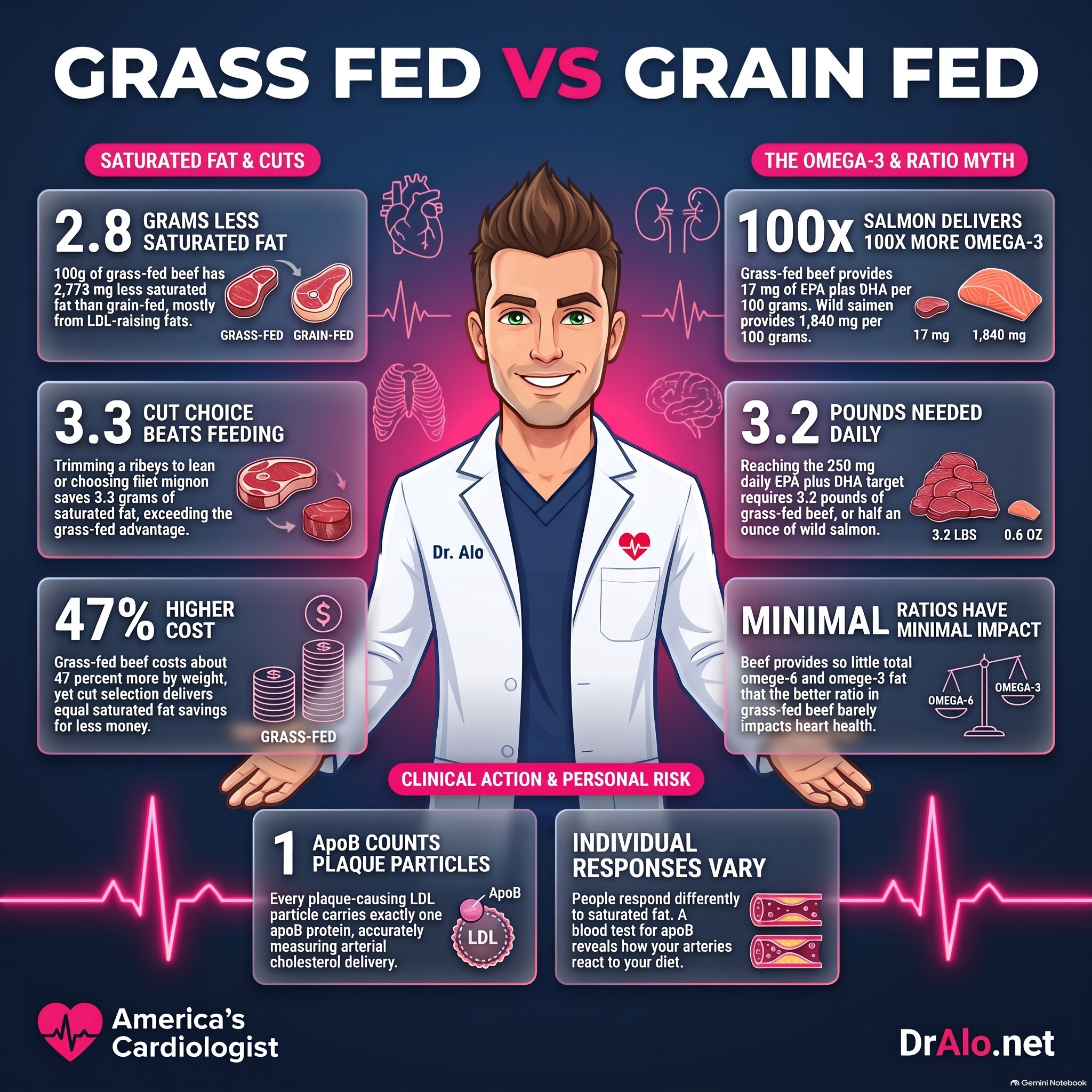
Infographic Summary:
Key takeaways
- Grass-fed beef is leaner. In a 2022 review of studies comparing the two, 100 grams of grass-fed beef had about 2,773 mg (2.8 g) less saturated fat than the same amount of grain-fed beef, mostly from the LDL-raising kinds.
- Grass-fed has more omega-3s, but not much. About 17 mg of EPA plus DHA per 100 grams, versus about 11 mg for grain-fed. Wild salmon has about 1,840 mg. That is over 100 times more.
- The omega-6 to omega-3 ratio is better with grass-fed, but beef supplies so little of either that the ratio barely matters for your heart. The American Heart Association has warned that the focus on ratios has real limitations.
- The cut matters at least as much as the feed. Choosing a lean cut instead of a fatty one saves about 3 grams of saturated fat per 100 grams, as much as or more than switching to grass-fed.
- My take: it makes a small difference, probably not enough to warrant a recommendation. Pick the one you like the taste of, eat red meat in a way that fits your overall eating pattern, and let us check your apoB.
Infographic Summary

First, what do grass-fed and grain-fed actually mean?
Almost all beef cattle start out the same way: on milk, then grass and pasture. The difference is how they finish.
- Grain-fed (conventional) cattle spend their last several months in a feedlot eating a high-energy mix of corn, soy and other grains. That builds marbling, the white streaks of fat inside the muscle. In the US, they are typically on grain for about 5 months before slaughter.
- Grass-fed cattle keep eating grass, hay and other forage instead of grain. Look for "grass-finished" or "100% grass-fed" if you want beef from animals that never went to grain, because a "grass-fed" label alone does not always tell you how the animal was finished.
Grass-fed cattle grow slower and come out leaner. That one fact, less fat, explains most of what you are about to see. It also explains the price: the review notes grass-fed beef costs about 47% more by weight.
Every study agrees: grass-fed is leaner

Figure: total saturated fat in 100 grams of grass-fed vs grain-fed beef in each study. Redrawn from Nogoy KMC, et al. Food Sci Anim Resour. 2022;42(1):18-33 (Table 1).
The 2022 review I cite in my book pulled together eight studies that measured the fats in grass-fed and grain-fed beef. What makes it useful is that the authors reported everything in milligrams per 100 grams of meat, the amount you actually eat, instead of as a percentage of the fat. That matters, because the percentages often look similar. The real difference is that grass-fed beef simply has less fat.
Here is how to read the chart:
- Each row is one comparison from one study. The green dot is grass-fed, the navy dot is grain-fed.
- The pink number is how much less saturated fat grass-fed had in 100 grams.
- Every single row goes the same direction. Grass-fed always had less saturated fat.
But look at the spread. The gap ranged from about 0.1 gram to 6.7 grams. The biggest gap was in Korean Hanwoo beef, which is raised on grain to be extremely marbled. And notice where the dots sit: grass-fed ground beef (the top two rows) still had more saturated fat than grain-fed ribeye or strip in the Duckett study. In other words, the cut you choose matters at least as much as what the cow ate. Hold on to that thought. We'll come back to it.
The saturated fat breakdown: less of everything

Figure: average fatty acid amounts in 100 grams of beef across the studies. Redrawn from Nogoy KMC, et al. Food Sci Anim Resour. 2022;42(1):18-33 (Table 4).
Not all saturated fats act the same. This chart splits them up, using the averages the review calculated across its studies.
- Myristic (C14:0) and palmitic (C16:0) acid are the saturated fats most tied to raising LDL, the "bad" cholesterol. Grass-fed had less than half as much: 139 vs 333 mg of myristic and 1,275 vs 2,976 mg of palmitic.
- Stearic acid (C18:0) is the odd one out. Part of it gets converted to oleic acid, the main fat in olive oil. A systematic review found that compared with other saturated fats, stearic acid lowered LDL, but compared with unsaturated fats like olive oil, it tended to raise it. So "roughly neutral" is the fair description. Grass-fed had less of it too: 745 vs 1,500 mg.
- Total saturated fat: 2,259 vs 5,033 mg. That is the 2,773 mg (2.8 g) difference in the headline.
- Monounsaturated fat, the olive-oil type, was higher in grain-fed beef (6,286 vs 2,714 mg). The review points out these fats have a role in lowering heart disease risk. True, but in beef they come packaged with more saturated fat, so I don't count that as a win for grain-fed.
Here is the key point. Grass-fed beef has less of every fat, the good and the bad, because it has less fat overall. The slightly better profile is mostly explained by having less fat in the same 100 gram cut, where more of it is protein.
Is 2.8 grams a lot? For perspective, the American Heart Association suggests keeping saturated fat to about 13 grams a day on a 2,000 calorie diet. So yes, on a big steak it adds up. But as you'll see below, picking a leaner cut does the same thing.
The omega-3 claim: meet salmon

Figure: EPA plus DHA omega-3 in 100 grams of beef and cooked salmon. Redrawn from Nogoy KMC, et al. Food Sci Anim Resour. 2022;42(1):18-33 (Table 4) and USDA FoodData Central. The amounts needed per day are my calculations.
This is the big selling point of grass-fed beef. And it is true that grass-fed has more omega-3s. The review found more of all three long-chain omega-3s: EPA (11.9 vs 6.3 mg per 100 grams), DPA (24.1 vs 16.8 mg) and DHA (5.5 vs 4.2 mg).
But the question that matters is: how much is that, really?
- Grass-fed beef: about 17 mg of EPA plus DHA per 100 grams (about 3.5 ounces).
- Grain-fed beef: about 11 mg.
- Wild Atlantic salmon, cooked: about 1,840 mg, according to the USDA.
- Farmed Atlantic salmon, cooked: about 2,147 mg.
One serving of salmon has over 100 times the EPA and DHA of the same serving of grass-fed beef. The review itself cites a target of at least 250 mg of EPA plus DHA a day. To get there from beef, you would need about 3.2 pounds of grass-fed beef a day, or 5.2 pounds of grain-fed. From wild salmon, about half an ounce. That's not a fair fight.
Two more things from the review that the marketing leaves out:
- The authors note that a bigger portion of grain-fed beef can give you a similar amount of long-chain omega-3s, because grain-fed beef has more fat overall.
- In Korean Hanwoo beef, it actually went the other way: grain-fed had more EPA and DHA than grass-fed (11.6 vs 6.5 mg of EPA, and 7.0 vs 4.4 mg of DHA per 100 grams).
Does the extra omega-3 in grass-fed beef show up in your blood? A little. In a small randomized, double-blinded trial, 20 healthy adults replaced their usual red meat with three portions a week of beef and lamb from either grass-fed or grain-fed animals for 4 weeks. The grass-fed group ended up with higher omega-3 levels in their blood and platelets. But there was no difference in cholesterol, triglycerides or blood pressure.
Fish, fish oil and your heart
Omega-3s from fish, like salmon, are thought to be heart-protective. The American Heart Association recommends 1 to 2 seafood meals a week to lower the risk of heart failure, coronary heart disease, ischemic stroke and sudden cardiac death, especially when seafood replaces less healthy foods.
Fish oil from fish has shown a protective effect, but not so much as an over-the-counter supplement. In the VITAL trial, nearly 26,000 adults took 1 gram a day of fish oil or a placebo for about 5 years. Fish oil did not lower the main combination of heart attacks, strokes and cardiovascular deaths (a hazard ratio of 0.92, which was not statistically significant). The exception is a prescription, high-dose purified EPA medicine (icosapent ethyl), which lowered cardiovascular events by 25% in the REDUCE-IT trial in high-risk patients with high triglycerides already on a statin. That is a specific drug for specific patients, not the fish oil capsule on the store shelf.
So if omega-3s are your goal, eat fish. Don't count on your steak for it.
The omega-6 to omega-3 ratio: better, but of very little

Figure: omega-6 and omega-3 in 100 grams of beef. Totals from Nogoy KMC, et al. Food Sci Anim Resour. 2022;42(1):18-33 (Table 4); the ratios are calculated from those totals. Quote from Harris WS, et al. Circulation. 2009;119:902-907.
You'll often hear that grass-fed beef has a "better omega-6 to omega-3 ratio". That's true. Using the review's averages, grass-fed beef comes out around 2.6 to 1 and grain-fed around 7.3 to 1. The theory is that too much omega-6 relative to omega-3 drives inflammation.
Here is why I don't lose sleep over it.
- The amounts are tiny. 100 grams of beef gives you about 0.2 to 0.3 grams of omega-6. The American Heart Association supports getting at least 5% to 10% of your calories from omega-6 fats, which works out to about 11 to 22 grams a day on a 2,000 calorie diet. Your steak is a rounding error either way.
- Omega-6 is not the villain it's made out to be. The same AHA advisory concluded that cutting omega-6 from current intakes would be more likely to increase than decrease heart disease risk.
- The ratio itself is a weak measure. The advisory said the focus on ratios, instead of how much of each fat you eat, has "many conceptual and biological limitations". A ratio can look better because omega-3 went up, or because omega-6 went down, and those are not the same thing.
The review also found grass-fed beef has a bit more trans-vaccenic acid, a natural fat in beef and dairy that the body can turn into conjugated linoleic acid (CLA). It has been studied for possible benefits, but only three of the five studies that measured it found more in grass-fed beef, and the human evidence is limited. I wouldn't pick a steak for it.
The cut beats the cow

Figure: saturated fat in 100 grams of cooked meat. Redrawn from USDA FoodData Central (SR Legacy). The 50/50 blend is my calculation from the two USDA values, and the pink bracket is the average grass vs grain gap from Nogoy KMC, et al. 2022.
This is the chart I most want you to remember. These are USDA numbers for regular grocery store meat, cooked, per 100 grams.
- Navy bars: the fatty choices. An 80/20 ground beef patty (6.8 grams of saturated fat) and a choice ribeye eaten with its fat (6.5 grams).
- Green bars: the lean choices. 93/7 ground beef (3.7 grams), a ribeye trimmed to the lean (3.4 grams), tenderloin, also called filet mignon (3.2 grams), and 93/7 ground turkey (3.0 grams).
- The amber bar: the easy swap. Mixing 80/20 ground beef half and half with 93% lean ground turkey brings it down to about 4.9 grams.
- The pink bracket is the average grass-fed advantage, about 2.8 grams.
Going from a ribeye with its fat to a filet saves about 3.3 grams of saturated fat per 100 grams. That is as much as or more than switching from grain-fed to grass-fed, it keeps the same protein (26 to 29 grams), and it doesn't cost you an extra 47%.
That's why my advice isn't "buy grass-fed". It's "choose your cuts and your portions wisely, whatever the cow ate".
Why I care about your apoB more than your steak's label
Saturated fat matters because it raises the particles that build plaque in your arteries. Every one of those plaque-causing particles, LDL and its cousins, carries exactly one protein called apolipoprotein B, or apoB. So measuring apoB is like counting the number of trucks delivering cholesterol into your artery wall.
A 2019 review in JAMA Cardiology explained that cholesterol can only get into the artery wall inside these apoB particles, and that apoB measures this risk more accurately than LDL cholesterol or non-HDL cholesterol. It "unifies, amplifies, and simplifies" the information from the usual cholesterol panel.
Here is why this is so practical. People respond very differently to saturated fat. Some people can eat a ribeye every week and their apoB barely moves. Others see it climb fast. The label on the package can't tell you which one you are. Your blood work can.
So if you don't want to change your current diet, that's okay. Just let us check your apoB, and treat if necessary. It doesn't have to be either or.
The fine print
- The review averages are rough. The 2,773 mg figure is a simple average across studies with very different breeds, cuts and countries (ground beef, sirloin, ribeye; US, Australia, Korea, Spain, Portugal, Canada). The spread was huge, so treat it as a ballpark, not a label number.
- Some studies compared different breeds or cuts between the grass-fed and grain-fed groups, which can exaggerate or shrink the difference.
- These are food composition studies, not health outcome studies. No study has shown that people who eat grass-fed beef have fewer heart attacks than people who eat the same amount of lean grain-fed beef. The one feeding trial I found was small (20 people, 4 weeks) and showed no change in cholesterol.
- The beef and salmon numbers come from different sources. The beef omega-3 values are the review's averages from mostly uncooked meat; the salmon values are USDA numbers for cooked fish. The gap is so large that this doesn't change the conclusion.
- Health isn't the only reason people choose grass-fed. The review also covers animal welfare, environmental impact and taste. Those are real, personal choices. I'm only talking about your heart here.
The myth I want to clear up: "Grass-fed beef is a heart-healthy omega-3 food"
It isn't. It's a slightly leaner red meat.
- Grass-fed beef has more omega-3 than grain-fed, but over 100 times less than salmon.
- It has less saturated fat than grain-fed, but a lean grain-fed cut gets you to the same place.
- Its "better ratio" is a better ratio of very small numbers.
If you like it, eat it. Just don't think of it as a free pass, or as a replacement for fish.
Where I stand, and what I eat
Grass-fed beef does taste different. It tastes more gamey. If you have ever had deer (venison), goat or lamb, you know the taste. For me personally, I don't like it. But it's a personal preference.
Fattier cuts of meat with more fat inside the muscle usually taste better. That's why everyone is chasing Angus, Wagyu, Kobe and other beef with more marbling. I love a great ribeye. I usually sous vide the steak and then finish it on a wood-burning or charcoal grill if one is available. I also enjoy very lean cuts, like filet mignon. My son likes leaner cuts of meat. We eat them together, just not that often.
Does it matter that much if it is grass-fed, grass-finished or grain-fed? It seems to make a small difference, but probably not enough to warrant a recommendation.
What I tell my patients
- Buy grass-fed if you like the taste. If you like the gamier flavor, go for it.
- Buy grass-fed if you want less total fat and saturated fat from the same cut, and the price works for you.
- Otherwise, choose lean cuts. Tenderloin, sirloin, eye of round, 93/7 ground beef, and trimming the visible fat get you the same saturated fat savings for less money.
- Mix ground turkey with ground beef. Half and half in burgers, meatballs, chili or tacos. No one can tell.
- Watch the portion and the frequency. Enjoy that ribeye, just not every day, and not the 24-ounce one.
- Get your omega-3s from fish. One to two seafood meals a week, like salmon, sardines or trout.
- Fit red meat into your overall eating pattern. A Mediterranean-style diet with lots of vegetables, beans, whole grains, nuts and olive oil leaves plenty of room for a good steak now and then.
- Check your apoB. If you don't want to change your diet, let us check your apoB and treat if necessary.
There are all kinds of tips and tricks. You can have your steak and eat it too!
Frequently asked questions
Is grass-fed beef healthier than grain-fed beef?
Slightly. In the 2022 review, 100 grams of grass-fed beef had about 2.8 grams less saturated fat and a little more omega-3. But the difference is small, and choosing a lean cut of regular beef gives you a similar saturated fat savings. No study has shown that grass-fed beef lowers heart attack risk compared with the same amount of lean grain-fed beef.
Is grass-fed beef a good source of omega-3?
No. Grass-fed beef has about 17 mg of EPA plus DHA per 100 grams, compared with about 11 mg in grain-fed beef. Wild salmon has about 1,840 mg. You would need over 3 pounds of grass-fed beef a day to reach 250 mg of EPA plus DHA. Fish is a far better source.
Does grass-fed beef raise cholesterol less?
It has less of the saturated fats that raise LDL, so a serving should raise LDL a bit less than the same serving of fatty grain-fed beef. In a small 4-week trial, people eating grass-fed beef and lamb had no difference in cholesterol compared with people eating grain-fed. The best way to know how your body responds is to check your apoB.
What is stearic acid, and is it good for you?
Stearic acid is a saturated fat found in beef and chocolate. Compared with other saturated fats, it lowers LDL, but compared with unsaturated fats like olive oil, it tends to raise it. So it's roughly neutral. Grain-fed beef actually has more of it, simply because it has more fat.
Does the omega-6 to omega-3 ratio in beef matter?
Not much. Grass-fed beef has a better ratio (about 2.6 to 1 vs 7.3 to 1), but beef provides very small amounts of either fat. The American Heart Association supports getting at least 5% to 10% of calories from omega-6 fats and has said the focus on ratios has many limitations.
Why does grass-fed beef taste different?
It is leaner with less marbling, and the fat has a different makeup from a grass diet. Many people describe it as gamey, closer to venison or lamb. Some studies found grass-fed steaks less tender, with a different flavor. It comes down to personal taste.
What is apoB and why should I check it?
ApoB is a protein carried by every LDL and other plaque-causing particle in your blood, so it counts how many of those particles you have. It predicts heart risk more accurately than LDL cholesterol alone. If you eat red meat regularly, apoB tells you whether your diet is working for your arteries.
The bottom line
Grass-fed beef is leaner, with about 2.8 grams less saturated fat per 100 grams, a little more omega-3 and a better omega-6 to omega-3 ratio. Those are real differences, but they are small. The omega-3 in beef is tiny next to fish, the ratio involves very small amounts, and choosing a lean cut of regular beef saves as much saturated fat as switching to grass-fed. So pick the beef you enjoy, eat it in a way that makes sense for your overall diet, get your omega-3s from fish, and let your apoB tell you how it's going.
Cook it the heart-healthy way
Grab my Heart 2 Heart Mediterranean Diet Cookbook for more awesome cooking ideas and recipes that include lean meats and no saturated fat, yet still enough protein to build muscle, or not lose muscle when dieting.
Get it here: https://DrAlo.net/heart
It's usually sold out on Amazon, but the link above gives you options for Amazon, BookBaby or a digital edition. The publisher, BookBaby, always has print editions.
Still have questions? Stop Googling and ask Dr. Alo.
You've read the science, but applying it to your own life can be confusing. That's exactly what the Heart 2 Heart VIP Community is for. You can ask me questions directly, join live video calls where we talk through your labs and situations like this one, and get physician-level guidance based on your actual numbers.
Join here: https://dralo.net/community 💪🏻🩺🫀
Dr. Alo
References
- Nogoy KMC, Sun B, Shin S, Lee Y, Li XZ, Choi SH, Park S. Fatty acid composition of grain- and grass-fed beef and their nutritional value and health implication. Food Science of Animal Resources. 2022;42(1):18-33. doi:10.5851/kosfa.2021.e73. Available at https://www.ncbi.nlm.nih.gov/pmc/articles/PMC8728510/.
- Daley CA, Abbott A, Doyle PS, Nader GA, Larson S. A review of fatty acid profiles and antioxidant content in grass-fed and grain-fed beef. Nutrition Journal. 2010;9:10. doi:10.1186/1475-2891-9-10.
- Duckett SK, Neel JPS, Lewis RM, Fontenot JP, Clapham WM. Effects of forage species or concentrate finishing on animal performance, carcass and meat quality. Journal of Animal Science. 2013;91:1454-1467.
- Hwang YH, Joo ST. Fatty acid profiles, meat quality, and sensory palatability of grain-fed and grass-fed beef from Hanwoo, American, and Australian crossbred cattle. Korean Journal for Food Science of Animal Resources. 2017;37(2):153-161.
- Hayek MN, Garrett RD. Nationwide shift to grass-fed beef requires larger cattle population. Environmental Research Letters. 2018;13:084005.
- McAfee AJ, McSorley EM, Cuskelly GJ, et al. Red meat from animals offered a grass diet increases plasma and platelet n-3 PUFA in healthy consumers. British Journal of Nutrition. 2011;105(1):80-89. doi:10.1017/S0007114510003090.
- Hunter JE, Zhang J, Kris-Etherton PM. Cardiovascular disease risk of dietary stearic acid compared with trans, other saturated, and unsaturated fatty acids: a systematic review. American Journal of Clinical Nutrition. 2010;91(1):46-63. doi:10.3945/ajcn.2009.27661.
- Harris WS, Mozaffarian D, Rimm E, et al. Omega-6 fatty acids and risk for cardiovascular disease: a science advisory from the American Heart Association. Circulation. 2009;119(6):902-907. doi:10.1161/CIRCULATIONAHA.108.191627.
- Rimm EB, Appel LJ, Chiuve SE, et al. Seafood long-chain n-3 polyunsaturated fatty acids and cardiovascular disease: a science advisory from the American Heart Association. Circulation. 2018;138(1):e35-e47. doi:10.1161/CIR.0000000000000574.
- Manson JE, Cook NR, Lee IM, et al. Marine n-3 fatty acids and prevention of cardiovascular disease and cancer (VITAL). New England Journal of Medicine. 2019;380(1):23-32. doi:10.1056/NEJMoa1811403.
- Bhatt DL, Steg PG, Miller M, et al. Cardiovascular risk reduction with icosapent ethyl for hypertriglyceridemia (REDUCE-IT). New England Journal of Medicine. 2019;380(1):11-22. doi:10.1056/NEJMoa1812792.
- Sniderman AD, Thanassoulis G, Glavinovic T, et al. Apolipoprotein B particles and cardiovascular disease: a narrative review. JAMA Cardiology. 2019;4(12):1287-1295. doi:10.1001/jamacardio.2019.3780.
- U.S. Department of Agriculture, Agricultural Research Service. FoodData Central, SR Legacy (2018). Foods 171998, 175168, 169436, 169438, 171811, 171797, 174752, 174492.
- American Heart Association. Saturated fat. heart.org (about 13 grams a day on a 2,000 calorie diet).
- European Food Safety Authority. Scientific opinion on dietary reference values for fats. EFSA Journal. 2010;8(3):1461.
Still Have Questions? Stop Googling and Ask Dr. Alo.
You’ve read the science, but applying it to your own life can be confusing. I created the Dr. Alo VIP Private Community to be a sanctuary away from social media noise.
Inside, you get:
-
Direct Access: I answer member questions personally 24/7/365.
-
Weekly Live Streams: Deep dives into your specific health challenges.
-
Vetted Science: No fads, just evidence-based cardiology and weight loss.
Don't leave your heart health to chance. Get the guidance you deserve. All this for less than 0.01% the cost of health insurance! You can cancel at anytime!
[👉 Join the Dr. Alo VIP Community Today]
Cardiology & Obesity Medicine