Brand New Trial: Soft Plaque Shrank in 98% on Rosuvastatin + Ezetimibe (FLOWPROMOTE)
Oct 31, 2026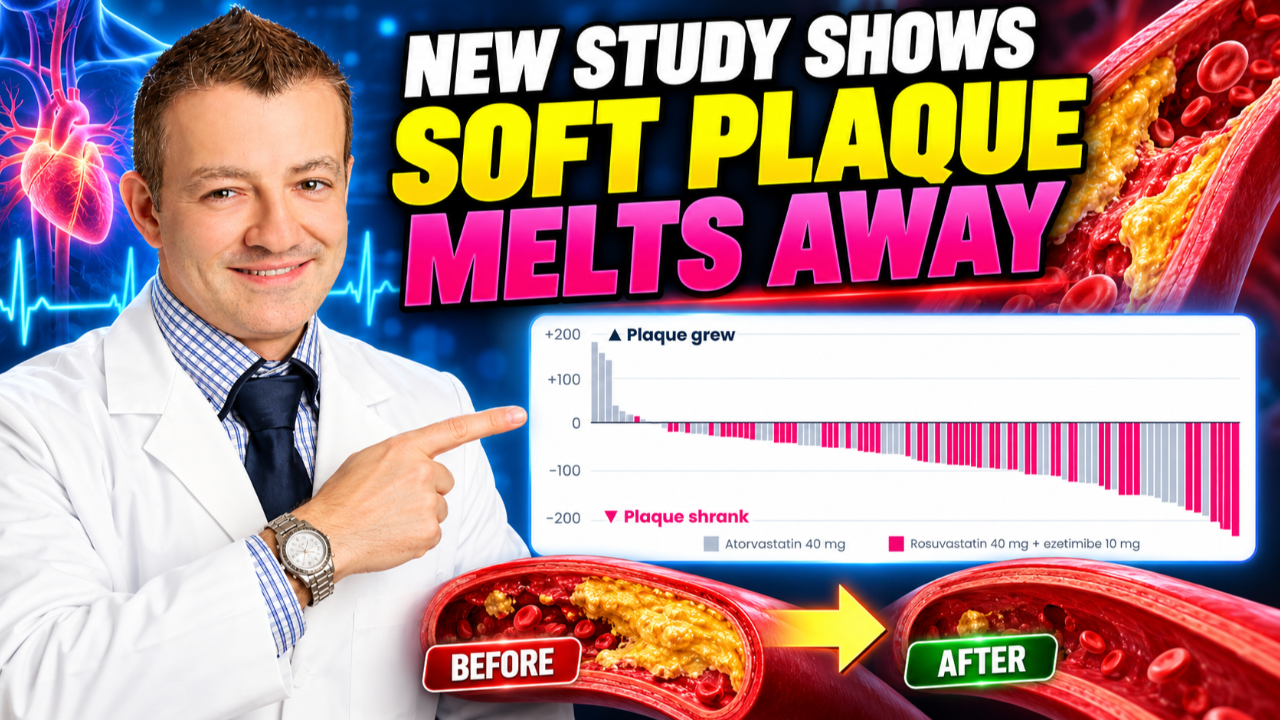
How To Reverse Soft Plaque
"Dr. Alo, my CT scan showed a blockage. Is it too late, or can this plaque actually go away?"
I get this question constantly, and until recently most of the proof I could point to came from trials where a tiny camera was threaded into one artery. Yesterday, on October 30, 2026, JAMA Cardiology published a brand new randomized trial called FLOWPROMOTE that measured plaque in every coronary artery with a CT scan, in people who had never taken a statin. It also tested exactly the combination I use in most of my patients: rosuvastatin plus ezetimibe.
The result is one of the most encouraging pictures of plaque reversal I have ever seen. Let me walk you through it, with every chart redrawn so it actually makes sense.
Key takeaways
- 104 people with newly found, significant coronary disease who had never taken a statin were randomized to atorvastatin 40 mg or rosuvastatin 40 mg plus ezetimibe 10 mg for 18 months.
- LDL fell 38% on atorvastatin (to 69.5 mg/dL) and 65% on rosuvastatin plus ezetimibe (to 42.5 mg/dL).
- Plaque shrank in both groups, but more with the combination: total plaque fell 21.1% vs 13.6%, and soft plaque fell 28.2% vs 20.0%.
- Soft plaque shrank in 51 of 52 patients (98%) on rosuvastatin plus ezetimibe, versus 77% on atorvastatin alone.
- The lower the LDL each person reached, the more plaque they lost, in a straight line.
- Calcified plaque went up a little in both groups. That is the plaque hardening and stabilizing, not getting worse.
First, what kind of plaque are we talking about?
Coronary plaque comes in two broad types. Soft (noncalcified) plaque is the fatty, inflamed material that can crack open and trigger a clot. That is what causes most heart attacks. Calcified plaque is plaque that has hardened. It still tells us disease is there, but it is far more stable.
A coronary CT angiogram (CTA) can measure both, in every artery, without a catheter. That is what makes FLOWPROMOTE different from the classic IVUS trials, which looked at one segment of one artery.
What the researchers did

Figure: who was in the trial. Redrawn from Mortensen MB, et al. JAMA Cardiol. 2026 (FLOWPROMOTE), Figure 1.
Here is how the trial was built:
- Researchers at hospitals in Denmark started with 449 people with chest pain who had a heart CT scan.
- The ones who qualified had a narrowing over 50% plus reduced blood flow on CT (an FFR-CT of 0.80 or lower), and had never taken a statin.
- 104 were randomized, 52 to each treatment, and every coronary artery was scanned again at 9 and 18 months. Nobody was lost to follow-up.
How low did LDL go?

Figure: average LDL at the start, 9 months and 18 months. Redrawn from Mortensen MB, et al. JAMA Cardiol. 2026 (FLOWPROMOTE), Table 2.
How to read it:
- Grey is atorvastatin 40 mg alone. LDL dropped from 119.7 to 69.5, right around 70.
- Pink is rosuvastatin 40 mg plus ezetimibe 10 mg. LDL dropped from 127.4 to 42.5, and almost all of that happened in the first 9 months.
- The combination group started higher and still finished about 27 points lower.
Every patient, one bar: down, down, down

Figure: change in total coronary plaque volume for each patient, sorted from most growth to most shrinkage. Redrawn from Mortensen MB, et al. JAMA Cardiol. 2026 (FLOWPROMOTE), Figure 2.
This is my favorite picture from the trial:
- Each bar is one person. Above the line, plaque grew. Below the line, plaque shrank.
- Look how many bars point down. The few that went up were mostly grey, atorvastatin alone.
- The deepest drops on the right side are mostly pink, rosuvastatin plus ezetimibe.

Figure: change in noncalcified (soft) plaque volume for each patient. Redrawn from Mortensen MB, et al. JAMA Cardiol. 2026 (FLOWPROMOTE), Figure 2.
Now the same picture for the dangerous soft plaque. Only one pink bar sits above the line. Every other patient on the combination lost soft plaque.
How much plaque went away?

Figure: percent change in plaque volume over 18 months. Redrawn from Mortensen MB, et al. JAMA Cardiol. 2026 (FLOWPROMOTE), Table 3.
How to read it:
- Every bar is plaque that went away, so taller means more reversal.
- Total plaque: down 13.6% on atorvastatin, 21.1% on the combination (between-group P = .02 in the main analysis).
- Soft plaque: down 20.0% versus 28.2% (P = .02).
Who actually reversed?

Figure: percent of patients whose plaque shrank by 18 months. Redrawn from Mortensen MB, et al. JAMA Cardiol. 2026 (FLOWPROMOTE).
How to read it:
- On atorvastatin alone, about 3 in 4 people shrank their plaque. That is already good news.
- On rosuvastatin plus ezetimibe, 9 in 10 shrank total plaque and 51 of 52 shrank soft plaque.
The fine print
I always want you to see the limits, not just the headline:
- It is a modest-sized trial. 104 people is enough to see plaque change clearly, but not enough to count heart attacks.
- It measured plaque, not events. Other trials (like PACMAN-AMI and the big outcome trials) tie plaque regression to fewer cardiac events, but FLOWPROMOTE itself did not test that.
- These are secondary endpoints. They were prespecified, but the trial's main question was about blood flow on CT, which was reported separately.
- The groups got two changes at once (a different statin and ezetimibe), so we cannot say how much came from each. What we can say is that the lower LDL won.
The myth I want to bury: "My calcium score went up, so my statin is not working"
In FLOWPROMOTE, calcified plaque increased in both groups while soft plaque melted away. That is not failure. Statins turn soft, rupture-prone plaque into hard, stable plaque. So a calcium score can creep up while your real risk is going down. Do not stop your medicine because of a rising calcium score.
What I tell my patients
- Know your numbers. Get your LDL and ApoB measured, not just your total cholesterol.
- Reduce saturated fat, increase fiber, and take your medication if you need it. Those three move the needle the most.
- If you have plaque, aim low. In this trial, LDL around 42 beat LDL around 70. In my practice I often start rosuvastatin and ezetimibe together, exactly the combination tested here.
- Then do your cardio, lift weights, lower your stress and get good sleep. They support the foundation, but they never replace a medication you actually need.
- Do not panic about a rising calcium score once you are treated. Look at the soft plaque and your LDL.
Frequently asked questions
Can plaque in the heart really go away?
Partly, yes. In FLOWPROMOTE, total plaque shrank about 21% and soft plaque about 28% in 18 months with rosuvastatin plus ezetimibe. That is real, measurable reversal, though not a complete cleanout.
Is rosuvastatin plus ezetimibe better than atorvastatin alone?
In this trial it lowered LDL more (42.5 vs 69.5 mg/dL) and removed more plaque. The key driver was how low LDL went, so the best regimen is the one that gets you to your target.
How long does it take to see plaque shrink?
Changes were already visible at 9 months and kept improving to 18 months. LDL fell almost completely within the first 9 months.
Why did my calcium score go up on a statin?
Because statins stabilize plaque by calcifying it. FLOWPROMOTE saw calcified plaque rise in both groups while the dangerous soft plaque fell.
How does this fit with the other reversal trials?
It lines up with all of them: the lower the LDL, the more the artery heals. I walk through every imaging trial that showed reversal, from REVERSAL in 2004 to this one, in my plaque reversal article.
The bottom line
FLOWPROMOTE is brand new proof that coronary plaque is, at least in part, reversible. In people who had never been treated, rosuvastatin plus ezetimibe took LDL to 42.5 mg/dL and shrank the dangerous soft plaque in 98% of them. The message is the same one every reversal trial keeps giving us: the lower your LDL, the more your arteries heal.
Still have questions? Stop Googling and ask Dr. Alo.
You've read the science, but applying it to your own life can be confusing. That's exactly what the Heart 2 Heart VIP Community is for. You can ask me questions directly, join live video calls where we talk through your labs and situations like this one, and get physician-level guidance based on your actual numbers.
Join here: https://dralo.net/community 💪🏻🩺🫀
Dr. Alo
References
- Mortensen MB, Iraqi N, Sand NPR, et al. Intensive vs More Intensive Lipid-Lowering Therapy and Plaque Regression in Statin-Naive Patients: Prespecified Analyses From the FLOWPROMOTE Randomized Clinical Trial. JAMA Cardiology. Published online October 30, 2026. doi:10.1001/jamacardio.2026.4788. ClinicalTrials.gov NCT04737408.
- Mortensen MB, Sand NP, Busk M, et al. Influence of intensive lipid-lowering on CT derived fractional flow reserve in patients with stable chest pain: rationale and design of the FLOWPROMOTE study. Clinical Cardiology. 2022;45(10):986-994.
- Dawson LP, Lum M, Nerleker N, Nicholls SJ, Layland J. Coronary atherosclerotic plaque regression: JACC state-of-the-art review. Journal of the American College of Cardiology. 2022;79(1):66-82.
Still Have Questions? Stop Googling and Ask Dr. Alo.
You’ve read the science, but applying it to your own life can be confusing. I created the Dr. Alo VIP Private Community to be a sanctuary away from social media noise.
Inside, you get:
-
Direct Access: I answer member questions personally 24/7/365.
-
Weekly Live Streams: Deep dives into your specific health challenges.
-
Vetted Science: No fads, just evidence-based cardiology and weight loss.
Don't leave your heart health to chance. Get the guidance you deserve. All this for less than 0.01% the cost of health insurance! You can cancel at anytime!
[👉 Join the Dr. Alo VIP Community Today]
Cardiology & Obesity Medicine