Aortic Stenosis Treatment: TAVR vs Open-Heart Surgery, Symptoms, Recovery and Risks
Oct 27, 2026
Aortic Stenosis Surgery or Catheter Based?
"Dr. Alo, my doctor heard a murmur and the echo says I have severe aortic stenosis. Do I really need open-heart surgery?"
A lot of people walk into my office expecting the worst: a cracked chest, a week in the hospital and months of recovery. Many of them walk out relieved. Today, a lot of patients can get a brand new heart valve through a small tube in the leg and go home in a day or two. But that doesn't mean the minimally invasive option is right for everyone, and the newest long-term data has made the decision more interesting, not less.
In this article I walk you through what aortic stenosis is, the symptoms to watch for, how fast it progresses, and the two ways to fix it: TAVR and open-heart surgery (SAVR). I redrew the key results from the major trials and the newest 2026 research so you can see exactly how the two compare, including the parts that are still uncertain.
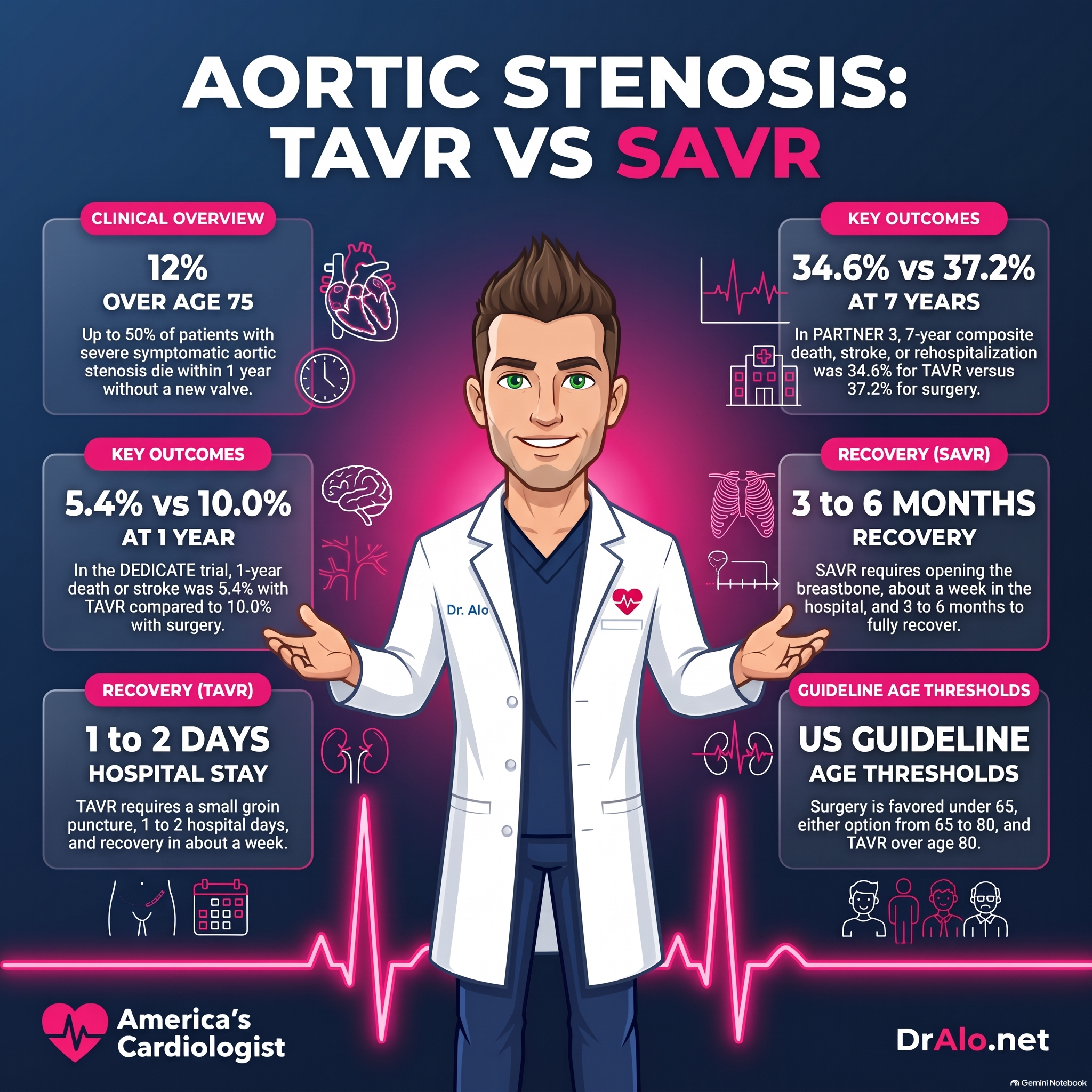
Infographic Summary:
Key takeaways
- Aortic stenosis is a narrowing of the aortic valve, usually from calcium building up with age. About 12% of adults over 75 have it.
- Once severe aortic stenosis causes symptoms (shortness of breath, chest pain, fainting, getting tired easily), up to half of people die within a year without a new valve. Replacing the valve brings life expectancy back to normal for your age.
- No pill can open a narrowed valve. Medicines can ease symptoms, but the only fix is a new valve.
- TAVR replaces the valve through a catheter in the groin: 1 to 2 days in the hospital, back to normal in about a week. SAVR is open-heart surgery: about a week in the hospital and months to fully recover.
- In the first year, TAVR wins. In the DEDICATE trial, death or stroke at 1 year was 5.4% with TAVR vs 10.0% with surgery.
- By 7 years, it is basically a tie in low-risk patients (PARTNER 3), and the newest 2026 meta-analyses disagree about whether surgery comes out slightly ahead long term.
- Who gets which depends mostly on age, anatomy and life expectancy. In the US, surgery is usually favored under 65, either is reasonable from 65 to 80, and TAVR is favored over 80.
What is aortic stenosis?
Your aortic valve is the main exit door of the heart. Every heartbeat, the left ventricle squeezes blood through this valve into the aorta and out to the rest of the body.
Aortic stenosis (AS) means that door has become narrow and stiff. The heart has to squeeze harder and harder to push blood through a smaller and smaller opening. Over time the heart muscle thickens, then tires out.
Aortic stenosis is the most common valve disease that needs treatment in older adults. In the US it affects 1 to 2% of adults over 65 and about 12% of adults over 75, and it causes more than 100,000 deaths a year worldwide (Otto, JAMA, 2024).

Figure: how common aortic stenosis is, how it progresses, and how often it should be checked. Redrawn from Otto CM, Newby DE, Hillis GS. JAMA. 2024;332(23):2014-2026.
What causes aortic stenosis?
- Calcium buildup with age (calcific aortic stenosis). This is by far the most common cause. It isn't just "wear and tear." It starts with fat (lipid) infiltration and inflammation in the valve leaflets, followed by scarring and calcium. In many ways it looks like atherosclerosis of the valve.
- A bicuspid aortic valve. About 1 to 2% of people are born with a valve that has two leaflets instead of three. These valves tend to calcify and narrow earlier, often in a person's 50s or 60s.
- Rheumatic heart disease. Rare in the US today, but still common worldwide.
Risk factors overlap with heart disease: age, high blood pressure, high LDL cholesterol, smoking, diabetes and a high lipoprotein(a). Lp(a) is one of the strongest genetic risk factors for calcific aortic stenosis, which is one more reason I want everyone to get it checked once.
Aortic stenosis symptoms
Mild and moderate aortic stenosis usually cause no symptoms at all. Most people find out because a doctor hears a heart murmur. Symptoms typically appear only once the valve is severely narrowed:
- Shortness of breath, especially with activity or lying flat
- Getting tired easily or not being able to do what you used to do (this is often the first sign, and people blame it on age)
- Chest pain or pressure with exertion
- Dizziness, lightheadedness or fainting, especially during or right after activity
- Swelling in the legs or a fast, pounding heartbeat as the heart starts to fail
Here is the trap: many people quietly slow down to avoid symptoms. They stop taking the stairs, stop walking the dog, and tell me they feel "fine." That is why your doctor may order a stress test to see what really happens when you exert yourself.
The stages of aortic stenosis and how fast it progresses
Aortic stenosis is measured with an echocardiogram (an ultrasound of the heart). It is graded by how fast blood shoots through the valve and how small the opening is.
- Mild: the valve is thickened and starting to narrow. An echo every 3 to 5 years.
- Moderate: an echo every 1 to 2 years.
- Severe, no symptoms: a jet speed of 4 m/s or more, an average gradient of 40 mmHg or more, or a valve area of 1.0 cm² or less. An echo every 6 to 12 months.
- Severe with symptoms: time to replace the valve.
How fast does it progress? It varies from person to person, but once the jet speed is above 2 m/s, most people progress to severe aortic stenosis within about 10 years. It almost never goes backward.
The "watch and wait" trap: why severe aortic stenosis is dangerous
This is the single most important number in this article: once severe aortic stenosis causes symptoms, up to 50% of people die within 1 year without a valve replacement (Otto, JAMA, 2024).
Why is it so dangerous? A narrowed valve limits how much blood can get out of the heart. The heart muscle thickens, stiffens and eventually fails. People with end-stage aortic stenosis develop heart failure, dangerous heart rhythms and can die suddenly, sometimes during exertion. Fainting with exertion is a warning sign that should never be ignored.
The good news is just as dramatic. Replacing the valve, with either surgery or TAVR, brings mortality back down to that of people the same age without aortic stenosis. That is why "let's just keep an eye on it" is the wrong plan once symptoms show up. Watching is right for mild and moderate disease. Waiting after symptoms appear is a trap.
Aortic stenosis treatment: can medicine or lifestyle fix it?
I wish I could tell you otherwise, but no. There is no medicine that opens a narrowed valve or stops it from getting worse. Statins lower LDL and prevent heart attacks, but large trials such as SEAS did not show that they slow aortic stenosis once it has started.
What medicine can do:
- Treat high blood pressure, high cholesterol and other heart risks, as the guidelines recommend during surveillance.
- Ease symptoms of fluid buildup (for example diuretics) while you wait for a valve.
So when people search for "aortic stenosis treatment without surgery," the honest answer is this: the treatment that works without open-heart surgery is TAVR. It is still a valve replacement, just done through a catheter instead of through the chest.
TAVR vs SAVR: two ways to replace the valve

Figure: SAVR goes through the chest; TAVR usually goes through the groin. Recovery details drawn from Otto CM, et al. JAMA. 2024;332(23):2014-2026 and typical practice at experienced US valve centers.
SAVR (surgical aortic valve replacement) is open-heart surgery. The surgeon opens the breastbone, puts you on the heart-lung machine, cuts out the diseased valve and sews in a new one. The new valve can be mechanical (lasts a lifetime but needs warfarin for life) or tissue (no lifelong blood thinner, but it wears out eventually).
TAVR (transcatheter aortic valve replacement), also called TAVI, is the minimally invasive option. A new tissue valve is crimped onto a thin tube (catheter), threaded up from an artery in the groin, and expanded inside the old valve. The old valve is pushed aside and the new one takes over immediately. No open chest, no heart-lung machine.
What is TAVR recovery like?
| TAVR | SAVR | |
|---|---|---|
| Incision | Small puncture in the groin | Breastbone opened |
| Anesthesia | Often sedation, not full general anesthesia | General anesthesia, heart-lung machine |
| Hospital stay | Usually 1 to 2 days | About a week |
| Back to normal activity | About a week | About 6 weeks of limits, full recovery in 3 to 6 months |
| Driving | Often within about a week | Usually after several weeks, once the breastbone heals |
In PARTNER 3, patients' quality-of-life scores 1 month after TAVR were dramatically better than after surgery (16 points higher on the Kansas City Cardiomyopathy Questionnaire). That difference faded by year 2 and disappeared by year 3, because surgery patients caught up once they healed (Brener, Journal of the American College of Cardiology, 2026).
Is TAVR a major surgery?
TAVR is a major heart procedure, but it is not open-heart surgery. It is done in a hybrid operating room or cath lab by a team that includes an interventional cardiologist and a cardiac surgeon, and it has real risks, which I cover below. But for most patients it is far easier on the body than SAVR.
TAVR vs SAVR outcomes: the first year

Figure: 1-year results of the DEDICATE trial. Redrawn from Blankenberg S, et al. N Engl J Med. 2024;390(17):1572-1583.
DEDICATE was a randomized trial at 38 hospitals in Germany. It enrolled 1,414 patients with severe aortic stenosis at low or intermediate surgical risk (average age 74) and let each hospital use the valves it normally used, which makes it closer to real-world practice.
- Death or stroke at 1 year: 5.4% with TAVR vs 10.0% with surgery. That is about half the risk.
- Death from any cause: 2.6% vs 6.2%.
- Stroke: 2.9% vs 4.7%. This one was not statistically significant on its own (the grey bars).
Pooled data from five low-risk trials agree: at 30 days, TAVR cut deaths by more than half (risk ratio 0.45), and that early advantage was still there at 12 months (Jarade, American Journal of Cardiology, 2026).
TAVR vs SAVR long term: what happens after year one?

Figure: 7-year outcomes in low-risk patients in the PARTNER 3 trial. Redrawn from Leon MB, et al. N Engl J Med. 2026;394(8):773-783 and Ternacle J, et al. JAMA Cardiol. 2026;11(8):747-757.
PARTNER 3 randomized 1,000 low-risk patients (average age 73) to TAVR with a balloon-expandable SAPIEN 3 valve or to surgery, and followed them for 7 years. Here is how to read the chart: pink bars are TAVR, navy bars are surgery, and shorter is better.
- Death, stroke or rehospitalization: 34.6% with TAVR vs 37.2% with surgery. Not a significant difference.
- Death: 19.5% vs 16.8%, slightly higher with TAVR.
- Stroke: 8.5% vs 8.1%, essentially the same.
- Rehospitalization: 20.6% vs 23.5%, slightly lower with TAVR.
- Valve failure: 6.9% vs 7.5%, and needing another valve procedure: 6.0% vs 5.5%. The valves held up the same.
Bottom line from PARTNER 3: the big early advantage of TAVR fades, and by 7 years the two are statistically tied. Notice that death was slightly higher with TAVR at 7 years even though TAVR started out ahead in the early years, which is why longer follow-up matters.
The 2026 meta-analyses: an honest disagreement

Figure: pooled risk ratios for TAVR vs surgery from three 2026 meta-analyses of randomized trials. Redrawn from Marin-Cuartas M, et al. Heart. 2026; Jarade C, et al. Am J Cardiol. 2026;272:77-86; Ramamoorthy L, et al. J Thromb Thrombolysis. 2026.
This is a forest plot. Each dot is a result and each line is its margin of error. Left of the dashed line (pink zone) favors TAVR, right of the line favors surgery, and grey means not statistically significant.
- Early (30 days): clearly favors TAVR, with less than half the deaths.
- 5 years, Marin-Cuartas (Heart, 2026): six trials, 7,249 low- to intermediate-risk patients. 5-year death was 29.7% with TAVR vs 27.6% with surgery, a 12% higher relative risk with TAVR. Stroke trended the same way but was not significant.
- 5 years, Jarade (American Journal of Cardiology, 2026): five low-risk trials. Death at 5 years or longer was a dead heat (risk ratio 0.99), and the authors called long-term results inconclusive.
- 3 to 10 years, Ramamoorthy (Journal of Thrombosis and Thrombolysis, 2026): four low-risk trials. No significant difference in cardiovascular death or stroke.
So here is my read. Nobody is saying TAVR is a bad operation. It is clearly safer up front. The open question is whether a small long-term difference favors surgery in younger, healthier patients who will live long enough for it to matter. That is exactly why the guidelines still lean toward surgery for younger patients.
TAVR risks and complications vs surgery

Figure: complications that are more common after each procedure. Redrawn from Jarade C, et al. Am J Cardiol. 2026; Ramamoorthy L, et al. J Thromb Thrombolysis. 2026; Ternacle J, et al. JAMA Cardiol. 2026; Jørgensen TH, et al. Eur Heart J. 2024.
More common after TAVR:
- Needing a permanent pacemaker. The new valve sits right next to the heart's electrical wiring. Pacemakers were needed about 2 to 3 times as often after TAVR (risk ratio 2.08 long term, 3.10 at 30 days). This depends a lot on the valve: self-expanding valves needed pacemakers more often than balloon-expandable ones.
- Clot or thickening on the valve leaflets. 5.2% vs 0.9% by 7 years in PARTNER 3, mostly in the first 3 years, and it rarely led to valve failure.
- A leak around the valve (paravalvular leak). More moderate or worse leaks after TAVR in NOTION-2.
- Problems at the groin artery where the catheter goes in.
More common after surgery:
- Atrial fibrillation: about 5 times as common after surgery (TAVR risk ratio 0.21 at 30 days).
- Life-threatening bleeding: more than 3 times as common after surgery.
- A longer hospital stay and longer recovery, with kidney injury and breastbone healing issues in some patients.
How long does a TAVR valve last?
This is the question I get most from younger patients, and it's a fair one. All tissue valves, surgical or TAVR, eventually wear out.
- Surgical tissue valves have more than 20 years of follow-up data.
- TAVR valves have about 10 years of randomized data so far, mostly in patients over 70.
- In PARTNER 3, valve failure at 7 years was 6.9% with TAVR vs 7.5% with surgery, and about 73 to 75% of patients in both groups were alive without valve failure. Durability was the same.
- The only 10-year randomized data (the NOTION trial) actually showed less severe structural valve deterioration with TAVR than with surgery (Ramamoorthy, 2026).
- Durability differs between valve brands and designs, so results from one TAVR valve can't be assumed for all of them.
For an 80-year-old, durability is rarely the deciding factor. For a 60-year-old who may live another 25 to 30 years, it matters a lot, because they will likely need a second valve one day. Planning for that "lifetime management" is now a core part of the decision.
Who qualifies for TAVR? Who should get surgery?

Figure: age bands in US and European guidelines. Redrawn from Otto CM, et al. JAMA. 2024; Sundt TM, Jneid H. JAMA Cardiol. 2021 (2020 ACC/AHA guideline); Praz F, et al. Eur Heart J. 2025 (2025 ESC/EACTS guideline); Coisne A, et al. JACC. 2023.
To qualify for any valve replacement, you need severe aortic stenosis with symptoms, or severe aortic stenosis with signs the heart is starting to suffer. Then the question becomes which procedure. Under the current US (2020 ACC/AHA) guideline:
| Patient | Usual recommendation |
|---|---|
| Under 65, or life expectancy over 20 years | Surgery (SAVR) |
| 65 to 80 with symptoms | Either SAVR or TAVR, by shared decision |
| Over 80, or life expectancy under 10 years | TAVR |
| High or prohibitive surgical risk (predicted surgical death 8% or more) | TAVR |
| Anatomy not suitable for TAVR | Surgery |
Europe moved the line. The 2021 European guideline favored TAVR from age 75. The 2025 ESC/EACTS guideline lowered that to 70 for patients with suitable anatomy. So depending on which side of the Atlantic you live on, a 72-year-old may hear a different default.
Special cases where surgery is often better
- Bicuspid aortic valves. Most of the big TAVR trials excluded them. In NOTION-2, low-risk patients 75 and younger with a bicuspid valve had a 14.3% rate of death, stroke or rehospitalization at 1 year with TAVR vs 3.9% with surgery. The trial was small and that difference wasn't statistically certain, but the authors urged caution. In patients with a normal three-leaflet valve, the results were identical (8.7% vs 8.3%).
- Complex coronary artery disease. If you also need bypass surgery, doing the valve and the bypass in one operation often makes the most sense.
- Other valve or aorta problems that need surgical repair at the same time, or anatomy that makes TAVR risky.
What I tell my patients
- If you have a murmur, get an echocardiogram. It is painless and it tells us exactly how tight the valve is.
- Don't ignore "slowing down." New shortness of breath, chest pressure, dizziness or getting tired easily with known aortic stenosis means call your cardiologist now, not at your next yearly visit.
- Never faint and shrug it off. Fainting with exertion and severe aortic stenosis is an emergency warning sign.
- Keep your echo schedule. Every 3 to 5 years for mild, 1 to 2 years for moderate, and every 6 to 12 months for severe.
- Treat the risk factors anyway. Control blood pressure and LDL and don't smoke. It won't reverse the valve, but it protects the rest of your heart and arteries.
- Ask for a Heart Team. The best decisions come from a cardiologist and a cardiac surgeon looking at your scans together and talking with you about your age, anatomy, other conditions and what matters to you.
- Ask which valve and why. Pacemaker rates and long-term durability differ between valve types.
- If you are under 70, think long term. Ask how your first valve choice affects options for a second valve down the road.
Frequently asked questions
What is the best treatment for aortic stenosis?
For severe aortic stenosis with symptoms, the only effective treatment is replacing the valve, either with TAVR or open-heart surgery (SAVR). Which one is best depends on your age, anatomy, life expectancy and other heart problems. Medicines can ease symptoms but cannot open the valve.
Can aortic stenosis be treated without surgery?
Not with medicine. But TAVR replaces the valve without open-heart surgery, through a catheter usually placed in the groin. For many patients, especially those over 75 to 80, it is the preferred option.
What are the end stages of aortic stenosis?
End-stage aortic stenosis is severe narrowing with symptoms such as shortness of breath at rest, chest pain, fainting, swelling and heart failure. Without a valve replacement, up to half of people die within a year once symptoms begin. With a new valve, survival returns to roughly normal for age.
How fast does aortic stenosis progress?
It varies, but once the jet speed through the valve is above 2 m/s, most people progress to severe aortic stenosis within about 10 years. That is why regular echocardiograms are so important.
Who qualifies for the TAVR procedure?
People with severe aortic stenosis who need a valve replacement and whose anatomy is suitable. In the US, TAVR is favored for people over 80, those with a life expectancy under 10 years, and those at high surgical risk. From 65 to 80, either TAVR or surgery is reasonable. Under 65, surgery is usually favored.
What is the recovery time after TAVR?
Most people stay in the hospital 1 to 2 days and get back to normal activity in about a week. Open-heart surgery usually means about a week in the hospital and 3 to 6 months to fully recover.
How long does a TAVR valve last?
So far, as long as a surgical tissue valve. In the PARTNER 3 trial, valve failure at 7 years was 6.9% with TAVR and 7.5% with surgery, and 10-year data from the NOTION trial looks reassuring. We have more than 20 years of data on surgical valves and about 10 on TAVR valves.
What are the risks of TAVR?
The main risks are needing a permanent pacemaker (about 2 to 3 times as often as after surgery), a leak around the valve, problems at the groin artery, stroke, and clot or thickening on the valve leaflets. Surgery has more atrial fibrillation, bleeding and a longer recovery.
Is TAVR better than open-heart surgery?
In the first year, TAVR has fewer deaths and strokes and a much faster recovery. By 7 years, the PARTNER 3 trial found no significant difference. One 2026 meta-analysis found slightly more deaths with TAVR at 5 years (29.7% vs 27.6%), while others found no difference. Both work well; the right choice depends on the patient.
The bottom line
Aortic stenosis is common, it creeps up slowly, and once it causes symptoms it becomes one of the most dangerous conditions in cardiology. The good news is that a new valve can bring life expectancy back to normal.
Both procedures work well. TAVR offers a faster, easier recovery and clear early advantages, and it has made valve replacement possible for many people who could never have had open-heart surgery. SAVR has the longest track record and is often the better choice for younger patients, bicuspid valves, unusual anatomy or people who also need bypass. The best choice comes from a Heart Team talking with you about your age, health, anatomy and priorities. And the worst choice is waiting too long.
Still have questions? Stop Googling and ask Dr. Alo.
You've read the science, but applying it to your own life can be confusing. That's exactly what the Heart 2 Heart VIP Community is for. You can ask me questions directly, join live video calls where we talk through your labs and situations like this one, and get physician-level guidance based on your actual numbers.
Join here: https://dralo.net/community 💪🏻🩺🫀
Dr. Alo
Related Cardiovascular Prevention Posts
- Lipoprotein(a): The Inherited Heart Risk
- Blood Pressure Management
- Dr. Alo's Dietary Guidelines
- STEMI vs NSTEMI
References
- Otto CM, Newby DE, Hillis GS. Calcific aortic stenosis: a review. JAMA. 2024;332(23):2014-2026. doi:10.1001/jama.2024.16477.
- Praz F, Borger MA, Lanz J, et al. 2025 ESC/EACTS Guidelines for the management of valvular heart disease. European Heart Journal. 2025. doi:10.1093/eurheartj/ehaf194.
- Sundt TM, Jneid H. Guideline update on indications for transcatheter aortic valve implantation based on the 2020 American College of Cardiology/American Heart Association guidelines for management of valvular heart disease. JAMA Cardiology. 2021;6(9):1088-1089. doi:10.1001/jamacardio.2021.2534.
- Coisne A, Lancellotti P, Habib G, et al. ACC/AHA and ESC/EACTS guidelines for the management of valvular heart diseases: JACC guideline comparison. Journal of the American College of Cardiology. 2023;82(8):721-734.
- Mafrica D, Dziewierz A, Dobrev D. Transcatheter aortic valve implantation: latest evidence, gaps in knowledge, and future directions. Postepy Kardiol Interwencyjnej. 2025. doi:10.5114/aic.2025.158101.
- Blankenberg S, Seiffert M, Vonthein R, et al. Transcatheter or surgical treatment of aortic-valve stenosis (DEDICATE-DZHK6). New England Journal of Medicine. 2024;390(17):1572-1583.
- Leon MB, Mack MJ, Pibarot P, et al. Transcatheter or surgical aortic-valve replacement in low-risk patients at 7 years. New England Journal of Medicine. 2026;394(8):773-783. doi:10.1056/NEJMoa2509766.
- Ternacle J, Hahn RT, Silva I, et al. Seven-year valve durability with transcatheter or surgical aortic valve replacement: an ad hoc analysis of the PARTNER 3 randomized clinical trial. JAMA Cardiology. 2026;11(8):747-757.
- Brener MI, Cohen DJ, Kodali SK, et al. Health status outcomes 7 years after transcatheter or surgical aortic valve replacement in low-surgical risk patients with aortic stenosis (PARTNER 3). Journal of the American College of Cardiology. 2026;88(14):1690-1700. doi:10.1016/j.jacc.2026.06.022.
- Marin-Cuartas M, Kawczynski MJ, de Waha S, et al. Updated 5-year outcomes of transcatheter versus surgical aortic valve replacement in patients with severe aortic stenosis at low- to intermediate-surgical risk. Heart. 2026. doi:10.1136/heartjnl-2025-327092.
- Jarade C, Levett JY, Zolotarova T, et al. Meta-analysis of transcatheter versus surgical aortic valve replacement in low surgical risk patients: an update. American Journal of Cardiology. 2026;272:77-86.
- Ramamoorthy L, Otmani F, Gupta A, et al. Long-term valve durability and clinical outcomes after transcatheter versus surgical aortic valve replacement in low-risk patients: a systematic review and meta-analysis of randomized trials. Journal of Thrombosis and Thrombolysis. 2026. doi:10.1007/s11239-026-03368-3.
- Jørgensen TH, Thyregod HGH, Savontaus M, et al. Transcatheter aortic valve implantation in low-risk tricuspid or bicuspid aortic stenosis: the NOTION-2 trial. European Heart Journal. 2024;45(37):3804-3814.
- Shuhaiber J. Transcatheter aortic valve replacement for patients at low risk and younger patients: a contemporary view. JAMA Internal Medicine. 2026;186(4):400-401.
- Rossebø AB, Pedersen TR, Boman K, et al. Intensive lipid lowering with simvastatin and ezetimibe in aortic stenosis (SEAS). New England Journal of Medicine. 2008;359(13):1343-1356.
Still Have Questions? Stop Googling and Ask Dr. Alo.
You’ve read the science, but applying it to your own life can be confusing. I created the Dr. Alo VIP Private Community to be a sanctuary away from social media noise.
Inside, you get:
-
Direct Access: I answer member questions personally 24/7/365.
-
Weekly Live Streams: Deep dives into your specific health challenges.
-
Vetted Science: No fads, just evidence-based cardiology and weight loss.
Don't leave your heart health to chance. Get the guidance you deserve. All this for less than 0.01% the cost of health insurance! You can cancel at anytime!
[👉 Join the Dr. Alo VIP Community Today]
Cardiology & Obesity Medicine