Salt and Your Heart: How Too Much Salt Raises Blood Pressure, Strokes and Heart Attacks
Oct 27, 2026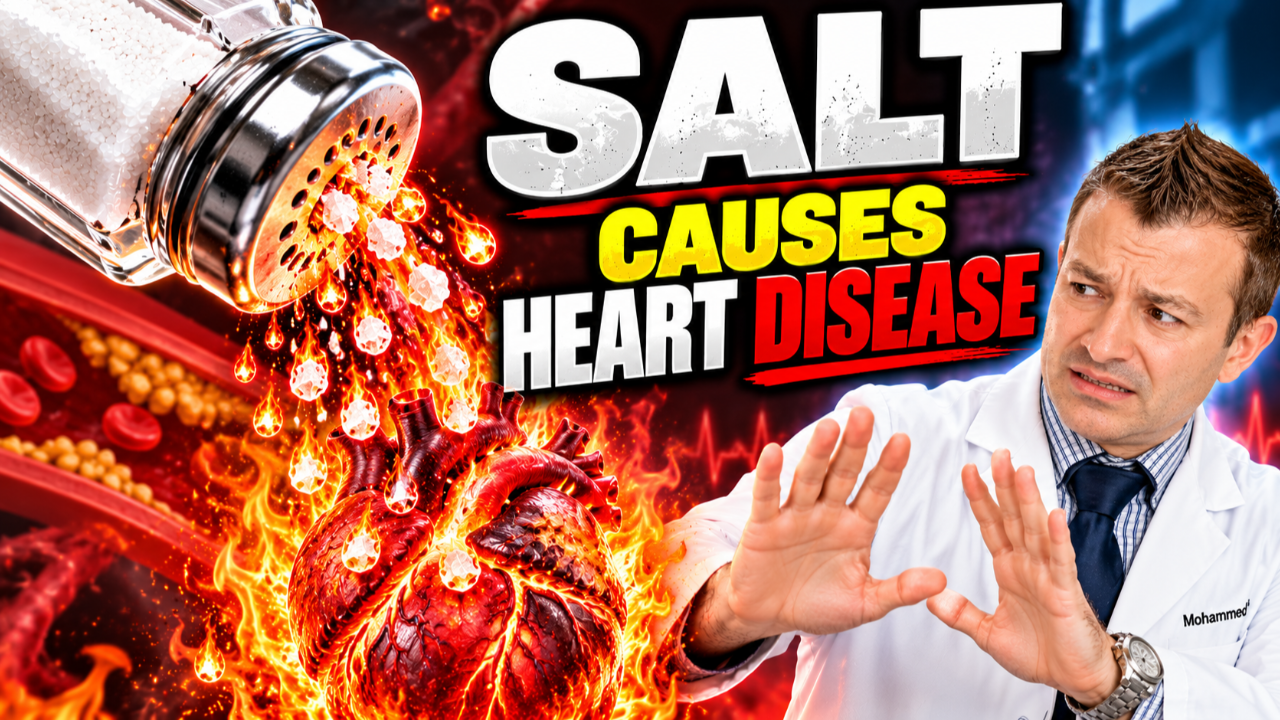
Does Salt Cause Heart Disease?
"Dr. Alo, I don't even use the salt shaker that much. And I saw a doctor online say salt is fine and low salt is actually dangerous. Who do I believe?"
I hear some version of this every week. And I get why people are confused. There are a few Medfluencers selling books right now telling you that excess salt is harmless, or even good for you.
So let's look at the actual data together. I went through the big randomized trials, the long-term follow-up studies, the population studies and the lab research on salt and inflammation. Below I redrew the key results so they actually make sense, and I walk you through what they show, and just as important, what they don't.
Key takeaways
- Salt raises blood pressure. This is proven in randomized trials. Cutting about 4.4 grams of salt a day lowered the top number by about 5.4 points in people with high blood pressure and 2.4 points in people without it.
- Cutting salt can work about as well as a blood pressure pill. One standard-dose medicine lowers the top number by about 9 points. A week of low sodium lowered it by 8. The DASH diet plus low sodium lowered it by up to 21 points in people with the highest pressures.
- Less salt means fewer strokes, heart events and deaths. In a randomized trial of nearly 21,000 people, a lower-sodium salt substitute cut strokes by 14%, major heart and stroke events by 13% and deaths by 12%.
- There was no "J-curve" in the best long-term data. People who ate the least sodium had the lowest risk of dying over 20+ years.
- Salt and inflammation: the lab and animal evidence is strong, and small human studies show salt revving up inflammatory immune cells. Bigger human trials have not yet proven a rise in blood markers like CRP. I'll show you exactly where that evidence stands.
- Many people have genetically high blood pressure and will need medication. But a low-sodium diet is the place to start, and it makes your medicine work better too.
First, salt vs sodium: the quick math
Table salt is sodium chloride. About 40% of salt by weight is sodium. That is why labels and guidelines talk about sodium in milligrams, while studies often talk about salt in grams.
- 1 teaspoon of salt has about 2,300 mg of sodium.
- The American Heart Association says to stay under 2,300 mg of sodium a day, and ideally aim for 1,500 mg, especially if you have high blood pressure.
- The average American eats around 3,400 mg a day, and most of it doesn't come from the shaker. It comes from bread, deli meat, cheese, soups, sauces, frozen meals and restaurant food.
That last point matters. "I don't salt my food" doesn't mean you eat a low-salt diet. It usually means the salt was added before the food reached you.
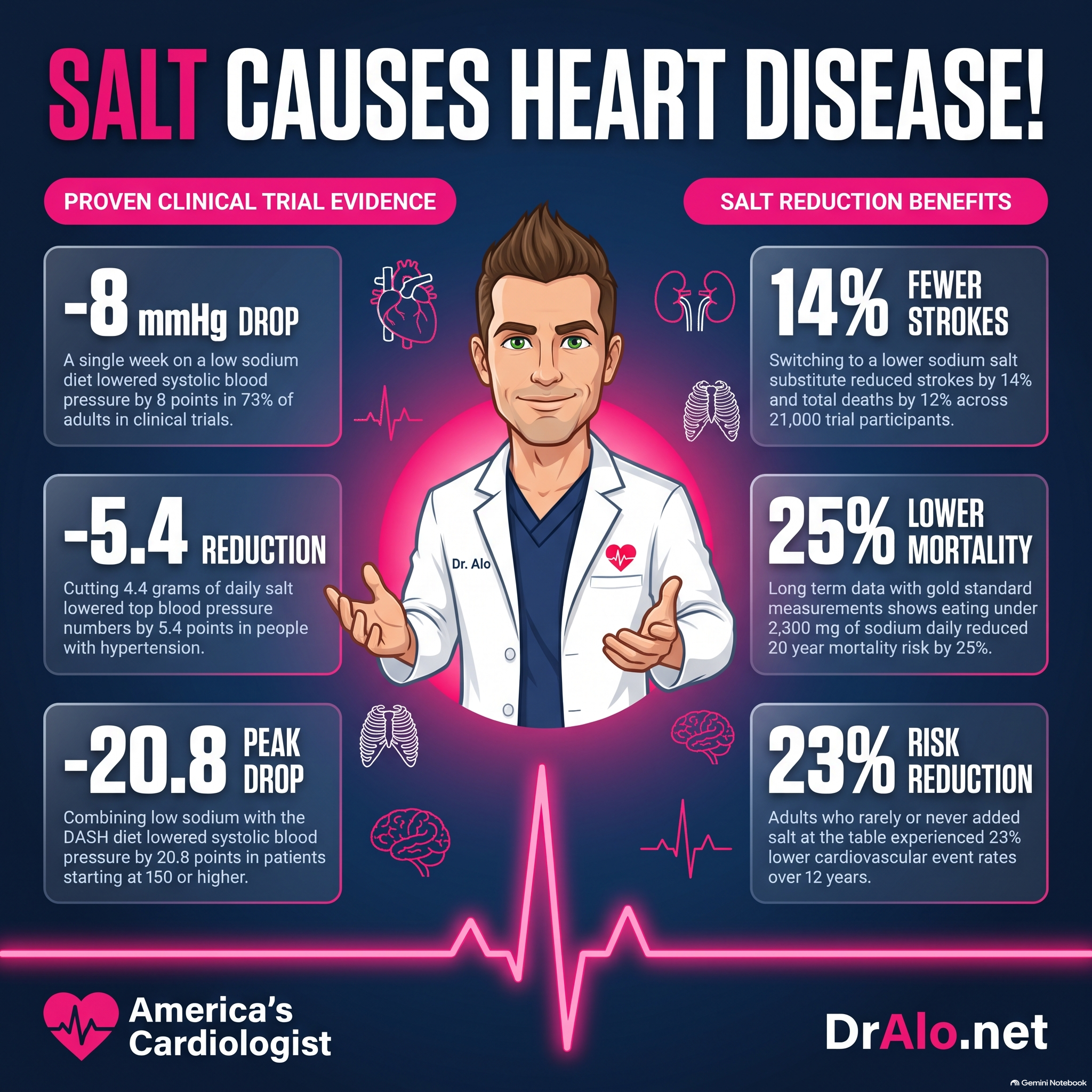
Infographic Summary:
Why I treat hypertension as its own category
Hypertension isn't on the CDC's list of the top ten causes of death. I still think of it as one of the biggest killers we have, because it contributes to, and worsens, nearly every disease state. Just like diabetes. Except hypertension is even more common than diabetes.
High blood pressure damages the arteries in your brain, heart, kidneys and eyes. It thickens the heart muscle. It is the leading driver of strokes. And the burden can be reduced with diet and lifestyle: a Mediterranean-style diet with a lot less salt, exercise, weight loss and quitting smoking are the best natural ways to bring it down.
The North Karelia Project in Finland is my favorite proof of what lifestyle change can do at scale. In the early 1970s, eastern Finland had the highest heart disease death rate in the world. The whole region changed how it ate and lived. Over 40 years, deaths from coronary heart disease in working-age adults fell by 82% in men and 84% in women. In the first 10 years, nearly all of that drop was explained by three changes: lower cholesterol (driven largely by eating less saturated fat), lower blood pressure, and less smoking.
How salt damages your arteries

Figure: how excess salt leads to organ damage. Redrawn from He FJ, et al. J Am Coll Cardiol. 2020;75(6):632-647 (Figure 1), as reproduced in Ghoneim S. J Am Coll Cardiol. 2022;80(23):2168-2170.
A 2020 state-of-the-art review in the Journal of the American College of Cardiology pulled together everything we know about how salt hurts the body. Here is the plain-words version:
- Pressure. Sodium holds water. More sodium in the bloodstream means more fluid in the pipes, and higher pressure against the artery walls. This is the main road, and it is the one proven in trials.
- Stiff, sticky arteries. Salt reduces nitric oxide, the molecule that lets your arteries relax, and increases oxidative stress. In animal studies this happens even when blood pressure doesn't change.
- Immune cells on alert. Salt pushes certain immune cells into a more inflammatory state. More on this below, because the evidence here needs careful reading.
- Organ damage. Over years, this shows up as a thickened heart, damaged kidneys, damaged brain vessels and plaque.
The review authors estimate that too much salt is linked to about 3 million deaths a year worldwide. That makes it one of the top dietary risk factors on the planet.
Salt raises blood pressure. The trials are clear.

Figure: drop in systolic blood pressure in randomized trials of salt reduction, compared with a standard dose of one blood pressure medicine. Redrawn from He FJ, et al. BMJ 2013;346:f1325; Gupta DK, et al. JAMA 2023;330:2258-2266; Sacks FM, et al. N Engl J Med 2001;344:3-10; Juraschek SP, et al. J Am Coll Cardiol 2017;70:2841-2848; and Law MR, et al. BMJ 2003;326:1427.
This is the part of the salt story that is not up for debate. Here is how to read the chart.
- Each bar is how much the top (systolic) number dropped when people ate less salt in a randomized trial. Longer bar, bigger drop.
- The amber dashed line is one blood pressure pill. A large analysis of 354 trials found that one medicine at a standard dose lowers the top number by about 9 points on average.
Now the rows, top to bottom:
- The Cochrane review (34 trials, 3,230 people). Cutting about 4.4 grams of salt a day (about 1,700 mg of sodium) for at least four weeks lowered the top number by 5.4 points in people with high blood pressure and 2.4 points in people with normal blood pressure. It worked in men and women, and in white and Black participants.
- The CARDIA-SSBP trial (2023). 213 adults aged 50 to 75 spent one week on a high-sodium diet and one week on a very low-sodium diet. After just one week, the top number was 8 points lower on low sodium. 73% of people saw their pressure fall. And this held up in people already taking blood pressure medicine.
- The DASH-Sodium trial. The DASH diet (lots of fruits, vegetables, whole grains and low-fat dairy, less saturated fat) combined with low sodium lowered the top number by 7.1 points in people without hypertension and 11.5 points in people with hypertension, compared with a typical American diet high in sodium.
- The highest pressures got the biggest drop. In people starting at a top number of 150 or higher, DASH plus low sodium lowered it by 20.8 points. That is more than two standard-dose pills' worth.
So when I say reducing salt can impact your blood pressure as much as a medication, this is what I mean. It is not a slogan. It is the trial data.
And it works in a dose-response way. A 2020 analysis of 133 randomized trials found that the more sodium people cut, the more their pressure fell, and that short trials actually underestimate the effect. A 2021 analysis of 85 trials in Circulation found a roughly straight-line relationship all the way down to the lowest intakes studied, with no point where cutting more stopped helping. Across all of these reviews the pooled answer was the same every time: less sodium, lower systolic blood pressure.
DASH plus low salt: the higher you start, the bigger the payoff

Figure: drop in systolic blood pressure with low sodium, the DASH diet, or both, compared with a high-sodium typical American diet, by starting blood pressure. Redrawn from Juraschek SP, et al. J Am Coll Cardiol. 2017;70(23):2841-2848.
The DASH-Sodium trial fed 412 adults with prehypertension or stage 1 hypertension (none on blood pressure medicine) carefully controlled diets. Researchers later split the results by where people started.
- Navy bars: low sodium alone. Already strong once the top number was 130 or higher, about 7 to 9 points.
- Amber bars: the DASH diet alone. About 4 to 5 points in most groups, and over 10 in the highest group.
- Pink bars: both together. The biggest drop in almost every group, climbing from 5.3 points in people under 130 to 20.8 points in people at 150 or higher.
Two lessons. First, the people who need it most get the most benefit. Second, diet and salt add together. A healthy diet doesn't give you a pass on salt, and cutting salt works even better on top of a healthy diet. That is why I say a Mediterranean-style diet, just with a lot less salt.
Less salt means fewer strokes, heart events and deaths

Figure: hard outcomes in randomized trials of salt reduction. Redrawn from Neal B, et al. N Engl J Med. 2021;385:1067-1077 (SSaSS) and Cook NR, et al. BMJ 2007;334:885-888 and J Am Coll Cardiol. 2016;68:1609-1617 (TOHP).
Lowering a blood pressure number is nice. But patients want to know: does it prevent strokes and heart attacks? Does it help me live longer? This chart answers that.
- The dot is the result, the line is the margin of error. Left of the dashed line (in the pink zone) means fewer events with less salt.
- Grey means not statistically significant: the margin of error crosses 1.0.
The Salt Substitute and Stroke Study (SSaSS) is the strongest evidence we have. Researchers randomly assigned 600 villages in rural China, almost 21,000 people with a past stroke or age 60+ with high blood pressure, to either keep using regular salt or switch to a salt substitute made of 75% sodium chloride and 25% potassium chloride. After almost 5 years:
- Strokes were 14% lower (29.1 vs 33.7 per 1,000 person-years).
- Major heart and stroke events were 13% lower.
- Deaths from any cause were 12% lower.
- Serious high-potassium problems were no more common (the grey row). Keep in mind people with serious kidney disease were not in this trial.
The Trials of Hypertension Prevention (TOHP) randomized over 3,000 adults aged 30 to 54 with slightly high blood pressure to sodium reduction or usual care for 18 to 48 months. They only cut about 33 to 44 mmol of sodium a day, roughly 750 to 1,000 mg. Ten to fifteen years later, the sodium-reduction group had a 25% lower risk of heart attack, stroke, bypass or stent, or cardiovascular death. Deaths from any cause were 15% lower about 24 years later, but that one was not statistically significant (grey), partly because these were young, fairly healthy people with few deaths.
A modest cut, for a few years, still showed up in heart events a decade later. That tells you how much a lifetime of high salt can add up.
"But low salt is dangerous!" What the best data says

Figure: risk of death from any cause over about 24 years by average measured sodium intake, in TOHP participants not assigned to sodium reduction. Redrawn from Cook NR, Appel LJ, Whelton PK. J Am Coll Cardiol. 2016;68(15):1609-1617.
This is the argument you'll hear from the "salt is fine" crowd: some studies show a J-curve, where people eating very little sodium seem to die more. So, they say, low salt is dangerous.
The problem is how those studies measured salt. Many used a single spot urine sample or a food questionnaire, and many included people who were already sick. People with heart failure, cancer or kidney disease often eat less because they are sick. Low intake ends up as a marker of illness, not a cause of it. That is called reverse causation.
TOHP did it the hard way. Researchers measured sodium with multiple 24-hour urine collections, the gold standard, in healthy middle-aged adults, then followed them for over 20 years. Here is how to read the chart:
- The grey bar (3,600 to 4,799 mg/day) is the reference, set at 1.00.
- People eating under 2,300 mg a day had a 25% lower risk of dying (0.75). People eating 4,800 mg or more had a 7% higher risk.
- Across the whole range, risk rose about 12% for every extra 1,000 mg of sodium a day. That finding was borderline (p = 0.05), and the comparison between groups was not statistically significant on its own, so I treat it as a strong clue, not proof.
What matters most: there was no J-curve. The lowest sodium group did the best. In the cleanest data we have, low sodium was not dangerous.
The real world agrees: the salt shaker tells on you

Figure: frequency of adding salt to food and cardiovascular events in UK Biobank, and higher vs lower salt intake and stroke in a meta-analysis of prospective studies. Redrawn from Ma H, et al. J Am Coll Cardiol. 2022;80(23):2157-2167, and Strazzullo P, et al. BMJ 2009;339:b4567.
Two very different kinds of population studies.
Left side: UK Biobank. 176,570 adults without heart disease answered one simple question: how often do you add salt to your food at the table? Over almost 12 years, compared with people who always added salt, people who never or rarely did had a 23% lower risk of heart and blood vessel events, even after accounting for how healthy the rest of their diet was. The link was strongest for heart failure and coronary heart disease, the disease behind heart attacks. In this study, it was not linked with stroke. People who combined a DASH-style diet with rarely salting their food had the lowest risk of all.
Right side: a meta-analysis of 13 studies with 177,025 people. Higher habitual salt intake was linked to a 23% higher risk of stroke. For cardiovascular disease overall the link was 14%, which was borderline, and became 17% and statistically significant when one outlier study was removed. The bigger the difference in salt intake and the longer the follow-up, the stronger the link.
These are observational studies, so on their own they can't prove cause and effect. But they line up with the randomized trials, and the authors point out that salt is hard to measure accurately, which tends to make the true effect look smaller than it is.
Does salt cause inflammation? Here is the honest answer

Figure: studies on salt, inflammation and oxidative stress sorted by strength of evidence. Sources listed on the figure and in the references below.
Salt has been shown to be pro-inflammatory and to increase oxidative stress, and I want to show you exactly how strong that evidence is at each level, because this is where the science is still moving.
Lab and animal studies: strong and consistent.
- Two papers in Nature in 2013 showed that salt levels found in the body push both mouse and human T cells into TH17 cells, a highly inflammatory type of immune cell involved in autoimmune disease. Mice on a high-salt diet developed more severe autoimmune disease.
- In 2015, researchers showed that high salt flips human and mouse macrophages (the immune cells that live in plaque) into a more inflammatory state they called M(Na), turning up inflammatory signals and turning down the cleanup ones.
- In mice prone to atherosclerosis, a high-salt diet increased superoxide (a damaging form of oxidative stress) in the artery wall and caused more plaque, without changing cholesterol levels. Blocking the superoxide restored normal artery function.
- In rats, just one week of high salt increased oxidative stress, lowered the body's own antioxidant defenses and weakened the ability of brain arteries to dilate, with no change in blood pressure. Immune cells in the lymph nodes and spleen also made more oxidative stress.
- A 2022 review describes how high salt damages the redox systems of the vessel wall, leading to endothelial dysfunction, inflammation, vessel remodeling and eventually atherosclerosis, and how sodium accumulates in inflamed tissues like psoriasis skin.
Small human feeding studies: promising signals.
- In a long-term controlled study, healthy volunteers had their salt fixed at 12, 9 and 6 grams a day for months. On 12 grams, they had more monocytes (inflammatory white blood cells). As salt came down, their cells made less IL-6 and IL-23 (inflammatory signals) and more IL-10 (an anti-inflammatory signal).
- In a 2019 randomized crossover trial, 11 healthy adults ate high salt and low salt for 2 weeks each. High salt raised monocyte CCR2 (the receptor that helps these cells move into tissues), raised the inflammatory signal MCP-1, and increased the number of macrophages in the skin.
- In 86 people with heart failure, those eating more salt had higher hsCRP (6.36 vs 5.21 mg/L), although other inflammation markers did not differ between groups.
Larger human data: not proven yet. I'm not going to hide this part from you.
- In a population study of 1,597 adults, higher sodium was linked with higher CRP, but most of that link went away after accounting for body weight. The authors concluded sodium was unlikely to be a major driver of CRP.
- A 2021 meta-analysis of 8 randomized trials found no significant change in CRP, TNF-alpha or IL-6 between high and low sodium. But the authors themselves pointed out the trials were all over the place: "low" sodium ranged from 460 to 6,740 mg a day, many included people with other diseases, and they called for bigger, cleaner trials.
So here is my read. Salt clearly damages arteries through blood pressure and oxidative stress, and the lab and small human studies show it revving up the immune system. Whether that shows up as higher CRP in your blood work is not settled. You do not need it to be settled to cut back. The blood pressure, stroke and heart event data already make the case. Diets that cut salt lower blood pressure and cardiovascular events. Any inflammation benefit is a bonus we are still measuring.
The fine print
- The salt substitute trial (SSaSS) was in rural China, where most salt is added at home during cooking. In the US, most sodium comes from packaged and restaurant food, so the way you cut it is different, even if the biology is the same.
- Salt substitutes contain potassium. That is part of why they work, but potassium can build up dangerously in people with kidney disease or people on certain medicines (some diuretics, ACE inhibitors, ARBs, spironolactone). SSaSS did not include people with serious kidney disease. Ask your doctor first.
- The cohort studies are observational. People who don't salt their food may also live healthier in other ways. The researchers adjusted for a lot, but adjustment is never perfect.
- Not everyone's blood pressure responds the same. In the 2023 crossover trial, 73% of people saw their pressure fall on low sodium, and about 46% met the definition of "salt sensitive" (a drop of 5 points or more in average pressure). Older adults, Black adults and people with higher blood pressure tend to respond the most.
- Very low sodium in trials is not a goal for everyone. The one-week trial used about 500 mg a day as an experiment. For most people, getting under 2,300 mg, and toward 1,500 mg if you have high blood pressure, is the realistic target.
The myth I want to bury: "Salt is harmless, and low salt is dangerous"
This one is spreading because it sounds contrarian and it sells books. It doesn't hold up.
- Randomized trials show cutting salt lowers blood pressure in people with and without hypertension, and on top of blood pressure medicine.
- Randomized trials show cutting sodium lowers strokes, heart events and deaths.
- The best long-term data, with sodium measured properly, shows no J-curve. The lowest intake did best.
- The studies that seem to show low salt is dangerous mostly measured salt poorly and included sick people who eat less because they are sick.
Yes, salt is an essential nutrient. Your body needs some sodium. But almost nobody in America is at risk of eating too little. The problem is the other end.
What I tell my patients
- Start with a low-sodium diet, then add medicine if you need it. Many people have genetically high blood pressure and there isn't a whole lot they can do to lower it naturally. Most of them will need medication. But starting low sodium first, and staying on it, often means fewer pills, lower doses, and medicines that work better.
- Aim for under 2,300 mg a day, and 1,500 mg if you have high blood pressure. Read labels. Anything with more than 20% of the daily value of sodium per serving is a high-sodium food.
- Go after the hidden salt first. Bread, deli meat, cheese, pizza, canned soup, sauces, frozen meals and restaurant food. Cooking at home is the single biggest step most people can take.
- Eat Mediterranean-style, with a lot less salt. Lots of vegetables, fruit, beans, whole grains, nuts and olive oil. The DASH-Sodium trial shows the diet and the salt cut add together.
- Use flavor instead of salt. Garlic, onion, lemon, vinegar, herbs, spices and pepper. Your taste buds adjust in a few weeks, and food you used to love will start tasting too salty.
- Ask about a salt substitute. If your kidneys are healthy and you are not on potassium-raising medicines, a potassium-based salt substitute is one of the best-proven swaps in nutrition. Check with your doctor first.
- Do the rest of the list too. Exercise, weight loss and quitting smoking lower blood pressure, and cutting saturated fat lowers your LDL. Remember, in North Karelia it was the combination that cut heart deaths by over 80%.
- Measure it. Check your blood pressure at home with a validated arm cuff. You'll often see the difference within one to two weeks of cutting salt.
Frequently asked questions
Does salt really raise blood pressure?
Yes. This is proven in randomized trials. In the Cochrane review of 34 trials, cutting about 4.4 grams of salt a day lowered the top number by about 5.4 points in people with high blood pressure and 2.4 points in people with normal blood pressure. The more salt people cut, the more their pressure fell.
Can cutting salt replace my blood pressure medicine?
For some people with mild hypertension, cutting salt plus the DASH diet can lower blood pressure about as much as one medicine. Many people still need medication, especially when high blood pressure runs in the family. Never stop your medicine on your own. Cut the salt first, check your numbers at home, and let your doctor adjust.
Does salt cause strokes and heart attacks?
High salt intake raises the risk. In a randomized trial of nearly 21,000 people, a lower-sodium salt substitute reduced strokes by 14% and major heart and stroke events by 13%. In the TOHP trials, cutting sodium lowered heart attacks, strokes and other cardiovascular events by 25% over the next 10 to 15 years. Stroke is the outcome most strongly tied to salt, because it is the outcome most strongly tied to blood pressure.
Does salt cause inflammation?
In lab and animal studies, yes, strongly: salt pushes immune cells into inflammatory states and increases oxidative stress in the artery wall. Small human studies show the same direction. Larger human trials have not yet shown a clear rise in blood markers like CRP or IL-6, and the trials so far were small and inconsistent. The inflammation story is promising but still being worked out.
Isn't a low-salt diet dangerous?
Not in the best data we have. In the TOHP trials, where sodium was measured with multiple 24-hour urine collections and people were followed for over 20 years, the lowest sodium group (under 2,300 mg a day) had the lowest risk of death. The studies that suggest otherwise mostly measured salt poorly and included people who ate less because they were already sick.
Is sea salt or pink salt healthier?
No. Sea salt, pink Himalayan salt and kosher salt are all mostly sodium chloride. The tiny amounts of other minerals don't change the effect on your blood pressure. Bigger crystals can mean slightly less sodium per teaspoon, but a teaspoon of most salts still gives you well over a full day's worth of sodium for someone with high blood pressure.
How fast will my blood pressure come down?
In the 2023 crossover trial, the top number was 8 points lower after just one week of low sodium. Most of the benefit shows up within a few weeks, and it keeps working as long as you keep the salt down.
The bottom line
Salt raises blood pressure, and that is proven. Cutting it lowers blood pressure about as much as a medicine, and even more when combined with a DASH or Mediterranean-style diet. In randomized trials, eating less sodium meant fewer strokes, fewer heart events and fewer deaths, and the best long-term data shows no danger from eating less. Salt also damages the artery wall through oxidative stress and revs up the immune system in lab and early human studies, though the effect on blood inflammation markers in people is still being worked out.
If you have high blood pressure, start with a low-sodium diet. Then add medication if you need it. Your arteries, your brain and your heart will thank you.
Still have questions? Stop Googling and ask Dr. Alo.
You've read the science, but applying it to your own life can be confusing. That's exactly what the Heart 2 Heart VIP Community is for. You can ask me questions directly, join live video calls where we talk through your labs and situations like this one, and get physician-level guidance based on your actual numbers.
Join here: https://dralo.net/community 💪🏻🩺🫀
Dr. Alo
References
- He FJ, Tan M, Ma Y, MacGregor GA. Salt reduction to prevent hypertension and cardiovascular disease: JACC state-of-the-art review. Journal of the American College of Cardiology. 2020;75(6):632-647. doi:10.1016/j.jacc.2019.11.055.
- Ghoneim S. Dietary salt intake preferences and the risk of cardiovascular disease. Journal of the American College of Cardiology. 2022;80(23):2168-2170. doi:10.1016/j.jacc.2022.10.005.
- Ma H, Wang X, Li X, Heianza Y, Qi L. Adding salt to foods and risk of cardiovascular disease. Journal of the American College of Cardiology. 2022;80(23):2157-2167. doi:10.1016/j.jacc.2022.09.039.
- He FJ, Li J, MacGregor GA. Effect of longer term modest salt reduction on blood pressure: Cochrane systematic review and meta-analysis of randomised trials. BMJ. 2013;346:f1325.
- Huang L, Trieu K, Yoshimura S, et al. Effect of dose and duration of reduction in dietary sodium on blood pressure levels: systematic review and meta-analysis of randomised trials. BMJ. 2020;368:m315.
- Filippini T, Malavolti M, Whelton PK, et al. Blood pressure effects of sodium reduction: dose-response meta-analysis of experimental studies. Circulation. 2021;143(16):1542-1567.
- Sacks FM, Svetkey LP, Vollmer WM, et al. Effects on blood pressure of reduced dietary sodium and the Dietary Approaches to Stop Hypertension (DASH) diet. New England Journal of Medicine. 2001;344(1):3-10.
- Juraschek SP, Miller ER 3rd, Weaver CM, Appel LJ. Effects of sodium reduction and the DASH diet in relation to baseline blood pressure. Journal of the American College of Cardiology. 2017;70(23):2841-2848.
- Gupta DK, Lewis CE, Varady KA, et al. Effect of dietary sodium on blood pressure: a crossover trial. JAMA. 2023;330(23):2258-2266.
- Law MR, Wald NJ, Morris JK, Jordan RE. Value of low dose combination treatment with blood pressure lowering drugs: analysis of 354 randomised trials. BMJ. 2003;326(7404):1427.
- Neal B, Wu Y, Feng X, et al. Effect of salt substitution on cardiovascular events and death. New England Journal of Medicine. 2021;385(12):1067-1077.
- Cook NR, Cutler JA, Obarzanek E, et al. Long term effects of dietary sodium reduction on cardiovascular disease outcomes: observational follow-up of the trials of hypertension prevention (TOHP). BMJ. 2007;334(7599):885-888.
- Cook NR, Appel LJ, Whelton PK. Sodium intake and all-cause mortality over 20 years in the Trials of Hypertension Prevention. Journal of the American College of Cardiology. 2016;68(15):1609-1617.
- Strazzullo P, D'Elia L, Kandala NB, Cappuccio FP. Salt intake, stroke, and cardiovascular disease: meta-analysis of prospective studies. BMJ. 2009;339:b4567.
- Jousilahti P, Laatikainen T, Salomaa V, et al. 40-year CHD mortality trends and the role of risk factors in mortality decline: the North Karelia Project experience. Global Heart. 2016;11(2):207-212.
- Basdeki ED, Kollias A, Mitrou P, et al. Does sodium intake induce systemic inflammatory response? A systematic review and meta-analysis of randomized studies in humans. Nutrients. 2021;13(8):2632. doi:10.3390/nu13082632.
- Fogarty AW, Lewis SA, McKeever TM, Britton JR. Is higher sodium intake associated with elevated systemic inflammation? A population-based study. American Journal of Clinical Nutrition. 2009;89(6):1901-1904.
- Azak A, Huddam B, Gonen N, et al. Salt intake is associated with inflammation in chronic heart failure. International Cardiovascular Research Journal. 2014;8(3):89-93.
- Ketonen J, Merasto S, Paakkari I, Mervaala EM. High sodium intake increases vascular superoxide formation and promotes atherosclerosis in apolipoprotein E-deficient mice. Blood Pressure. 2005;14(6):373-382.
- Krajina I, Stupin A, Šola M, Mihalj M. Oxidative stress induced by high salt diet: possible implications for development and clinical manifestation of cutaneous inflammation and endothelial dysfunction in psoriasis vulgaris. Antioxidants. 2022;11(7):1269.
- Cosic A, Jukic I, Stupin A, et al. Attenuated flow-induced dilatation of middle cerebral arteries is related to increased vascular oxidative stress in rats on a short-term high salt diet. Journal of Physiology. 2016;594(17):4917-4931.
- Zhang WC, Zheng XJ, Du LJ, et al. High salt primes a specific activation state of macrophages, M(Na). Cell Research. 2015;25(8):893-910.
- Kleinewietfeld M, Manzel A, Titze J, et al. Sodium chloride drives autoimmune disease by the induction of pathogenic TH17 cells. Nature. 2013;496(7446):518-522.
- Wu C, Yosef N, Thalhamer T, et al. Induction of pathogenic TH17 cells by inducible salt-sensing kinase SGK1. Nature. 2013;496(7446):513-517.
- Yi B, Titze J, Rykova M, et al. Effects of dietary salt levels on monocytic cells and immune responses in healthy human subjects: a longitudinal study. Translational Research. 2015;166(1):103-110.
- Wenstedt EF, Verberk SG, Kroon J, et al. Salt increases monocyte CCR2 expression and inflammatory responses in humans. JCI Insight. 2019;4(21):e130508.
Still Have Questions? Stop Googling and Ask Dr. Alo.
You’ve read the science, but applying it to your own life can be confusing. I created the Dr. Alo VIP Private Community to be a sanctuary away from social media noise.
Inside, you get:
-
Direct Access: I answer member questions personally 24/7/365.
-
Weekly Live Streams: Deep dives into your specific health challenges.
-
Vetted Science: No fads, just evidence-based cardiology and weight loss.
Don't leave your heart health to chance. Get the guidance you deserve. All this for less than 0.01% the cost of health insurance! You can cancel at anytime!
[👉 Join the Dr. Alo VIP Community Today]
Cardiology & Obesity Medicine