Ezetimibe (Zetia): Does It Really Prevent Heart Attacks? What the Big Trials Show
Oct 27, 2026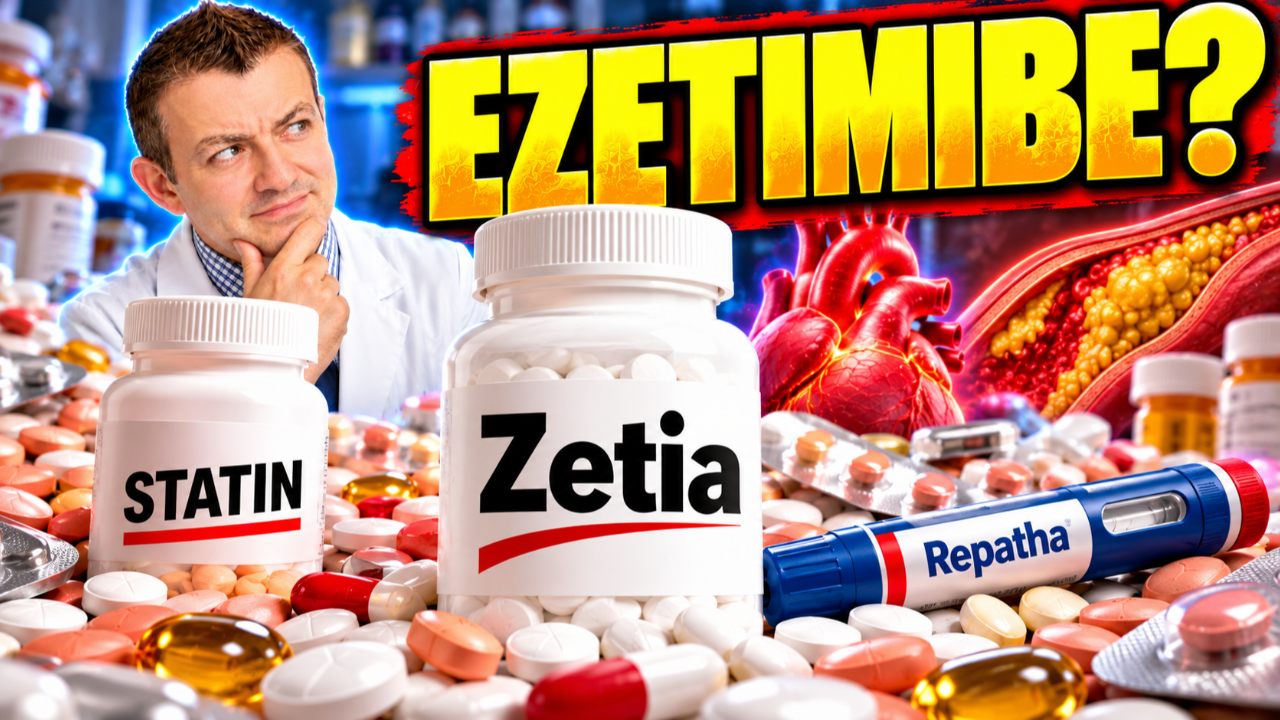
"Dr. Alo, you added a second cholesterol pill. Do I really need ezetimibe, or does it just make my numbers look better?"
I hear some version of this almost every day, and I understand why. Ezetimibe is the medication I prescribe the most. Most of my patients start it on day one, right alongside rosuvastatin. I use it personally as an add-on to statins too. So it deserves a real answer, not a shrug.
Ezetimibe, sold under the brand name Zetia, is a great medication. It gives you about a 15% to 25% drop in LDL cholesterol with almost no side effects. But "it lowers LDL" is not the same as "it prevents heart attacks". So I went back through the big trials: IMPROVE-IT, SHARP, RACING, EWTOPIA 75 and the Cochrane review that pooled them. I redrew the key numbers so they make sense, and I'll show you exactly what ezetimibe does, what it doesn't do, and why I use it the way I do.
Key takeaways
- Ezetimibe lowers LDL by about 15% to 25%, on its own or on top of a statin, by blocking cholesterol absorption in your gut.
- Adding ezetimibe beats doubling your statin. In a pooled analysis of 17 trials, adding ezetimibe dropped LDL another 26%, versus about 10% for doubling the statin dose.
- It prevents heart attacks and strokes. In IMPROVE-IT, adding ezetimibe to a statin after a heart attack cut heart attacks by 13% and ischemic strokes by 21%.
- The higher your risk, the bigger the payoff. In high-risk patients, only 16 people needed treatment for 7 years to prevent one major event.
- A moderate statin plus ezetimibe works as well as a high-dose statin, with more people reaching their LDL goal and fewer stopping because of side effects (RACING).
- It has not been shown to help people live longer. The benefit comes from fewer nonfatal heart attacks and strokes.
- My approach: I start most people on rosuvastatin and ezetimibe together. You get a bigger LDL drop without a high statin dose, and we can always titrate the statin up if needed.
Infographic Summary:
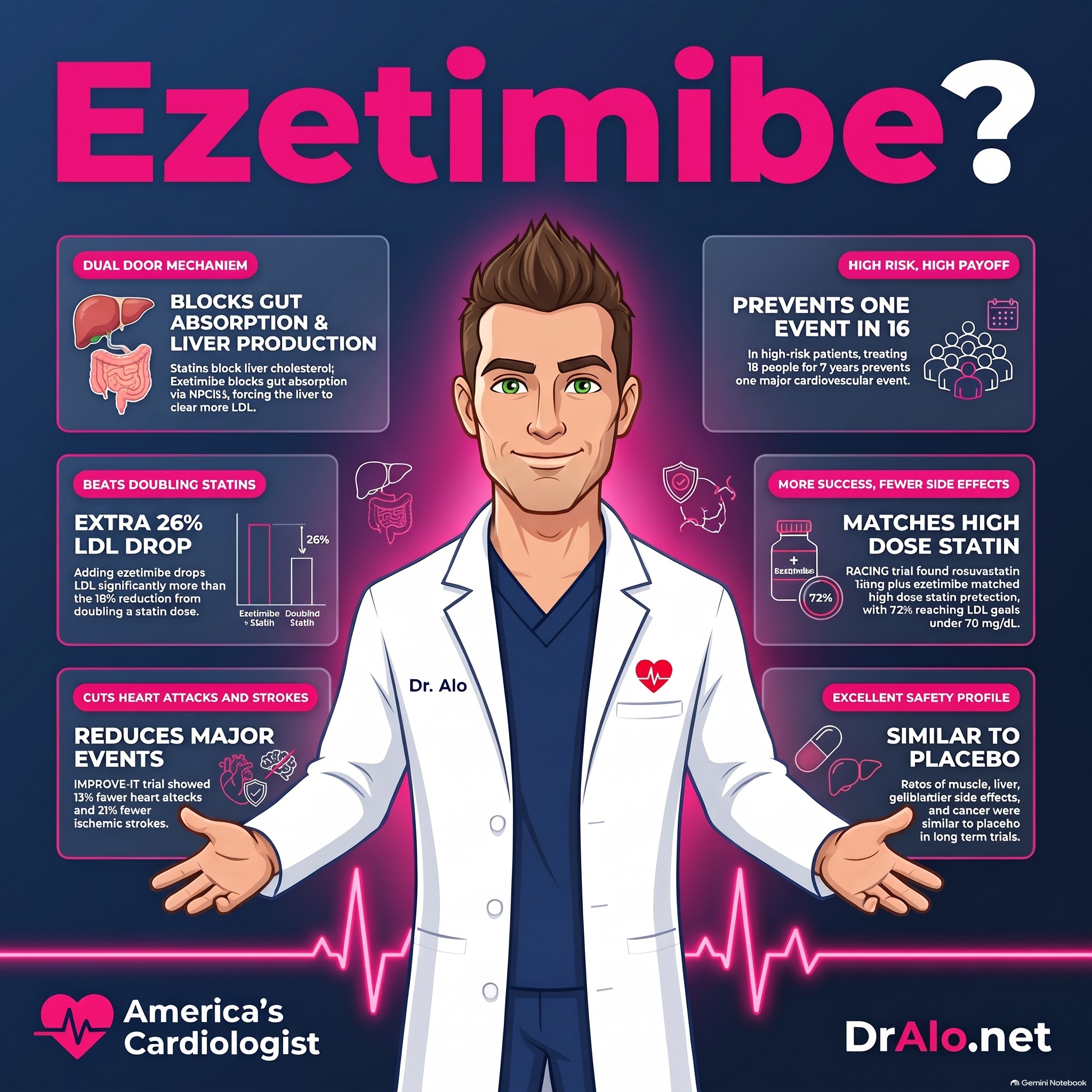

How ezetimibe works: two doors for cholesterol

Figure: how statins and ezetimibe lower LDL. Mechanism as described in Preiss D, et al. JACC. 2020;75:1945-1955.
The cholesterol in your blood comes from two places: what your liver makes, and what your gut absorbs from food and from the bile your liver dumps into your intestine every day.
- Statins close the first door. They block the enzyme your liver uses to make cholesterol.
- Ezetimibe closes the second door. It blocks a protein called NPC1L1, the doorway your small intestine uses to absorb cholesterol.
Either way, your liver runs short of cholesterol. So it does the smart thing: it puts more LDL receptors on its surface and pulls more LDL out of your blood. That is the number that goes down on your lab report.
Because the two pills work on different doors, they add up. That's the whole reason I like them together.
Why I add ezetimibe instead of doubling the statin

Figure: extra LDL lowering in people already taking a statin. Redrawn from Ambegaonkar BM, et al. Atherosclerosis. 2014;237:829-837 and Bays HE, et al. (ACTE) Am J Cardiol. 2011;108:523-530.
This is the chart that explains how I prescribe. Statins have a quirk: the first dose does most of the work. Every time you double the dose after that, you only get a little more LDL lowering, while the chance of side effects keeps creeping up.
Here is how to read the chart:
- Top panel: a pooled analysis of 17 trials in people who were already on a statin. Adding ezetimibe dropped LDL another 26.0%. Switching to rosuvastatin 10 mg dropped it 19.7%. Doubling the statin they were on dropped it only 9.7%.
- Bottom panel: the ACTE trial, in people on rosuvastatin 5 or 10 mg. Adding ezetimibe lowered LDL by 21%. Doubling the rosuvastatin lowered it by only 5.7%. Ezetimibe plus rosuvastatin 10 mg even beat rosuvastatin 20 mg.
So when I start rosuvastatin and ezetimibe together, you get a more pronounced LDL drop without needing such a high statin dose. If your LDL still isn't where we want it, we can always titrate the statin up. If you want to know why rosuvastatin is my first statin, I wrote about that in which statin should you take and Crestor vs Lipitor.
IMPROVE-IT: the trial that proved it prevents heart attacks

Figure: the main results of IMPROVE-IT. Redrawn from Cannon CP, et al. NEJM. 2015;372:2387-2397, with stroke data from Bohula EA, et al. Circulation. 2017 and total events from Murphy SA, et al. JACC. 2016.
For years, the knock on ezetimibe was that it lowered LDL but nobody had shown it prevented anything. IMPROVE-IT settled that. It enrolled 18,144 people who had just had a heart attack or unstable angina. Everyone got simvastatin, and half also got ezetimibe. They were followed for a median of 6 years, and some for much longer.
Here is how to read the chart:
- Left side, LDL: average LDL during the trial was 69.5 mg/dL on simvastatin alone and 53.7 mg/dL with ezetimibe added. Remember, these people already had pretty good LDL levels when they started.
- Right side, events: ischemic strokes (the kind caused by a clot) fell 21% (3.4% vs 4.1%). Heart attacks fell 13%. When you count every event, including second and third ones, events fell 9%. The main measure, the first major event, fell 6%: from 34.7% to 32.7% at 7 years.
- Death: there was no difference in deaths from heart disease or from any cause.
That 2 percentage point difference means about 50 people needed to take ezetimibe for 7 years to prevent one major event. That may not sound dramatic, but remember who these people were: they were already on a statin, with LDL already around 70. Ezetimibe got them lower, and lower meant fewer heart attacks and strokes. That's the lower-is-better principle in action.
One more detail I like: rates of muscle, gallbladder and liver side effects, and cancer, were similar in the two groups.
Who benefits the most?

Figure: absolute reduction in major events with ezetimibe added, by subgroup. Redrawn from Giugliano RP, et al. Circulation. 2018 (diabetes), Bach RG, et al. JAMA Cardiol. 2019 (age) and Bohula EA, et al. JACC. 2017 (risk factors). The "1 in 18" and "1 in 11" numbers are my calculations.
An average can hide a lot. When researchers broke IMPROVE-IT down, the benefit was concentrated in the people at the highest risk. Each bar shows how many fewer events happened out of every 100 people over 7 years.
- Diabetes: 5.5 fewer events per 100 people, versus 0.7 in people without diabetes. That works out to about 1 in 18 people with diabetes helped.
- Age 75 and older: 8.7 fewer events per 100, the biggest benefit of any group, with no increase in side effects. People under 75 had a much smaller benefit.
- Three or more risk factors (things like diabetes, high blood pressure, kidney disease, prior stroke or bypass surgery): 6.3 fewer events per 100. Only 16 people needed treatment to prevent one heart attack, ischemic stroke or heart death. People with 0 or 1 risk factor didn't show a clear benefit.
This is the pattern you see with every LDL-lowering drug. The more risk you carry, the more events there are to prevent, and the more a few extra points of LDL lowering pays off. People with diabetes and people over 75 are exactly the ones I'm most aggressive with.
RACING: a moderate statin plus ezetimibe vs a high-dose statin

Figure: the main results of RACING. Redrawn from Kim BK, et al. Lancet. 2022;400:380-390.
This is the trial that matches what I do in my clinic almost exactly. RACING took 3,780 people with heart or vascular disease and gave them either rosuvastatin 10 mg plus ezetimibe 10 mg, or rosuvastatin 20 mg alone, a high-intensity dose. They were followed for 3 years.
- Heart events, strokes or heart deaths: 9.1% with the combination vs 9.9% with the high-dose statin. The combination was just as protective.
- Reached LDL under 70 mg/dL at year 3: 72% vs 58%. More people got to goal.
- Stopped the drug or cut the dose because of side effects: 4.8% vs 8.2%. Fewer people quit.
That last line matters more than people think. The best cholesterol medicine is the one you actually keep taking. A plan that gets more people to goal and keeps more people on treatment is a better plan.
The rest of the evidence, on one chart

Figure: outcome results with ezetimibe. Redrawn from Cannon CP, et al. NEJM 2015; Baigent C, et al. (SHARP) Lancet 2011; Ouchi Y, et al. (EWTOPIA 75) Circulation 2019; Zhan S, et al. Cochrane 2018.
This is a forest plot. Each square is one result, and the line through it is the range the true answer probably falls in. Anything to the left of the dotted line at 1 means fewer events with ezetimibe. If the line crosses 1, we can't say there was a difference.
- IMPROVE-IT (0.936): covered above.
- SHARP (0.83): 9,270 people with chronic kidney disease, a group with very high heart risk, got simvastatin plus ezetimibe or placebo. Major atherosclerotic events fell 17% (11.3% vs 13.4%). Since there was no simvastatin-only group, SHARP shows the combination works, not how much came from ezetimibe alone.
- EWTOPIA 75 (0.66): 3,796 Japanese adults aged 75 and older with high LDL and no history of heart disease got ezetimibe alone, without a statin, or usual care. Events fell 34%. More on its limitations below.
- Cochrane, major events (0.94): 26 trials and 23,499 people. Adding ezetimibe to a statin lowered major cardiovascular events by 6%, nonfatal heart attacks by 12% and nonfatal strokes by 17%.
- Cochrane, death (0.98 and 1.00): the grey rows. No clear difference in death from any cause or from heart disease.
So the story is consistent. Ezetimibe means fewer heart attacks and strokes. It has not been shown to help people live longer.
What about CLEAR Outcomes and Nexlizet?
You might see CLEAR Outcomes mentioned next to ezetimibe, but it was not an ezetimibe trial. It tested bempedoic acid (Nexletol), a different pill, in nearly 14,000 people who couldn't take statins. Bempedoic acid lowered major heart events by 13%.
The connection: bempedoic acid and ezetimibe are sold together as one pill, Nexlizet. In its main trial, the combination lowered LDL about 38% more than placebo in people already on their highest tolerated statin. For patients who truly can't take a statin, that's a useful option.
Is ezetimibe safe?
This is the part of the story I like the most. Ezetimibe is one of the best-tolerated medications I prescribe.
- In IMPROVE-IT, muscle, gallbladder and liver side effects and cancer were similar with and without ezetimibe, over years of follow-up.
- The Cochrane review found little or no difference in liver problems, cancer, gallbladder disease, or people stopping the drug because of side effects. Data on muscle problems were too limited to say much either way.
- In RACING, the combination with ezetimibe led to fewer people stopping or cutting their dose than the high-dose statin.
It's one 10 mg tablet a day. That's it.
The fine print
- No trial showed that ezetimibe lowers death. The benefit comes from fewer nonfatal heart attacks and strokes. That still matters a lot. A stroke you never have is a stroke you never recover from.
- IMPROVE-IT used simvastatin 40 mg, a moderate statin, as the background. It didn't directly test ezetimibe on top of a high-intensity statin. RACING helps fill that gap, but it compared strategies, not ezetimibe vs no ezetimibe.
- The subgroup results are subgroups. They line up with the general rule that higher-risk people get more benefit, but they are not separate trials.
- EWTOPIA 75 has real limitations. It was open-label (people knew what they were taking), and some patients were excluded from the main analysis for consent and protocol problems. The authors themselves said the size of the benefit should be interpreted with caution.
- RACING was open-label and done in South Korea, and it was a noninferiority trial, designed to show the combination was not worse, not that it was better.
The myth I want to clear up: "Ezetimibe just makes your numbers look better"
This myth goes back to a 2008 trial called ENHANCE. In about 720 people with a genetic form of very high cholesterol, adding ezetimibe to high-dose simvastatin lowered LDL but didn't slow the thickening of the carotid artery wall over 2 years. The headlines said ezetimibe "didn't work".
But ENHANCE measured an imaging marker in a small group for a short time. It didn't measure heart attacks or strokes. IMPROVE-IT did, in over 18,000 people, for years. And it showed exactly what you'd expect if LDL causes heart disease: lower LDL, fewer heart attacks and fewer strokes.
Ezetimibe doesn't just change a number. It changes the number that builds plaque in your arteries.
What I tell my patients
- Most people start on rosuvastatin plus ezetimibe together. You get a bigger LDL drop without needing a high statin dose.
- If we need more, we titrate the statin up. We always have room to go higher.
- If a statin gave you side effects, don't give up on treatment. We use the highest statin dose you tolerate, add ezetimibe, and consider other options like bempedoic acid or a PCSK9 medicine if needed.
- The higher your risk, the more ezetimibe helps. Diabetes, a prior heart attack or stroke, kidney disease and age over 75 are where it shines.
- Ezetimibe is not a replacement for a statin if you have heart disease. No outcome trial has shown that, so I use it alongside one.
- Take it every day. One tablet, any time of day, with or without food.
- Check your numbers. We recheck your LDL and apoB after starting, so we know the plan is working.
Frequently asked questions
How much does ezetimibe lower LDL?
About 15% to 25%, whether you take it alone or on top of a statin. In a pooled analysis of 17 trials, adding it to a statin lowered LDL another 26%, compared with about 10% for doubling the statin dose.
Does ezetimibe prevent heart attacks and strokes?
Yes. In IMPROVE-IT, adding ezetimibe to a statin after a heart attack lowered heart attacks by 13% and ischemic strokes by 21%. The Cochrane review of 26 trials found 6% fewer major cardiovascular events.
Does ezetimibe help you live longer?
That hasn't been shown. In IMPROVE-IT and in the Cochrane review, there was no difference in death from heart disease or from any cause. The benefit is fewer nonfatal heart attacks and strokes.
Why not just take a higher dose of statin?
Each doubling of a statin dose only lowers LDL a little more, often around 6% to 10%. Adding ezetimibe usually lowers it 20% to 25% more. In the RACING trial, rosuvastatin 10 mg plus ezetimibe was as protective as rosuvastatin 20 mg, got more people to goal and caused fewer people to stop treatment.
What are the side effects of ezetimibe?
In large trials, side effects were about the same as placebo. The Cochrane review found little or no difference in liver problems, cancer, gallbladder disease or stopping the drug because of side effects.
Can I take ezetimibe instead of a statin?
If you have heart disease, no outcome trial has shown that ezetimibe alone can replace a statin, so I use it alongside the highest statin dose you tolerate. In adults 75 and older without heart disease, the EWTOPIA 75 trial found ezetimibe alone lowered events by 34%, though that trial had limitations.
Is ezetimibe the same as Zetia?
Yes. Zetia is the brand name. Generic ezetimibe is the same medicine. It's also combined with simvastatin (Vytorin) and with bempedoic acid (Nexlizet).
The bottom line
Ezetimibe is not a miracle drug, but it is a proven and very well tolerated way to lower LDL further. It lowers LDL by 15% to 25%, prevents heart attacks and strokes, works best for people at the highest risk, and lets us reach your LDL goal without pushing your statin dose sky high. That's why I start most people on rosuvastatin and ezetimibe together, and why it's the medication I prescribe the most. The lower your LDL goes, the fewer heart attacks and strokes you're likely to have, and ezetimibe helps get you there.
Still have questions? Stop Googling and ask Dr. Alo.
You've read the science, but applying it to your own life can be confusing. That's exactly what the Heart 2 Heart VIP Community is for. You can ask me questions directly, join live video calls where we talk through your labs and situations like this one, and get physician-level guidance based on your actual numbers.
Join here: https://dralo.net/community 💪🏻🩺🫀
Dr. Alo
References
- Cannon CP, Blazing MA, Giugliano RP, et al. Ezetimibe added to statin therapy after acute coronary syndromes (IMPROVE-IT). New England Journal of Medicine. 2015;372(25):2387-2397. doi:10.1056/NEJMoa1410489.
- Murphy SA, Cannon CP, Blazing MA, et al. Reduction in total cardiovascular events with ezetimibe/simvastatin post-acute coronary syndrome: the IMPROVE-IT trial. Journal of the American College of Cardiology. 2016;67(4):353-361. doi:10.1016/j.jacc.2015.10.077.
- Bohula EA, Wiviott SD, Giugliano RP, et al. Prevention of stroke with the addition of ezetimibe to statin therapy in patients with acute coronary syndrome in IMPROVE-IT. Circulation. 2017;136(25):2440-2450. doi:10.1161/CIRCULATIONAHA.117.029095.
- Bohula EA, Morrow DA, Giugliano RP, et al. Atherothrombotic risk stratification and ezetimibe for secondary prevention. Journal of the American College of Cardiology. 2017;69(8):911-921. doi:10.1016/j.jacc.2016.11.070.
- Giugliano RP, Cannon CP, Blazing MA, et al. Benefit of adding ezetimibe to statin therapy on cardiovascular outcomes and safety in patients with versus without diabetes mellitus: results from IMPROVE-IT. Circulation. 2018;137(15):1571-1582. doi:10.1161/CIRCULATIONAHA.117.030950.
- Bach RG, Cannon CP, Giugliano RP, et al. Effect of simvastatin-ezetimibe compared with simvastatin monotherapy after acute coronary syndrome among patients 75 years or older. JAMA Cardiology. 2019;4(9):846-854. doi:10.1001/jamacardio.2019.2306.
- Baigent C, Landray MJ, Reith C, et al. The effects of lowering LDL cholesterol with simvastatin plus ezetimibe in patients with chronic kidney disease (SHARP). Lancet. 2011;377(9784):2181-2192. doi:10.1016/S0140-6736(11)60739-3.
- Kim BK, Hong SJ, Lee YJ, et al. Long-term efficacy and safety of moderate-intensity statin with ezetimibe combination therapy versus high-intensity statin monotherapy in patients with atherosclerotic cardiovascular disease (RACING). Lancet. 2022;400(10349):380-390. doi:10.1016/S0140-6736(22)00916-3.
- Ouchi Y, Sasaki J, Arai H, et al. Ezetimibe lipid-lowering trial on prevention of atherosclerotic cardiovascular disease in 75 or older (EWTOPIA 75). Circulation. 2019;140(12):992-1003. doi:10.1161/CIRCULATIONAHA.118.039415.
- Zhan S, Tang M, Liu F, et al. Ezetimibe for the prevention of cardiovascular disease and all-cause mortality events. Cochrane Database of Systematic Reviews. 2018;11:CD012502. doi:10.1002/14651858.CD012502.pub2.
- Ambegaonkar BM, Tipping D, Polis AB, et al. Achieving goal lipid levels with ezetimibe plus statin add-on or switch therapy compared with doubling the statin dose: a pooled analysis. Atherosclerosis. 2014;237(2):829-837. doi:10.1016/j.atherosclerosis.2014.10.105.
- Bays HE, Davidson MH, Massaad R, et al. Safety and efficacy of ezetimibe added on to rosuvastatin 5 or 10 mg versus up-titration of rosuvastatin in patients with hypercholesterolemia (the ACTE study). American Journal of Cardiology. 2011;108(4):523-530. doi:10.1016/j.amjcard.2011.03.079.
- Preiss D, Tobert JA, Hovingh GK, Reith C. Lipid-modifying agents, from statins to PCSK9 inhibitors: JACC focus seminar. Journal of the American College of Cardiology. 2020;75(16):1945-1955.
- Kastelein JJP, Akdim F, Stroes ESG, et al. Simvastatin with or without ezetimibe in familial hypercholesterolemia (ENHANCE). New England Journal of Medicine. 2008;358(14):1431-1443. doi:10.1056/NEJMoa0800742.
- Nissen SE, Lincoff AM, Brennan D, et al. Bempedoic acid and cardiovascular outcomes in statin-intolerant patients (CLEAR Outcomes). New England Journal of Medicine. 2023;388(15):1353-1364. doi:10.1056/NEJMoa2215024.
- Alexander JH. Benefits of bempedoic acid: clearer now. New England Journal of Medicine. 2023. doi:10.1056/NEJMe2301490.
- Ballantyne CM, Laufs U, Ray KK, et al. Bempedoic acid plus ezetimibe fixed-dose combination in patients with hypercholesterolemia and high CVD risk treated with maximally tolerated statin therapy. European Journal of Preventive Cardiology. 2020;27(6):593-603.
Still Have Questions? Stop Googling and Ask Dr. Alo.
You’ve read the science, but applying it to your own life can be confusing. I created the Dr. Alo VIP Private Community to be a sanctuary away from social media noise.
Inside, you get:
-
Direct Access: I answer member questions personally 24/7/365.
-
Weekly Live Streams: Deep dives into your specific health challenges.
-
Vetted Science: No fads, just evidence-based cardiology and weight loss.
Don't leave your heart health to chance. Get the guidance you deserve. All this for less than 0.01% the cost of health insurance! You can cancel at anytime!
[👉 Join the Dr. Alo VIP Community Today]
Cardiology & Obesity Medicine