Should You Take a Statin If You Are Over 60?
Oct 27, 2026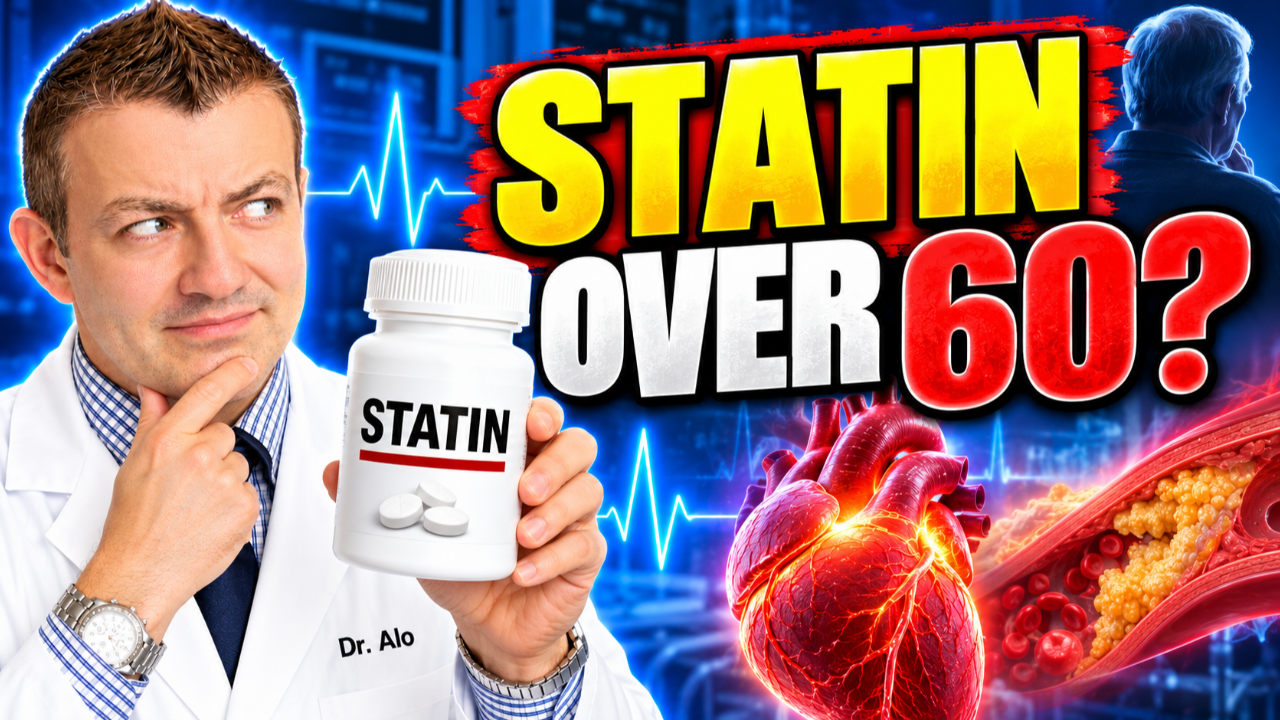
Do Statins Work After Age 60?
"Dr. Alo, I'm 68. Isn't it a little late for a statin? My neighbor read a book that says older people shouldn't even try to lower their cholesterol."
I get this question all the time, and I understand where it comes from. One popular book, The Cholesterol Myth, concluded that treating older adults with a statin had no benefit and that people over 60 should not attempt to lower their cholesterol.
That flies in the face of almost every major statin trial ever run. Most of them enrolled people in their 60s and 70s, and those people benefited. And in 2026 we finally got the trial everyone was waiting for, in healthy adults over 70. So let's go through what the research actually shows, one situation at a time, with the charts redrawn so they make sense.
Key takeaways
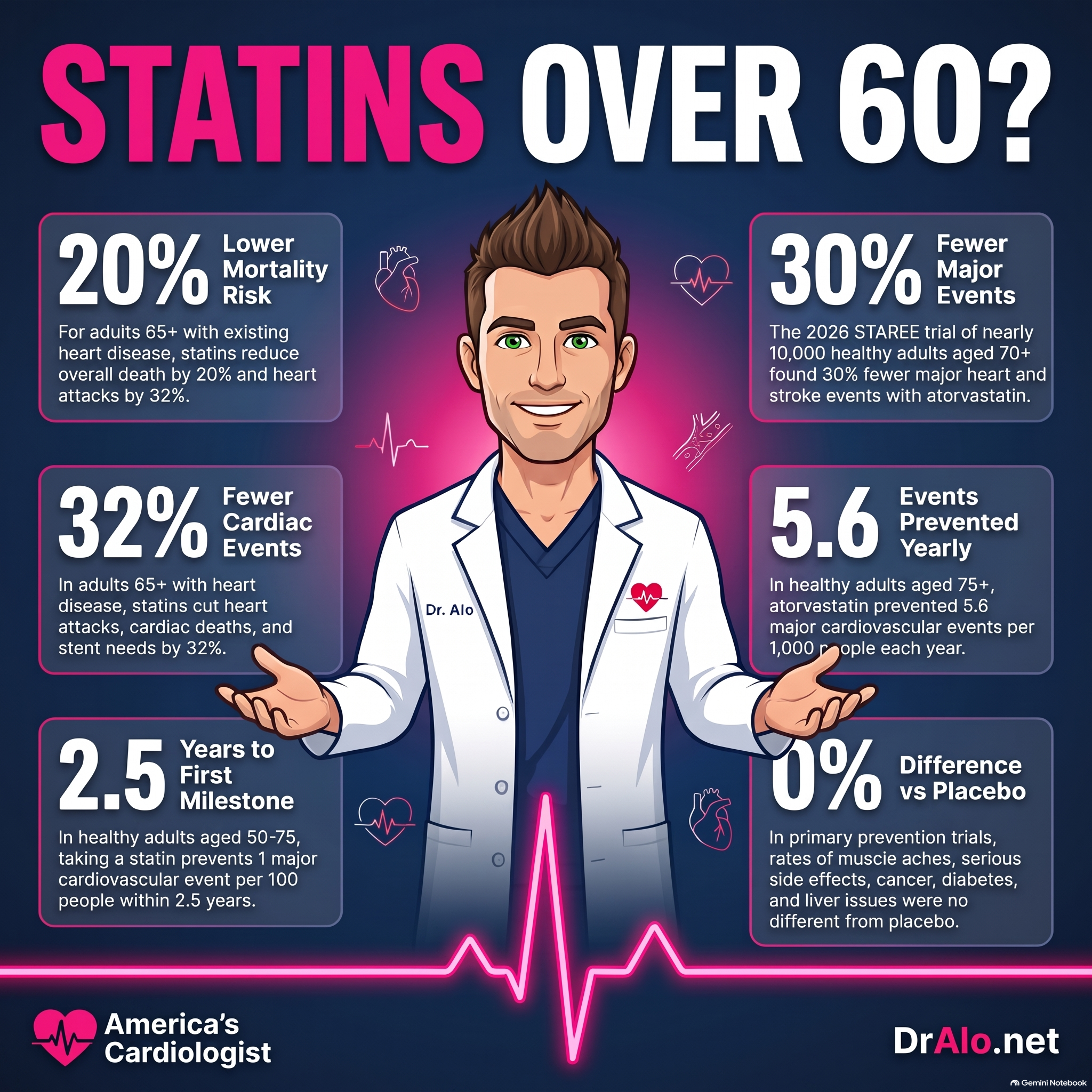
- If you already have heart disease (a heart attack, stroke, stent or bypass), a statin after 65 lowers your risk of dying by about 20% and of another heart attack by about 32%. This is high-certainty evidence.
- If you have no heart disease and you are 60 to 75, statins cut heart attacks substantially. Treat 100 people for 2.5 years and you prevent 1 heart attack, stroke or cardiac death, and the benefit keeps growing every year after that.
- If you are over 70 and healthy, the 2026 STAREE trial of nearly 10,000 people found 30% fewer major heart and stroke events with atorvastatin. People over 75 got the largest benefit in absolute terms.
- Side effects: in placebo-controlled prevention trials, muscle aches, serious side effects, cancer, diabetes and liver problems were no different between statin and placebo.
- Age alone should not decide. Your risk, your LDL, your calcium score, your other health problems and your goals should.
Infographic Summary:
The first question I ask: have you already had heart disease?
Doctors split statin use into two groups. Secondary prevention means you have already had a heart attack, stroke, stent, bypass or blocked leg arteries, and we are trying to prevent the next one. Primary prevention means you have never had an event and we are trying to prevent the first one.
The answer to "should I take a statin after 60?" is different for each group, so I'll take them one at a time.

Figure: Percent lower risk with a statin in adults 65 and older. Redrawn from Ponce et al., Journal of Clinical Endocrinology and Metabolism, 2019 (abstract results).
How to read it: each bar is how much lower the risk was with a statin. The little whisker line is the 95% range, which is the zone where the true answer most likely sits. A team at the Mayo Clinic pooled 23 randomized trials that enrolled 60,194 people aged 65 or older. In people who already had heart disease (the pink bars), statins lowered death from any cause by 20%, death from heart causes by 32%, heart attacks by 32% and the need for stents or bypass by 32%. The authors rated that evidence as high certainty.
In people without heart disease (the navy bars), heart attacks fell by 55%. Death and stroke did not change significantly. I'll come back to why, because it is not what the anti-statin crowd says it is.
With heart disease, age does not change the benefit

Figure: Major vascular events by age, with and without known vascular disease. Redrawn from the Cholesterol Treatment Trialists' Collaboration, The Lancet, 2019.
How to read it: the Cholesterol Treatment Trialists pooled the individual records of 186,854 people from 28 trials. Each square is one age band. A square left of the dashed line means fewer heart attacks, strokes and stents or bypass on a statin. The middle column shows how many people per 100 had an event each year, statin versus control.
Look at the pink rows. If you have heart disease, a statin cut major events by about 20% at every age, from 55 or younger all the way past 75. Notice also that the event rate climbs with age, from 5.1% a year to 6.8% a year in the control groups. The older you are, the more events there are to prevent.
The navy rows are people without heart disease. The benefit is clear up to age 70. After that, the squares drift toward the line and the ranges cross it. That does not mean the statin stopped working at 71. It means these older trials enrolled very few healthy people over 75, so the answer was uncertain. That was the honest gap in the evidence for years, and it is exactly the gap the STAREE trial closed. More on that below.
Ages 50 to 75 without heart disease: how long does a statin take to work?
A 2021 study in JAMA Internal Medicine, "Evaluation of Time to Benefit of Statins for the Primary Prevention of Cardiovascular Events in Adults Aged 50 to 75 Years," asked a very practical question. If you are older and healthy, how long do you have to take a statin before it pays off?
The researchers pooled 8 randomized placebo-controlled trials with 65,383 adults whose average ages ranged from 55 to 69. They found that adults 50 to 75 get a significant benefit from a statin for primary prevention. The exact opposite of what The Cholesterol Myth concluded. It's just not as sexy, and no one is selling a book with it.

Figure: Events prevented per 100 people treated, by years on a statin. Redrawn from Yourman et al., JAMA Internal Medicine, 2021 (Results and Table 2).
How to read it: the line shows how many heart attacks, strokes or cardiac deaths a statin prevented for every 100 people, depending on how long they took it. At 1 year it was 0.3. At 2.5 years it reached 1 in 100, which is a number needed to treat of 100. At 3 years it was 1.3, and by 5 years it was 2.5 per 100, which is a number needed to treat of only 40.
The boxes on the right tell the same story another way. Within about 10 months, 1 event is prevented for every 500 people. By 1.3 years, 1 for every 200. By 2.5 years, 1 for every 100.
This is the part people miss. The benefit is not a one-time thing. Plaque builds up over decades because of lifelong exposure to LDL. A statin lowers that exposure, and the longer you are on it, the more events it prevents. A 2.5-year snapshot badly underestimates what 10 or 20 years of treatment does.
Older and higher risk? The payoff comes faster

Figure: Time to prevent 1 event per 100 treated, trial by trial. Redrawn from Yourman et al., JAMA Internal Medicine, 2021 (Table 2).
How to read it: each dot is one trial, and a shorter distance means faster benefit. The pink trials had an average age of 65 or older. The fastest of all was CARDS, which enrolled people aged 65 to 75 with type 2 diabetes. It took only 1.4 years to prevent 1 event per 100. That makes sense: the higher your risk, the sooner a statin pays off, and age itself is one of the biggest risk factors there is.
The slowest was MEGA, which used a low dose of pravastatin, 10 to 20 mg. The dose matters too. The statistical tests showed that the differences between trials were consistent with chance, so the pooled answer of 2.5 years is a fair summary.
What about side effects?
This is the other half of the decision, so let's look at it head on.

Figure: Benefits and side effects, statin versus placebo. Redrawn from Chou et al., US Preventive Services Task Force evidence report, JAMA, 2022.
How to read it: each square is the risk with a statin compared with placebo. Left of the dashed line means lower with the statin. Pink means a real, proven difference. Grey means the range crosses the line, so no proven difference.
In adults 40 to 75 without heart disease, statins lowered heart attacks by 33%, stents or bypass by 29%, strokes by 22% and death from any cause by 8%. Now look at the bottom half. Serious side effects, stopping because of side effects, muscle aches, cancer, diabetes and liver enzyme rises were all no different from placebo. Severe muscle breakdown, the one everyone fears, happened in 4 out of 30,213 people on a statin and 2 out of 29,459 on placebo.
Muscle aches are real for some people, and I take them seriously. But in blinded trials, people on placebo report them just as often. If you have had trouble with one statin, there are other statins, lower doses, every-other-day dosing and non-statin options. Don't give up on lowering your LDL.
Over 70 and healthy: the STAREE trial
For years, the honest answer for healthy people over 70 was "we think so, but we don't have a big trial." Guidelines called it an evidence gap. In 2026, the New England Journal of Medicine published STAREE, and the gap is closed.

Figure: Major cardiovascular events per 1,000 person-years. Redrawn from Zoungas et al., New England Journal of Medicine, 2026 (abstract).
How to read it: STAREE randomized 9,971 adults in Australia aged 70 or older, average age 74.7, who had no heart disease, no diabetes and no dementia. Half took atorvastatin 40 mg and half took a placebo, for a median of 5.9 years. The bars show how often a heart attack, stroke, stent or bypass, or cardiac death happened. On placebo it was 15.5 per 1,000 person-years. On atorvastatin it was 10.9. That is 30% fewer major events.
Serious side effects were identical at 2.7% in both groups. And here is a detail I love: by 5 years only about 56% of the atorvastatin group was still taking it, and some people on placebo had started a statin on their own. That dilutes the difference between the groups, so the true benefit of actually taking the pill is probably bigger than 30%.
Over 75? The oldest people benefited the most

Figure: Percent lower risk of a major event by subgroup. Redrawn from Zoungas et al., New England Journal of Medicine, 2026 (subgroup analysis).
How to read it: each bar is how much lower the risk was on atorvastatin in that group. People aged 70 to 74 had 33% fewer events, and people 75 and older had 27% fewer. Here is the key point. Because people over 75 have more heart attacks and strokes to begin with (20.8 per 1,000 per year on placebo versus 12.0 in the 70 to 74 group), the statin prevented more events in the oldest group: about 5.6 per 1,000 people every year, versus 4.0.
The higher the starting LDL, the bigger the benefit: 37% fewer events when LDL was over 139 mg/dL. Men had a clear 38% benefit. In women the bar points the same way, 15% lower, but the range crosses zero. Subgroups are smaller, so I read them as clues, not rules, and I would not tell an older woman a statin doesn't work for her based on this.
A 2020 review in The Lancet backs this up across all cholesterol-lowering drugs.

Figure: Percent lower risk per 39 mg/dL drop in LDL. Redrawn from Gencer et al., The Lancet, 2020 (abstract).
How to read it: this review pooled 29 trials with 244,090 patients, of whom 21,492 were 75 or older, most of them with heart disease or high risk. For every 39 mg/dL drop in LDL, major vascular events fell 26% in people 75 and older, at least as much as the 15% in younger people. The benefit showed up for stroke, heart attack, stents or bypass and cardiovascular death. And it was not only statins: ezetimibe and PCSK9 inhibitors worked too. The editorial that ran with it was titled "Never too old to benefit from lipid-lowering treatment."
The fine print
I promised you the honest version, so here it is.
- Lifespan in primary prevention. In older people without heart disease, the trials show fewer heart attacks and strokes, but most did not show a longer life. That is mainly because the trials ran only 2 to 6 years and older people die of many other things in that time. Across all ages, the Task Force review did find 8% fewer deaths from any cause.
- STAREE did not change disability-free survival. The combined outcome of death, dementia or persistent disability was 21.6 versus 23.0 per 1,000 person-years, which is not a significant difference. Statins prevent heart attacks and strokes. They are not a dementia drug.
- Some side effects were a little more common in STAREE. Muscle-related events were 1.1% versus 0.9%, liver-related events 1.4% versus 0.3% and diabetes-related events 1.1% versus 0.7%. Small numbers, but worth knowing and worth checking your labs.
- STAREE enrolled healthy, independent people, mostly white and English-speaking, and excluded frail people and those with many medical problems. If that is not you, the decision needs more individual thought.
- Subgroups are small, so the differences between men and women and between LDL groups are clues, not proof.
Myth: "After 60, lowering cholesterol doesn't help"
This is the claim from The Cholesterol Myth, and you now have the evidence to answer it yourself.
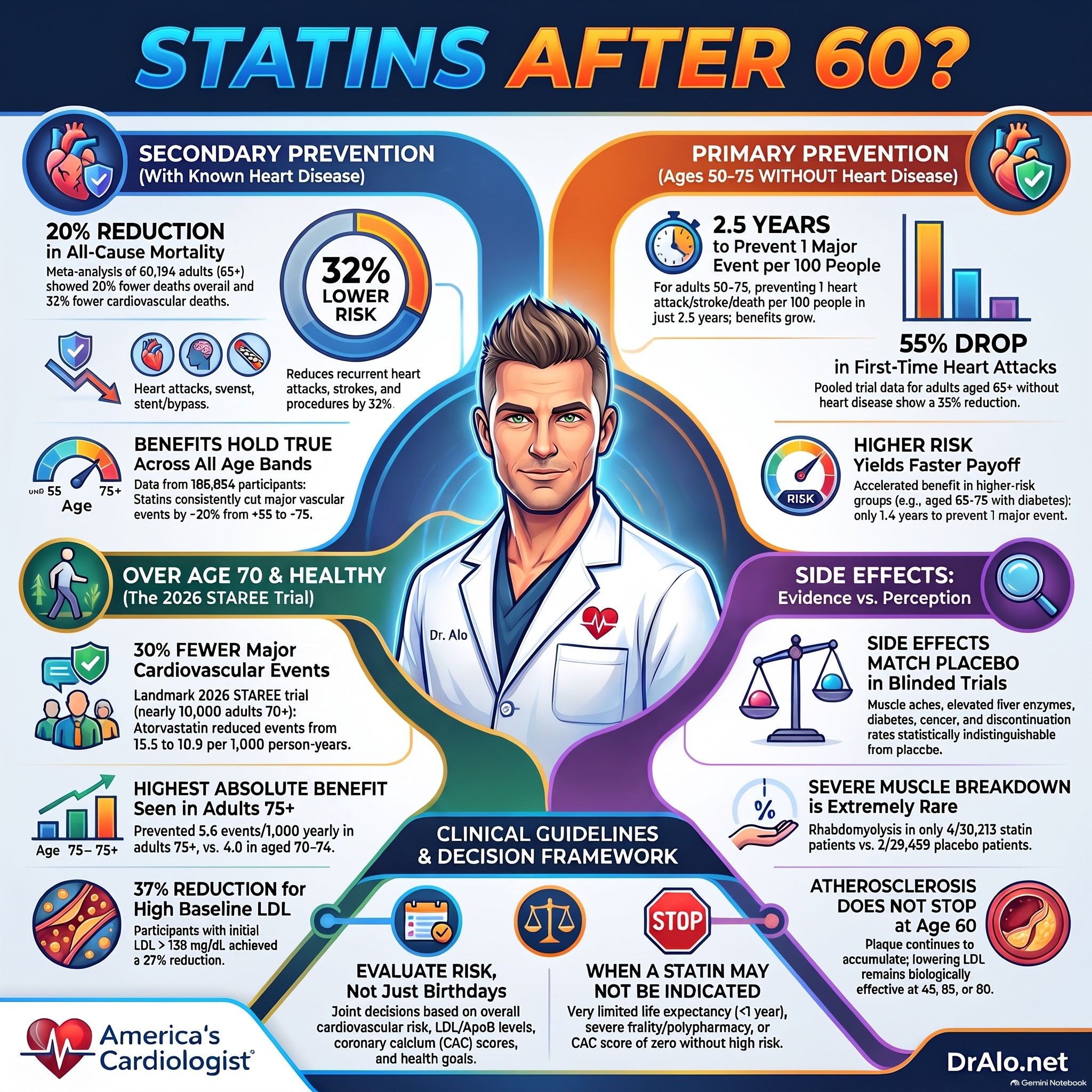
With heart disease, statins after 65 help you live longer, with high-certainty evidence from 23 trials. In 28 trials, the benefit was the same at every age, including past 75. Without heart disease, adults 50 to 75 get a clear, measurable benefit within 2.5 years that keeps growing. And in healthy people over 70, a large, placebo-controlled trial published in 2026 found 30% fewer major events.
Atherosclerosis does not retire at 60. Plaque keeps growing as long as LDL keeps delivering cholesterol into the artery wall. Lowering LDL works at 45, at 65 and at 80.
When a statin might not make sense
I am not going to pretend a statin is right for every single older person. These are the situations where I slow down and talk it through:
- Very limited life expectancy. In a 2015 trial of people with advanced illness and less than about a year to live, stopping a statin was safe and slightly improved quality of life. The benefit simply doesn't have time to show up.
- Frailty and many medications, where every added pill carries a risk of interactions and falls.
- A coronary calcium score of zero in an older person without diabetes, without smoking and without a very high LDL. That can make it reasonable to wait and recheck.
- Your own goals. Some people want to prevent every heart attack they can. Others want fewer pills. Both are valid, and that conversation belongs to you and your doctor.
What the guidelines say
- US Preventive Services Task Force (2022): recommends a statin for adults 40 to 75 with at least one risk factor (high LDL, diabetes, high blood pressure or smoking) and a 10-year risk of 10% or more; at 7.5% to 10%, it is a personal choice. For 76 and older, it said the evidence was insufficient. That was written years before STAREE.
- European Society of Cardiology (2021): uses age 70 as the cutoff, says to look at biological age rather than birthdays, and says statins may be considered at high or very high risk, taking frailty and other illnesses into account.
- American College of Cardiology and American Heart Association (2026): do not decide on age alone; decide together, using risk, LDL and tools like the calcium score. Also written before STAREE was published.
What I tell my patients
- If you have had a heart attack, stroke, stent or bypass, stay on your statin. At any age. It is one of the most proven things you can do to live longer.
- If you are 60 to 75 without heart disease, know your numbers. LDL, apoB, Lp(a) once in your life, blood pressure, A1c and your 10-year risk. If your risk is elevated, a statin is usually the right call.
- If you are on the fence, get a coronary calcium scan. Plaque you can see on a scan settles the question for most people. A high score means treat; a score of zero buys time.
- Turning 75 is not a reason to stop. If you are healthy and independent, STAREE says a statin still prevents heart attacks and procedures.
- If one statin bothers you, don't quit LDL lowering. Try another statin, a lower dose, every-other-day dosing, or add ezetimibe.
- Never stop on your own. Talk to your doctor first, especially if you have heart disease.
FAQ
Is it too late to start a statin at 70?
No. The STAREE trial started people at 70 or older and found 30% fewer major heart and stroke events over about 6 years. In people who already have heart disease, the benefit holds at every age.
How long before a statin starts helping?
For people without heart disease, about 2.5 years to prevent 1 event per 100 people treated, and some benefit within the first year. In higher-risk people, like the older adults with diabetes in CARDS, it was faster, about 1.4 years.
Do statins help older people live longer?
If you already have heart disease, yes: about 20% lower risk of death after 65. Without heart disease, the trials clearly prevent heart attacks and strokes, but most were too short to show a longer life.
Do statins cause dementia?
No. In STAREE, the combined outcome of death, dementia or disability was not higher on atorvastatin. Statins do not prevent dementia either. They prevent heart attacks and strokes.
I'm over 75 and healthy. Should I stop my statin?
Not just because of a birthday. Talk to your doctor. The newest evidence says a statin keeps preventing events in healthy people over 75, and stopping is mainly reasonable near the end of life.
The bottom line
Should you take a statin if you are over 60? For many people, yes. If you already have heart disease, the evidence is strong that it helps you live longer, at any age. If you don't, a statin prevents heart attacks and strokes within a few years, and the benefit grows the longer you take it. And for healthy people over 70, we now have a large placebo-controlled trial showing 30% fewer major events.
Your age is not the deciding factor. Your risk, your LDL, your plaque and your goals are.
Infographic Summary:
References
- Yourman LC, Cenzer IS, Boscardin WJ, et al. Evaluation of time to benefit of statins for the primary prevention of cardiovascular events in adults aged 50 to 75 years: a meta-analysis. JAMA Internal Medicine. 2021;181(2):179-185. doi:10.1001/jamainternmed.2020.6084. Link
- Ponce OJ, Larrea-Mantilla L, Hemmingsen B, et al. Lipid-lowering agents in older individuals: a systematic review and meta-analysis of randomized clinical trials. Journal of Clinical Endocrinology and Metabolism. 2019;104(5):1585-1594. doi:10.1210/jc.2019-00195.
- Cholesterol Treatment Trialists' Collaboration. Efficacy and safety of statin therapy in older people: a meta-analysis of individual participant data from 28 randomised controlled trials. The Lancet. 2019;393(10170):407-415.
- Zoungas S, Wolfe R, Moran C, et al. Atorvastatin, cardiovascular events, and disability-free survival in older adults. New England Journal of Medicine. 2026. doi:10.1056/NEJMoa2607314.
- Gencer B, Marston NA, Im K, et al. Efficacy and safety of lowering LDL cholesterol in older patients: a systematic review and meta-analysis of randomised controlled trials. The Lancet. 2020;396(10263):1637-1643. doi:10.1016/S0140-6736(20)32332-1.
- Chou R, Cantor A, Dana T, et al. Statin use for the primary prevention of cardiovascular disease in adults: updated evidence report and systematic review for the US Preventive Services Task Force. JAMA. 2022;328(8):754-771.
- US Preventive Services Task Force. Statin use for the primary prevention of cardiovascular disease in adults: US Preventive Services Task Force recommendation statement. JAMA. 2022;328(8):746-753.
- Visseren FLJ, Mach F, Smulders YM, et al. 2021 ESC Guidelines on cardiovascular disease prevention in clinical practice. European Heart Journal. 2021;42(34):3227-3337.
- Blumenthal RS, Morris PB, Gaudino M, et al. 2026 ACC/AHA multisociety guideline on the management of dyslipidemia. Journal of the American College of Cardiology. 2026.
- Kutner JS, Blatchford PJ, Taylor DH Jr, et al. Safety and benefit of discontinuing statin therapy in the setting of advanced, life-limiting illness: a randomized clinical trial. JAMA Internal Medicine. 2015;175(5):691-700.
- Raal FJ, Mohamed F. Never too old to benefit from lipid-lowering treatment. The Lancet. 2020;396(10263):1608-1609.
Still Have Questions? Stop Googling and Ask Dr. Alo.
You’ve read the science, but applying it to your own life can be confusing. I created the Dr. Alo VIP Private Community to be a sanctuary away from social media noise.
Inside, you get:
-
Direct Access: I answer member questions personally 24/7/365.
-
Weekly Live Streams: Deep dives into your specific health challenges.
-
Vetted Science: No fads, just evidence-based cardiology and weight loss.
Don't leave your heart health to chance. Get the guidance you deserve. All this for less than 0.01% the cost of health insurance! You can cancel at anytime!
[👉 Join the Dr. Alo VIP Community Today]
Cardiology & Obesity Medicine