Do Statins Help You Live Longer? What 54 Real-World Studies Show
Oct 27, 2026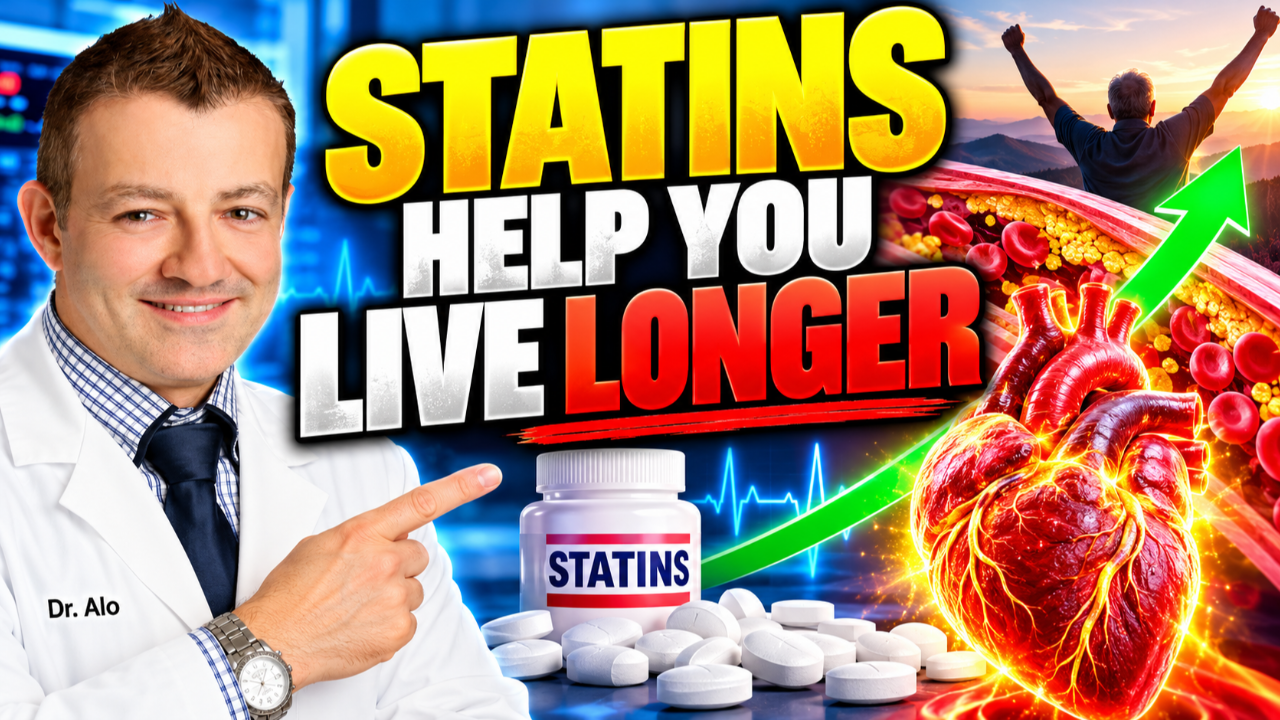
Do Statins Increase Your Lifespan?
"Dr. Alo, I know the statin brings my cholesterol number down. But will it actually help me live longer?"
It is one of the best questions a patient can ask me. A lab number is not the goal. Living longer, and living well, is the goal. And there is a popular idea online that statins "just treat a number" and do nothing for how long you live.
A meta-analysis in the Journal of Clinical Medicine went after that exact question in everyday patients, not just in carefully selected trial volunteers. It pooled 54 real-world studies with more than 4 million patient-years of follow-up. Below I redrew their main chart so it actually makes sense, and I walk you through what it shows, what it can't show, and how it fits with the randomized trials.
Medical note: This article is for general education and is not a substitute for advice from your own doctor. Never stop or start a medication without talking to your doctor first.
Key takeaways
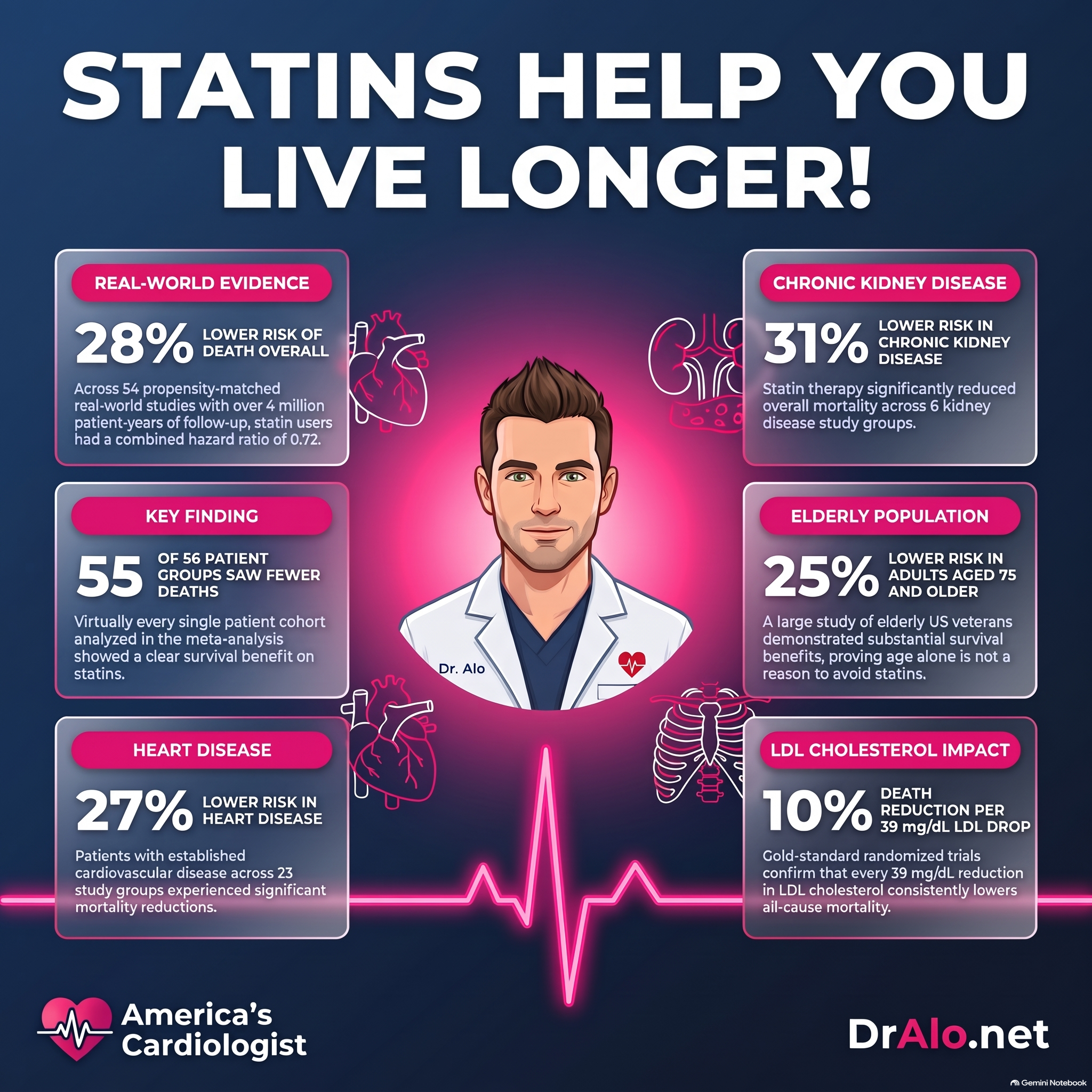
- Across 54 studies (56 groups of patients), people taking a statin had a 28% lower risk of dying from any cause than closely matched people who were not (hazard ratio 0.72).
- 55 of the 56 groups had fewer deaths on a statin. The one exception was a tiny study whose margin of error was huge.
- The benefit showed up in heart disease, kidney disease, inflammatory diseases like rheumatoid arthritis and lupus, cancer, and older adults, on every continent studied.
- These are observational studies, so the true size of the benefit is probably smaller than 28%. Randomized trials, the gold standard, already prove that statins lower the risk of death, by about 10% for every 39 mg/dL drop in LDL.
- Both kinds of evidence point the same way: statins do not just change a lab number. They help people live longer.
First, what is "all-cause mortality"?
All-cause mortality simply means death from any cause. Heart attack, stroke, cancer, infection, an accident, anything.
I love this outcome because it is the hardest one in medicine to fudge. A drug can lower heart attacks but quietly raise deaths from something else, and all-cause mortality would catch that. If a medicine lowers all-cause mortality, the people taking it are, on balance, alive more often. That is the bottom line every patient cares about.
What the researchers did

Figure: study selection and key numbers. Redrawn from Nowak MM, et al. J Clin Med. 2022;11(19):5643 (Figure 1, Table 1 and section 3.1).
A team of physicians in Poland, led by Marcin Nowak, searched PubMed for studies published between 2012 and 2022. They found 665 records, read 210 in full, and kept 54 studies. One of those studies reported three separate groups, so the analysis has 56 rows.
The rule for getting in was strict. Every study had to compare statin users with non-users using something called propensity score matching, follow people for at least a year, and report deaths from any cause.
Here is propensity matching in plain words. For every person taking a statin, the researchers found a person not taking one who looked as similar as possible on paper: same age range, same sex, same diseases, same other medicines. It is the closest you can get to a fair comparison without a coin flip.
The average patient was 67 years old, and 58% were men. 21 studies looked at people with heart and blood vessel disease, 6 at chronic kidney disease, 6 at inflammatory diseases, 3 at cancer, and 18 at other groups such as older adults, people with diabetes, lung disease or hepatitis B.
The answer is reported as a hazard ratio. An HR of 1.0 means no difference. Below 1.0 means a lower death rate. The combined answer was 0.72, a 28% lower risk of dying during follow-up.
Infographic Summary:
Every study, on one chart

Figure: risk of death from any cause, statin users vs matched non-users, for each of the 56 patient groups and all of them combined. Redrawn from Nowak MM, et al. J Clin Med. 2022;11(19):5643 (Figure 2; disease groups from Table 1).
This is a forest plot. Once you know how to read one, you will see them all over medicine.
- Each row is one group of patients. The square is that study's result. The line through it is its margin of error (the 95% confidence interval).
- The dashed line is 1.0, no difference. Anything to the left, in the pink zone, means fewer deaths in people taking a statin.
- Bigger squares carry more weight in the final answer, usually because the study was bigger or more precise.
- Grey rows are not statistically significant on their own. Their margin of error crosses 1.0. Notice that even almost all of the grey ones still sit to the left.
- The colored dot next to each name tells you what kind of patients were studied.
- The pink diamond is all 56 combined: 0.72, with a range of 0.68 to 0.76. The whole diamond is far left of the line.
I redid the math myself from the numbers in the paper and got the same answer, 0.72 (0.68 to 0.76). So the chart you are looking at matches the published result.
A few rows are worth a closer look.
- Woo 2015 is the only group on the right side of the line (1.42). It was a tiny study of heart attack survivors with severe heart failure, and its range runs from 0.75 to 2.69, so it really can't tell us much either way.
- Shavadia 2021 studied people starting dialysis who also had artery disease, and found almost no difference (0.96). That actually lines up with the randomized trials in dialysis patients, 4D and AURORA, which did not show a clear benefit from starting a statin at that late stage. It is one more reason I want LDL lowered years earlier.
- Orkaby 2020 followed US veterans aged 75 and older and found a 25% lower risk of death (0.75). That is one of the biggest, most precise squares on the chart, and it matters, because older adults are often told they are "too old" for a statin.
- Fung 2017, Cheung 2021 and Marume 2019 show drops of 62% or more. No randomized trial has ever shown a statin cutting deaths that much, and I would not believe those numbers at face value. More on that in the fine print.
Who benefits? Heart, kidney, cancer, everyone they looked at

Figure: subgroup results shown as percent lower risk of death (1 minus the hazard ratio) with 95% confidence ranges. Redrawn from Nowak MM, et al. J Clin Med. 2022;11(19):5643 (Table 2).
The researchers split the studies by the kind of patient and by where in the world they were done. I turned the hazard ratios into a simpler number: percent lower risk of death. Every single bar is significant, and none of the whiskers come close to zero.
- Heart and blood vessel disease: 27% lower (23 groups).
- Chronic kidney disease: 31% lower (6 groups). Heart disease is the number one killer of people with kidney disease, so this makes sense.
- Inflammatory diseases: 22% lower (6 groups), such as rheumatoid arthritis, lupus, gout and ankylosing spondylitis. These patients have more heart attacks than their LDL alone would predict.
- Cancer: 23% lower (3 groups, prostate cancer and multiple myeloma).
- Other groups: 32% lower (18 groups), including older adults, diabetes, lung and liver disease.
The differences between disease groups were not statistically significant. In other words, the benefit looked about the same whether or not someone already had heart disease.
By continent, studies from Asia showed the biggest drop (33%) and North America and Australia the smallest (22% each). The authors point out that statins are prescribed more widely in the US and Australia, including to lower-risk people, and lower-risk people have less to gain in absolute terms. That is a sensible explanation, but it is the authors' reasoning, not something this study proved.
The fine print: why the real number is probably smaller than 28%

Figure: risk of death from any cause in landmark randomized trial data compared with this meta-analysis. Redrawn from the 4S trial (Lancet 1994), the CTT Collaboration (Lancet 2010), the USPSTF evidence review (JAMA 2022) and Nowak MM, et al. J Clin Med. 2022;11(19):5643 (sections 3.1 and 3.3).
I want to be straight with you, because this is where people on both sides of the statin debate get it wrong.
This is not a randomized trial. Propensity matching is good, but it can only match on what got written down. It cannot match on what didn't. People who fill their statin every month for years tend to be people who also walk more, smoke less, show up for checkups and take their other medicines. Researchers call this the "healthy adherer" effect, and it makes any pill look better than it really is in observational data. That is why I don't believe the 62% drops in a few of these studies.
The studies disagreed a lot. The disagreement score, I squared, was 95%, which is very high. That shows up in the amber bar on the forest plot: the "prediction interval" of 0.51 to 1.02. It is the range where a brand new study of this kind would likely land. When the researchers removed the six studies that pulled the result around the most, the answer barely moved (0.73), and the prediction range tightened to 0.58 to 0.92, fully below 1.0.
There was a hint of publication bias (Egger test p = 0.096), meaning studies with positive results may have been more likely to get published. They also only searched PubMed. The authors themselves call the overall quality of this real-world evidence "suboptimal." I appreciate that honesty.
So what do we actually know? For that, look at the top half of the chart. In the 4S trial, people with heart disease were randomly assigned by a coin flip to simvastatin or placebo, and deaths from any cause dropped 30%. Across 26 randomized trials and about 170,000 people, the CTT Collaboration found deaths from any cause fall about 10% for every 39 mg/dL (1 mmol/L) drop in LDL. And in people who don't have heart disease yet, the US Preventive Services Task Force found an 8% lower risk of death across 18 trials.
The trials prove statins save lives. This meta-analysis shows that benefit holds up outside of trials, in older, sicker, everyday patients who are often left out of trials. The real-world number is likely inflated. The direction is not in question.
The myth I want to bury: "Statins only lower a number. They don't make you live longer."
I hear this one constantly on social media. It is wrong.
Statins lower LDL cholesterol, and LDL is not an innocent bystander. LDL particles are what get trapped in the artery wall and build plaque. Lower LDL means less plaque, fewer heart attacks and strokes, and fewer deaths. The randomized trials showed this decades ago, and the more LDL you lower, the more benefit you get.
The other trick I see is quoting only the absolute numbers from short trials, five years or less, and calling the benefit tiny. Plaque builds over decades. A trial that lasts five years captures only the start of a benefit that keeps adding up the longer LDL stays low. In this meta-analysis the drop in deaths actually tended to get bigger with longer follow-up.
If you want the full history, I walk through 4S, HPS, the CTT and the USPSTF reviews in my article Do statins reduce all-cause mortality?
What I tell my patients
- Your statin is not treating a number. It is treating your arteries. The goal is fewer heart attacks, fewer strokes and a longer life, and the evidence for that is strong.
- Earlier and lower is better. LDL damage adds up over a lifetime. Starting years before plaque causes trouble does more than starting after a heart attack, or after kidney failure.
- Age alone is not a reason to stop. In US veterans aged 75 and older, statin users had a 25% lower risk of death. Talk with your doctor before stopping a statin because of a birthday.
- Don't quit on your own because of side effects. Most muscle aches blamed on statins happen just as often on placebo. Talk to your doctor about switching the statin, lowering the dose or changing the schedule. I break this down in my article on statin side effects.
- If you truly can't take a statin, you still have options. Ezetimibe, bempedoic acid and PCSK9 inhibitors all lower LDL. Don't just leave it high.
- Do the habits too. Cut saturated fat, eat more fiber, take your medicines, move every day and don't smoke. A statin works best on top of those, not instead of them.
- Know your numbers. Recheck your LDL, and ideally apoB, after starting so you and your doctor can see you reached your goal.
Frequently asked questions
Do statins help you live longer?
Yes. Randomized trials show statins lower the risk of death from any cause, about 10% for every 39 mg/dL drop in LDL, and more in people with heart disease. This real-world meta-analysis found a 28% lower risk of death in statin users, although that number is probably inflated by healthier habits in people who take their medicine.
Will I personally get a 28% lower risk of dying?
Not necessarily. 28% is an average across very different groups in observational studies. Your benefit depends on how high your LDL is, how much it drops, how long you take the statin, and how high your risk was to begin with. The higher your risk, the more you have to gain.
Do statins help people over 75?
In this analysis, a large study of US veterans aged 75 and older found a 25% lower risk of death in statin users. That was observational, so it is a strong clue, not proof. Older adults are often under-treated, and age alone should not be the reason to skip or stop a statin.
I don't have heart disease. Is a statin still worth it?
In this meta-analysis, patient groups that were not selected for heart disease saw about the same relative drop in deaths as groups that were. In randomized trials of people without heart disease, the risk of death was 8% lower. Whether you need one depends on your LDL, your other risk factors and sometimes a coronary calcium scan or plaque imaging. Have that conversation with your doctor, and don't let a low 10-year risk score talk you out of treating a high LDL when you are young.
Why didn't every study show a benefit?
Ten of the 56 groups were too small or too uncertain to reach significance on their own, but 9 of those 10 still leaned toward fewer deaths. Only one tiny study leaned the other way. That is exactly what you'd expect when a real effect is studied in groups of very different sizes.
The bottom line
Across 54 real-world studies and more than 4 million patient-years, people taking a statin had a 28% lower risk of dying from any cause than closely matched people who weren't, and 55 of 56 patient groups pointed the same way. The benefit showed up in heart disease, kidney disease, inflammatory disease, cancer and older adults.
Because these were observational studies, the true size of the effect is likely smaller. But the randomized trials already settled the big question: statins save lives. This study shows that benefit doesn't vanish in the real world. If your doctor has recommended a statin, it is not about a number on a lab sheet. It is about your arteries, and your years.
Still have questions? Stop Googling and ask Dr. Alo.
You've read the science, but applying it to your own life can be confusing. That's exactly what the Heart 2 Heart VIP Community is for. You can ask me questions directly, join live video calls where we talk through your labs and situations like this one, and get physician-level guidance based on your actual numbers.
Join here: https://dralo.net/community 💪🏻🩺🫀
Dr. Alo
References
- Nowak MM, Niemczyk M, Florczyk M, Kurzyna M, Pączek L. Effect of statins on all-cause mortality in adults: a systematic review and meta-analysis of propensity score-matched studies. Journal of Clinical Medicine. 2022;11(19):5643. doi:10.3390/jcm11195643.
- Scandinavian Simvastatin Survival Study Group. Randomised trial of cholesterol lowering in 4444 patients with coronary heart disease: the Scandinavian Simvastatin Survival Study (4S). Lancet. 1994;344(8934):1383-1389.
- Cholesterol Treatment Trialists' (CTT) Collaboration. Efficacy and safety of more intensive lowering of LDL cholesterol: a meta-analysis of data from 170,000 participants in 26 randomised trials. Lancet. 2010;376(9753):1670-1681.
- Chou R, Cantor A, Dana T, et al. Statin use for the primary prevention of cardiovascular disease in adults: updated evidence report and systematic review for the US Preventive Services Task Force. JAMA. 2022;328(8):754-771.
- Orkaby AR, Driver JA, Ho YL, et al. Association of statin use with all-cause and cardiovascular mortality in US veterans 75 years and older. JAMA. 2020;324(1):68-78.
- Shavadia JS, Wilson J, Edmonston D, et al. Statins and atherosclerotic cardiovascular outcomes in patients on incident dialysis and with atherosclerotic heart disease. American Heart Journal. 2021;231:36-44.
- Wanner C, Krane V, März W, et al. Atorvastatin in patients with type 2 diabetes mellitus undergoing hemodialysis (4D). New England Journal of Medicine. 2005;353(3):238-248.
- Fellström BC, Jardine AG, Schmieder RE, et al. Rosuvastatin and cardiovascular events in patients undergoing hemodialysis (AURORA). New England Journal of Medicine. 2009;360(14):1395-1407.
- Woo JS, Hwang SJ, Kim HS, et al. Effects of statin therapy on clinical outcomes of survivors of acute myocardial infarction with severe systolic heart failure. PLoS ONE. 2015;10:e0144602.
- Fung CSC, Wan EYF, Chan AKC, Lam CLK. Statin use reduces cardiovascular events and all-cause mortality amongst Chinese patients with type 2 diabetes mellitus: a 5-year cohort study. BMC Cardiovascular Disorders. 2017;17:166.
Still Have Questions? Stop Googling and Ask Dr. Alo.
You’ve read the science, but applying it to your own life can be confusing. I created the Dr. Alo VIP Private Community to be a sanctuary away from social media noise.
Inside, you get:
-
Direct Access: I answer member questions personally 24/7/365.
-
Weekly Live Streams: Deep dives into your specific health challenges.
-
Vetted Science: No fads, just evidence-based cardiology and weight loss.
Don't leave your heart health to chance. Get the guidance you deserve. All this for less than 0.01% the cost of health insurance! You can cancel at anytime!
[👉 Join the Dr. Alo VIP Community Today]
Cardiology & Obesity Medicine