Blood Pressure Spikes After Coffee, Stress, or Exercise: What’s Normal (and What’s Not)
Dec 31, 2025
Why Blood Pressure Spikes: Coffee, Exercise, Stress, and What Really Matters
You check your blood pressure and it's elevated. You drank coffee an hour ago. Or you just finished a workout. Or you were in a stressful conversation.
Your immediate thought: "Is something wrong with me?"
Here's what I tell my patients: Blood pressure is supposed to change. Your BP at rest is not the same as your BP during exercise or stress. The question isn't whether you get spikes. The question is whether your spikes are normal and temporary, or whether they reveal that your baseline blood pressure is actually too high.
That distinction matters for your health and your treatment decisions. Let me walk you through what causes spikes, when they're reassuring, and when they're a sign you need to pay attention.
Key takeaways
- Coffee, stress, exercise, and poor sleep can all raise blood pressure temporarily.
- A single "post-spike" reading is not a diagnosis.
- Your true blood pressure is your resting average measured properly over multiple days.
- The goal is understanding your pattern, not chasing individual numbers.
First: What counts as a spike?
Blood pressure naturally varies throughout the day. Here's what's normal and what's not:
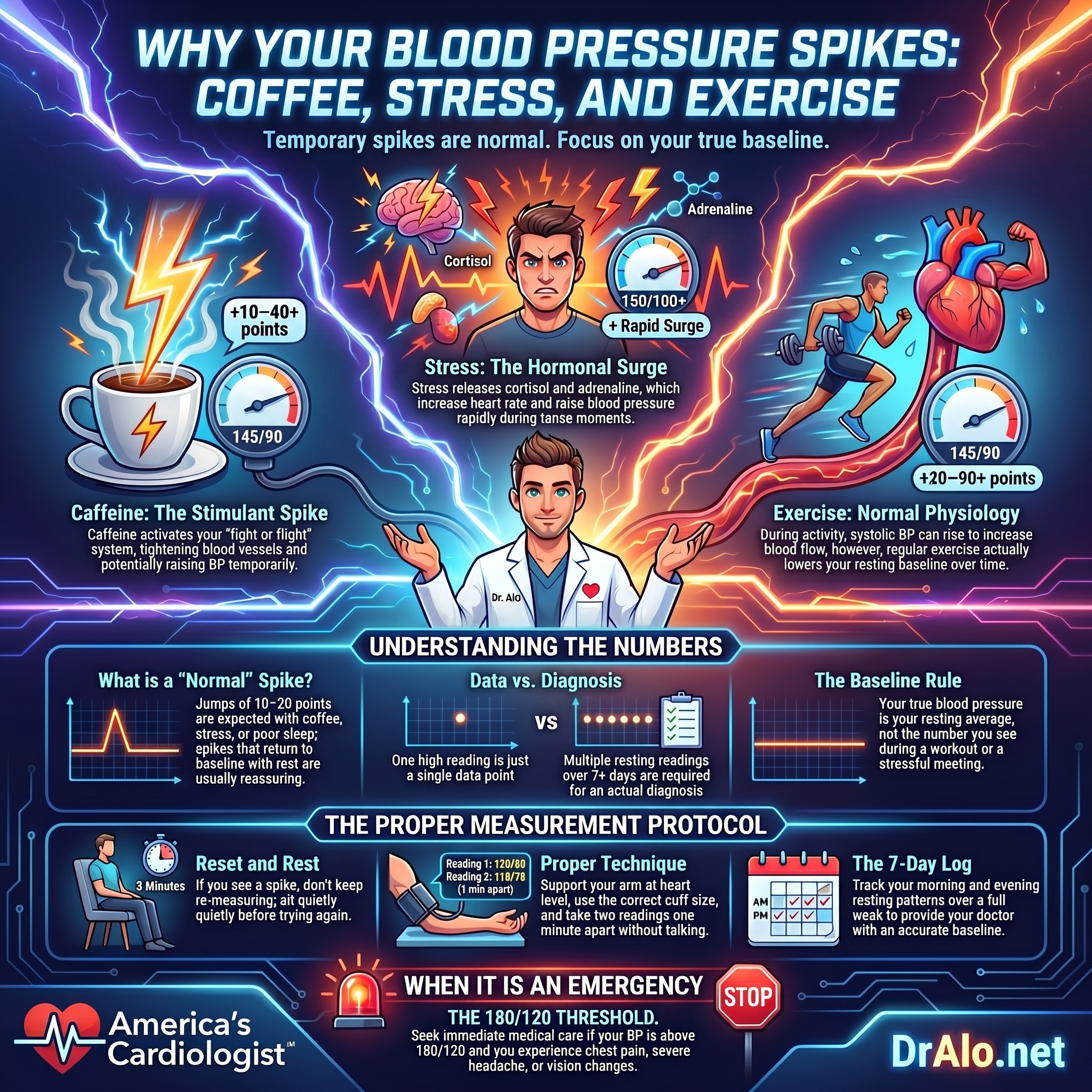
- A jump of 10-20 points with stress, coffee, pain, or poor sleep is expected.
- A jump of 30-50+ points should prompt you to check your technique, identify triggers, and reassess your true baseline.
- If your spikes happen regularly and don't come back down with rest, that's different information than an isolated spike.
One reading is data. Multiple readings over time are the diagnosis.
Infographic Summary:
Coffee and blood pressure: Does it affect you?
Why caffeine raises blood pressure
Caffeine is a stimulant. It activates your sympathetic nervous system (your "fight or flight" system), increases heart rate, and tightens blood vessels. The result: a temporary rise in blood pressure.
But here's the critical part: Not everyone responds the same way. Some people spike 10-20 points. Others spike 40+ points. Many regular coffee drinkers develop tolerance and see minimal effect.
What you should do
If you want your most accurate baseline blood pressure: Measure before coffee in the morning, when you've been sitting quietly for 5 minutes. Don't use a post-coffee reading to make treatment decisions.
If you want to know whether caffeine actually affects you: Do a simple experiment. Measure your resting BP once before coffee. Drink your normal coffee. Recheck 30 minutes later. Repeat this on a different day. If you consistently spike, you have your answer.
If caffeine does spike you: You have options. Reduce your coffee dose, switch to half-caf, or separate your coffee from stressful mornings. The goal is your data, not a one-size-fits-all rule.
Stress and blood pressure: The fight-or-flight response
How stress raises your pressure
Stress activates your sympathetic nervous system. Your body releases hormones (cortisol and adrenaline) that:
- Increase heart rate
- Constrict blood vessels
- Raise blood pressure rapidly
This is the "fight or flight" response. It's adaptive in short bursts. But if you're chronically stressed, your baseline blood pressure climbs because your nervous system stays partially activated.
This is why blood pressure taken during a difficult doctor's visit, a tense conversation, or right after a frustrating work meeting often looks worse than your true baseline. You're measuring during stress, not rest.
How to interpret a stress-related spike
If you get a high reading during stress:
1) Don't panic. A spike during stress is not unexpected.
2) Reset the conditions. Sit quietly for 5 minutes. Slow your breathing (inhale for 4 seconds, exhale for 6 seconds). Relax your shoulders.
3) Recheck. Take two readings, 1 minute apart, with proper technique (feet flat, back supported, arm at heart level).
4) Look at the trend. A stress spike that comes down significantly with rest is reassuring. Your baseline is probably fine. A reading that stays high even after resting means your baseline needs to be addressed.
Exercise and blood pressure: Why it rises during activity
Yes, blood pressure rises during exercise. That's normal.
During physical activity, your body increases blood flow to your working muscles. Your heart pumps harder. Your systolic blood pressure (the top number) can rise 20-50+ points depending on exercise intensity.
This is normal physiology. It's not a sign of a problem. It's a sign your cardiovascular system is working as designed.
The two truths about exercise and blood pressure
Truth 1: During exercise, your BP rises. This is expected and healthy. Don't measure your BP right after a workout and use that number to make treatment decisions.
Truth 2: Over weeks and months of regular exercise, your resting blood pressure actually decreases and your vascular health improves. Exercise is one of the most effective interventions for hypertension management.
So don't judge your cardiovascular health by a post-workout reading. Judge it by your resting average and your long-term trend. If your resting BP comes down over the months you've been exercising, exercise is working for you.
When exercise-related blood pressure spikes need medical evaluation
Talk to your doctor if:
- You experience chest pain, unusual shortness of breath, dizziness, or fainting during exercise
- Your resting blood pressure is very high (above 160/100) before you even start exercising
- You've had an exercise stress test showing an abnormal blood pressure response
- You have a history of heart disease or other cardiovascular risk factors
But a normal, expected rise in blood pressure during activity is not a reason to stop exercising.
Other triggers for blood pressure spikes you might miss
- Poor sleep or insomnia. A single night of poor sleep can raise BP. Chronic sleep deprivation raises your baseline.
- Sleep apnea. Pauses in breathing during sleep cause blood pressure spikes throughout the night.
- Alcohol (especially the night before). Alcohol disturbs sleep and can cause morning BP spikes.
- High-sodium meals. Sodium holds fluid, which increases blood volume and pressure.
- Nicotine. Smoking constricts blood vessels immediately.
- Decongestants. Many cold medications and decongestants raise blood pressure. Always check labels.
- NSAIDs like ibuprofen. Anti-inflammatory pain meds can raise BP and interfere with some blood pressure medications.
- Pain. Acute pain from any source (dental pain, back pain, injury) raises BP.
- Full bladder. A full bladder before measurement can raise readings.
- Improper cuff size or technique. A cuff that's too small gives falsely high readings. Arms unsupported, feet dangling, talking during measurement all raise readings artificially.
The protocol when you see a spike: Don't chase the number
Step 1: Stop measuring repeatedly
I see this constantly in my practice. Someone gets a high reading and immediately measures again. And again. And again. This doesn't help. It increases anxiety, which raises BP further.
One measurement during stress or after a trigger is enough information. Don't chase it.
Step 2: Reset the conditions properly
- Sit with feet flat on the floor
- Back supported by a chair
- Arm supported at heart level
- No talking
- Rest for 5 minutes before measuring
Step 3: Take two readings
Measure twice, 1 minute apart. Write both numbers down.
Step 4: What your doctor cares about
Your clinician wants to know:
- Your average resting blood pressure (measured properly, multiple times over 7+ days)
- Your morning vs. evening pattern
- How often you get spikes and how quickly they return to baseline
- Whether spikes happen randomly or in response to specific triggers
A single spike during a specific trigger is not a diagnosis. A pattern of elevated resting readings is.
When a blood pressure spike is a medical emergency
Call 911 or go to the ER immediately if:
- Your blood pressure is above 180/120 AND you have symptoms like chest pain, shortness of breath, severe headache, vision changes, weakness, numbness, or difficulty speaking
- You have repeated very high readings (180/120+) that don't come down with proper rest and correct technique
FAQs
Should I stop drinking coffee if I have high blood pressure?
Not automatically. First, check whether coffee actually spikes your BP and by how much. Many people with hypertension tolerate moderate caffeine well. If coffee raises your pressure 40+ points, consider reducing dose or switching to half-caf. If it raises you 10-15 points and you love coffee, the answer might be to focus on other interventions.
Should I measure my blood pressure right after exercise?
No. For baseline monitoring, measure at rest, at least 30-60 minutes after you've fully cooled down. Post-exercise readings are not representative of your true baseline blood pressure.
If I get stress spikes, does that mean I have hypertension?
Not necessarily. But it means your nervous system is reactive to stress, which is important information. If stress spikes are frequent and your resting readings are borderline elevated, it's time to do a proper 7-day home BP monitoring protocol to understand your true baseline.
How much can blood pressure normally change throughout the day?
Your blood pressure naturally dips 10-20 points during sleep and rises when you wake up. Throughout the day, variations of 10-20 points with activity, stress, meals, and caffeine are normal. Spikes of 30-40 points with specific triggers are usually stress-related and reversible. Persistent elevation across all conditions suggests your baseline is actually high.
Should I be worried if I only get spikes sometimes?
Occasional spikes in response to specific triggers (coffee, stress, intense exercise) are normal and usually not a sign of disease. What matters is your resting average. If your resting readings are normal and your spikes are clearly trigger-related and short-lived, you're probably fine. If spikes happen frequently without obvious triggers, or your resting readings are chronically elevated, that's when you need to address it with your doctor.
The bottom line
Blood pressure spikes are not abnormal. They happen to everyone. The key is understanding the difference between a temporary spike during stress or after a trigger versus a chronically elevated baseline.
If you see a high number, don't assume you have hypertension. Don't immediately reach for medication. Instead, measure properly at rest over multiple days, identify your triggers, and understand your true baseline.
That's the modern, evidence-based approach to blood pressure diagnosis. And it's a lot less anxiety-inducing than chasing individual numbers.
Still confused about your specific readings?
Blood pressure patterns can be tricky to interpret, especially when you're seeing conflicting numbers. You might have stress-related spikes, medication timing questions, or uncertainty about whether your baseline is actually elevated. That's exactly what the Heart 2 Heart VIP Community is for.
You can text me with your blood pressure log, we discuss your specific pattern and triggers, and you get physician-level interpretation. You can also join live video calls where we talk through these exact scenarios. No generic advice. Just evidence-based guidance tailored to your actual numbers and your actual situation.
Join here: https://dralo.net/community
💪🏻🩺🫀 Dr. Alo
References
Related Blood Pressure Management Posts
Complete blood pressure library:
- What Does 130/80 Mean? Stage 1 Hypertension
- How to Take Blood Pressure at Home Correctly
- Why Is My Blood Pressure High in the Morning?
- White Coat vs Masked Hypertension
- When Is High Blood Pressure an Emergency?
- Low Blood Pressure Symptoms
- Best Foods to Lower Blood Pressure
- Blood Pressure Medications Explained
- How To Lower Blood Pressure Naturally Without Meds
- Is Salt Burning Your Heart?
Prevention & Guidelines
- Dr. Alo's Dietary Guidelines – Complete prevention framework
- Statins And Dementia – Medication options
Still Have Questions? Stop Googling and Ask Dr. Alo.
You’ve read the science, but applying it to your own life can be confusing. I created the Dr. Alo VIP Private Community to be a sanctuary away from social media noise.
Inside, you get:
-
Direct Access: I answer member questions personally 24/7/365.
-
Weekly Live Streams: Deep dives into your specific health challenges.
-
Vetted Science: No fads, just evidence-based cardiology and weight loss.
Don't leave your heart health to chance. Get the guidance you deserve. All this for less than 0.01% the cost of health insurance! You can cancel at anytime!
[👉 Join the Dr. Alo VIP Community Today]
Cardiology & Obesity Medicine