
Best Time To Exercise In Ramadan? Running? Weights?
Feb 17, 2026
The Complete Guide to Exercise Timing During Ramadan: What the Science Says About Aerobic Training and Weight Lifting
For the 1.8 billion Muslims worldwide who observe Ramadan, the holy month presents a unique challenge for those committed to maintaining their fitness routines. Fasting from dawn to sunset, which can span anywhere from 12 to 18 hours depending on geographic location and season, fundamentally alters the relationship between nutrition, hydration, and exercise. The question of when to train during Ramadan isn't merely one of convenience; it's a matter of physiology, performance optimization, and long-term health.
Dr. Alo is a certified personal trainer and double board certifed cardiologist who plays and coaches sports.
This comprehensive guide examines what the scientific literature tells us about the best times to exercise during Ramadan, with specific recommendations for both aerobic training and resistance exercise.
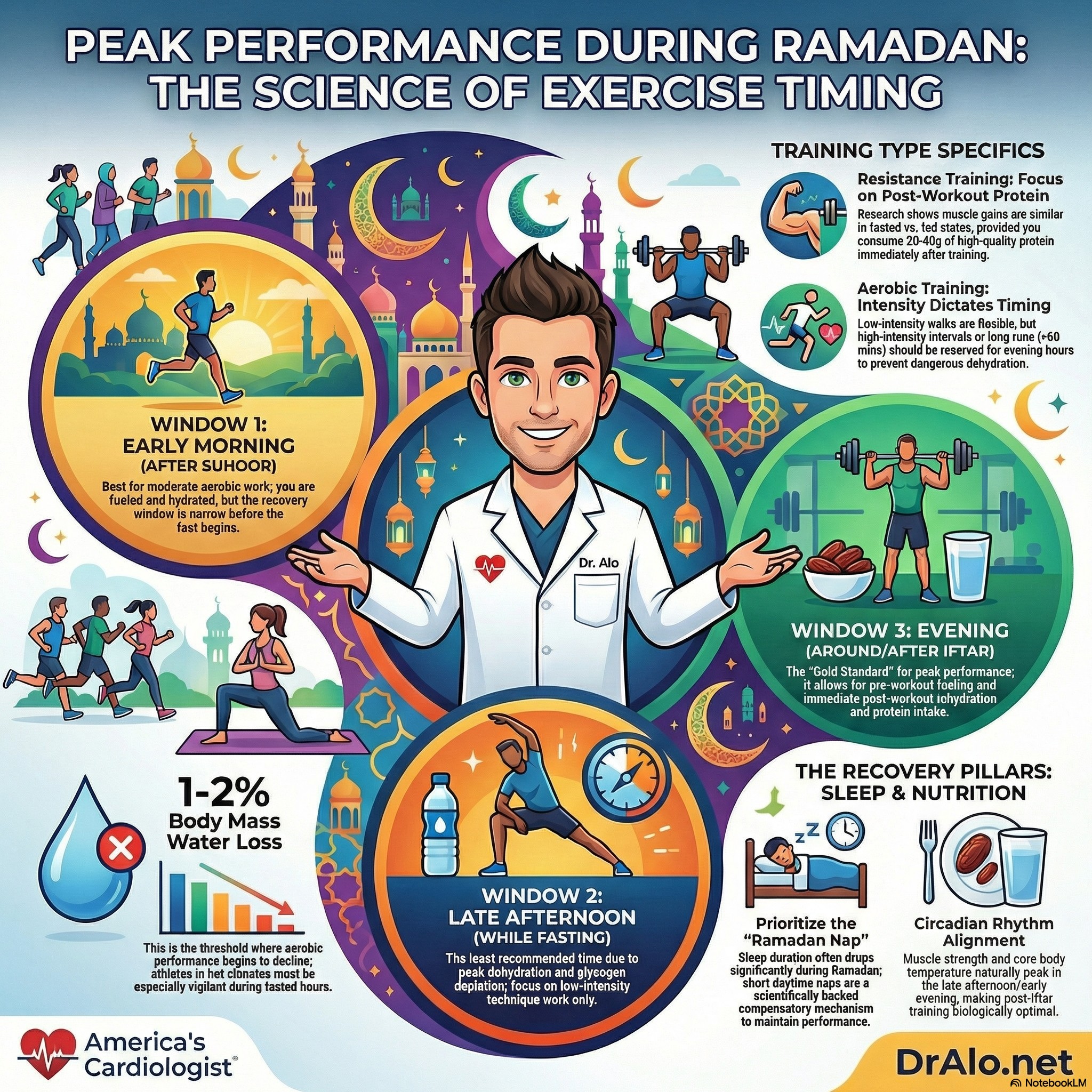
Ramadan Exercise Infographic Summary:
Understanding the Ramadan Fasting Challenge
Before diving into timing recommendations, it's essential to understand what makes Ramadan fasting physiologically distinct from other forms of intermittent fasting. Unlike time-restricted eating protocols that allow water consumption, Ramadan fasting prohibits both food and fluid intake during daylight hours. This creates a progressive state of dehydration over the course of each day, alongside the expected metabolic shifts from fasting.
Research published in the Journal of Sports Sciences demonstrates that for resting individuals in temperate environments, water loss during a day without food or fluid typically amounts to about 1% of body mass by sunset. While this small loss is unlikely to significantly impair performance, larger body water losses occur in hot weather or when exercise is undertaken. Performance in events lasting approximately one hour or longer may be impaired in the absence of fluid intake during the event.
The behavioral modifications accompanying Ramadan fasting are associated with alterations in metabolic, physiological, and psychological responses that may affect sport performance. These include energy restriction, sleep deprivation, circadian rhythm perturbation, dehydration, and alterations in training load.
The Three Windows: When to Exercise During Ramadan
Research consistently identifies three potential exercise windows during Ramadan, each with distinct advantages and disadvantages.
Window 1: Early Morning (After Suhoor)
Training immediately after the pre-dawn meal (suhoor) offers several advantages. You've just consumed food and fluids, providing energy substrates and hydration for your workout. There's also a brief window after training to consume additional protein or fluids before the fast begins.
However, this window has practical limitations. Depending on the time of year and location, suhoor may occur as early as 3:00 or 4:00 AM, making consistent training challenging for those with conventional work schedules. Additionally, the window between finishing your meal and the start of the fast may be too narrow for optimal post-exercise nutrition.
For those who can manage the early wake-up, this window works well for moderate-intensity aerobic exercise and lighter resistance training sessions. The key is ensuring adequate protein intake at suhoor to support muscle protein synthesis, as research shows that protein ingestion around training times is critical for maintaining optimal plasma amino acid levels.
Window 2: Late Afternoon (While Fasting)
This is generally the least recommended window, though it may be unavoidable for some athletes with fixed training schedules. Studies in professional football players showed decreased mean power and peak power at 5:00 PM and 9:00 PM during the third and fourth weeks of Ramadan compared to pre-Ramadan values.
Research examining elite young female handball players found that Ramadan intermittent fasting increased sleepiness scores and decreased repeated sprint performance, with higher muscle damage markers and fatigue, especially in the last week of Ramadan. Importantly, these alterations were attributed to disturbances of sleep and circadian rhythms rather than nutritional deficiency or dehydration alone.
A meta-analysis examining the effects of Ramadan fasting on physical performance found that while aerobic performance, muscular strength, jump height, and total work are generally well-preserved, high-intensity interval training, repeated sprints, and anaerobic activities show more pronounced decrements when performed while fasted.
If afternoon training is unavoidable, consider reducing training intensity and volume, focusing on technique work rather than maximal efforts, and scheduling the session as close to iftar as possible to minimize the fasting duration before you can rehydrate and refuel.
Window 3: Evening (Around or After Iftar)
This is generally considered the optimal training window for most athletes during Ramadan. Training close to or after sunset allows for nutritional interventions after exercise to promote training adaptations, enhance recovery, and reduce muscle damage.
The evening window enables consumption of carbohydrates, protein, and fluids before, during, or immediately after the session—all critical for optimizing performance and recovery. This timing aligns with the body's natural circadian rhythms, as research demonstrates that muscle strength, endurance, and performance peak in the late afternoon and early evening, roughly corresponding to the peak of core body temperature.
A study examining time-of-day effects on cycling performance found that time to complete a 1000-meter time trial was significantly lower in the evening than in the morning (88.2 versus 94.7 seconds). This improved evening performance was accompanied by a more favorable hormonal and metabolic environment.
Aerobic Exercise: Specific Timing Considerations
For cardiovascular training during Ramadan, the timing considerations depend largely on the intensity and duration of your planned session.
Low to Moderate Intensity Aerobic Exercise
For activities like walking, light jogging, or easy cycling lasting 30-45 minutes, the timing is more flexible. These activities can be performed during any of the three windows without significant performance decrements. The metabolic demands are low enough that glycogen depletion and dehydration are less likely to become limiting factors.
Research shows that aerobic power shows little change during Ramadan when overall training is maintained. For recreational exercisers focused on general health and fitness, morning sessions after suhoor or evening sessions around iftar are both viable options.
High-Intensity or Prolonged Aerobic Exercise
For interval training, tempo runs, or endurance sessions lasting longer than 60 minutes, evening training after iftar is strongly preferred. A systematic review and meta-analysis found that pre-exercise feeding enhanced prolonged aerobic exercise performance, while shorter duration aerobic exercise performance was not significantly affected by fasting status.
The inability to consume fluids during exercise is particularly problematic for prolonged efforts. Research indicates that body water deficits as small as 1-2% of body mass may begin to affect performance. For athletes training in hot environments, these deficits can accumulate rapidly during fasted exercise.
If you must perform high-intensity aerobic training while fasted, consider scheduling it in the final 1-2 hours before iftar. This minimizes the time you'll spend dehydrated post-exercise and allows immediate rehydration and refueling upon breaking the fast.
Resistance Training: Optimizing Muscle and Strength Gains
For those focused on building or maintaining muscle mass and strength during Ramadan, the timing considerations are somewhat different from aerobic training.
The Muscle Protein Synthesis Question
A central concern for resistance trainers during Ramadan is whether fasted training impairs muscle protein synthesis and long-term hypertrophy. The evidence here is reassuring. A recent randomized clinical trial comparing 12 weeks of resistance training performed in the fasted state versus the fed state found no significant differences in muscle hypertrophy or strength gains.
Both groups showed similar increases in quadriceps muscle thickness (1.21 cm fasted versus 1.18 cm fed), maximum dynamic strength, and muscle power. The researchers concluded that regardless of food consumption prior to sessions, resistance training performed twice weekly was associated with improvements in muscle hypertrophy and neuromuscular performance.
This finding is consistent with research showing that the acute post-exercise period is when rapid hyperaminoacidemia (elevated blood amino acids) promotes a marked rise in muscle protein synthesis. What matters most is not whether you train fasted, but whether you can consume adequate protein in the hours following your training session.
Optimal Timing for Resistance Training
Given the importance of post-exercise nutrition for muscle protein synthesis, evening training after iftar emerges as the optimal choice for resistance training during Ramadan. This allows you to:
1. Consume a pre-workout meal 1-2 hours before training
2. Train with adequate energy and hydration
3. Consume protein immediately post-workout to maximize muscle protein synthesis
4. Continue eating throughout the evening to meet daily protein and calorie targets
Research on muscle protein synthesis demonstrates that dietary proteins with a full complement of essential amino acids and high leucine contents that are rapidly digested are most effective for stimulating muscle protein synthesis. The post-exercise period is a time when these nutrients can be most effectively utilized.
If evening training isn't possible, early morning training after suhoor is the second-best option. In this case, prioritize protein intake at suhoor (aim for 0.4-0.5 grams per kilogram of body weight) and ensure you consume adequate protein at iftar to support recovery from the morning session.
Maintaining Muscle Mass During Ramadan
Research examining protein metabolism during Ramadan observance provides reassurance that muscle mass can be maintained with proper planning. In elite competitors, there is typically an increased fractional ingestion of protein with a small reduction in overall energy intake, which may lead to small reductions of body and lean tissue mass.
However, systematic reviews have found no significant association between Ramadan observance and changes in athletes' lean mass or hematological indices. The key is maintaining total daily protein intake, even if the timing of that intake is compressed into the evening hours.
The Sleep Factor: An Often-Overlooked Variable
One of the most significant challenges during Ramadan isn't the fasting itself—it's the disruption to sleep patterns. A systematic review and meta-analysis found that individuals who continued to train during Ramadan experienced a significant decrease in sleep duration (effect size g = -0.766) and impairment of sleep quality as measured by the Pittsburgh Sleep Quality Index.
This sleep disruption has direct implications for exercise performance and recovery. Research in professional athletes found that both quality of sleep and physical performance deteriorated during Ramadan, with those experiencing better sleep quality demonstrating better physical fitness both before and during fasting.
The relationship between sleep and exercise timing creates a practical consideration: if evening training pushes your bedtime later, potentially reducing sleep duration, you may need to weigh the benefits of optimal training timing against the costs of sleep deprivation.
Strategies to mitigate sleep disruption include:
- Taking short daytime naps (research shows nap duration increases during Ramadan, which may be a compensatory mechanism)
- Maintaining consistent sleep and wake times as much as possible
- Completing evening training sessions early enough to allow adequate wind-down time before sleep
- Prioritizing sleep quality over training volume if forced to choose
Circadian Rhythms and Performance
The body's internal clock influences nearly every aspect of exercise performance. Research demonstrates that many physiological functions affected by exercise—including blood pressure, respiratory control, and core body temperature—are regulated by the circadian system. Furthermore, the response to exercise varies by time of day, with peaks in muscle strength, endurance, and performance occurring in the late afternoon and early evening.
Animal studies have shown that training in the late compared with the early part of the active phase improves exercise performance. This appears to relate to liver glycogen levels and feeding behavior—factors that are particularly relevant during Ramadan when feeding is restricted to nighttime hours.
For athletes, this circadian biology supports the recommendation for evening training during Ramadan. Not only does this timing allow for proper nutrition around training, but it also aligns with the body's natural performance peaks.
However, individual chronotype matters. Research suggests that evening types (those who naturally prefer later sleep and wake times) are most affected when forced to exercise outside their optimal time of day. If you're naturally a morning person, you may find that early morning training after suhoor works well for you, even if the research generally favors evening sessions.
Practical Recommendations by Exercise Type
For Aerobic Exercise
Optimal timing: 1-2 hours after iftar, allowing time for initial digestion
Second-best option: Immediately after suhoor, before the fast begins
Avoid if possible: Late afternoon while fasted, especially for high-intensity or prolonged sessions
Key strategies:
- Hydrate aggressively during non-fasting hours
- Reduce training volume and intensity by 10-20% during the first week as your body adapts
- Monitor for signs of excessive fatigue or dehydration
- Consider splitting longer sessions into two shorter sessions (morning and evening)
For Resistance Training
Optimal timing: 1-2 hours after iftar, with protein consumption immediately post-workout
Second-best option: After suhoor, with emphasis on protein intake before the fast begins
Avoid if possible: Afternoon sessions while fasted, especially for high-volume or high-intensity training
Key strategies:
- Prioritize compound movements that provide the most stimulus per unit of training time
- Consider reducing training volume while maintaining intensity to preserve strength
- Consume 20-40 grams of high-quality protein within 1-2 hours of training
- Spread protein intake across multiple meals during non-fasting hours (iftar, evening snack, suhoor)
Nutrition Strategies to Support Training
Regardless of when you train, nutritional strategies during non-fasting hours are critical for maintaining performance and supporting recovery.
Research emphasizes that Muslim athletes who fast during Ramadan should use overnight opportunities to consume foods and drinks that supply the nutrients needed to promote performance, adaptation, and recovery. Because of the benefits of consuming nutrients before, during, or after exercise, the schedule of exercise should be shifted where possible to times when nutritional support can be provided.
At Suhoor:
- Consume complex carbohydrates for sustained energy release
- Include protein (eggs, dairy, lean meats) to support muscle maintenance
- Include healthy fats to slow gastric emptying and prolong satiety
- Hydrate well, but avoid excessive fluid intake that may cause discomfort
At Iftar:
- Begin with dates and water (traditional and physiologically sound for rapid glucose and fluid replacement)
- Consume a balanced meal with adequate protein, carbohydrates, and vegetables
- If training after iftar, allow 1-2 hours for digestion before exercise
Post-Training (if training after iftar):
- Consume 20-40 grams of protein within 1-2 hours of training
- Include carbohydrates to replenish glycogen stores
- Continue hydrating throughout the evening
Special Considerations
Hot Climates
Athletes training in hot environments face additional challenges during Ramadan. Daytime fluid depletion is inevitable if athletes exercise in the heat, though the immediate deficit can usually be made good at night. Some studies show an initial fluid depletion with recovery as Ramadan continues, possibly reflecting changes in urine and sweat production.
In hot climates, evening training becomes even more important, and outdoor afternoon training while fasted should be avoided if possible.
Competition During Ramadan
For athletes who must compete during Ramadan, the timing of competition is often outside their control. Research suggests that the impact of Ramadan upon athletic performance is small relative to the precision of test procedures, although it may be sufficient to cause a loss of medals.
Strategies for competition include:
- Scheduling competitions as close to iftar as possible
- Maintaining training load and intensity in the weeks leading up to competition
- Optimizing sleep and nutrition during non-fasting hours
- Considering the use of pre-competition tapering strategies
Individual Variation
Perhaps the most important takeaway from the research is that individual responses to Ramadan fasting vary widely. The diverse findings in the literature probably indicate individual differences in the adaptability and self-generated coping strategies of athletes during fasting and training.
Current evidence supports the conclusion that athletes who maintain their total energy and macronutrient intake, training load, body composition, and sleep length and quality are unlikely to suffer any substantial decrements in performance during Ramadan.
Conclusion
The science is clear: for most people, evening training around or after iftar represents the optimal timing for both aerobic exercise and resistance training during Ramadan. This timing allows for proper nutrition and hydration around training sessions, aligns with the body's natural circadian performance peaks, and supports recovery and adaptation.
However, the best training time is ultimately the one you can consistently maintain. If early morning training after suhoor fits better with your schedule and allows you to maintain your training routine, the research suggests you can still make excellent progress—provided you pay attention to nutrition during non-fasting hours.
The key principles remain constant regardless of timing: maintain adequate total energy and protein intake, prioritize sleep quality and duration, stay well-hydrated during non-fasting hours, and be willing to adjust training volume and intensity as needed. With these strategies in place, Ramadan can be a time of spiritual growth without sacrificing your fitness goals.
Full YouTube Ramadan Playlist on: https://RamadanPlaylist.com
References:
Still Have Questions? Stop Googling and Ask Dr. Alo.
You’ve read the science, but applying it to your own life can be confusing. I created the Dr. Alo VIP Private Community to be a sanctuary away from social media noise.
Inside, you get:
-
Direct Access: I answer member questions personally 24/7/365.
-
Weekly Live Streams: Deep dives into your specific health challenges.
-
Vetted Science: No fads, just evidence-based cardiology and weight loss.
Don't leave your heart health to chance. Get the guidance you deserve. All this for less than 0.01% the cost of health insurance! You can cancel at anytime!
[👉 Join the Dr. Alo VIP Community Today]
Cardiology & Obesity Medicine