
Ozempic & Heart Health: A Cardiologist Explains Benefits vs. Muscle Risks
Dec 29, 2025
Beyond Weight Loss: How GLP-1 Medications Are Saving Hearts
If you open social media right now, you will see endless posts about "Ozempic Face," celebrity transformations, and debates about whether taking a weight loss injection is "cheating."
Everyone is talking about medications like Ozempic and Wegovy for weight loss. But as a cardiologist, I look at these drugs through a different lens. As a dual board-certified Cardiologist and Obesity Medicine specialist, I need to cut through the noise.
Yes, they help you lose weight. But the latest science from 2025 proves they do something even more important: they save lives.
While the world is focused on the waistlines, the medical community is celebrating something much more profound: The Arteries.
We have entered a new era of medicine where treating obesity is treating heart disease. Here is why drugs like Semaglutide (Ozempic/Wegovy) and Tirzepatide (Mounjaro/Zepbound) are becoming some of the most powerful tools in a cardiologist's arsenal.
We now have massive amounts of data showing that GLP-1 receptor agonists (the technical name for this class of drugs) are powerful tools for protecting your heart, your brain, and even your kidneys.
Here is the breakdown of the latest research and what it means for your health.
The "SELECT" Trial: The Data That Changed Everything
For years, critics dismissed weight loss drugs as cosmetic. Then came the SELECT Trial.
This was a massive study involving over 17,000 patients. These patients did not have diabetes, but they did have obesity and established cardiovascular disease.
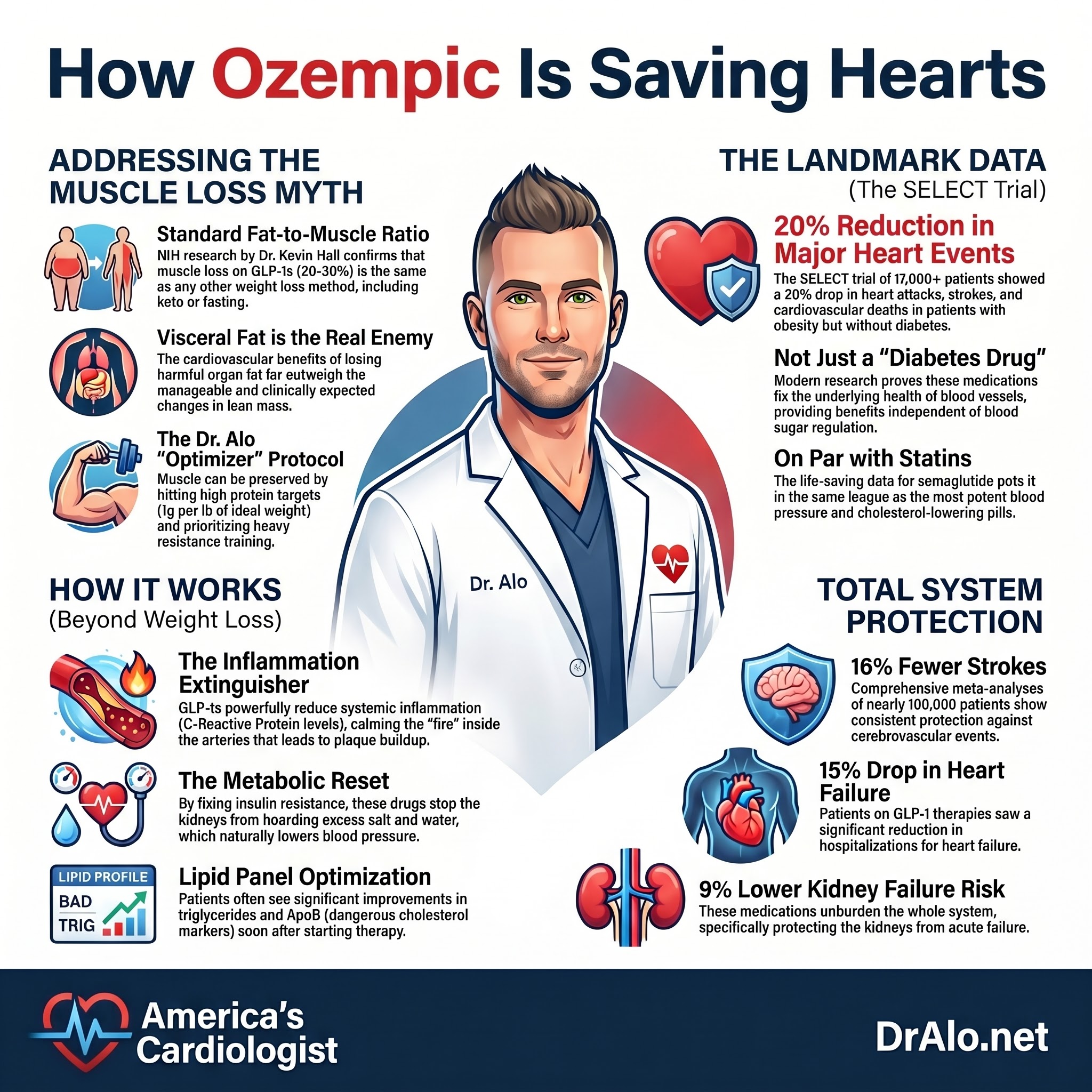
The results were staggering. Patients taking Semaglutide (Wegovy) saw a 20% reduction in major adverse cardiovascular events (MACE).
- 20% fewer heart attacks.
- 20% fewer strokes.
- 20% fewer cardiovascular deaths.
This is not just about fitting into a smaller pair of jeans. This is about staying alive. This data puts these medications on par with some of our most potent statins and blood pressure pills.
Infographic Summary:
You Don’t Have to Be Diabetic to Benefit
For a long time, we thought these were just "diabetes drugs." That has changed.
The SELECT trial was a landmark study that looked at people who were overweight or obese and had heart risks—but did not have diabetes. The drug (semaglutide) still worked wonders. It reduced cardiovascular events significantly.
This means the drug isn't just fixing blood sugar; it is fixing the underlying health of your heart and blood vessels.
Protecting the Whole System
It’s not just about preventing death. These medications improve specific health outcomes across the board:
- Heart Attacks: Reduced by 15% (with even better results seen in patients who are obese but don't have diabetes).
- Strokes: Reduced by 16%.
- Heart Failure: Hospitalizations for heart failure dropped by 15%.
- Kidneys: Acute kidney failure risks dropped by 9%.
Which Other Drugs Reduce Cardiovascular Risk?
Not all drugs in this class are created equal. The strongest evidence for heart protection currently comes from:
- Semaglutide (Ozempic, Wegovy)
- Dulaglutide (Trulicity)
- Liraglutide (Victoza)
In fact, the FDA has specifically approved Dulaglutide and Semaglutide to reduce the risk of major cardiovascular events in certain high-risk adults.
Before Ozempic, There Was Victoza (Liraglutide)
While Ozempic is getting all the headlines today, we have to give credit to the pioneer drug: Liraglutide (brand name Victoza).
A massive study called the LEADER Trial followed over 9,000 people with Type 2 Diabetes for almost four years. These weren't just random people—most of them already had heart disease or were at high risk for it.
Here is what the study proved:
- It Saves Lives: The most shocking finding was that taking Liraglutide reduced the risk of dying from heart issues by 22%.
- Fewer Events: It lowered the total risk of having a major heart problem (like a heart attack or stroke) by 13%.
- Kidney Bonus: Patients who also had kidney disease actually saw even better heart protection than those with healthy kidneys.
Why did it work? Just like with Ozempic, the benefits didn't come just from lowering blood sugar. The drug acted like a multi-tool for the body: it lowered blood pressure, dropped body weight, and most importantly, reduced inflammation (swelling) inside the arteries.
The Bottom Line: If you have Type 2 Diabetes and a history of heart trouble (like a past heart attack or stroke), Liraglutide has a proven track record of keeping you alive and out of the hospital. It was the first GLP-1 to get the FDA seal of approval for protecting the heart.
The Big Numbers: 14% Less Risk
In 2025, researchers conducted a massive "meta-analysis." This is a study that combines data from many other studies to get the most accurate picture possible. They looked at 21 major trials involving nearly 100,000 patients.
The results were conclusive. Patients taking these medications saw a 12% to 14% drop in major heart events.
When doctors say "major heart events" (or MACE), we are talking about the scary stuff:
- Heart attacks
- Strokes
- Cardiovascular death
This isn't just a guess. The evidence is now considered "high certainty." If you are at high risk for heart disease, these medications act like a shield.
How Do GLP1 Meds Protect the Heart? (It’s Not Just Weight)
You might think, "Well, of course their hearts got better, they lost weight!"
But the data tells a deeper story. The cardiovascular protection started happening before the patients reached their maximum weight loss. This suggests that GLP-1 agonists have direct benefits on the cardiovascular system independent of the scale.
- The Inflammation Extinguisher
We know that inflammation is a primary driver of atherosclerosis (plaque buildup). These medications appear to powerfully reduce systemic inflammation (lowering CRP levels), calming the "fire" inside your arteries.
- Blood Pressure & Lipids
Patients on these therapies often see a significant drop in systolic blood pressure and improvements in their lipid panels (triglycerides and ApoB), likely due to improved insulin sensitivity.
- The Metabolic Reset
By fixing Insulin Resistance, these drugs stop the kidneys from hoarding salt and water (as we discussed in my Hypertension Guide), further unburdening the heart.
The Elephant in the Room: Muscle Loss (The Kevin Hall Study)
Now, let’s address the biggest concern I hear in my clinic, often fueled by terrifying headlines: "Dr. Alo, will this drug melt my muscles?"
The fear is that while you lose fat, you also lose dangerous amounts of lean muscle mass (sarcopenia), leaving you frail.
Let’s look at the actual science, specifically the work of top NIH researcher Dr. Kevin Hall.
The Verdict: It’s No Different Than Any Other Diet
When you lose a significant amount of weight by any method—whether it's keto, intermittent fasting, bariatric surgery, or GLP-1s—you will lose some lean mass alongside fat. It’s unavoidable. The typical ratio is that about 20-30% of weight lost is lean mass.
Dr. Hall's analysis of the data confirms this: Patients on GLP-1s do NOT lose more muscle than patients on other diets. The ratio of fat loss to lean mass loss is standard.
Furthermore, Dr. Hall and other experts have concluded that the amount of muscle lost is not clinically relevant for the vast majority of people, especially when weighed against the massive cardiovascular benefits of losing harmful visceral fat. You are not becoming "frail"; you are becoming "smaller," and a smaller body requires less supportive tissue.
Study:
https://jamanetwork.com/journals/jama/article-abstract/2819410
The Bottom Line: The "Ozempic melts muscle" narrative is fear-mongering.
The Dr. Alo Protocol for GLP-1 Users (The Optimizer)
Even though the muscle loss isn't "dangerous," as your doctor, I still want to optimize your body composition. We don't just want you smaller; we want you stronger and metabolically healthier.
If I prescribe these medications, I give my patients a specific protocol to ensure that the weight they lose is almost entirely fat.
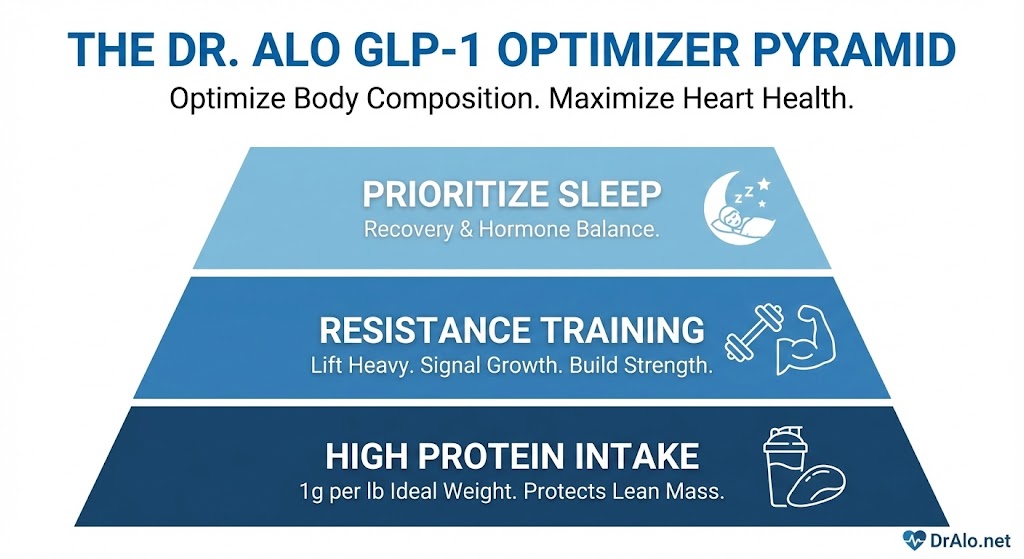
- Protein is King: You must hit high protein targets (roughly 1 gram per pound of ideal body weight). Since these drugs kill your appetite, you have to be intentional. You might need shakes to hit your numbers.
- Resistance Training: You cannot just do cardio. You must lift heavy things. This signals your body to keep the muscle while burning the fat.
- Slow and Steady: We are not racing to the finish line. I titrate doses slowly to ensure you are eating enough to sustain your lean mass.
Infographic Summary:
The Verdict
Are these "miracle drugs"? No. There is no such thing.
But they are a tool. A very, very sharp tool.
If you have a history of heart disease and struggle with obesity, these medications are no longer just an "option"—they are a guideline-directed therapy to save your life. The data is clear: the benefits to your heart far outweigh the manageable risk of muscle changes.
Don't take them to look good for a wedding. Take them to be around for your grandchildren's wedding.
Are you on a GLP-1 medication (or thinking about it) and want to optimize your results?
Don't just lose weight; change your body composition. In the Dr. Alo Community, I teach members exactly how to structure their macros and lifting routines to ensure they are following the science, not the headlines.
[Join the Community and Build a Heart-Healthy Body]
References:
- Comprehensive Meta-Analysis (2025): Cardiovascular Effects and Tolerability of GLP-1 Receptor Agonists: A Systematic Review and Meta-Analysis of 99,599 Patients.
- Finding: 12-14% reduction in MACE across 21 RCTs.
- Source: PubMed / Journal of the American College of Cardiology, Nov 2025.
- The SOUL Trial (Oral Semaglutide): McGuire DK, et al. Oral Semaglutide and Cardiovascular Outcomes in High-Risk Type 2 Diabetes.
- Finding: 14% reduction in major adverse cardiovascular events (MACE) with oral semaglutide.
- Source: The New England Journal of Medicine, March/May 2025.
- The FLOW Trial (Kidney & Heart Outcomes): Perkovic V, et al. Effects of Semaglutide on Chronic Kidney Disease in Patients with Type 2 Diabetes.
- Finding: Semaglutide reduced the risk of major kidney events by 24% and major cardiovascular events by 18%.
- Source: The New England Journal of Medicine, 2024/2025.
- The SELECT Trial (Non-Diabetic Patients): Lincoff AM, et al. Semaglutide and Cardiovascular Outcomes in Obesity without Diabetes.
- Finding: 20% reduction in MACE in overweight/obese patients without diabetes.
- Source: The New England Journal of Medicine, Nov 2023.
- FDA Approval & Safety Data:
- Wegovy (Semaglutide): FDA approved for cardiovascular risk reduction in adults with CVD and obesity (March 2024).
- Rybelsus (Oral Semaglutide): FDA label expansion for cardiovascular risk reduction in Type 2 Diabetes (October 2025).
Still Have Questions? Stop Googling and Ask Dr. Alo.
You’ve read the science, but applying it to your own life can be confusing. I created the Dr. Alo VIP Private Community to be a sanctuary away from social media noise.
Inside, you get:
-
Direct Access: I answer member questions personally 24/7/365.
-
Weekly Live Streams: Deep dives into your specific health challenges.
-
Vetted Science: No fads, just evidence-based cardiology and weight loss.
Don't leave your heart health to chance. Get the guidance you deserve. All this for less than 0.01% the cost of health insurance! You can cancel at anytime!
[👉 Join the Dr. Alo VIP Community Today]
Cardiology & Obesity Medicine