Is It Safe to Stop Your Statin After 70? What the New STREAM Trial Really Shows
Nov 08, 2026
Is It Safe to Stop Your Statin After 70? What the New STREAM Trial Really Shows
On November 7, 2026, a trial called STREAM was presented at the American Heart Association meeting and published in the New England Journal of Medicine. The headline you will see everywhere is that stopping statins in older adults was "noninferior" to staying on them.
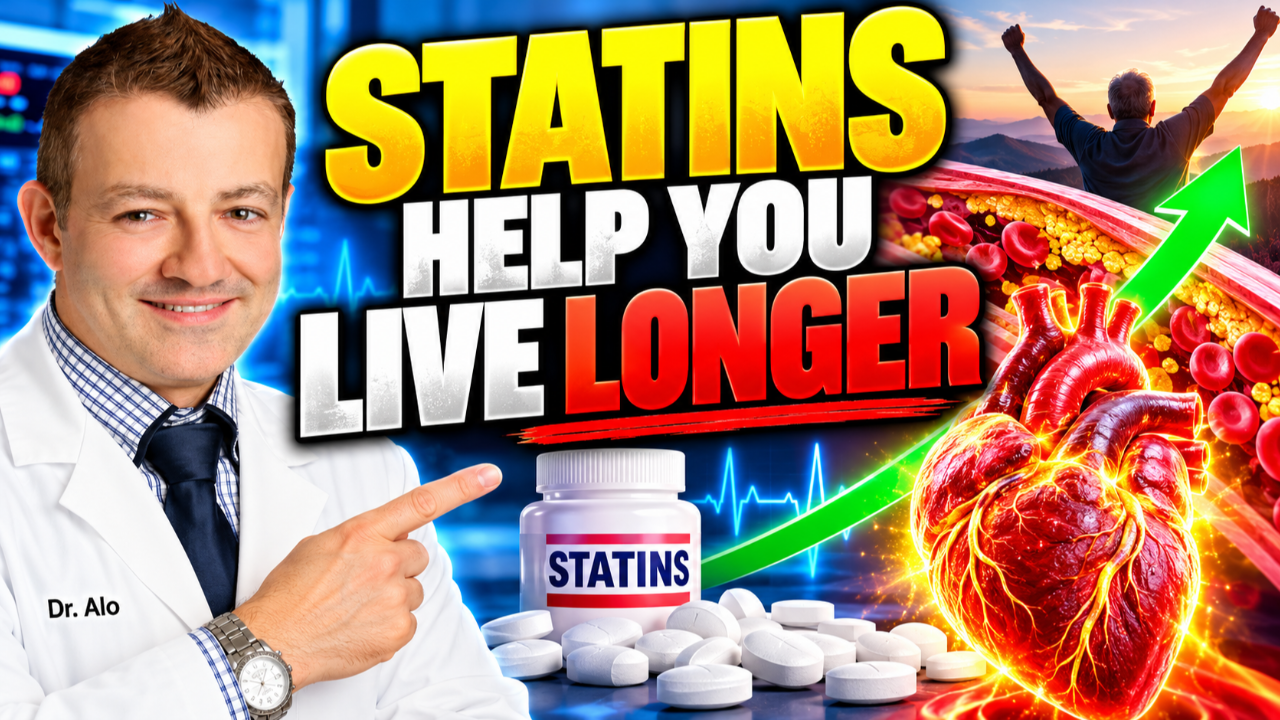
A lot of people are going to read that as "it's safe to stop your statin once you're over 70."
Wrong!
That is not what the paper shows. In this trial, the people who stopped their statin had more than twice as many heart attacks and more than twice as many strokes, and they did not feel any better for it.
So what did the study show and what does noninferior mean?
The short version
- Who: 1,880 adults aged 70 and older (average age 77.5) who had been taking a statin for at least a year, and on average more than 6 years, to prevent a first heart attack or stroke. Everyone had at least two chronic conditions.
- What: half were told to stop their statin, half to keep taking it. They were followed for about two years.
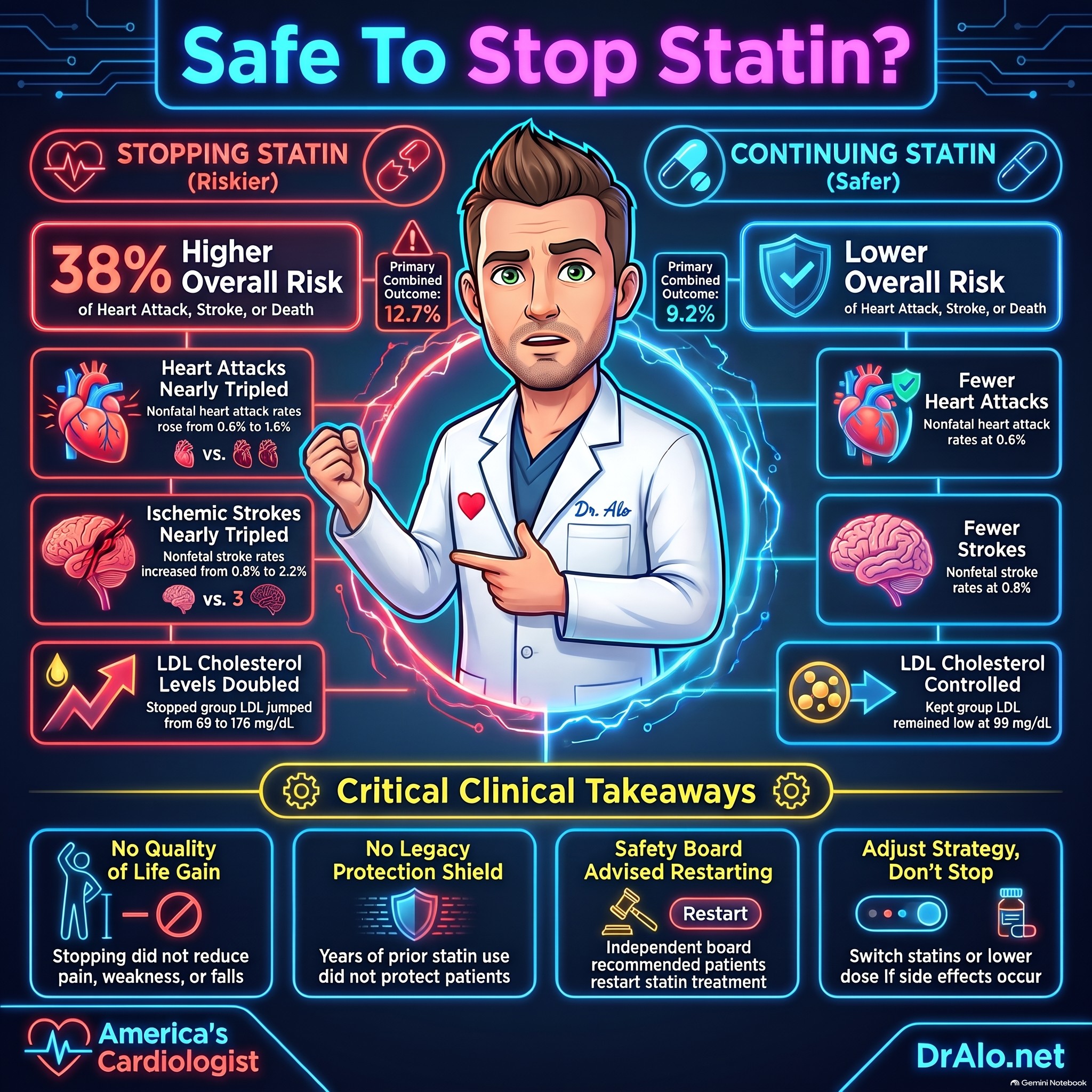
- Heart attacks: 1.6 percent after stopping vs 0.6 percent when continuing.
- Ischemic strokes: 2.2 percent vs 0.8 percent.
- Deaths: 9.8 percent vs 8.0 percent.
- Overall: 12.7 percent of people who stopped had a heart attack, stroke, or died, vs 9.2 percent of people who continued. That is a 38 percent higher risk (hazard ratio 1.38, 95% CI 1.05 to 1.81).
- Quality of life, pain, falls, and muscle weakness: no difference. Stopping did not make people feel better.
- LDL cholesterol: roughly doubled after stopping, from about 89 mg/dL on a statin to 176 mg/dL one year later, compared with 99 mg/dL in people who stayed on it.
Infographic Summary:
What the trial did
STREAM was run at 24 sites in Switzerland, the Netherlands, and France, and funded by the Swiss National Science Foundation, not by a drug company. People were enrolled between 2021 and 2025. To qualify, you had to be 70 or older, be taking a statin only for prevention (no prior heart attack, stroke, or known artery disease), and have at least two chronic conditions, such as diabetes, high blood pressure, or kidney disease. About a third had diabetes, and about half were recruited by their family doctor.
This is exactly the patient I see all the time: someone in their late 70s, on several medications, wondering whether the statin is still worth it.
The trial was "open label," meaning everyone knew whether they had stopped or not. There was no placebo pill. The heart attacks, strokes, and deaths were judged by experts who did not know which group each person was in.
Why it was called "noninferior"
A noninferiority trial does not ask "is stopping as good as continuing?" It asks "is stopping not worse than continuing by more than a certain amount?" The researchers chose that amount ahead of time.
They measured how many weeks, out of the first two years, people lived without a heart attack, stroke, or death. They decided in advance that stopping would count as "noninferior" as long as people lost fewer than 5.2 weeks of event-free time over those two years. That is about a 5 percent loss.
The result: people who stopped their statin lost 2.0 weeks (95% CI 0.3 to 3.7 weeks). Because 2.0 is less than 5.2, the trial met its definition of noninferior.
But look at that confidence interval. It does not include zero. In plain English, stopping was measurably worse. It was just less worse than the limit the researchers were willing to accept. When they analyzed only the people who actually followed their assigned plan, the loss was a bit bigger, 2.4 weeks.
"Two weeks" sounds tiny, but it is an average spread across everyone, including the large majority who had no event at all. For the people who did have the heart attack or stroke, it was not two weeks. It was a heart attack or a stroke. The authors put it another way: for every 40 people who stop their statin, one extra person has a heart attack, stroke, or dies within two years.
The numbers in detail
| Outcome (full follow-up, median 2 years) | Stopped statin | Kept statin |
|---|---|---|
| Heart attack, stroke, or death (main outcome) | 12.7% | 9.2% |
| Nonfatal heart attack | 1.6% (15 people) | 0.6% (6 people) |
| Nonfatal ischemic stroke | 2.2% (21 people) | 0.8% (8 people) |
| Death from any cause | 9.8% | 8.0% |
| At least one serious adverse event | 43.0% | 39.8% |
| LDL cholesterol at 12 months (subgroup of 235) | 176 mg/dL | 99 mg/dL |
Major cardiovascular events (heart attack, stroke, or cardiovascular death) and the broader "any cardiovascular event" outcome were also both significantly worse after stopping.
The event curves tell the story. For the first year or so, the two groups track together. Then they split, and the gap keeps widening right up to the end of follow-up. Statin benefit builds over time, and so does the harm of stopping. A two-year window is short, and the trend was still moving the wrong way when the trial ended.
Five things I want you to take away
1. Stopping your statin raises your LDL right back up
This should not surprise anyone. LDL roughly doubled after stopping, from about 89 to 176 mg/dL. Based on decades of trial data, a rise of about 77 mg/dL in LDL is expected to raise cardiovascular risk by roughly 40 percent, and that is almost exactly what happened (38 percent). The biology did not change because you turned 70.
2. Years of statin use did not "protect" people after they stopped
These people had been on statins for more than 6 years on average. Some people hope that past statin use leaves a lasting "legacy" that keeps protecting you after you stop. The authors specifically note that their results suggest it did not. Within months of stopping, risk started to climb.
3. Stopping did not make anyone feel better
The most common reasons people want to stop a statin are muscle aches, pill burden, and a sense that it is no longer doing anything. STREAM measured quality of life, pain, falls, muscle strength and sarcopenia, and medication adherence. None of them improved after stopping. So people took on more heart attacks and strokes and got nothing back for it.
If you have true side effects on a statin, the answer is usually a different statin, a lower dose, or a non-statin option like ezetimibe or bempedoic acid, not stopping lipid lowering altogether.
4. These were real-world, sicker older adults, and the statin still worked
An earlier French trial of statin discontinuation in people over 75 did not find a difference, but its participants were healthier: about 7.5 percent died within three years, compared with 15.1 percent in STREAM. STREAM enrolled people with multiple chronic conditions, the exact group many people assume no longer benefits. Even in this group, the statin was still preventing heart attacks and strokes.
5. The trial's own safety board recommended restarting
After reviewing the final data, the independent data and safety monitoring board recommended in June 2026 that everyone in the stopping group be advised to talk to their doctor about restarting their statin. That tells you how the people closest to the data interpreted it.
What about STAREE?
Earlier this year, the STAREE trial showed that starting atorvastatin in healthy older adults reduced major cardiovascular events but did not improve "disability-free survival." Some people have used that to argue statins are pointless after 70. The STREAM authors make an important point: starting a drug and stopping a drug are different questions, and STAREE should not be used to decide whether to stop. STREAM is the trial that actually tested stopping, and stopping led to more heart attacks and strokes.
The fair limitations
- No placebo. Everyone knew whether they had stopped. The authors note that the main outcomes (heart attack, stroke, death) are objective and were judged by blinded experts, which limits this problem.
- People switched groups. 131 people in the stopping group restarted and 112 in the continuing group stopped. Switching makes the two groups look more alike, which, if anything, makes stopping look safer than it really is. The authors ran several analyses showing it did not change their conclusions.
- Only two years. As I mentioned, the gap was still widening when follow-up ended.
- Mostly European participants. The trial was done in Switzerland, the Netherlands, and France.
So, should you stop your statin after 70?
Here is how I think about it in my clinic:
- If you are doing well on your statin, this trial is a reason to keep taking it, not to stop. Stopping more than doubled heart attacks and strokes and did not improve how people felt.
- Age alone is not a reason to stop. Your arteries do not stop responding to LDL because of a birthday.
- There are good reasons to stop, and they are individual: a limited life expectancy from another illness, a move to comfort-focused care, or side effects that a different statin or a non-statin option cannot solve. Those are conversations to have with your own doctor.
- If you have side effects, change the plan, not the goal. Try a different statin, a lower dose, alternate-day dosing, or add ezetimibe or bempedoic acid. Keep your LDL down.
- If you already stopped, talk to your doctor about restarting, just as the trial's own safety board advised.
The authors say their results support shared decision making, and I agree completely. Shared decision making works best when you know the real numbers, and the real numbers here are more heart attacks, more strokes, and no improvement in how people felt.
Frequently asked questions
Didn't the trial say stopping was safe?
It said stopping was "noninferior," which means it was not worse than continuing by more than a pre-set limit of 5.2 weeks of event-free time over two years. Stopping was still measurably worse, with 38 percent more heart attacks, strokes, and deaths, and more than double the heart attacks and strokes.
I'm 80. Is my statin still doing anything?
In this trial of people averaging 77.5 years old with several chronic conditions, yes. Stopping the statin raised LDL from about 89 to 176 mg/dL and was followed by more heart attacks and strokes within two years.
My muscles ache. Should I just stop?
In STREAM, stopping did not improve pain or muscle strength on average. Talk to your doctor about switching statins, lowering the dose, or using a non-statin medication instead of stopping all cholesterol treatment.
I've taken a statin for 10 years. Doesn't that protect me now?
The trial suggests not. These participants had taken statins for more than 6 years on average, and their risk still rose within months of stopping.
Related reading
- Statins and Cholesterol Treatment in Older Adults: Benefits Proven at Any Age
- Should You Take a Statin If You Are Over 60?
- Atorvastatin Side Effects: What Is Normal and What Is Not
References
- Rodondi N, Haller ML, Bardoczi JB, et al. Discontinuing Statins in Older Adults without Cardiovascular Disease. N Engl J Med. Published online November 7, 2026. https://doi.org/10.1056/NEJMoa2606634 (STREAM, ClinicalTrials.gov NCT05178420)
- American College of Cardiology. STREAM, eZ-PAVE Add New Insights Into Statin Therapy Treatment. November 7, 2026. acc.org
Go deeper inside the community
Articles like this one cover the general case. The questions that actually decide what you should do next are usually about your own numbers, and those are the ones worth asking somewhere you can get an answer. Dr. Alo's private community is where the lab patterns, the case examples, and the follow-up questions live, alongside people working through the same things.
Still Have Questions? Stop Googling and Ask Dr. Alo.
You’ve read the science, but applying it to your own life can be confusing. I created the Dr. Alo VIP Private Community to be a sanctuary away from social media noise.
Inside, you get:
-
Direct Access: I answer member questions personally 24/7/365.
-
Weekly Live Streams: Deep dives into your specific health challenges.
-
Vetted Science: No fads, just evidence-based cardiology and weight loss.
Don't leave your heart health to chance. Get the guidance you deserve. All this for less than 0.01% the cost of health insurance! You can cancel at anytime!
[👉 Join the Dr. Alo VIP Community Today]
Cardiology & Obesity Medicine