
Women, Testosterone Replacement, And Heart Disease Risk?
Jan 11, 2026
Testosterone Therapy for Women: What the Evidence Says
Testosterone for women? Yes, unfortunately this s commonly ignored, but can cause serious issues.
An increasing number of women, particularly during perimenopause and early post menopause, are asking about testosterone therapy. Common concerns include low libido, fatigue, brain fog, reduced motivation, and feeling suboptimal despite estrogen therapy. At the same time, women are appropriately concerned about cardiovascular disease, stroke, and blood clot risk. Understanding what the evidence truly shows is essential for informed decision-making.
Are You In Perimenopause? Check my other article for my Perimenopause Checklist!
The Role of Testosterone in Women
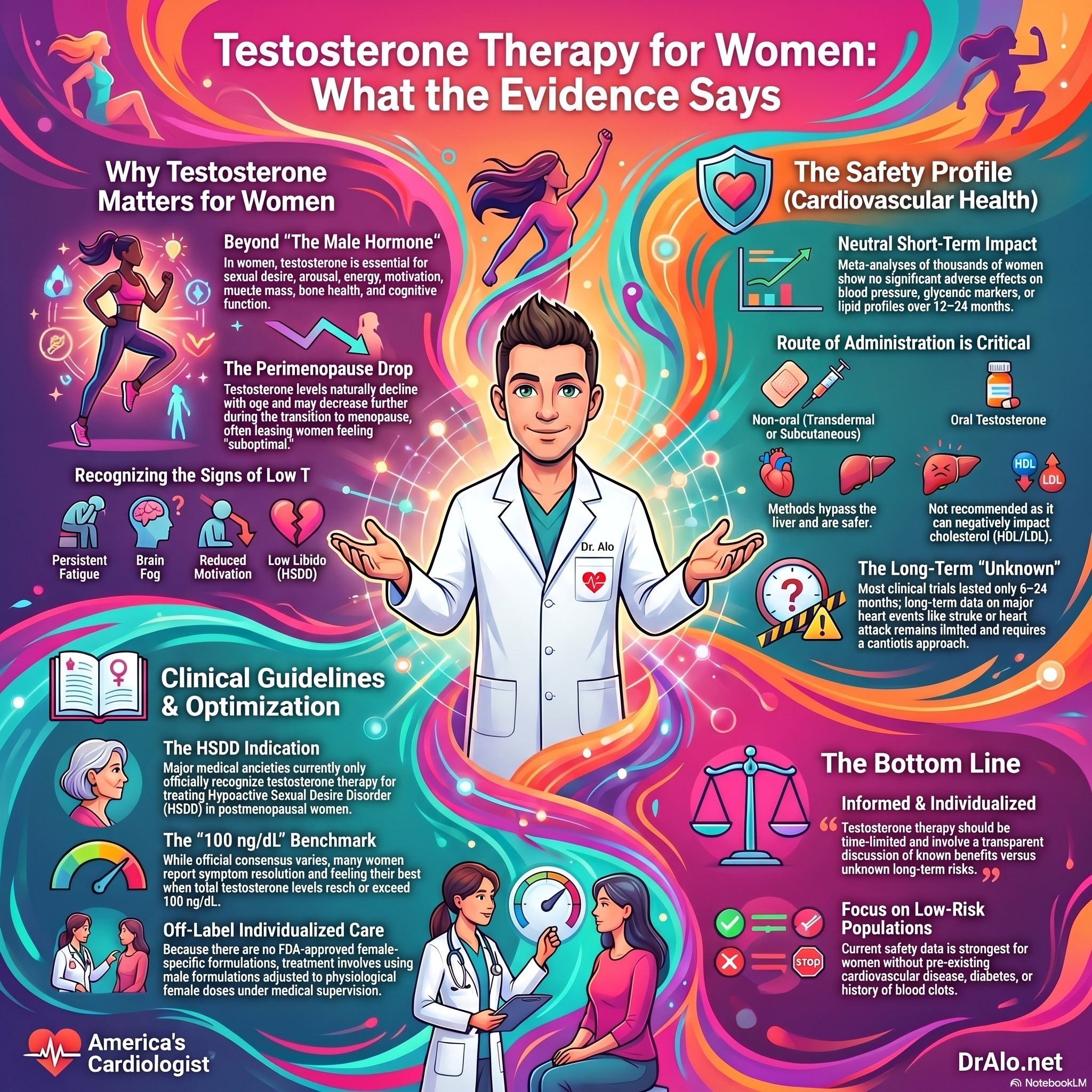
Testosterone is not exclusively a male hormone. In women, testosterone contributes to sexual desire, arousal, energy, motivation, muscle mass, bone health, and cognitive function. Testosterone levels naturally decline with age and may decrease further during perimenopause, although there is no universally accepted testosterone deficiency syndrome in women outside specific clinical indications.
Women Testosterone Infographic Summary:
Evidence-Based Indications for Testosterone Therapy
All major medical societies agree that the only evidence-based indication for testosterone therapy in women is the treatment of hypoactive sexual desire disorder (HSDD) in postmenopausal women. There are no FDA-approved testosterone formulations for women, so treatment is prescribed off-label using male formulations adjusted to physiological female doses.
Short-Term Cardiovascular Safety Data
Short-term randomized controlled trials and meta-analyses suggest that non-oral testosterone therapy administered at physiological doses has not demonstrated statistically significant adverse effects on blood pressure, glycemic markers, or lipid profiles. Meta-analyses involving thousands of women show neutral cardiometabolic effects over follow-up periods of up to 12 to 24 months.
Importance of Route of Administration
Route of administration is critical for cardiovascular safety. Oral testosterone is associated with adverse lipid changes, including decreased HDL cholesterol and increased LDL cholesterol, and is not recommended. Transdermal and subcutaneous testosterone bypass hepatic first-pass metabolism and demonstrate neutral lipid effects in short-term studies.
Long-Term Cardiovascular Outcomes Remain Unknown
Long-term cardiovascular outcome data for testosterone therapy in women are extremely limited. Most randomized controlled trials followed participants for only 12 to 24 months, with many evaluating therapy for six months or less. The longest available safety data extend to approximately 24 months, and no trials have been powered to assess hard cardiovascular endpoints such as myocardial infarction, stroke, or cardiovascular death.
Exclusion of Higher-Risk Women From Trials
A critical limitation of existing trials is the systematic exclusion of women at high cardiometabolic risk. Women with established cardiovascular disease, diabetes, significant dyslipidemia, or prior thrombotic events were typically excluded. Many participants were also taking concurrent estrogen therapy. As a result, current findings are not generalizable to higher-risk populations or long-term use.
Observational Data Beyond Two Years
Observational studies evaluating longer-term testosterone use in women show conflicting results. Some large database analyses report neutral or even lower rates of major cardiovascular events, likely influenced by healthy-user and prescribing bias. Other studies suggest increased risks of composite cardiovascular disease, coronary artery disease, and stroke. These observational findings cannot establish causality but reinforce uncertainty regarding long-term safety.
Venous Thromboembolism and Blood Clot Risk
The risk of venous thromboembolism with testosterone therapy in women remains uncertain. Randomized trials have not demonstrated statistically significant increases in deep vein thrombosis or pulmonary embolism, although some analyses show nonsignificant trends toward increased risk. Concurrent estrogen therapy represents a major confounding factor, and modest risk increases cannot be excluded, particularly in higher-risk women.
Current Guideline Recommendations
Given the substantial evidence gaps, current guidelines recommend a cautious approach to testosterone therapy in women. Therapy should be limited to carefully selected postmenopausal women with diagnosed HSDD, using physiologic dosing via non-oral routes. Treatment duration is generally short-term, often limited to six months, with clear counseling regarding unknown long-term cardiovascular and thrombotic risks.
Women's Optimal Testosterone Levels?
What should your testosterone level be? While there isn't a consensus amongst the societies and specialty organizations, most women feel better when total testosterone is above 100 ng/dL. This may not be right for everyone, but this appears to be the number at which most feel their best and symptoms resolve. Some will be fine at much lower levels. I have seen women with numbers in teh signle digits, and most physicians will completely ignore this.
Women And Testosterone Bottom Line
Testosterone therapy for women appears cardiometabolically neutral in the short term when used at physiological doses via non-oral routes in lower-risk populations. However, long-term cardiovascular and thromboembolic safety remains uncertain due to limited trial duration, exclusion of higher-risk women, and conflicting observational data. Testosterone therapy should be individualized, time-limited, and prescribed with transparent discussion of what is known and what remains unknown.
References
Islam RM, Bell RJ, Green S, Page MJ, Davis SR. Safety and Efficacy of Testosterone for Women: A Systematic Review and Meta-Analysis of Randomised Controlled Trial Data. The Lancet Diabetes & Endocrinology. 2019.
Davis SR, Baber R, Panay N, et al. Global Consensus Position Statement on the Use of Testosterone Therapy for Women. The Journal of Clinical Endocrinology & Metabolism. 2019.
Wierman ME, Arlt W, Basson R, et al. Androgen Therapy in Women: A Reappraisal. The Journal of Clinical Endocrinology & Metabolism. 2014. Endocrine Society Clinical Practice Guideline.
Lincoff AM, Bhasin S, Flevaris P, et al. Cardiovascular Safety of Testosterone-Replacement Therapy. The New England Journal of Medicine. 2023. Male population study referenced for safety context.
Agrawal P, Singh SM, Hsueh J, et al. Testosterone Therapy in Females Is Not Associated With Increased Cardiovascular or Breast Cancer Risk: A Claims Database Analysis. The Journal of Sexual Medicine. 2024.
Vo TT, Roy S, Ye T, et al. Effect of Exogenous Testosterone on Cardiovascular, Cerebrovascular, and Thromboembolic Adverse Events: Results of Three Complementary Research Designs. American Journal of Epidemiology. 2025.
American College of Obstetricians and Gynecologists. Clinical guidance on hormone therapy duration and safety in women, noting limited evaluation of testosterone therapy beyond six months.
Canonico M, Plu-Bureau G, Lowe GDO, Scarabin PY. Hormone Replacement Therapy and Risk of Venous Thromboembolism in Postmenopausal Women: Systematic Review and Meta-Analysis. BMJ. 2008.
Vinogradova Y, Coupland C, Hippisley-Cox J. Use of Hormone Replacement Therapy and Risk of Venous Thromboembolism: Nested Case-Control Studies Using the QResearch and CPRD Databases. BMJ. 2019.
El Khoudary SR, Aggarwal B, Beckie TM, et al. Menopause Transition and Cardiovascular Disease Risk: Implications for Timing of Early Prevention. Circulation. 2020.
Still Have Questions? Stop Googling and Ask Dr. Alo.
You’ve read the science, but applying it to your own life can be confusing. I created the Dr. Alo VIP Private Community to be a sanctuary away from social media noise.
Inside, you get:
-
Direct Access: I answer member questions personally 24/7/365.
-
Weekly Live Streams: Deep dives into your specific health challenges.
-
Vetted Science: No fads, just evidence-based cardiology and weight loss.
Don't leave your heart health to chance. Get the guidance you deserve. All this for less than 0.01% the cost of health insurance! You can cancel at anytime!
[👉 Join the Dr. Alo VIP Community Today]
Cardiology & Obesity Medicine