
White Coat Syndrome vs Masked Hypertension: When Blood Pressure Readings Lie
Dec 31, 2025
White Coat Syndrome vs. Masked: Which One Do You Have
Your doctor checks your blood pressure in the clinic. It's high. They recommend medication.
You go home. You check it on your own monitor. It's normal.
Now what? Who's right? Do you really need treatment?
Or here's the opposite: Your office readings look fine. Your doctor says you're good. But when you check at home, your readings are consistently elevated. Should you be worried?
This is not your imagination. This is not a broken monitor. This is a real phenomenon. It affects millions of people and fundamentally changes how we should treat blood pressure. It's one of the biggest reasons the medical community moved away from trusting office readings alone.
In this article, I'll explain the difference between white coat and masked hypertension, why each one matters differently, how to figure out which one you have, and what you should actually do about it.
What is white coat syndrome?
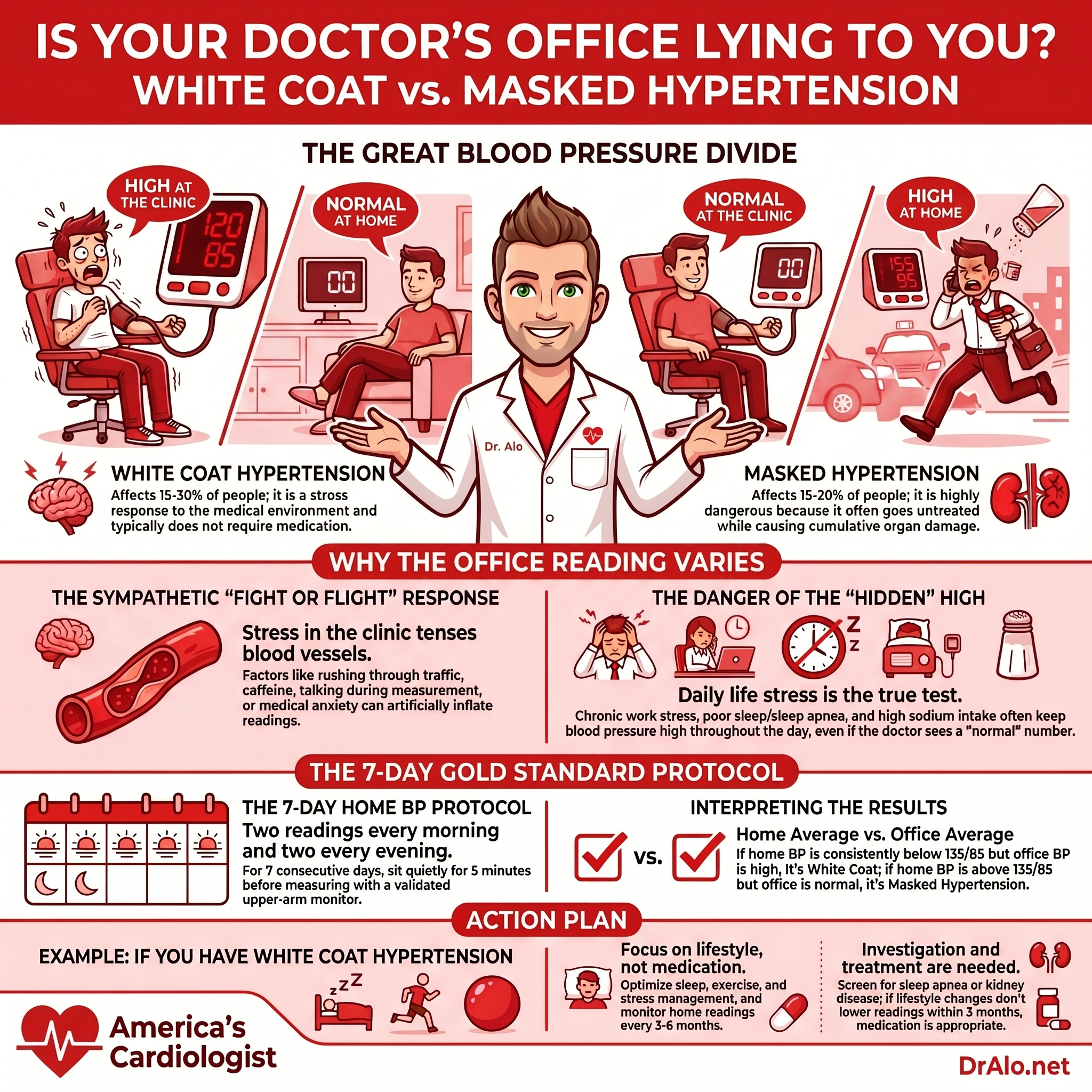
White coat hypertension means your blood pressure is elevated when a doctor measures it, but normal when you measure it at home or over 24 hours.
Here's what's happening: Your body is responding to the stress of being in a medical setting. The anxiety of a clinic visit, the white coat effect, the artificial circumstances of the measurement. All of it causes your sympathetic nervous system to activate. Your heart rate goes up. Your blood vessels tense. Your pressure rises.
But in your normal daily life, away from the stress of the doctor's office, your blood pressure is actually fine.
White coat hypertension affects approximately 15-30% of people who appear to have high blood pressure in the clinic. That's roughly 15-30 million Americans whose office readings don't reflect their true daily blood pressure exposure.
What is masked hypertension?
Masked hypertension is the reverse. Your blood pressure looks normal in the clinic, but it's actually elevated in your daily life. You're at work, dealing with stress, or going about your routine with elevated pressure that your doctor doesn't see.
This is more dangerous than white coat hypertension because your organs (your heart, your kidneys, your brain, your arteries) are experiencing high blood pressure every day. But your doctor thinks you're fine because they only measured you in that one artificial moment.
Masked hypertension is common, affecting about 15-20% of people with "normal" office blood pressure readings. And because it's hidden, it often goes untreated.
Infographic Summary:
Why this matters: The real risk difference
White coat and masked hypertension are not equal problems.
White coat hypertension: If your true out-of-office blood pressure is actually normal, you don't need medication. You should not be treated. The risk from taking a blood pressure medication you don't actually need (side effects, overtreatment, cost) outweighs any benefit.
That said, white coat hypertension still tells us something: your nervous system is highly reactive to stress. That's a signal to monitor, and it means lifestyle interventions (sleep, stress management, exercise) matter more for you than for others.
Masked hypertension: This usually deserves treatment. Your organs are experiencing high blood pressure every single day. That's cumulative damage. Research shows that masked hypertension carries similar cardiovascular risk to sustained hypertension. Your heart, kidneys, and arteries are exposed to elevated pressure 24/7, even though your doctor doesn't know it yet.
The problem is that you could have masked hypertension and not know it if your doctor only checks your office reading.
Who is more likely to have white coat syndrome?
You're at higher risk if you experience:
- Significant anxiety in medical settings
- Pain during the visit (which raises BP temporarily)
- Rushing through traffic and arriving stressed at the appointment
- Talking during the blood pressure measurement (talking raises pressure)
- Caffeine or nicotine consumed right before the visit
- A naturally high-stress personality
Age matters too. White coat hypertension is more common in older adults and women.
Who is more likely to have masked hypertension?
Masked hypertension is more common and more dangerous in people with:
- Chronic stress at work or home
- Poor sleep quality or untreated sleep apnea (major culprit)
- Frequent alcohol intake
- High sodium diet
- Lack of physical activity
- Diabetes or early kidney disease
- Already established cardiovascular disease
- Younger age (surprisingly, masked hypertension is more common in young adults who think they're fine)
How to find out which one you have: Testing options
Option 1: Home blood pressure monitoring (HBPM)
This is the simplest starting point and what I usually recommend first.
The 7-day home BP protocol:
- Take two readings each morning and two readings each evening
- Do this for 7 consecutive days
- Wait 1-2 minutes between the two readings
- Sit quietly for 5 minutes before measuring
- Use the same validated upper-arm monitor (wrist cuffs are less accurate)
- Record the readings in a log
Then analyze the pattern:
- Calculate your home BP average and compare it to your office average
- Look for morning vs. evening patterns (morning surge is normal; extreme spike needs investigation)
- If you're on medication, track whether timing affects readings
Interpretation:
- If home BP is consistently normal (below 135/85) but office BP is high: You have white coat hypertension. You likely don't need medication for BP control.
- If home BP is consistently elevated (above 135/85) but office BP is normal: You have masked hypertension. You likely do need treatment.
- If both are consistently elevated: You have sustained hypertension. You need treatment.
Option 2: Ambulatory blood pressure monitoring (ABPM)
ABPM is a device that automatically measures your blood pressure every 15-30 minutes while you wear it for 24 hours (sometimes 48 hours).
ABPM gives you the gold-standard picture because it captures your true pressure pattern throughout your actual day. It includes work, stress, sleep, meals, and exercise.
ABPM is especially useful if:
- Your home readings are ambiguous or hard to interpret
- Your office and home readings tell conflicting stories
- You have resistant hypertension (still high on three or more medications)
- You suspect nighttime hypertension or a morning surge problem
- Your doctor wants a definitive answer before starting medication
If you have white coat syndrome: Here's what to do
If your home/ambulatory readings confirm that your true blood pressure is normal, here's my approach:
- First: Do not start medication based on office readings alone. You don't need it.
- Second: Focus on lifestyle optimization. Exercise, sleep quality, stress management, and sodium reduction all matter for your reactivity.
- Third: Monitor periodically. Check your home BP every 3-6 months to ensure it stays normal.
- Fourth: Improve your office visit experience. Arrive early, sit quietly, ask the staff to recheck at the end of the visit, avoid caffeine beforehand, bring your home log.
Many people with white coat hypertension never need medication. But some do progress to sustained hypertension over time, so monitoring is important.
If you have masked hypertension: Here's what to do
If your home/ambulatory readings show that your true blood pressure is elevated despite normal office readings, treatment is usually needed.
Your doctor may recommend:
- Investigation first: Screen for sleep apnea, kidney disease, medication side effects (like NSAIDs or decongestants), high alcohol use. These can all be treated and may resolve the hypertension.
- Lifestyle changes: Weight loss, exercise, DASH diet, sodium reduction, stress management, improved sleep.
- Medication: If lifestyle changes don't lower your readings to target within 3 months, medication is appropriate. Your home readings provide clear evidence of the need.
Practical tips to make your office BP reading more accurate
Even if you have white coat hypertension, you want your office readings to be as accurate as possible for comparison purposes. Here's how:
- Arrive 10-15 minutes early and sit quietly
- Ask the staff to recheck your BP at the end of your visit (readings often come down with familiarity)
- Avoid caffeine for 30 minutes before the appointment
- Avoid nicotine for 30 minutes before the appointment
- Use the bathroom before the measurement (full bladder raises BP)
- Request the correct cuff size (too small = falsely high reading)
- Keep your back supported and feet flat on the floor during measurement
- Don't talk during the measurement
- Bring your home BP log to show your doctor
Frequently asked questions
Is white coat syndrome actually dangerous?
It's generally less risky than sustained hypertension, but it's not "no big deal." Your cardiovascular system is showing that it's highly reactive to stress. Some people with white coat hypertension do progress to sustained hypertension over time. Plus, chronic stress reactivity itself has health consequences. But the key point: if your true daily BP is normal, you don't need medication.
Can I have both white coat and masked hypertension?
You can have variable patterns, especially if you're already on medication or your BP is naturally variable. That's why tracking trends over time matters more than any single reading.
My doctor is recommending medication based on one office visit. Should I worry?
One reading is not enough for a confident BP diagnosis. Current guidelines recommend out-of-office measurement (home BP monitoring or ABPM) before starting treatment, especially for people with only mildly elevated readings. Bring your home log to your next visit.
What's more common, white coat or masked hypertension?
Both are relatively common (each affecting 15-20% of their respective groups). But masked hypertension is the bigger clinical problem because it goes unnoticed.
Can anxiety medication help white coat hypertension?
It might lower your office BP, but the real question is: what is your true daily BP? If it's already normal, you don't need medication for it. Addressing the anxiety itself through relaxation techniques, lifestyle changes, or therapy is more appropriate.
The bottom line
Your office blood pressure reading is not your true blood pressure. Your home readings, taken consistently over multiple days, reflect your actual exposure. If they differ, out-of-office measurement is what matters for treatment decisions.
If you have white coat hypertension, you're one of millions. You don't need to be medicated for anxiety. If you have masked hypertension, it's critical that you know it. Treatment can prevent future heart disease, stroke, and kidney damage.
The solution is simple: stop guessing. Get a validated home monitor, follow the 7-day protocol, and bring your data to your doctor. That's the modern standard of care for hypertension diagnosis.
Questions about your specific situation?
This is exactly the kind of nuanced conversation the Heart 2 Heart VIP Community is designed for. You have conflicting readings. Your doctor says one thing. Your home monitor says another. You need clarity on what your numbers actually mean and whether you should be treated.
That's what we do in the community. You can text me anytime with your BP log, we discuss your specific pattern and risk factors, and you get physician-level guidance. Not generic advice. You can also join live video calls where we talk through these exact scenarios, and connect directly with others working through their own BP management.
Join here: https://dralo.net/community
💪🏻🩺🫀 Dr. Alo
References
American Heart Association. Understanding Blood Pressure Readings. Updated 2023.
Related Blood Pressure Management Posts
Complete blood pressure library:
- What Does 130/80 Mean? Stage 1 Hypertension
- How to Take Blood Pressure at Home Correctly
- Why Is My Blood Pressure High in the Morning?
- Blood Pressure Spikes After Coffee, Stress, or Exercise
- When Is High Blood Pressure an Emergency?
- Low Blood Pressure Symptoms
- Best Foods to Lower Blood Pressure
- Blood Pressure Medications Explained
- How To Lower Blood Pressure Naturally Without Meds
- Is Salt Burning Your Heart?
Prevention & Guidelines
- Dr. Alo's Dietary Guidelines – Complete prevention framework
- Statins And Dementia – Medication options
Still Have Questions? Stop Googling and Ask Dr. Alo.
You’ve read the science, but applying it to your own life can be confusing. I created the Dr. Alo VIP Private Community to be a sanctuary away from social media noise.
Inside, you get:
-
Direct Access: I answer member questions personally 24/7/365.
-
Weekly Live Streams: Deep dives into your specific health challenges.
-
Vetted Science: No fads, just evidence-based cardiology and weight loss.
Don't leave your heart health to chance. Get the guidance you deserve. All this for less than 0.01% the cost of health insurance! You can cancel at anytime!
[👉 Join the Dr. Alo VIP Community Today]
Cardiology & Obesity Medicine