
57% of Healthy Adults Already Have Plaque
Sep 02, 2026
Silent Atherosclerosis: 57% of Healthy Adults Already Have Plaque
A new study just imaged the arteries of 16,808 adults who had no known heart disease. No prior heart attack. No stroke. No stents. No bypass. Just ordinary people between 18 and 70 years old who would tell you, if you asked, that their heart is fine.
More than half of them had plaque.
Not "risk of plaque." Not "elevated risk score." Actual atherosclerotic plaque, visualized directly in the carotid arteries, the femoral arteries, or the coronary arteries. In 57.1% of participants.
This is the REACT study, published in the New England Journal of Medicine on August 29, 2026. I have been saying some version of this for years, and I have been called alarmist for it. Now there is a 16,808 person imaging atlas that says it out loud.
Let me walk you through what it found, because a few of these numbers should permanently change how you think about your own arteries.
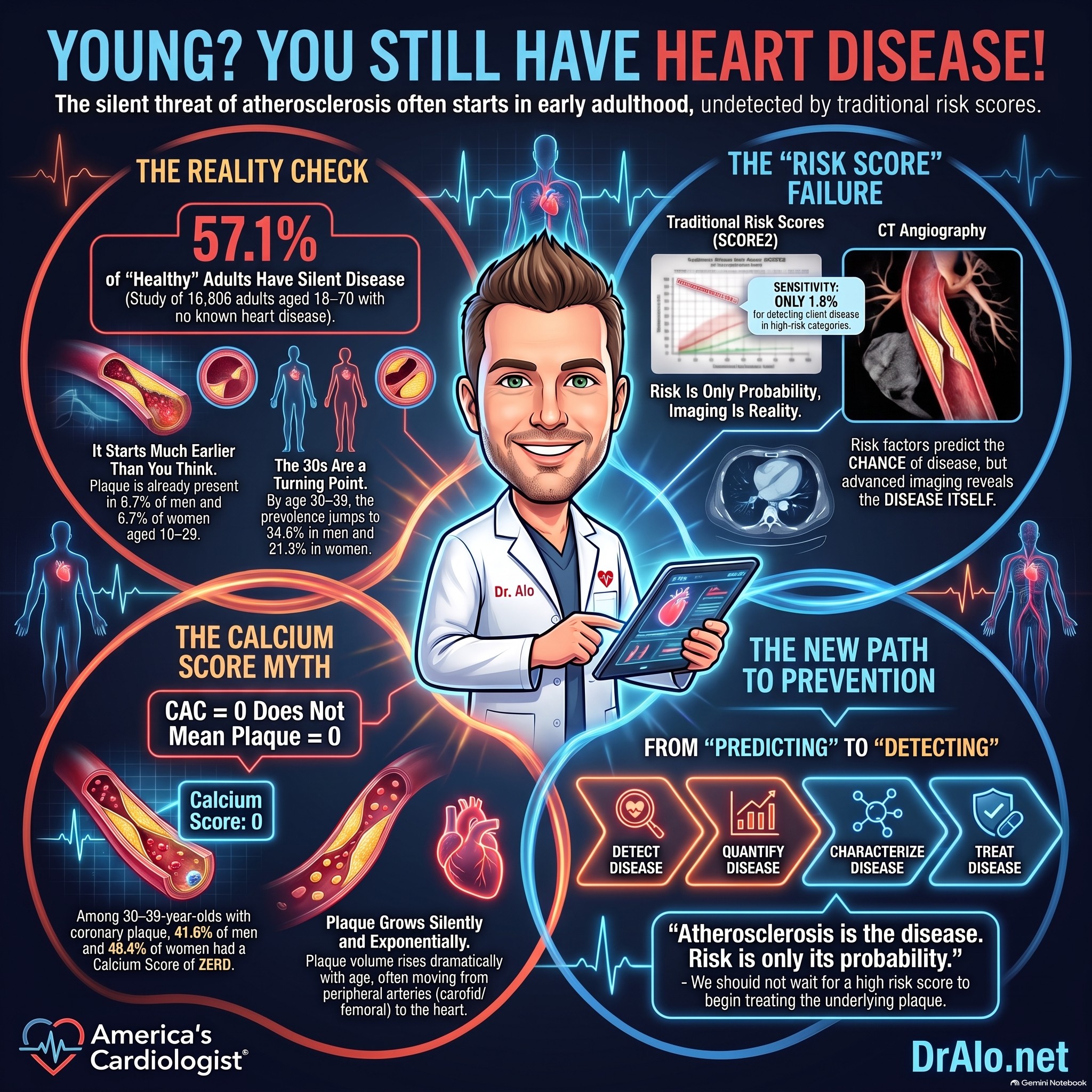
Infographic Summary:
What the REACT Study Actually Did
REACT enrolled adults 18 to 70 years old across Denmark and Spain between November 2024 and June 2026. The enrollment was deliberately balanced by age, sex, and country, roughly 2,000 participants each in the 18 to 29 and 60 to 70 groups and roughly 4,000 each in the 30s, 40s, and 50s. Just over half the cohort was women.
Everyone was excluded if they had established atherosclerotic cardiovascular disease. Notably, symptoms like chest pain or leg claudication were not exclusion criteria, only diagnosed disease and prior revascularization.
Then they imaged three vascular beds in every participant:
- Carotid arteries with three-dimensional vascular ultrasound
- Femoral arteries with three-dimensional vascular ultrasound
- Coronary arteries with coronary CT angiography, plus noncontrast CT for calcium scoring
Complete three-territory imaging was available in 13,186 people, and that group formed the primary prevalence analysis. This is not intima-media thickness. This is not a surrogate marker. This is direct quantification of plaque presence and plaque volume in three arterial territories, in the same person, on the same day.
Nobody has done this across the full adult age span before. PESA started at 40. BioImage started at 55. SCAPIS started at 50. MESA started at 45. REACT started at 18.
The Headline Number: 57% of Adults Have Plaque
Silent atherosclerosis in at least one vascular territory was present in 57.1% of participants, with a 95% confidence interval of 56.3 to 58.0. That is a tight interval on a very large sample. This is not a noisy estimate.
Broken down by sex, it was 63.4% of men and 50.9% of women. The adjusted odds ratio for women versus men was 0.44.
Now hold that thought and consider who these people are. They are not a cardiology clinic population. They are not a chest pain cohort. In Denmark they were pulled by stratified random sampling from the national Civil Registration System. In Spain they were recruited by open advertisement. Only 10.3% of the entire cohort was on any lipid-lowering therapy at baseline. Mean LDL cholesterol was 3.2 mmol/L, which is about 124 mg/dL. Mean BMI was 26.2. These are unremarkable adults.
The authors even note that healthy-participant bias likely caused them to underestimate the true prevalence, because the kind of person who volunteers for a research CT scan tends to be healthier than the general population.
It Starts in Your Twenties
Here is the part that should end the "I'm too young to worry about my cholesterol" conversation permanently.
In the youngest stratum, ages 18 to 29, silent atherosclerosis was present in 8.7% of men and 6.7% of women. Roughly one in thirteen people in their twenties already had detectable plaque somewhere in their arterial tree.
By ages 30 to 39, that number jumped to 34.6% of men and 21.3% of women. One in three men in their thirties. One in five women.
The adjusted odds of having plaque rose 4.52-fold per decade of life in men and 3.85-fold per decade in women. That is not a gentle slope. That is a compounding process.
And at the other end, among adults 60 to 70 years old, only 1.9% of men and 8.1% of women had no plaque detected in any examined territory. Read that again. In the seventh decade of life, having clean arteries in all three beds put you in a group of roughly two men in a hundred.
Atherosclerosis is not a disease that arrives in your sixties. It is a disease that becomes symptomatic in your sixties. It has been building since your twenties, and this study is the imaging proof.
A Calcium Score of Zero Does Not Mean Your Arteries Are Clean
This deserves its own section because the coronary calcium score has become a wellness industry talisman. People post their zero score like a clean bill of health. Podcasters treat it as the "you're fine, stop worrying about LDL" card.
REACT tested that directly, because every participant got both a calcium score and a coronary CT angiogram. Among participants aged 30 to 39 who had coronary plaque on CTA, 41.8% of the men and 48.4% of the women had a coronary artery calcium score of zero.
Half of the young adults with actual coronary plaque scored zero on the test people use to rule out coronary plaque.
That percentage declined with age, as it should, because plaque calcifies over time. But the authors report that coronary plaque without detectable calcium was still being found in adults aged 60 to 70. Their conclusion is stated plainly in the discussion: calcium scoring alone does not exclude early coronary atherosclerosis.
A calcium score of zero tells you that you do not have a lot of old, calcified plaque. It tells you very little about soft, noncalcified, early plaque. And soft plaque is the kind that ruptures.
If you are 38 and you got a zero and you used that to stop caring about your apoB, this study is talking directly to you.
The Risk Calculator Missed Almost Everyone
This finding is, to me, the most important one in the entire paper.
Every participant had their 10-year cardiovascular risk estimated with SCORE2, the European equivalent of the PREVENT equations we use in the United States. Then the investigators asked a simple question: how well does the risk score identify the people who actually have plaque in their arteries?
The answer is that it barely does at all.
A high-risk SCORE2 classification was 99.8% specific for silent atherosclerosis, which sounds impressive until you see the other number. Sensitivity was 1.9%.
Loosening the threshold to moderate-to-high risk gave a specificity of 87.9% and a sensitivity of 34.1%. So even the generous threshold missed two out of three people who had documented plaque.
Put differently: of the participants with combined peripheral and coronary silent atherosclerosis, only 3.8% were flagged as high 10-year risk. Of those with single-territory plaque, only 0.5% were.
The discordance was worst in the young, which is exactly where it does the most damage. These risk equations are heavily weighted by age. PREVENT is not calibrated below age 30. SCORE2 is not calibrated below age 40. A 34-year-old with an LDL of 160, an elevated Lp(a), and a family history will be told his 10-year risk is under 2%, because his 10-year risk of an event genuinely is low. His 40-year risk is another story entirely, and the calculator was never designed to tell him about it.
Risk factor scores and direct imaging capture different information. The authors say so themselves, and they conclude that primary prevention informed by imaging may improve risk assessment and may warrant starting early in life.
That is a mainstream NEJM paper endorsing what the wellness-adjacent prevention world has been arguing for a decade, and what the ischemia-to-atheroma shift in the 2025 Lancet Commission and the 2026 ACC/AHA dyslipidemia guideline has been building toward.
Plaque Does Not Start in the Heart
Here is a finding that changes how screening should be done.
Isolated coronary artery atherosclerosis, meaning coronary plaque with no peripheral plaque, was uncommon in every single age stratum. At most 9.3% of men and 5.0% of women. In the younger participants, plaque was usually peripheral, usually confined to one territory, and most often found in the carotids.
The territories were tightly linked. Among people with coronary plaque, 82.0% also had peripheral plaque. Among people without coronary plaque, only 41.5% had peripheral plaque. And the probability of coronary disease climbed with peripheral plaque volume, with odds ratios of 1.32, 1.85, and 3.70 across rising quartiles of peripheral plaque compared to none.
By ages 60 to 70, all three territories were involved in 56.3% of men and 30.7% of women. In the 30s, two or three territories were involved in only 6.0% of men and 2.6% of women.
The practical translation: a carotid ultrasound, which involves no radiation, no contrast, no IV, and costs a fraction of a CTA, has the highest diagnostic yield of the three. It is not perfect. The authors note that 18% of people with femoral plaque but no carotid plaque would be missed by looking at carotids alone. But as a first look in a young adult, a vascular ultrasound is an absurdly underused tool, and this study makes the case for it better than anything I have seen.
Plaque Volume Grows Exponentially, Not Linearly
Presence of plaque is binary. Volume of plaque is the thing that actually predicts events, and volume behaved very badly with age.
Among participants with plaque, median volumes were 23.9 mm3 in the carotids, 44.8 mm3 in the femorals, 39.7 mm3 across combined peripheral territories, and 74.7 mm3 in the coronaries.
The age-related patterns were consistent with exponential increase. In men, predicted plaque volume rose roughly 6.1% per year in the femorals, 5.5% per year in the carotids, and 4.7% per year in the coronaries. In women, 5.8%, 4.6%, and 3.7% respectively. Calcium score climbed about 8% per year in men and 5.6% per year in women.
Compounding at 5% per year doubles in about fourteen years. This is why the age you start controlling apoB matters so much more than most people appreciate, and it is precisely the mechanism the Mendelian randomization work has been pointing at for over a decade. Ference and colleagues showed that lifelong genetically lower LDL produces a risk reduction roughly three times larger than the same LDL reduction started in midlife with a statin. Cohen's PCSK9 work showed the same thing: a modest lifelong reduction in LDL produced an 88% reduction in coronary heart disease.
It was never about your LDL number today. It is about the area under the curve of apoB exposure across your entire life. REACT is what that area under the curve looks like when you photograph it.
Women Are Not Protected, They Are Delayed
The sex difference in REACT is real but it is a timing difference, not an immunity.
In men, prevalence started climbing in the 30s and began to plateau by midlife. In women, the steepest increase occurred after age 40, and the sex gap narrowed with every subsequent decade. The authors describe a male atherosclerotic phenotype developing 5 to 10 years earlier than the female one.
The steep female rise between 40 and 60 broadly overlaps the menopausal transition, which fits with what we already know about early and premature menopause carrying higher cardiovascular risk.
There is also an important detail buried in Table 1. Lipid-lowering therapy at ages 60 to 70 was used by 33.4% of men and 29.8% of women, but at ages 40 to 49 it was 8.5% of men and only 3.1% of women. Women in their forties are being treated at less than half the rate of men, during exactly the decade when their plaque burden starts accelerating.
The "women get heart disease ten years later" line has been misused for decades as a reason to defer screening and defer treatment in women. What it should mean is that women have a longer window in which prevention works, and we are wasting it.
What REACT Did Not Measure
I want to be honest about a gap here, because it is the gap I care most about.
REACT measured LDL cholesterol, HDL, triglycerides, Lp(a), and CRP. Median Lp(a) in the cohort was 23.1 nmol/L with an interquartile range of 10.0 to 77.9, which means a substantial slice of this population was carrying meaningful Lp(a) elevation. But the baseline paper does not report apoB.
That matters, because apoB counts the particles and LDL cholesterol measures the cargo. Every atherogenic particle carries exactly one apoB, and roughly one in three people with an LDL under 70 mg/dL still has an elevated apoB. If you want to know how many particles are available to be trapped in the arterial wall, you measure apoB. The cholesterol content is a proxy that fails in exactly the people you most need it to work in: the insulin resistant, the hypertriglyceridemic, the metabolically unwell.
REACT gives us the outcome side of that equation in extraordinary detail. I would like to see the apoB and Lp(a) analyses from this cohort next, and given that the REACT initiative includes comprehensive biologic phenotyping, I expect we will.
The Limitations Worth Naming
I am not going to oversell this study, because it does not need it.
The analyses are cross-sectional. Comparing a 25-year-old to a 65-year-old is not the same as watching one person age, and the authors explicitly warn against reading the age curves as within-person progression. Enrollment was stratified by age, sex, and country, so the 57.1% is a cross-sectional estimate rather than a population-weighted prevalence figure.
Complete three-territory imaging was available in 13,186 of 16,808 participants, and incomplete imaging may have introduced selection bias. The cohort is Danish and Spanish, so generalizing directly to a more diverse population requires caution. Territories outside the carotid, femoral, and coronary beds were not assessed at all.
And critically, this is a baseline prevalence paper. It does not report outcomes. It does not show that imaging-guided prevention improves survival, because those participants have not been followed long enough yet. What it establishes is prevalence, distribution, volume, and the failure of risk scores to identify who has disease. Whether acting on that information changes outcomes is the next study, not this one.
What I Would Actually Do With This
This is where I depart from the paper and give you my opinion as a cardiologist and lipidologist.
Stop using your 10-year risk score as a reason to relax. It has a sensitivity in the single digits for detecting existing plaque. It was designed to estimate event probability in a population, not to tell you whether you personally have disease. Those are different questions and it only answers one of them.
Get an apoB, not just a lipid panel. It is inexpensive, it is standardized, and it counts what actually matters. If your apoB is elevated in your thirties, you now have imaging evidence of what that decade is costing you.
Get an Lp(a) once in your life. It is genetically determined, it is essentially fixed, and 20 to 25% of people carry an elevated level they have never been told about. The pipeline drugs are coming and you want to know your number before they arrive.
Consider a carotid and femoral ultrasound if you are between 30 and 50 with risk factors. No radiation, no contrast, highest yield of the three territories, and it answers the only question that really matters: do I have plaque right now, yes or no.
Do not treat a zero calcium score as a clean bill of health if you are under 50. Roughly half of young adults with coronary plaque in this study scored zero.
Understand that the goal is exposure, not a number on a lab report. Every year you spend with an elevated apoB adds to a cumulative burden that compounds. Lowering it at 55 helps. Lowering it at 35 helps far more, and the difference is not small.
The Bottom Line
If you are a healthy adult with no diagnosed heart disease, there is a better than even chance you already have atherosclerotic plaque somewhere in your arteries. If you are a man over 60, there is a 98% chance. If you are in your thirties, it is one in three for men and one in five for women. And the risk calculator your physician is using to decide whether to treat you will miss the overwhelming majority of it.
Atherosclerosis is not something that happens to you at 65. It is something that has been happening to you since your twenties, silently, and the only reason you do not know about it is that nobody looked.
The disease is silent. Your prevention strategy does not have to be.
Frequently Asked Questions
What is silent atherosclerosis?
Silent atherosclerosis, also called subclinical atherosclerosis, is plaque buildup in the arteries in a person who has never had a heart attack, stroke, or other clinical cardiovascular event and has no symptoms. It is detected only by imaging. It is associated with future cardiovascular events and death independent of traditional risk factors.
Can you have plaque with a coronary calcium score of zero?
Yes, and it is common in younger adults. In REACT, among participants aged 30 to 39 with coronary plaque on CT angiography, 41.8% of men and 48.4% of women had a calcium score of zero. Calcium scoring detects calcified plaque and can miss early noncalcified plaque.
At what age does atherosclerosis start?
REACT detected plaque in 8.7% of men and 6.7% of women aged 18 to 29. Autopsy and intravascular ultrasound studies going back to the Bogalusa Heart Study and Tuzcu's work in young transplant donors have shown the same thing. The process begins in early adulthood and often in adolescence.
Which imaging test is best for detecting silent atherosclerosis?
In REACT, carotid ultrasound had the highest single-territory diagnostic yield, though 18% of people with femoral-only plaque would be missed by carotid imaging alone. Coronary CT angiography detects coronary plaque that calcium scoring misses. The right test depends on your age, risk factors, and what you plan to do with the result.
Does a low 10-year risk score mean I do not have plaque?
No. In REACT, a high-risk SCORE2 classification had a sensitivity of only 1.9% for silent atherosclerosis, and a moderate-to-high classification had a sensitivity of 34.1%. Risk scores estimate the probability of an event over the next decade. They do not tell you whether disease is already present.
Want to Go Deeper on This?
This is exactly the kind of thing we work through together inside my Heart 2 Heart VIP Community. Real papers, real numbers, and a plan for what to actually do about your own arteries instead of guessing. If you want help interpreting your apoB, your Lp(a), or your imaging results, come join us at dralo.net/community.
Your arteries are keeping score whether you look or not. Look.
References
Bundgaard H, García-Lunar I, Kofoed KF, et al. Prevalence of Silent Atherosclerosis across Adult Life. N Engl J Med. 2026. https://doi.org/10.1056/NEJMoa2609059
Hasselbalch RB, Kunkel JB, Perez-Garcia CN, et al. Prevalence and predictors of silent atherosclerosis across life: design of the REACT phase 1 study. Am J Prev Cardiol. 2026. https://doi.org/10.1016/j.ajpc.2026.101726
Fernández-Friera L, Peñalvo JL, Fernández-Ortiz A, et al. Prevalence, vascular distribution, and multiterritorial extent of subclinical atherosclerosis in a middle-aged cohort: the PESA study. Circulation. 2015;131:2104-2113. https://doi.org/10.1161/CIRCULATIONAHA.114.014310
Baber U, Mehran R, Sartori S, et al. Prevalence, impact, and predictive value of detecting subclinical coronary and carotid atherosclerosis in asymptomatic adults: the BioImage study. J Am Coll Cardiol. 2015;65:1065-1074. https://doi.org/10.1016/j.jacc.2015.01.017
Bergström G, Persson M, Adiels M, et al. Prevalence of subclinical coronary artery atherosclerosis in the general population. Circulation. 2021;144:916-929. https://doi.org/10.1161/CIRCULATIONAHA.121.055340
Detrano R, Guerci AD, Carr JJ, et al. Coronary calcium as a predictor of coronary events in four racial or ethnic groups (MESA). N Engl J Med. 2008;358:1336-1345. https://doi.org/10.1056/NEJMoa072100
Ference BA, Yoo W, Alesh I, et al. Effect of long-term exposure to lower LDL cholesterol beginning early in life on the risk of coronary heart disease: a Mendelian randomization analysis. J Am Coll Cardiol. 2012;60:2631-2639. https://doi.org/10.1016/j.jacc.2012.09.017
Cohen JC, Boerwinkle E, Mosley TH Jr, Hobbs HH. Sequence variations in PCSK9, low LDL, and protection against coronary heart disease. N Engl J Med. 2006;354:1264-1272. https://doi.org/10.1056/NEJMoa054013
Fuchs A, Kühl JT, Sigvardsen PE, et al. Subclinical coronary atherosclerosis and risk for myocardial infarction in a Danish cohort. Ann Intern Med. 2023;176:433-442. https://doi.org/10.7326/M22-3027
Honigberg MC, Zekavat SM, Aragam K, et al. Association of premature natural and surgical menopause with incident cardiovascular disease. JAMA. 2019;322:2411-2421. https://doi.org/10.1001/jama.2019.19191
Still Have Questions? Stop Googling and Ask Dr. Alo.
You’ve read the science, but applying it to your own life can be confusing. I created the Dr. Alo VIP Private Community to be a sanctuary away from social media noise.
Inside, you get:
-
Direct Access: I answer member questions personally 24/7/365.
-
Weekly Live Streams: Deep dives into your specific health challenges.
-
Vetted Science: No fads, just evidence-based cardiology and weight loss.
Don't leave your heart health to chance. Get the guidance you deserve. All this for less than 0.01% the cost of health insurance! You can cancel at anytime!
[👉 Join the Dr. Alo VIP Community Today]
Cardiology & Obesity Medicine