
Colchicine With No Cardiovascular Benefits
Aug 02, 2026
Colchicine and Heart Disease: Reading the Negative Trials Honestly
I want to walk you through one of the more interesting stories in cardiology right now, because it is not a story about a drug that failed. It is a story about what happens when a genuinely good hypothesis meets a genuinely large trial, and the answer turns out to be more complicated than a clean yes or no. That is real science, and I think you deserve to see it play out honestly rather than see it flattened into a headline.
Colchicine is about as old as pharmacology gets. It is extracted from the autumn crocus, it has been used for gout since antiquity, it is cheap as dirt, and it is unglamorous in every way. Over the past decade it became one of the most interesting drugs in my field, because it offered a way to test a big idea: that atherosclerosis is not just a lipid problem, it is also an inflammatory disease, and that damping inflammation independent of LDL and ApoB might prevent heart attacks and strokes on its own.
For many years, colchicine and other anti inflammatory medications have not shown benefit in cardiovascular outcomes. They often made things worse.
But then, a few new studies looked promising. COLCOT and LoDoCo2 both showed meaningful reductions in cardiovascular events, and the FDA approved low-dose colchicine at 0.5 mg daily to reduce the risk of myocardial infarction, stroke, coronary revascularization, and cardiovascular death in patients with established atherosclerotic disease or multiple risk factors.[1]
Then came the negative trials. Understanding what they did and did not show is genuinely useful, because the honest summary is not "colchicine failed." It is something more nuanced, and more interesting.
Infographic Summary:
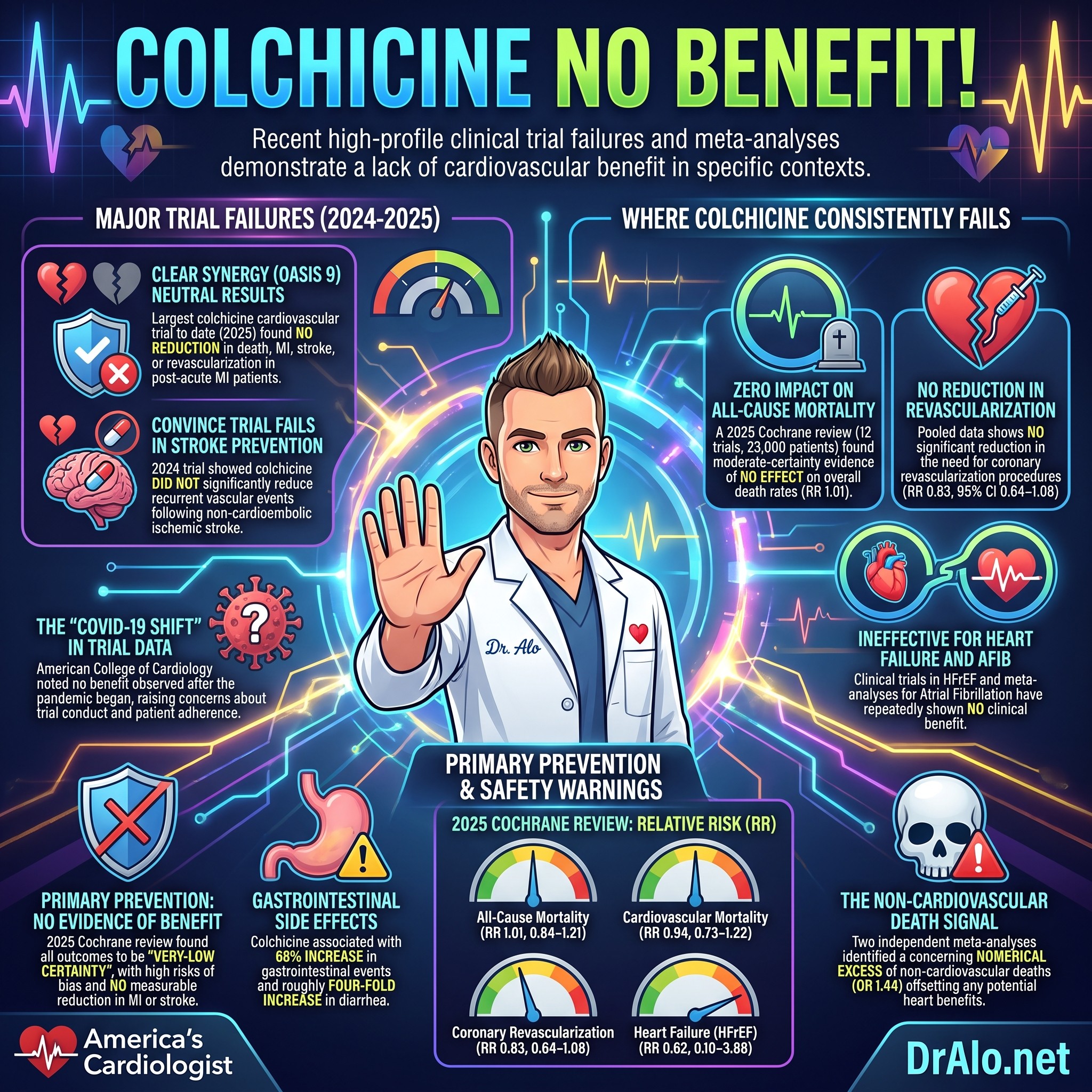
The Big Neutral Trial: CLEAR SYNERGY
CLEAR SYNERGY, also known as OASIS 9, published in the New England Journal of Medicine in 2025, is the largest randomized trial of colchicine in cardiovascular disease ever run. It enrolled patients after acute myocardial infarction and tested colchicine against placebo for the composite of cardiovascular death, recurrent myocardial infarction, stroke, or ischemia-driven revascularization.
It found no benefit. The primary composite was not reduced, and the null result held with remarkable consistency across essentially every prespecified subgroup.[2]
That was a serious blow. A trial of that size, in a population where inflammation should be maximally relevant, ought to have detected a real effect if one existed at the magnitude the earlier trials suggested.
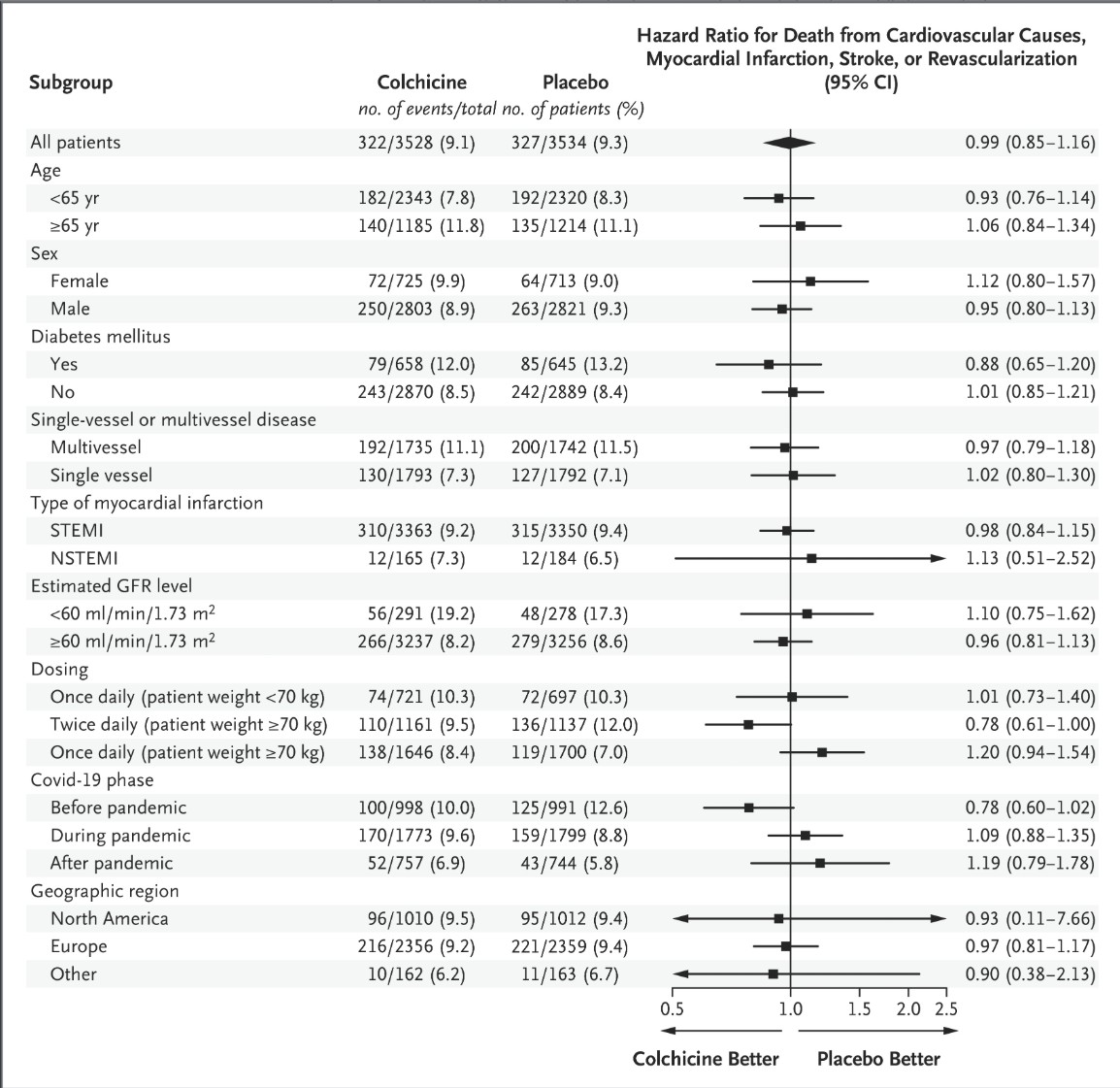
But the 2025 American College of Cardiology scientific statement on inflammation raised several caveats that deserve to be heard rather than dismissed.[1] Before the COVID-19 pandemic began, the hazard ratio in CLEAR SYNERGY was 0.78, with a 95 percent confidence interval of 0.60 to 1.02, a point estimate quite consistent with COLCOT and LoDoCo2. After the pandemic onset, no benefit was observed. That temporal split raises legitimate questions about adherence, follow-up quality, and trial conduct during a period of global disruption. The same statement notes that the spironolactone arm of that same factorial trial also failed to show benefit, and that more than a third of participants, 2,589 patients, were enrolled at just four sites in a single small Eastern European country.
None of this proves the trial was wrong. I want to be clear about that. Post hoc temporal subgroup analyses are exactly the kind of reasoning that has misled cardiology before, and I am not going to wave away a well-run trial because I do not like where it landed. But it does mean CLEAR SYNERGY should be weighed, not treated as a definitive refutation of everything that came before it.
The Stroke Trial: CONVINCE
CONVINCE tested colchicine after non-cardioembolic ischemic stroke and did not show a significant reduction in recurrent vascular events in the primary intention-to-treat analysis.[3] It is now one of the large trials anchoring current pooled estimates, and it extended the neutral signal beyond the coronary bed into cerebrovascular disease.
Where Colchicine Consistently Does Nothing
Separate from any single trial, there are outcomes on which the evidence has been reliably flat. The 2025 Cochrane review of colchicine for secondary prevention pooled 12 randomized trials and roughly 23,000 patients, and it found moderate-certainty evidence of no effect on the following:
- All-cause mortality: risk ratio 1.01, 95 percent confidence interval 0.84 to 1.21, with essentially no heterogeneity at I-squared of 1 percent
- Cardiovascular mortality: risk ratio 0.94, 95 percent confidence interval 0.73 to 1.22
- Coronary revascularization: risk ratio 0.83, 95 percent confidence interval 0.64 to 1.08
This is important, and it is often glossed over in enthusiastic summaries. Colchicine has never convincingly reduced death from any cause, and it has never convincingly reduced cardiovascular death.
The same review, however, found high-certainty evidence of benefit for two hard outcomes: myocardial infarction, risk ratio 0.74, 95 percent confidence interval 0.57 to 0.96, and stroke, risk ratio 0.67, 95 percent confidence interval 0.47 to 0.95. Gastrointestinal adverse events increased, risk ratio 1.68, but serious adverse events did not, risk ratio 0.98, 95 percent confidence interval 0.94 to 1.02.[3]
So the picture from the most rigorous synthesis we have is mixed, not negative: fewer heart attacks and strokes, no change in survival.
Take a look at the forest plot below of all of the colchicine trials. They all show no difference.
https://www.nejm.org/doi/full/10.1056/NEJMoa2405922
Primary Prevention: Almost No Evidence at All
If secondary prevention is contested, primary prevention is close to a vacuum. A 2025 Cochrane review of colchicine for primary cardiovascular prevention identified 15 randomized trials, but only 1,721 randomized participants total, and rated every single outcome as very low certainty.[4] All but one trial carried a high risk of bias, and many enrolled patients with liver disease rather than populations selected for cardiovascular risk.
The numbers reflect that fragility. No effect on non-fatal myocardial infarction, risk ratio 0.87, 95 percent confidence interval 0.41 to 1.82. No reduction in stroke, risk ratio 2.43, 95 percent confidence interval 0.67 to 8.86. A cardiovascular mortality estimate so imprecise it is essentially meaningless, risk ratio 1.27, with a confidence interval running from 0.03 to 62.43. And a roughly four-fold increase in diarrhea, with a number needed to harm of 10.
My practical conclusion here is straightforward. There is no basis for using colchicine in people who do not already have established cardiovascular disease.
Failed In Acute Myocardial Infarction
You would think it would show benefit when patients have an acute myocardial infarction and inflammation is at it's highest level. That wasn't the case. This was studied and published in the New England Journal of Medicine.
A total of 7062 patients at 104 centers in 14 countries underwent randomization; at the time of analysis. A primary-outcome event occurred in 322 of 3528 patients (9.1%) in the colchicine group and 327 of 3534 patients (9.3%) in the placebo group over a median follow-up period of 3 years (hazard ratio, 0.99; 95% confidence interval [CI], 0.85 to 1.16; P=0.93). The incidence of individual components of the primary outcome appeared to be similar in the two groups. The least-squares mean difference in C-reactive protein levels between the colchicine group and the placebo group at 3 months, adjusted according to the baseline values, was −1.28 mg per liter (95% CI, −1.81 to −0.75). Diarrhea occurred in a higher percentage of patients with colchicine than with placebo (10.2% vs. 6.6%; P<0.001), but the incidence of serious infections did not differ between groups.
Among patients who had myocardial infarction, treatment with colchicine, when started soon after myocardial infarction and continued for a median of 3 years, did not reduce the incidence of the composite primary outcome (death from cardiovascular causes, recurrent myocardial infarction, stroke, or unplanned ischemia-driven coronary revascularization).
Other Settings Where It Has Failed
Several specific populations and endpoints have produced negative results:
- The 2016 Cochrane review, covering 39 trials and 4,992 participants, found no effect on all-cause mortality, risk ratio 0.94, 95 percent confidence interval 0.82 to 1.09, no effect on heart failure, risk ratio 0.62, 95 percent confidence interval 0.10 to 3.88, and no effect on stroke, risk ratio 0.38, 95 percent confidence interval 0.09 to 1.70.[5]
- In heart failure with reduced ejection fraction, a randomized trial showed no reduction in death or heart failure hospitalization despite measurable reductions in inflammatory markers, a striking dissociation between biomarker and outcome.[6]
- An older trial of colchicine to prevent restenosis after angioplasty was negative.[6]
- Meta-analyses have repeatedly failed to show a reduction in atrial fibrillation, odds ratio 0.84, 95 percent confidence interval 0.68 to 1.04.[7]
The heart failure result is worth sitting with for a moment. It is a clean demonstration that lowering C-reactive protein is not the same thing as helping a patient, and it should temper any argument for colchicine that is built primarily on how a biomarker moves rather than on how a patient does.
A Safety Signal That Refuses to Fully Resolve
Two independent meta-analyses detected an excess of non-cardiovascular death. One reported an odds ratio of 1.44, 95 percent confidence interval 1.04 to 2.01.[7] The Fiolet analysis reported a risk ratio of 1.38, 95 percent confidence interval 0.99 to 1.92, in a pattern where fewer cardiovascular deaths were roughly offset by more non-cardiovascular deaths, which neatly explains why all-cause mortality never budges.[8]
The most recent and largest pooled analysis, covering 30,659 patients, did not find an increase in non-cardiovascular death, nor in pneumonia hospitalization or new cancers.[9] The signal may well have been noise. But given that colchicine is being proposed as a lifelong preventive therapy in otherwise stable patients, it is not something I am willing to file away permanently. I want more data before I stop asking the question.
Along with no benefit, there appears to be a potential for harm.
The Net Position
Pooling nine trials and 30,659 patients, including all the neutral data, colchicine reduced the composite of cardiovascular death, myocardial infarction, or stroke by 12 percent, risk ratio 0.88, 95 percent confidence interval 0.81 to 0.95. The effect was driven by myocardial infarction, risk ratio 0.84, with neutral cardiovascular death, risk ratio 0.94, and a non-significant effect on stroke, risk ratio 0.90.[9]
A 2026 meta-analysis of 20 randomized trials examined whether the clinical setting explained the discrepancy and found no significant interaction between acute and chronic coronary presentations. It did find a significant interaction by dose, and by relationship to the COVID-19 pandemic.[10] That second finding is provocative. It suggests, without proving, that something about trials conducted during the pandemic differed systematically from those conducted before it.
What I Take From This as a Cardiologist
Three points seem defensible to me.
First, colchicine does not save lives. Across every synthesis, all-cause and cardiovascular mortality are flat, with tight confidence intervals and minimal heterogeneity for all-cause mortality. Any conversation I have with a patient about this drug starts there, not with the headline numbers on MI reduction.
Second, a modest reduction in myocardial infarction remains the most durable finding, and it survives the incorporation of CLEAR SYNERGY into the pooled estimates. Whether a 12 percent relative reduction in a composite driven by non-fatal infarction justifies a daily pill with a meaningful diarrhea burden is a preference-sensitive decision. It is not a mandate, and I am not going to tell every patient with atherosclerosis they need to be on it.
Third, the field has not settled, and I think we should say that plainly instead of pretending otherwise. The FDA approval stands, the pooled data still favor treatment, and the largest single trial we have does not. This is what genuine scientific uncertainty looks like in real time, and the right response is neither to abandon the drug nor to pretend CLEAR SYNERGY never happened.
This should not be recommended in the guidelines as the science is not settled and it actually favors not using colchicine.
Colchicine Bottom Line
Colchicine remains a questionable intervention and likely should not be used. It remains unjustified in primary prevention, in heart failure, and for atrial fibrillation prophylaxis. The main neutral trials, CLEAR SYNERGY in acute MI and CONVINCE in non-cardioembolic stroke, join consistently null findings for mortality and revascularization across the meta-analyses. But even with those negative trials fully incorporated, pooled analyses still show some reductions in MI and stroke. The current controversy is about magnitude and about which patients actually benefit, not a wholesale reversal of everything the inflammation hypothesis has taught us.
There appears to be no benefit with the potential for harm and increases in non cardiovascular mortality.
This is the kind of nuance that gets lost when trial results get turned into social media headlines, and it is exactly the kind of question I like to work through with the members of Heart 2 Heart VIP, where we go deeper on inflammation, ApoB, and how to build a real, individualized cardiovascular risk reduction plan. If that sounds like you, I would love to have you in the VIP community.
References
1. Inflammation and Cardiovascular Disease: 2025 ACC Scientific Statement: A Report of the American College of Cardiology. Mensah GA, Arnold N, Prabhu SD, Ridker PM, Welty FK. Journal of the American College of Cardiology. 2025;:S0735-1097(25)07555-2. doi:10.1016/j.jacc.2025.08.047.
2. Colchicine in Acute Myocardial Infarction. Jolly SS, d'Entremont MA, Lee SF, et al. The New England Journal of Medicine. 2025;392(7):633-642. doi:10.1056/NEJMoa2405922.
3. Colchicine for the Secondary Prevention of Cardiovascular Events. Ebrahimi F, Ebrahimi R, Beer M, et al. The Cochrane Database of Systematic Reviews. 2025;11:CD014808. doi:10.1002/14651858.CD014808.pub2.
4. Colchicine for the Primary Prevention of Cardiovascular Events. Martí-Carvajal AJ, Gemmato-Valecillos MA, Monge Martín D, et al. The Cochrane Database of Systematic Reviews. 2025;2:CD015003. doi:10.1002/14651858.CD015003.pub2.
5. Colchicine for Prevention of Cardiovascular Events. Hemkens LG, Ewald H, Gloy VL, et al. The Cochrane Database of Systematic Reviews. 2016;(1):CD011047. doi:10.1002/14651858.CD011047.pub2.
6. Colchicine for Secondary Cardiovascular Prevention: A Systematic Review. Webb CA, Barry AR. Pharmacotherapy. 2020;40(6):575-583. doi:10.1002/phar.2401.
7. A Meta-Analysis Evaluating Efficacy and Safety of Colchicine for Prevention of Major Cardiovascular Events in Patients With Coronary Artery Disease. Chen T, Liu G, Yu B. Clinical Research in Cardiology: Official Journal of the German Cardiac Society. 2023;112(11):1487-1505. doi:10.1007/s00392-023-02254-9.
8. Efficacy and Safety of Low-Dose Colchicine in Patients With Coronary Disease: A Systematic Review and Meta-Analysis of Randomized Trials. Fiolet ATL, Opstal TSJ, Mosterd A, et al. European Heart Journal. 2021;42(28):2765-2775. doi:10.1093/eurheartj/ehab115.
9. Colchicine for Secondary Prevention of Vascular Events: A Meta-Analysis of Trials. d'Entremont MA, Poorthuis MHF, Fiolet ATL, et al. European Heart Journal. 2025;46(26):2564-2575. doi:10.1093/eurheartj/ehaf210.
10. Safety and Efficacy of Colchicine Across the Spectrum of Coronary Artery Disease: A Systematic Review and Meta-Analysis of 20 Randomized Trials. Laudani C, Bujak K, Occhipinti G, et al. Clinical Pharmacology and Therapeutics. 2026;119(6):1431-1439. doi:10.1002/cpt.70246.
Still Have Questions? Stop Googling and Ask Dr. Alo.
You’ve read the science, but applying it to your own life can be confusing. I created the Dr. Alo VIP Private Community to be a sanctuary away from social media noise.
Inside, you get:
-
Direct Access: I answer member questions personally 24/7/365.
-
Weekly Live Streams: Deep dives into your specific health challenges.
-
Vetted Science: No fads, just evidence-based cardiology and weight loss.
Don't leave your heart health to chance. Get the guidance you deserve. All this for less than 0.01% the cost of health insurance! You can cancel at anytime!
[👉 Join the Dr. Alo VIP Community Today]
Cardiology & Obesity Medicine