
VESALIUS-CV: Repatha Cut All-Cause Mortality by 20% in Primary Prevention
Sep 02, 2026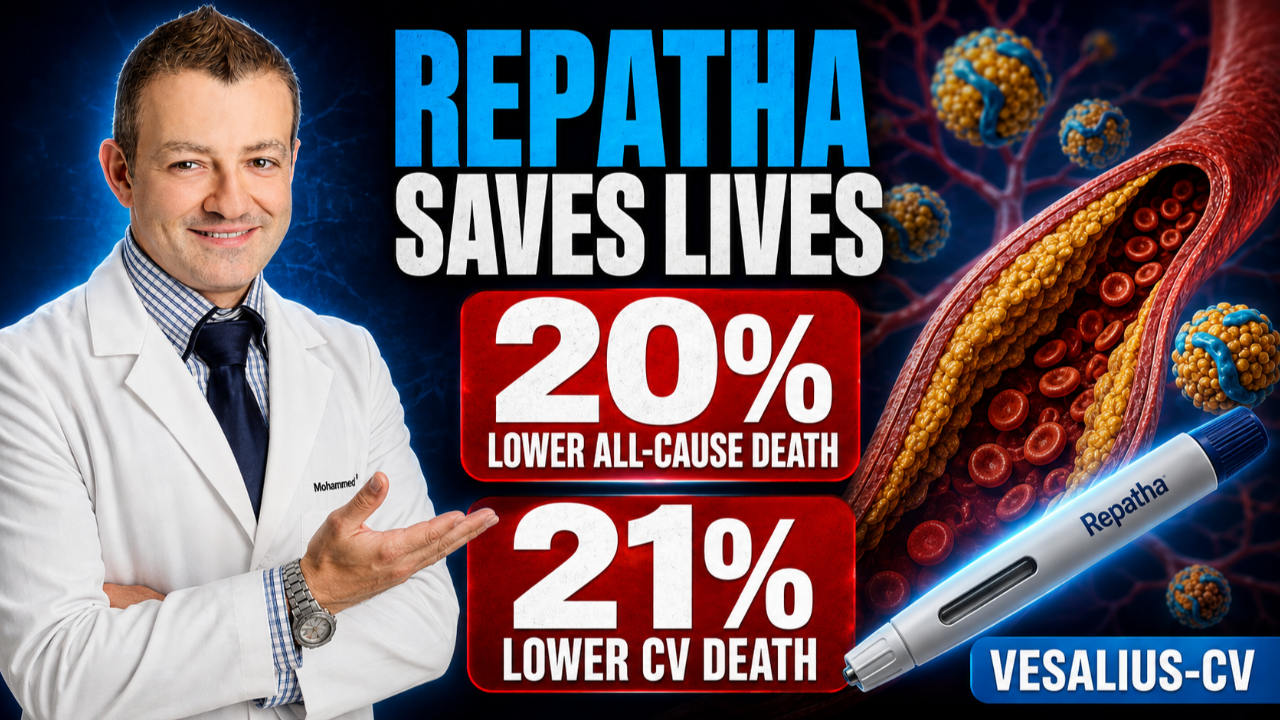
Repatha Cut All-Cause Death by 20% in People Who Never Had a Heart Attack
Most large cholesterol trials are built to show fewer heart attacks and strokes. Very few of them are built to show fewer deaths (all-cause mortality). Studies aren't generally powered for all-cause mortality. This is an important distinction because "fewer events" and "you live longer" are not always the same claim, and patients know the difference even when the literature blurs it.
The prespecified mortality analysis of VESALIUS-CV was presented at ESC Congress in August of 2026 and published simultaneously in Circulation. It adds an important new piece to the evidence for intensive LDL-C lowering, and an even more important one about when we should intervene.
As always, the lower the LDL cholesterol, the longer, the better. The mountain of evidence continues to grow.
What VESALIUS-CV Actually Tested
VESALIUS-CV was a double-blind, randomized, placebo-controlled trial that enrolled 12,257 adults between June 2019 and November 2021. It included men aged 50 to 79 and women aged 55 to 79 who had qualifying atherosclerosis or high-risk diabetes, no previous myocardial infarction or stroke, and an LDL-C of at least 90 mg/dL despite optimized background lipid-lowering therapy.
Median age was 66. Forty-three percent were women. Patients were randomized to evolocumab 140 mg every two weeks or matching placebo, on top of statin or other lipid therapy, and followed for a median of 4.6 years.
This is the population I see constantly in clinic and almost never treat aggressively enough: the person with plaque on a scan or long-standing diabetes, an LDL that everyone calls "borderline," and no event yet to justify escalation in anyone's mind.
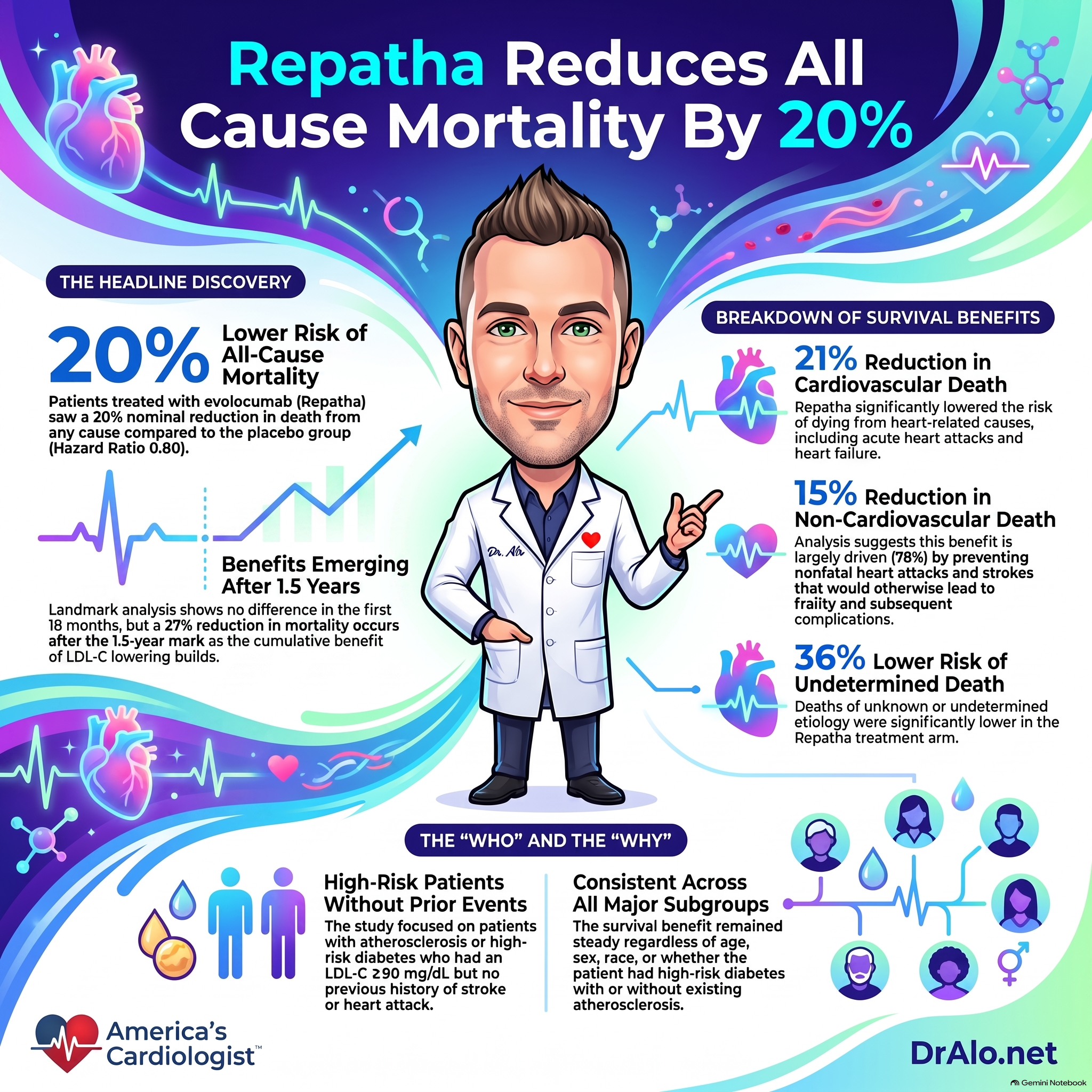
Infographic Summary:
The Mortality Results
All-cause mortality and cause-specific death were prespecified secondary outcomes, not findings someone went hunting for after the fact.
All-cause mortality fell 20%. HR 0.80 (95% CI 0.70 to 0.91). Death occurred in 434 patients on evolocumab versus 539 on placebo. Five-year rates were 7.9% versus 9.7%.
Cardiovascular mortality fell 21%. HR 0.79 (95% CI 0.64 to 0.98).
Death of undetermined cause fell 36%. Noncardiovascular death was numerically lower but did not reach statistical significance. The benefit was consistent across age, sex, region, race, diabetes status, and background lipid therapy.
An absolute 1.8% reduction in death at five years, in people who had never had an event, is not a small thing. That is roughly one death prevented for every 55 people treated over five years.
The Signal Was Time-Dependent, and That Is the Real Lesson
Here is the finding I want you to sit with. The mortality curves did not separate right away.
In the prespecified landmark analysis, the first 1.5 years showed essentially nothing: HR 0.99. After 1.5 years, the hazard ratio dropped to 0.73, a 27% reduction in death.
This is exactly the delayed pattern seen in the statin trials. It is not a fluke and it is not disappointing. It is what you would predict if atherosclerosis behaves the way we think it does. Plaque takes decades to build. Stabilizing and regressing it takes time. The clinical consequences of reducing cumulative apoB exposure require time to emerge.
Which means a two-year trial of a lipid drug is almost designed to fail on mortality, and a patient who quits after eight months because they "don't feel any different" has stopped right before the part that counts.
It Worked in Diabetes Without Established Atherosclerosis
The lower mortality was not limited to patients with qualifying atherosclerosis, where the hazard ratio was 0.84. It was also seen in patients with high-risk diabetes and no qualifying atherosclerosis, where the hazard ratio was 0.74, with no significant interaction between the groups.
Read that again. The group with no documented plaque did at least as well. PCSK9 inhibition has largely been reserved for people with significant established atherosclerosis. This finding argues that the biology does not require a visible lesion to be worth interrupting, it just requires enough atherogenic particle exposure and enough time.
Preventing a Nonfatal Event Buys You More Than You Think
An exploratory multistate model estimated that roughly 78% of evolocumab's effect on noncardiovascular death was explained by its prevention of earlier nonfatal MI, ischemic stroke, and revascularization.
That is a genuinely interesting result. A nonfatal heart attack is not a discrete episode you recover from and move past. It is an inflection point that raises your risk of dying later, including from causes we would not label cardiac on a death certificate. Preventing the event appears to influence survival well beyond the event itself.
The authors are careful here and so am I: this model was not prespecified and should be read as descriptive, not as proof of mechanism.
Study Limitations
I am not going to oversell this, because the honest version is more persuasive than the promotional one.
VESALIUS-CV was not designed or powered for mortality endpoints. Because the trial's endpoint hierarchy placed coronary heart disease death above these outcomes, the P values here are nominal and exploratory rather than confirmatory. The authors note that a P value this low makes chance an unlikely explanation, but the statistical status of the finding is what it is.
The trial population was 93% White and drawn largely from high-income countries, which limits how confidently these numbers generalize. Evolocumab was the only PCSK9 inhibitor tested, so you cannot transfer these mortality figures directly onto other drugs in the class.
What the analysis does have going for it: size, randomization, double-blinding, and prespecification of the mortality outcomes.
The Principle Underneath All of This
Atherosclerosis is driven by cumulative exposure to apoB-containing lipoproteins. Every LDL, VLDL remnant, and Lp(a) particle that crosses the endothelium and gets trapped in the arterial wall adds to a lifetime total that never resets. If the disease is cumulative, then the benefit of lowering apoB is also cumulative.
That reframes the entire question. For twenty years the debate has been "how low?" The VESALIUS-CV mortality data suggests the more useful questions are how early and for how long.
A 25% LDL reduction starting at 40 will beat an 60% reduction starting at 68, because area under the curve is what damages the artery. Trials cannot easily test that, but the biology is not ambiguous about it.
What I Tell My Patients
If you have plaque on a CT calcium score or CTA, or you have had diabetes for a decade or more, and your LDL-C is still above 70 mg/dL on whatever you are currently taking, you are the VESALIUS-CV patient. You do not need to wait for a heart attack to earn aggressive treatment.
Get an apoB, not just an LDL-C. Roughly a third of people with an LDL-C under 70 mg/dL still have an elevated apoB, and those are the people whose risk gets missed by the standard panel.
And if you start therapy, plan on staying on it. The mortality benefit in this trial did not exist in year one. It showed up in years two through five, and it kept widening.
Want to Go Deeper on This?
I break down trials like VESALIUS-CV every month inside the Heart 2 Heart VIP Community, where members bring their own labs, scans, and questions and we work through them together. If you want the version of this conversation that applies to your numbers instead of a trial average, that is where to find it.
References
Giugliano RP, et al. Effects of Evolocumab on Mortality Outcomes in Patients Without Previous Myocardial Infarction or Stroke: A Prespecified Analysis of the VESALIUS-CV Randomized Clinical Trial. Circulation. 2026. doi:10.1161/CIRCULATIONAHA.126.082436
Bohula EA, Marston NA, et al. Evolocumab in Patients Without a Previous Myocardial Infarction or Stroke. N Engl J Med. 2026;394(2):117-127. doi:10.1056/NEJMoa2514428
Marston NA, et al. Evolocumab to Reduce First Major Cardiovascular Events in Patients Without Known Significant Atherosclerosis and With Diabetes: Results From the VESALIUS-CV Trial. JAMA. 2026;335(16):1400-1407. doi:10.1001/jama.2026.3277
Leiter LA, et al. Evolocumab in Patients With High-Risk Diabetes: Results From the VESALIUS-CV Trial. Diabetes Care. 2026;49(8):1366-1373. doi:10.2337/dc26-0847
Nicolau JC, et al. Cumulative Benefit With Evolocumab in Patients With No Prior Myocardial Infarction or Stroke in the VESALIUS-CV Study. JACC. 2026. doi:10.1016/j.jacc.2026.08.015
Still Have Questions? Stop Googling and Ask Dr. Alo.
You’ve read the science, but applying it to your own life can be confusing. I created the Dr. Alo VIP Private Community to be a sanctuary away from social media noise.
Inside, you get:
-
Direct Access: I answer member questions personally 24/7/365.
-
Weekly Live Streams: Deep dives into your specific health challenges.
-
Vetted Science: No fads, just evidence-based cardiology and weight loss.
Don't leave your heart health to chance. Get the guidance you deserve. All this for less than 0.01% the cost of health insurance! You can cancel at anytime!
[👉 Join the Dr. Alo VIP Community Today]
Cardiology & Obesity Medicine