
Frank's Sign: What a Crease in the Earlobe Can Tell You About Your Heart
Aug 02, 2026
Frank's Sign: Does It Mean You Have Heart Disease
In 1973, an American pulmonologist named Sanders T. Frank published a brief report noting something peculiar about his patients with coronary artery disease. Many of them had a diagonal crease running across the earlobe, extending from the tragus toward the outer edge of the auricle at roughly a 45 degree angle. The observation was simple, free, and required nothing more than a pair of eyes.
More than fifty years later, the diagonal earlobe crease, now widely known as Frank's sign, remains one of the most argued-about physical findings in medicine. Dozens of studies have examined it. Meta-analyses have pooled it. Autopsy series have dissected it. And yet clinicians still disagree about whether it deserves a place in the routine cardiovascular examination.
The short version of the answer is this: the association between Frank's sign and coronary artery disease is real and statistically robust, but the sign performs poorly as a diagnostic test. Those two statements are not contradictory, and understanding why they coexist is a useful exercise in clinical epidemiology.
What Is Frank's Sign?
A diagonal earlobe crease is a wrinkle running obliquely across the lobule. It is not the same thing as the fine skin wrinkling that accompanies general aging, though the two are easy to conflate and this conflation is a major source of methodological trouble in the literature.
Creases vary along several dimensions. They may be unilateral or bilateral. They may be shallow or deep. They may cross the entire lobe or only part of it. They may be accompanied by smaller accessory creases. These distinctions matter, because the strength of the cardiovascular association scales with the completeness, depth, and bilaterality of the crease. A faint partial crease on one side is a very different finding from a deep bilateral crease with accessory wrinkling.
Unfortunately, no universally accepted grading system exists, and studies have used different definitions. This alone explains a substantial portion of the wildly divergent accuracy figures reported across the literature.
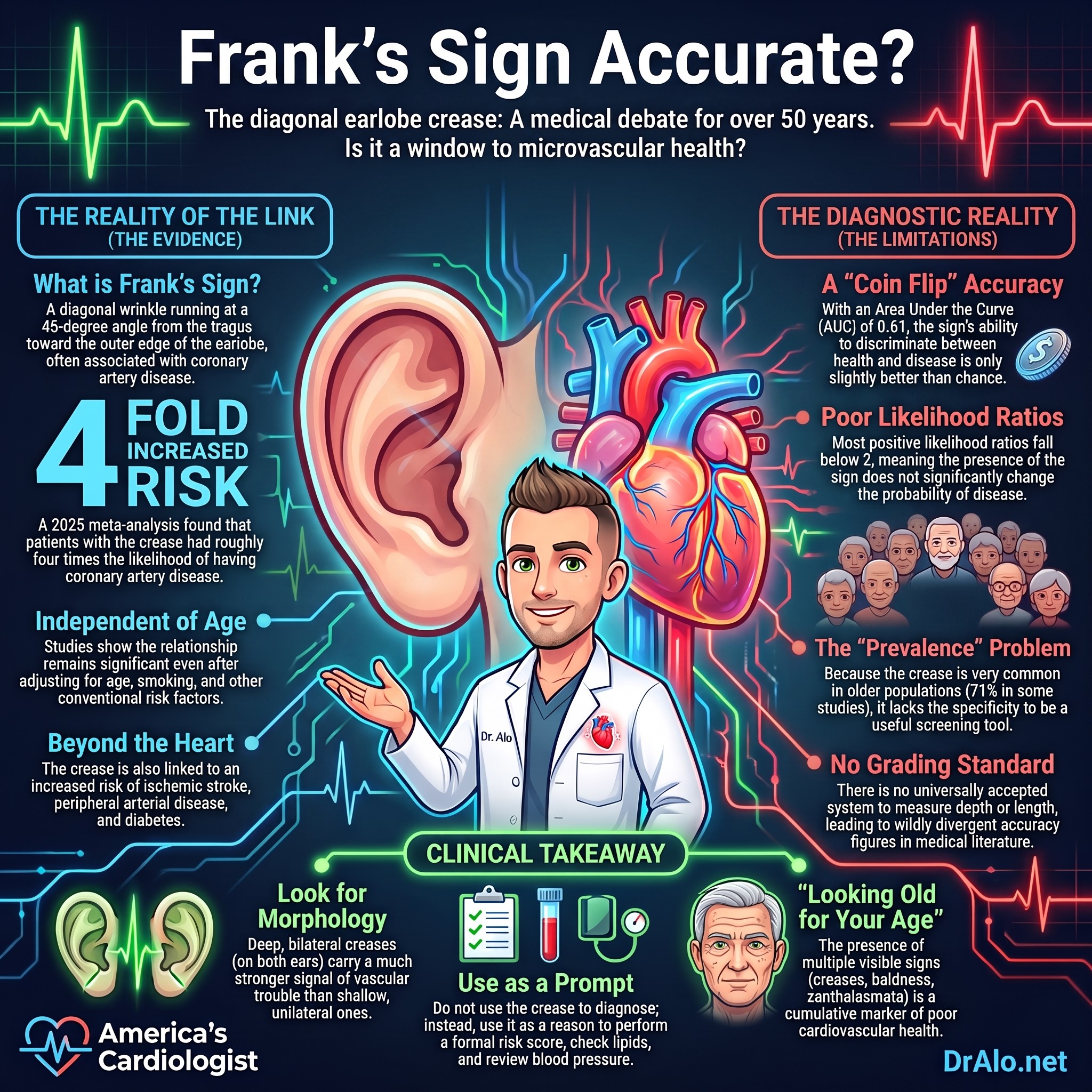
Infographic Summary:
Is Frank's Sign Real?
Start with the strongest evidence in favor of the sign.
A 2025 systematic review and meta-analysis pooled 12 studies comprising 2,415 cases and 2,545 controls. Patients with a diagonal earlobe crease had roughly a four-fold increased likelihood of having coronary artery disease. Perhaps more importantly, all 10 of the included studies that specifically examined confounding found the relationship held independent of age and of conventional cardiovascular risk factors. This addresses the most obvious skeptical objection, which is that older people simply have more wrinkles and more coronary disease.
Prospective data reinforce this. The Copenhagen City Heart Study followed 10,885 individuals for 35 years with complete follow-up. Earlobe crease, along with frontoparietal baldness, crown-top baldness, and xanthelasmata, was associated with incident ischemic heart disease and myocardial infarction after adjustment for chronologic age and standard risk factors. The risk climbed in stepwise fashion with the number of visible age-related signs present, reaching hazard ratios of 1.40 for ischemic heart disease and 1.57 for myocardial infarction in those with three or four signs versus none. The authors summarized the finding memorably: looking old for your age is a marker of poor cardiovascular health.
Cross-sectional imaging data agree. In a study of 430 consecutive patients undergoing dual-source coronary CT angiography, the diagonal earlobe crease remained a significant independent predictor of every measure of coronary disease examined, including any plaque, significant stenosis, multivessel disease, and plaque burden, with odds ratios ranging from 1.8 to 3.3 after adjusting for age, sex, symptoms, and risk factors.
So the epidemiologic signal is genuine. The problem lies elsewhere.
The Diagnostic Performance Is Poor
The most rigorous appraisal of Frank's sign as a diagnostic test is a systematic review conducted using Cochrane methodology for diagnostic test accuracy, covering 13 cross-sectional studies and 3,951 patients. Most used invasive coronary angiography as the reference standard.
The results were sobering. Sensitivity ranged from 26 percent to 90 percent. Specificity ranged from 32 percent to 96 percent. Positive likelihood ratios spanned 1.11 to 7.03, but most fell below 2. Negative likelihood ratios ranged from 0.30 to 0.84, with most exceeding 0.5.
For clinicians who think in likelihood ratios, those numbers are damning. A positive likelihood ratio below 2 and a negative likelihood ratio above 0.5 together describe a test that barely moves pre-test probability in either direction. The review's conclusion was that diagnostic accuracy is insufficient and that the presence or absence of the sign should not, by itself, alter clinical management.
Individual studies illustrate the same problem in concrete terms. In the CT angiography cohort mentioned earlier, sensitivity was 78 percent, specificity 43 percent, positive predictive value 77 percent, negative predictive value 45 percent, and overall test accuracy 67 percent, with an area under the receiver operating characteristic curve of only 0.61. An AUC of 0.61 is closer to a coin flip than to a useful discriminator.
Notice the tension embedded in that single study. The same finding that was a statistically significant independent predictor after multivariable adjustment was also a nearly useless standalone test. This is a recurring theme in clinical epidemiology and deserves explanation.
Why a Real Association Can Still Be a Bad Test
Three factors drive the gap between statistical association and diagnostic utility.
The first is prevalence. In the CT angiography study, the diagonal earlobe crease was present in 71 percent of patients. When a finding is that common, it cannot discriminate. Specificity collapses because most people without disease also have the sign. In an older population, nearly everyone has some degree of earlobe creasing, which is precisely the population in whom coronary risk assessment matters most.
The second is effect size relative to the discrimination required. An odds ratio of 2 or even 4 sounds impressive in an abstract, but odds ratios of that magnitude translate into very modest shifts in individual probability. A risk factor generally needs an odds ratio in the range of 15 or higher to function as a useful standalone diagnostic test.
The third is measurement heterogeneity. Because studies defined the crease differently, applied different reference standards, and enrolled populations with different disease prevalence, the pooled picture is blurred. Studies requiring a deep bilateral crease naturally report higher specificity and lower sensitivity than those accepting any visible crease.
What Might Explain the Link
Several mechanistic threads make the association biologically plausible rather than merely coincidental.
Autopsy work in 100 men found that the grade of earlobe creasing correlated with the extent of atherosclerosis in both the coronary arteries and the aorta, and that this correlation persisted after accounting for age. This is important because autopsy data bypass the selection biases that plague catheterization-based studies.
Vascular function studies add another layer. Bilateral earlobe creases, but not unilateral ones, have been associated with impaired flow-mediated dilation and impaired nitroglycerin-induced vasodilation. The first reflects endothelial dysfunction and the second reflects vascular smooth muscle dysfunction, suggesting that the crease marks a generalized vascular abnormality rather than a purely local phenomenon.
The prevailing hypothesis is that the earlobe is supplied by end arterioles with no collateral circulation. Microvascular disease in this territory may produce loss of elastic tissue and collapse of the dermal architecture, leaving a permanent crease. Under this model, the earlobe functions as a visible window onto microvascular health elsewhere in the body. Telomere shortening and other markers of accelerated biological aging have also been proposed as shared upstream drivers.
Beyond the Coronaries
The vascular story does not end with the heart. A review of five studies encompassing 1,469 subjects found that diagonal earlobe crease is associated with cerebrovascular events, predominantly ischemic stroke, presumably through the same atherosclerotic mechanisms. Work examining crease morphology found that bilateral diagonal creases carried an odds ratio of 1.67 for ischemic stroke, and that bilateral creases predicted cardiovascular events with a sensitivity of 43 percent and specificity of 70 percent, with an adjusted odds ratio of 1.45.
Associations with peripheral arterial disease and with diabetes have also been reported, further supporting the idea that the crease reflects systemic vascular pathology rather than a heart-specific process.
How to Actually Use Frank's Sign
Given all of this, what should a clinician do when a deep bilateral crease is noticed during an otherwise routine examination?
The sign should not be used to rule coronary disease in or out. It cannot substitute for validated risk scores, lipid measurement, blood pressure assessment, or anatomic and functional cardiac testing. Anyone using an earlobe crease to decide whether to pursue further cardiac evaluation in a symptomatic patient is misusing it.
It is reasonable, however, to treat the finding as a prompt. It costs nothing to observe, requires no equipment, and takes no time. In a patient who has not had formal cardiovascular risk assessment, particularly one who is not otherwise engaged with preventive care, a striking bilateral crease is a legitimate reason to calculate a formal risk score, check a lipid panel, and review modifiable risk factors. Reviewers of the cerebrovascular literature have made essentially this recommendation, suggesting that patients with the sign undergo a workup for vascular risk factors and implementation of preventive therapy.
Specialists outside cardiology are in an interesting position here. Otolaryngologists, dermatologists, and anyone else who routinely examines the head and neck see earlobes constantly and are well placed to notice the finding in patients who may not have a primary care relationship.
Weight the finding by its morphology. A complete, deep, bilateral crease with accessory creases carries considerably more signal than a shallow unilateral one. And consider it alongside other visible markers. The Copenhagen data showed that risk accumulated with the number of age-related signs present, so an earlobe crease in a patient who also has xanthelasmata and male-pattern baldness is a more meaningful observation than the crease alone.
The Broader Lesson
Frank's sign is a useful teaching case precisely because it sits in the awkward middle ground that so much of medicine occupies. It is not a myth. The association survived multivariable adjustment across essentially every study that tested for confounding, appeared in a large prospective cohort with 35 years of follow-up, and has autopsy and vascular physiology data supporting a plausible mechanism.
But it is also not a test. Its likelihood ratios are too close to 1, its prevalence in older populations is too high, and its definition is too inconsistent for it to change what happens next in the care of an individual patient.
The right posture is neither dismissal nor overreach. Look at the earlobes. Notice the crease. Let it nudge attention toward the cardiovascular risk assessment that should probably be happening anyway. Then go get the data that actually matter.
References
1. Diagonal Earlobe Crease (Frank's Sign) for Diagnosis of Coronary Artery Disease: A Systematic Review of Diagnostic Test Accuracy Studies. Journal of Clinical Medicine. 2021. Wieckowski K, Gallina T, Surdacki A, Chyrchel B. Review
2. Why We Should Be Looking for Earlobe Creases in ENT. A Systematic Review and Meta-Analysis of Diagonal Earlobe Crease and Coronary Artery Disease. The Journal of Laryngology and Otology. 2025. Curtis J, Walford S. SR
3. Relation of Diagonal Ear Lobe Crease to the Presence, Extent, and Severity of Coronary Artery Disease Determined by Coronary Computed Tomography Angiography. The American Journal of Cardiology. 2012. Shmilovich H, Cheng VY, Rajani R, et al.
4. Visible Age-Related Signs and Risk of Ischemic Heart Disease in the General Population: A Prospective Cohort Study. Circulation. 2014. Christoffersen M, Frikke-Schmidt R, Schnohr P, et al.
5. Diagonal Earlobe Crease (Frank's Sign) and Increased Risk of Cerebrovascular Diseases: Review of the Literature and Implications for Clinical Practice. Neurological Sciences. 2020. Pacei F, Bersano A, Brigo F, Reggiani S, Nardone R. SR
Still Have Questions? Stop Googling and Ask Dr. Alo.
You’ve read the science, but applying it to your own life can be confusing. I created the Dr. Alo VIP Private Community to be a sanctuary away from social media noise.
Inside, you get:
-
Direct Access: I answer member questions personally 24/7/365.
-
Weekly Live Streams: Deep dives into your specific health challenges.
-
Vetted Science: No fads, just evidence-based cardiology and weight loss.
Don't leave your heart health to chance. Get the guidance you deserve. All this for less than 0.01% the cost of health insurance! You can cancel at anytime!
[👉 Join the Dr. Alo VIP Community Today]
Cardiology & Obesity Medicine