
Cardiovascular Exercise Prescription That Reduces Heart Risk Based On Science
Apr 09, 2026
How to Lift for Strength, Muscle, and a Longer Life: What the Newest Science Actually Says
You already know that resistance training is good for you. But I want to talk about something more specific:
How to do it. Not just "lift weights" as a vague wellness suggestion, but the actual prescription. Sets. Reps. Load. Frequency. The details matter, especially for my patients who are serious about protecting their hearts, preserving their muscle mass, and staying functional into their 70s, 80s, and beyond.
The American College of Sports Medicine just published a major 2026 Position Stand on resistance training prescription, and it is the most comprehensive evidence review on this topic to date. They synthesized 137 systematic reviews involving more than 30,000 participants. I read the whole thing so you do not have to. Here is what it means for you.
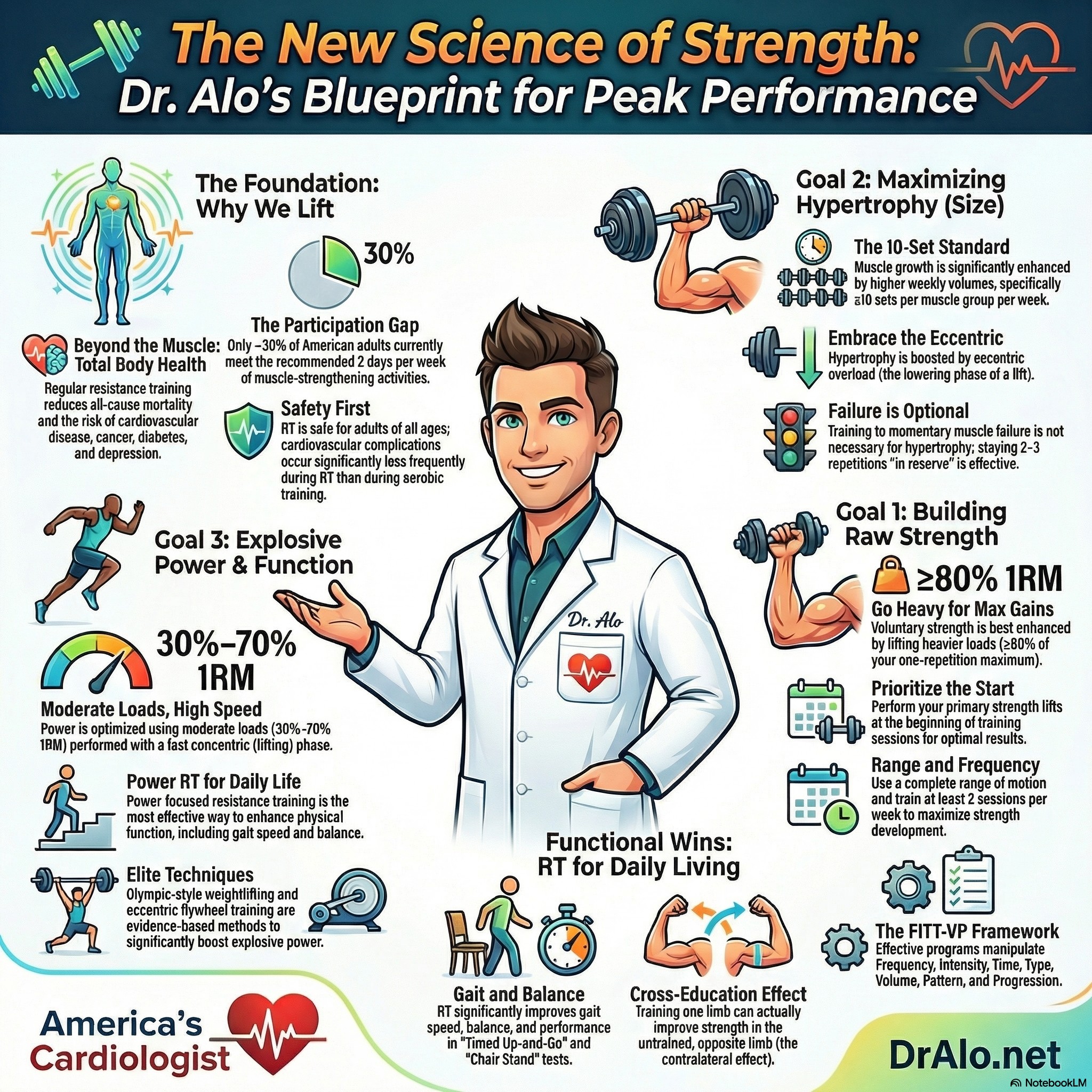
Exercise Prescription infographic Summary:
Why Resistance Training Matters for Your Heart
As a cardiologist, I am going to start where this always has to start: cardiovascular outcomes. I see patients every week who walk into my office thinking that cardio is the only exercise that protects their heart. That is simply not the evidence.
Resistance training reduces all-cause mortality. It lowers your risk of cardiovascular disease, cancer, and diabetes. It reduces depression. It improves sleep. These are not soft, feel-good benefits. These are hard clinical outcomes backed by systematic evidence.
And nonfatal cardiovascular complications during resistance training are far less common than during aerobic exercise. In a dataset of over 1,100 adults with coronary heart disease, every single nonfatal cardiovascular event occurred during aerobic training, not during resistance training.
Let me be clear: resistance training belongs in your life at every age, including if you have heart disease. Full stop.
What the ACSM 2026 Evidence Review Actually Found
This is not just another position paper repeating old guidelines. This is an umbrella review, meaning the researchers looked across hundreds of systematic reviews and meta-analyses to find the highest-level patterns in the data.
The headline finding: compared to no exercise at all, resistance training significantly improved every meaningful outcome they measured.
- Muscle strength and size (hypertrophy)
- Power and contraction velocity
- Muscular endurance (cardio)
- Gait speed, balance, and chair stand performance
- Timed up-and-go and overall physical function
That last cluster, gait speed, balance, chair stand, these are not just athletic metrics. These predict falls, hospitalizations, loss of independence, and mortality in older adults. Resistance training improves all of them.
The Prescription: What to Optimize for Each Goal
Here is where it gets practical. Not every training variable moves the needle equally. The review identified which specific prescription elements matter most for each outcome.
|
For Maximum Strength Load: At least 80% of your one-rep maximum (dose-response, heavier is better for strength) Sets: 2-3 sets per session Frequency: At least 2 sessions per week Range of motion: Full range of motion beats partial Exercise order: Put your priority lifts first in the session Equipment: Free weights or machines both work equally well |
|
For Maximum Muscle Growth (Hypertrophy) Volume: At least 10 sets per muscle group per week (dose-response) Contraction type: Include eccentric-emphasis work (the lowering phase) Load: Surprisingly, load matters less here. Anywhere from 30%-100% 1RM can build muscle if volume is matched Frequency: Can train a muscle 1-5+ days per week and see similar results when total volume is equated |
|
For Power (Critical for Functional Aging) Load: Moderate, 30%-70% of your one-rep maximum Speed: Move the weight explosively on the concentric (lifting) phase Volume: Keep it low-to-moderate per session (reps x sets under 24) This is called Power Training. It significantly enhances physical function in older adults. |
What Does NOT Matter as Much as You Think
This section will surprise you, because a lot of what the fitness industry obsesses over turned out to make no significant difference in the evidence.
- Training to failure: Not necessary. Stopping 2-3 reps short of failure produces equivalent strength and hypertrophy gains, and may be safer, particularly for older adults due to risks to form and vascular stress.
- Free weights versus machines: No significant difference in strength or hypertrophy when comparing the two.
- Time under tension: Slow reps versus faster reps showed no consistent advantage.
- Morning versus evening training: Does not matter for outcomes.
- Short versus long rest intervals: No meaningful difference in the evidence.
- Periodization: More complex programming is not significantly superior to simpler non-periodized training when volume and load are matched.
- Blood flow restriction: Did not consistently outperform standard training.
- Rigid routines: Keep it simple and fun. If doesn't need to be complicated.
- Consistency: If you can do it once a week, stick to that. Don't try to go too hard in the beginning and then fizzle out and end up doing nothing. Slow and steady wins.
- Muscle Confusion: You don't need to change up your exercises to improve. You can stick to the same movements every week and every month. Switching up your exercises should only be done if you get bored and you are likely to lose interest and quit. Muscles do not need to be confused to continue to make progress. As long as you are hitting all muscle groups, it's ok to use the same exercises over and over again. It's also easier to track progress if you do the same exercises and use the same machines, bands, dumbbells, movements every week.
I want to be honest about what this means: the fancy details of programming matter far less than simply showing up and lifting with sufficient effort. Consistency and progressive challenge over time drive most of the adaptation.
Just do it.
The Minimum Effective Dose
I know many of my patients are busy. I know some are deconditioned, recovering from cardiac events, or managing multiple health conditions. So let me give you the minimum that the evidence supports:
- 2 sessions per week covering all major muscle groups
- 2-3 sets per exercise with meaningful effort (leave 2-3 reps in reserve)
- Moderate-to-heavy load relative to your capacity
- Progressive increase in load or reps over time as you get stronger
Even elastic band training and home-based bodyweight resistance training showed significant improvements in strength and functional outcomes. You do not need a gym. You need consistency and progressive challenge.
If this is too much, you can just go once a week, or even just once a month. Just be consistent. Someone who has never exercised will still benefit from once a month training, if they have never trained before. As you adapt, you can add more days.
One important point from the ACSM review: elastic band training increased strength and even showed some hypertrophy benefit. This matters enormously for patients who cannot access a gym, are homebound, or are just starting out.
There are even home based physical therapy and cardiac rehab programs that you can start. Ask your doctor to enroll you.
My Clinical Take: What I Prescribe to My Patients
As a cardiologist, internist, and certified personal trainer, I want to give you the synthesis of this evidence in language that is practical and actionable:
- Start lifting. Any resistance training is better than none. Do not let perfect be the enemy of good.
- Train at least twice per week covering upper body push, upper body pull, lower body push, and lower body pull.
- If your goal is strength, load matters. You need to be lifting at a challenging weight. The evidence is clear that heavier loads, at or above 80% of your max, produce superior strength gains.
- If your goal is muscle mass, total weekly volume matters most. Get to at least 10 sets per muscle group per week over time.
- If your goal is functional independence as you age, power training is the prescription. Light-to-moderate load, moved quickly on the lifting phase. This is what protects gait speed, balance, and your ability to get out of a chair.
- Stop worrying about training to failure. It provides no extra benefit and increases injury risk, especially for those of us over 50.
- Stop debating free weights versus machines. Both work.
- Progress over time. Add a little more weight, or a little more volume, as you adapt. That is the key driver.
In the Dr. Alo app there are FREE exercise programs for beginners, moderate, advanced, as well as the elderly. There's even a program for those who do not want to leave the house or just have a small pair of dumbbells at home.
Participation Is The Most Important!
The ACSM makes one philosophical point I want to highlight explicitly: getting you to participate is more important than optimizing your programming. Across the US, only about 30% of adults complete even the minimum recommended muscle-strengthening activity. Nearly 60% do none at all. For older adults, participation rates may be as low as 10-15%.
That is a public health crisis. And it is one where the solution is simple, safe, and well-established.
Exercise Prescription Bottom Line
Resistance training is one of the most powerful longevity tools available to you. It protects your heart, your muscles, your bones, your brain, and your independence. The newest evidence confirms that you do not need a complicated program to get dramatic benefits. You need to lift, consistently, with enough challenge to keep pushing your body to adapt.
Two days a week. Major muscle groups. Progressive effort. That is the foundation.
If you are not doing this yet, start today. If you are doing it, this evidence should give you confidence to keep going and fine-tune based on what your body actually needs.
Questions? This is exactly the kind of individualized conversation I have with members of my Heart 2 Heart VIP Community. Join us at dralo.net/community.
Reference:
Currier BS, D'Souza AC, Fiatarone Singh MA, et al. American College of Sports Medicine Position Stand. Resistance Training Prescription for Muscle Function, Hypertrophy, and Physical Performance in Healthy Adults: An Overview of Reviews. Med Sci Sports Exerc. 2026;58(4):851-872.
https://journals.lww.com/acsm-msse/fulltext/2026/04000/american_college_of_sports_medicine_position.21.aspx
Still Have Questions? Stop Googling and Ask Dr. Alo.
You’ve read the science, but applying it to your own life can be confusing. I created the Dr. Alo VIP Private Community to be a sanctuary away from social media noise.
Inside, you get:
-
Direct Access: I answer member questions personally 24/7/365.
-
Weekly Live Streams: Deep dives into your specific health challenges.
-
Vetted Science: No fads, just evidence-based cardiology and weight loss.
Don't leave your heart health to chance. Get the guidance you deserve. All this for less than 0.01% the cost of health insurance! You can cancel at anytime!
[👉 Join the Dr. Alo VIP Community Today]
Cardiology & Obesity Medicine