
Are Seed Oils Inflammatory? The Science Is Finally In!
May 11, 2026
Seed Oils Don't Cause Inflammation. Science Just Proved It Again.
A new randomized controlled trial compared soybean oil to palm oil in overweight adults. Here is what the data actually showed, and why your favorite wellness influencer still has it wrong.
Let's Talk About the Seed Oil Hysteria & Myths
If you have spent any time on social media over the past few years, you have almost certainly encountered the claim that seed oils are toxic. Soybean oil, sunflower oil, corn oil, canola oil. The argument, repeated endlessly by wellness influencers, podcasters, and self-appointed nutrition experts, goes something like this: these oils are high in an omega-6 fatty acid called linoleic acid, linoleic acid converts to arachidonic acid in the body, arachidonic acid is inflammatory, and therefore seed oils are slowly destroying your cardiovascular system and driving the chronic disease epidemic.
It is a tidy narrative. It is also not supported by the evidence.
I have addressed this before, and I will keep addressing it as long as the misinformation keeps circulating. Because every time a new well-designed clinical trial comes out, the science points in the same direction. A study published in Current Developments in Nutrition in early 2026 is the latest addition to that pile. Let me walk you through what it found.
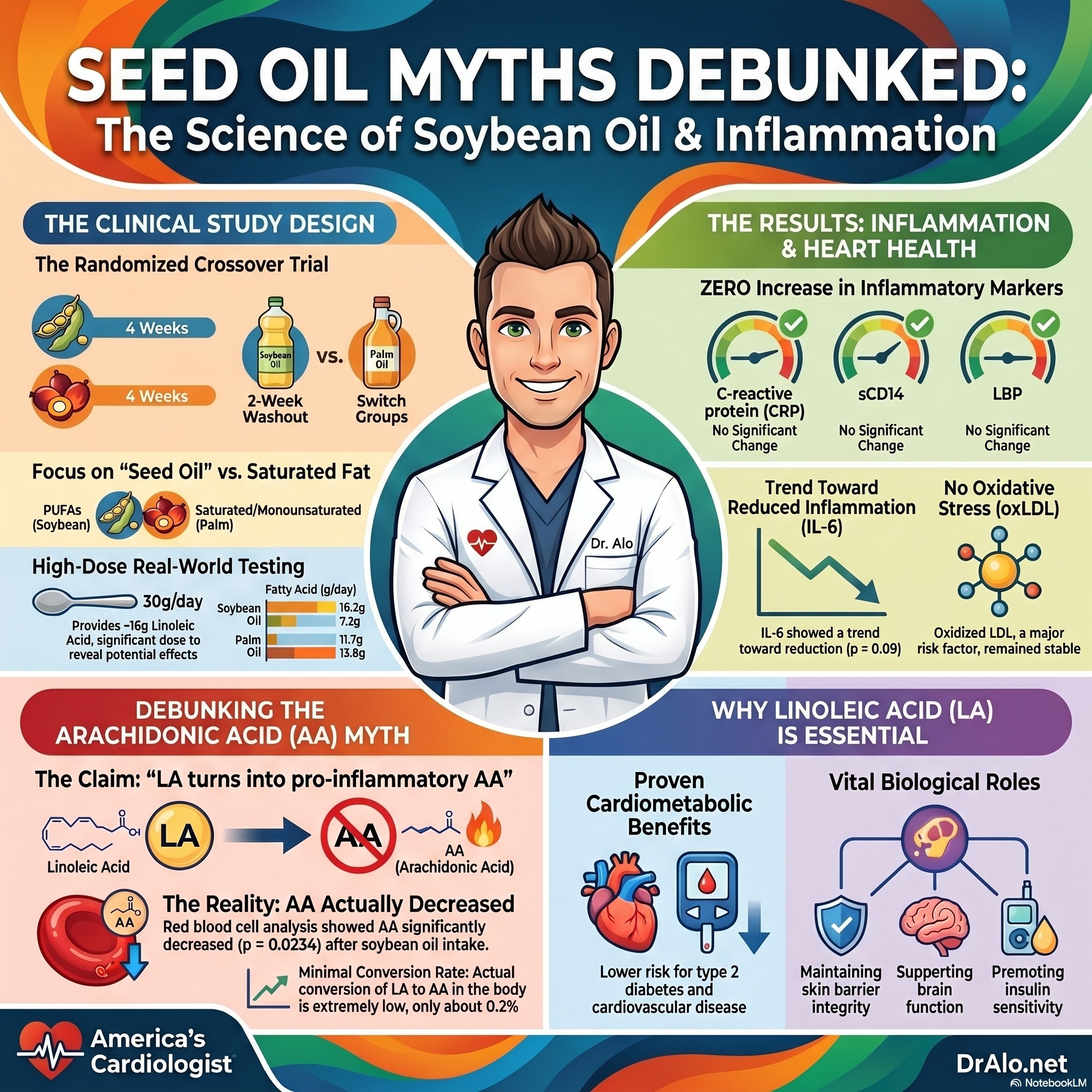
Seed Oil Myths Debunked Infographic Summary:
What Was This Study, and Why Does It Matter?
This was a double-masked, randomized, placebo-controlled crossover trial conducted at The Ohio State University. Researchers enrolled 10 adults with overweight or obesity and fed them snack foods fortified with either soybean oil (high in linoleic acid) or palm oil (high in saturated and monounsaturated fat, low in polyunsaturated fat) for four-week periods, with a two-week washout in between.
Participants consumed 30 grams of oil per day through study foods like brownies, cookies, muffins, and bread rolls. The soybean oil group was getting approximately 16 grams of linoleic acid per day, which is in line with amounts used in previous clinical trials that have shown measurable biological effects.
The researchers measured an extensive panel of biomarkers before and after each diet period, including:
- IL-6, a cytokine that signals upstream inflammation
- C-reactive protein (CRP), the classic inflammatory marker used in clinical practice
- Soluble CD14 (sCD14) and LPS-binding protein (LBP), markers tied to chronic low-grade inflammation and metabolic dysfunction
- Oxidized LDL (oxLDL), a marker of oxidative stress and vascular damage
- Fatty acid profiles across red blood cells, plasma, peripheral blood mononuclear cells, and dried blood spots
This is not a simple observational study. This is an interventional design where researchers controlled what participants were eating and measured outcomes rigorously.
A double-masked crossover design is one of the strongest study designs in nutrition science. Each participant serves as their own control. It minimizes confounding and gives us real signal.
The Results: What the Data Actually Showed
Inflammation Did Not Go Up With Soybean Oil (Seed Oil)
After four weeks of consuming 30 grams of soybean oil per day, meaning 16 grams of linoleic acid daily, here is what happened to inflammatory markers:
- IL-6: showed a trend toward reduction in the soybean oil group (p = 0.09). It did not increase. It trended lower.
- CRP: did not significantly change in either group.
- sCD14: did not significantly change in either group.
- LBP: did not significantly change in either group.
- oxLDL: did not significantly change in either group.
Let me be direct: there was zero evidence that eating soybean oil increased inflammation in overweight adults. If anything, the directional signal on IL-6 was favorable.
"Incorporating study foods containing 30 g oil/d of soybean or palm oil had no significant impact on inflammatory markers, suggesting that higher linoleic acid intake is not proinflammatory as stated in popular media outlets." -- Yang et al., Current Developments in Nutrition, 2026
Arachidonic Acid Did Not Rise. It Actually Fell.
This is the part that directly dismantles the core claim of the seed oil critics.
The influencer argument depends on this chain: linoleic acid converts to arachidonic acid, arachidonic acid causes inflammation, therefore linoleic acid causes inflammation. There are multiple problems with that logic, but the most fundamental one is that the first link in the chain barely happens in humans.
The conversion rate of linoleic acid to arachidonic acid in plasma is estimated at approximately 0.2%. Not 2 percent. Point-two percent. And in this study, arachidonic acid in red blood cells did not rise after four weeks of high-dose soybean oil intake. It significantly decreased (p = 0.023).
This replicates what a systematic review of randomized controlled trials has already established: increasing dietary linoleic acid does not raise plasma or tissue arachidonic acid concentrations in adults. The biochemical pathway that forms the basis of the seed oil fear narrative does not function the way the influencers claim it does.
More linoleic acid in the diet does not mean more arachidonic acid in your blood. That is not an opinion. That is what controlled clinical trials consistently show.
A Note on Arachidonic Acid Itself
Even if arachidonic acid did rise, the narrative would still be oversimplified. Arachidonic acid is not a purely proinflammatory molecule. Yes, it is a precursor to prostaglandins, thromboxanes, and leukotrienes, some of which promote inflammation. But it also generates lipoxins, which are pro-resolving compounds that actually turn off the inflammatory response. Framing arachidonic acid as simply bad reflects a superficial understanding of eicosanoid biology.
What About DHA?
One finding worth noting: DHA concentrations in red blood cells decreased significantly in the soybean oil group (p = 0.008). The mechanism is not fully understood, but one hypothesis is competition for incorporation into membrane phospholipids. This does not mean soybean oil is harmful, but it is a data point that warrants attention in people who are not consuming adequate omega-3s.
If you are eating a diet high in plant-based polyunsaturated fats, make sure you are also getting sufficient EPA and DHA, either from fatty fish or a quality fish oil or algae-based supplement. This is sound nutritional practice regardless of what oils you cook with.
Study Limitations: Being Honest About What This Is
I always want to give you the full picture, and that means being transparent about what this study can and cannot tell us.
- This was a small pilot trial with only 10 participants. The findings are directionally informative but cannot be extrapolated to the broader population.
- The intervention was four weeks. Some inflammatory markers, particularly sCD14 and LBP, respond slowly and may require longer exposure to show meaningful change.
- Participant health status was based on self-report rather than confirmed through laboratory testing.
- The soybean oil used was donated by Cargill, and the trial was funded in part by the United Soybean Board and Soy Nutrition Institute Global. The authors disclose this transparently, and the study design appears rigorous, but industry funding is always worth noting.
A small pilot study is not the end of the conversation. But it is consistent with a much larger body of evidence pointing in the same direction.
How This Fits the Broader Evidence
This is not one isolated study. The finding that dietary linoleic acid does not promote inflammation is consistent with:
- A 2012 systematic review: published in the Journal of the Academy of Nutrition and Dietetics that found no evidence dietary linoleic acid increases inflammatory markers in healthy people.
- A population-based cross-sectional study: where serum n-6 polyunsaturated fatty acid concentrations were not linked to increased systemic inflammation in men. Linoleic acid was associated with lower CRP.
- A prior trial from the same research group: in which 6.9 grams of linoleic acid per day for 16 weeks did not affect oxLDL or CRP in postmenopausal women with metabolic syndrome.
- Prospective cohort data: consistently showing that higher dietary linoleic acid intake is associated with reduced coronary artery disease risk, not increased risk.
The claim that seed oils cause cardiovascular disease through an inflammatory pathway is not supported by clinical trial data. The epidemiological data actually points in the opposite direction.
Why Does This Misinformation Spread?
I get asked this a lot. If the science is this clear, why do so many people believe the seed oil narrative?
Part of it is that in vitro cell studies are real, even if they do not translate to human physiology. Researchers have shown that extremely high concentrations of linoleic acid, sometimes 75 to 600 times what would circulate in human blood, can promote oxidative stress in isolated cells. When you strip away the complexity of a whole human organism, the feedback regulation, the enzymatic controls, the competing metabolic pathways, you can make almost any nutrient look harmful under the right conditions.
Part of it is that the wellness industry profits from fear. If seed oils are the enemy, you need to buy the alternative products being hawked by the people telling you that. There is a direct financial incentive to keep the narrative alive.
And part of it is that correlation gets weaponized as causation. Seed oil consumption has risen in the US over the past several decades. Obesity and chronic disease rates have also risen. Therefore seed oils cause chronic disease. But seed oil intake has actually been declining as high-oleic oil varieties have replaced traditional soybean and canola oils, while chronic disease rates continue climbing. The correlation narrative falls apart when you look at the actual intake data.
Seed Oil Bottom Line
What this study showed:
- 30 grams of soybean oil per day for four weeks did not increase any measured marker of inflammation in overweight adults.
- IL-6 trended downward, not upward, with soybean oil consumption.
- Linoleic acid did not raise arachidonic acid. Red blood cell arachidonic acid actually decreased.
- Oxidized LDL, the marker most directly tied to the seed oil oxidation hypothesis, did not change.
What you should do with this:
- Do not eliminate soybean oil, sunflower oil, or other linoleic-acid-rich oils from your diet based on social media claims. The evidence does not support doing so.
- Focus your dietary attention on what the cardiovascular evidence consistently supports: reducing saturated fat, increasing vegetables, legumes, and fiber, getting adequate omega-3 fatty acids, and managing your ApoB.
- If you are concerned about cardiovascular risk, the conversation should center on your ApoB level, your Lp(a), your blood pressure, and whether you need pharmacotherapy, not on whether you are using the wrong cooking oil.
- Be skeptical of anyone selling you fear about a specific ingredient without randomized clinical trial data to back up the claim.
Your cardiologist is not telling you to avoid soybean oil. Your influencer is. Think carefully about who has more to gain from that advice.
Study Reference
Yang CT, Cole RM, Colombo E, Angelotti A, Ni A, Belury MA. Foods Fortified with Soybean or Palm Oil Show No Effect on Inflammation or Oxidized Low-Density Lipoprotein in Adults with Overweight or Obesity: a Secondary Analysis of a Randomized Placebo-Controlled Crossover Trial. Current Developments in Nutrition. 2026;10:107635. https://doi.org/10.1016/j.cdnut.2025.107635
Still Have Questions? Stop Googling and Ask Dr. Alo.
You’ve read the science, but applying it to your own life can be confusing. I created the Dr. Alo VIP Private Community to be a sanctuary away from social media noise.
Inside, you get:
-
Direct Access: I answer member questions personally 24/7/365.
-
Weekly Live Streams: Deep dives into your specific health challenges.
-
Vetted Science: No fads, just evidence-based cardiology and weight loss.
Don't leave your heart health to chance. Get the guidance you deserve. All this for less than 0.01% the cost of health insurance! You can cancel at anytime!
[👉 Join the Dr. Alo VIP Community Today]
Cardiology & Obesity Medicine