
Your LDL Target of 70 Is Not Low Enough. A Major New Trial Just Proved It.
Apr 05, 2026
Why LDL Of 55 Is Better Than 70!
For years, cardiologists have debated a deceptively simple question: when it comes to LDL cholesterol, just how low should we go?
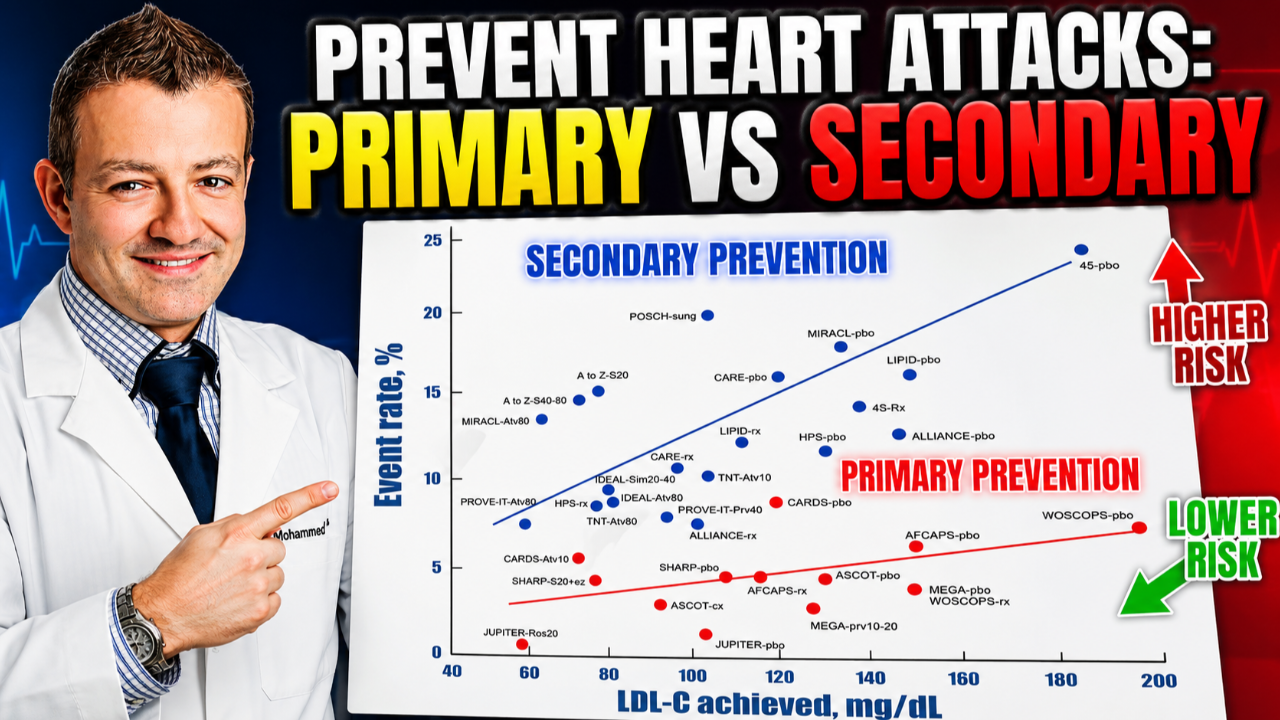
For secondary prevention patients, meaning people who have already had a heart attack, stroke, stent, bypass surgery, or any other manifestation of atherosclerotic cardiovascular disease, guidelines have moved the goalposts repeatedly over the past two decades.
First the target was below 100 mg/dL. Then below 70. And now the 2019 European guidelines and 2022 ACC expert consensus say below 55 mg/dL for very high-risk patients, with some guidance even pushing toward below 40 mg/dL in extreme-risk cases.
But here is the problem that clinicians have faced: those aggressive guideline targets were not supported by a dedicated randomized trial directly comparing below 55 to below 70 mg/dL. Prior trials showed that adding ezetimibe or PCSK9 inhibitors to statins further lowered LDL and further reduced events. But those trials were testing drugs, not targets.
The question of whether specifically aiming for below 55 mg/dL as the defined goal, and adjusting therapy accordingly, is better than aiming for below 70 mg/dL had never been cleanly answered.
Infographic Summary:

The Ez-PAVE trial, published March 28, 2026 in the New England Journal of Medicine, closes that gap. And its findings are ones every high-risk cardiac patient needs to understand.
What Was the Ez-PAVE Trial?
Ez-PAVE stands for: Effects of Ezetimibe Combination Therapy for Patients with Atherosclerotic Cardiovascular Disease, Randomized Comparison of LDL Cholesterol Targeting below 70 mg/dL versus below 55 mg/dL.
This was a multicenter, randomized, open-label superiority trial conducted at 17 hospitals across South Korea. It enrolled 3,048 patients between January 2021 and July 2022 and followed them for a median of 3.0 years.
Patients had to have documented atherosclerotic cardiovascular disease, defined as any of the following: prior acute coronary syndrome (heart attack or unstable angina), stable angina confirmed by imaging or functional testing, prior coronary or other arterial revascularization, prior stroke or TIA, or peripheral artery disease. In other words, these were real-world high-risk patients with established heart disease.
They were randomly assigned in a 1:1 ratio to one of two treatment strategies:
- Intensive targeting: LDL-C goal below 55 mg/dL
- Conventional targeting: LDL-C goal below 70 mg/dL
Physicians in both groups had flexibility to use statins, ezetimibe, and PCSK9 inhibitors as needed to reach the assigned target. Importantly, 50% of patients were also randomized to receive ezetimibe from the start, and the most potent statins, rosuvastatin and atorvastatin, were the preferred agents. PCSK9 inhibitors were allowed but reserved as a final step, partly due to reimbursement constraints in South Korea.
Who Were the Patients?
The average patient was 64.4 years old. About 79% were male. Most had a median baseline LDL-C of 76 mg/dL, meaning many were already on some form of lipid-lowering therapy at enrollment. In fact, about 91% were on statins at baseline, with roughly 23% already on high-intensity therapy. About 28% to 30% were already taking ezetimibe.
The distribution of cardiovascular disease was as follows: 55.6% had prior acute coronary syndrome, 67.2% had undergone revascularization, 48.4% had stable angina with confirmed coronary disease, 3.8% had prior stroke or TIA, and 8.7% had peripheral artery disease. This is a genuinely sick, high-risk group.
About 39.6% had diabetes and 74% had hypertension, reflecting the typical comorbidity burden seen in secondary prevention populations.
What Happened to LDL Levels?
Both groups moved in the right direction, but the intensive group moved further. During the trial:
- Intensive targeting group: median LDL-C of 56 mg/dL (just at the 55 mg/dL boundary)
- Conventional targeting group: median LDL-C of 66 mg/dL
The gap between the two groups was maintained consistently throughout follow-up, which is important for interpreting the outcome data. At 3 years, 60.8% of the intensive group had reached their below-55 target, and 85.2% had reached the below-70 threshold. In the conventional group, 68.1% had reached their below-70 target.
The intensive group used more therapy to get there: 48.4% were on high-intensity statins at 3 years versus 32.3% in the conventional group. Ezetimibe use climbed to 66.6% in the intensive group versus 56.7% in the conventional group. PCSK9 inhibitor use was low overall (2.3% in the intensive group at 3 years) due to reimbursement limitations in South Korea, a key limitation worth noting.
The Results: A Clear Win for Lower LDL
The primary endpoint was a composite of cardiovascular death, nonfatal heart attack, nonfatal stroke, any revascularization, or hospitalization for unstable angina at 3 years.
Here is what happened:
- Intensive targeting (below 55 mg/dL): 100 patients experienced the primary endpoint. Kaplan-Meier cumulative incidence: 6.6%
- Conventional targeting (below 70 mg/dL): 147 patients experienced the primary endpoint. Kaplan-Meier cumulative incidence: 9.7%
- Hazard ratio: 67 (95% CI 0.52 to 0.86), P=0.002
That is a 33% relative risk reduction and a 3.1 percentage point absolute risk reduction in favor of the lower target over just 3 years. Those are clinically meaningful numbers, not marginal differences.
The secondary endpoints told a consistent story:
- Nonfatal heart attack: 8% vs. 1.7% (HR 0.46). That is a 54% relative reduction in myocardial infarction.
- Any revascularization: 8% vs. 7.5% (HR 0.63). Fewer repeat procedures.
- Three-component MACE (CV death, MI, stroke): 3% vs. 3.6% (HR 0.63).
- Cardiovascular death: 0% vs. 1.2% (HR 0.83). Not statistically significant, likely underpowered for this rare endpoint over 3 years.
The subgroup analyses showed consistent benefit across most prespecified groups, including younger versus older patients, those with or without prior ACS, those with or without diabetes, and those with or without prior revascularization. The female subgroup showed a numerically higher hazard ratio (1.22), but the confidence interval was wide and crossed 1.0, and the trial was not powered for sex-specific analyses.
Here is a quick reference summary of the trial:
|
Category |
Detail |
|
Trial name |
Ez-PAVE |
|
Published |
March 28, 2026, NEJM |
|
Design |
Open-label, randomized superiority trial |
|
Patients |
3,048 with established ASCVD |
|
Intensive target |
LDL-C below 55 mg/dL |
|
Conventional target |
LDL-C below 70 mg/dL |
|
Follow-up |
Median 3.0 years |
|
Primary endpoint |
CV death, MI, stroke, revascularization, unstable angina |
|
Intensive group result |
6.6% event rate |
|
Conventional group result |
9.7% event rate |
|
Hazard ratio |
0.67 (95% CI 0.52 to 0.86), P=0.002 |
|
Relative risk reduction |
33% |
|
Absolute risk reduction |
3.1 percentage points |
Was It Safe to Go That Low?
This is the question patients and clinicians always ask, and it is a fair one. The cholesterol skeptics have long warned about dangers of very low LDL. What does the safety data show here?
The short answer: going lower was safe, and in one important area, actually safer.
- New-onset diabetes: 6% in the intensive group vs. 16.1% in the conventional group. No meaningful difference.
- Worsening glycemic control in diabetics: 8% vs. 50.7%. No meaningful difference.
- Muscle symptoms requiring dose change: 0% vs. 0.6%. No meaningful difference.
- Cancer: 4% vs. 2.6%. No difference.
- Liver enzyme elevation: 4% vs. 1.5%. Slightly higher in the intensive group but not statistically significant (P=0.09) and not clinically concerning.
- Creatinine elevation: 2% in the intensive group vs. 2.7% in the conventional group. P=0.004. The intensive group actually had LESS kidney function impairment. This aligns with prior data suggesting statins may be kidney-protective.
No signal for hemorrhagic stroke, neurocognitive decline, or any of the other theoretical concerns that have been raised about very low LDL. Three years is not long enough to fully rule out every possible long-term concern, but this safety profile is reassuring.
Why This Trial Matters: Filling a Critical Evidence Gap
Let me put this in context, because the design of this trial matters as much as the results.
Prior landmark trials like PROVE-IT, TNT, IMPROVE-IT, and FOURIER tested the impact of specific drugs or drug combinations on outcomes. What they showed, consistently, is that lowering LDL further with additional therapy reduced events further. The Cholesterol Treatment Trialists meta-analysis synthesized all of this and showed that each 1 mmol/L (about 39 mg/dL) reduction in LDL-C produces approximately a 22% proportional reduction in major cardiovascular events.
But none of those trials were designed as a target-to-target comparison. The question was always: does Drug X added to Drug Y reduce events? Not: does targeting below 55 mg/dL as an explicit goal outperform targeting below 70 mg/dL?
That distinction matters in clinical practice. A target-based strategy gives clinicians a concrete goal and allows them to escalate therapy stepwise until that goal is reached, regardless of which specific drugs are needed. This is how the treat-to-target philosophy works in blood pressure management and diabetes, and Ez-PAVE now validates it for LDL-C in secondary prevention.
The TST trial (Treat Stroke to Target) had previously shown benefit from targeting below 70 mg/dL compared to 90 to 110 mg/dL in stroke patients. But that comparison does not reflect modern practice. Ez-PAVE takes the next step and compares what current guidelines actually recommend against the prior standard.
The Real-World Problem This Trial Exposes
The Ez-PAVE investigators cite a troubling reality from real-world data: fewer than 25% of patients with established cardiovascular disease are reaching an LDL-C below 55 mg/dL. Fewer than 10% are on ezetimibe. And only about 1% are on PCSK9 inhibitors.
Let that sink in. We have a target that guidelines have endorsed. We now have a trial proving it reduces events. And yet the overwhelming majority of high-risk patients are not reaching it.
Why? A few reasons. Inertia in prescribing. Statin side effect concerns, real and perceived. Cost and reimbursement barriers for ezetimibe and PCSK9 inhibitors. And, until now, the lack of a clean randomized trial directly validating the below-55 target versus below-70. That last excuse is now gone.
Even in this trial, which was conducted in a research setting with motivated investigators and protocol-driven follow-up, only 60.8% of the intensive group reached their below-55 target by year 3. PCSK9 inhibitor use was constrained to just 2.3% by reimbursement policies. The authors correctly note that inclisiran and bempedoic acid were also unavailable in South Korea during the trial period. Had those agents been available and used, even more patients would likely have reached target, and the benefit may have been even greater.
My Cardiologist Take: What You Need to Know
This trial confirms what the evidence has been pointing to for years: in secondary prevention, lower LDL-C means fewer events, and the below-55 mg/dL target is the right goal for most patients with established cardiovascular disease.
A few specific points I want to highlight from a clinical perspective:
- The 10-point LDL difference drove meaningful outcomes.
The median achieved LDL-C was 56 mg/dL in the intensive group and 66 mg/dL in the conventional group. A difference of just 10 mg/dL between two already-treated groups produced a 33% relative reduction in the primary endpoint. This is entirely consistent with the log-linear dose-response relationship established in the prior evidence base. Every milligram per deciliter counts.
- Ezetimibe is underutilized and should be standard therapy.
In a world where fewer than 10% of eligible patients are on ezetimibe, this trial reinforces that adding it is not optional for high-risk patients who are not at target. It is cheap, well-tolerated, and demonstrably effective at reducing events. The IMPROVE-IT trial proved it for outcomes. Ez-PAVE reinforces it as part of a target-based strategy.
- PCSK9 inhibitors need to be used earlier and more broadly.
Only 2.3% of the intensive group reached PCSK9 inhibitor therapy by year 3, largely due to reimbursement constraints. If those barriers were removed, and PCSK9 inhibitors were used earlier in the treatment escalation, target achievement rates would be higher and cardiovascular event rates would likely be even lower. The renal safety signal in this trial (actually better in the intensive group) and the absence of any diabetes signal should help reassure clinicians and payers.
- ApoB remains my preferred metric.
LDL-C is a useful clinical tool and is what this trial measured. But in patients with diabetes, metabolic syndrome, or hypertriglyceridemia, LDL-C can underestimate true atherosclerotic risk. ApoB, which directly counts the number of atherogenic particles in circulation, is a more precise target. My goal for high-risk patients is ApoB below 65 mg/dL, which aligns with an LDL-C below 55 mg/dL in most cases but provides more accurate risk stratification in patients where LDL-C and particle number diverge.
- The female subgroup should be treated the same as men.
The numerically unfavorable result in women (HR 1.22) is intriguing but must be interpreted cautiously. The trial enrolled only 20.9% women (638 patients), and the confidence interval was very wide (0.66 to 2.28). This is almost certainly an underpowered subgroup finding, not a true signal of harm. But it reinforces the need for dedicated trials with adequate sex-specific enrollment in lipid-lowering research.
- The 3-year horizon likely understates the long-term benefit.
One of the central themes from the European Atherosclerosis Society LDL causality paper is that LDL-C has a cumulative effect on cardiovascular risk over a lifetime. The Mendelian randomization data suggest that years of lower LDL-C exposure multiply the benefit far beyond what short-term trials can capture. A 3-year trial necessarily shows only a fraction of the long-term advantage of aggressive LDL lowering started early. The real benefit of getting a secondary prevention patient to below 55 mg/dL and keeping them there for 10 to 20 years is almost certainly much larger than what Ez-PAVE measured.
Limitations to Keep in Mind
This was an open-label trial, meaning physicians and patients knew which group they were in. Blinding was not feasible because you cannot make treat-to-target decisions without knowing the target. The event adjudication committee was blinded, and the endpoints were objectively defined, which limits bias in outcome ascertainment.
The actual number of events was lower than the trial's power calculations assumed (the conventional group had a 9.7% event rate vs. the anticipated 15%). This means the trial, despite showing superiority, may not have been fully powered to detect differences in harder individual endpoints like cardiovascular death alone.
The trial included only East Asian patients, specifically South Koreans. While the biology of LDL-driven atherosclerosis is universal, baseline cardiovascular risk profiles, body habitus, and medication tolerability can differ by ethnicity. Generalizability to Western populations should be considered, though there is no compelling mechanistic reason the findings would not translate.
Finally, the limited use of PCSK9 inhibitors means we are seeing a below-55 mg/dL strategy that was not fully optimized. The potential benefit of more aggressive non-statin therapy to push achievement rates above 60.8% remains to be studied.
Ez PAVE Bottom Line
The Ez-PAVE trial is the evidence the field has been waiting for. It directly randomized patients with established cardiovascular disease to two LDL targets and demonstrated, in a rigorous randomized trial, that targeting below 55 mg/dL produces significantly fewer heart attacks, repeat procedures, and cardiovascular events over 3 years compared to targeting below 70 mg/dL, with no meaningful safety concerns.
If you have established heart disease and your LDL-C is sitting at 65 or 70 mg/dL, that is not good enough. If you have been told your cholesterol is controlled because you are below 70, ask your doctor whether you have been evaluated against the current below-55 target. If you are not there, ask what it would take to get there: higher-intensity statin, adding ezetimibe, or, if needed, a PCSK9 inhibitor.
The evidence is clear. The targets are defined. The therapies exist. The only question is whether they are being used.
Reference
Lee YJ, Lee SJ, Kim JW, et al. Intensive LDL Cholesterol Targeting in Atherosclerotic Cardiovascular Disease. N Engl J Med. Published March 28, 2026. DOI: 10.1056/NEJMoa2600283
Still Have Questions? Stop Googling and Ask Dr. Alo.
You’ve read the science, but applying it to your own life can be confusing. I created the Dr. Alo VIP Private Community to be a sanctuary away from social media noise.
Inside, you get:
-
Direct Access: I answer member questions personally 24/7/365.
-
Weekly Live Streams: Deep dives into your specific health challenges.
-
Vetted Science: No fads, just evidence-based cardiology and weight loss.
Don't leave your heart health to chance. Get the guidance you deserve. All this for less than 0.01% the cost of health insurance! You can cancel at anytime!
[👉 Join the Dr. Alo VIP Community Today]
Cardiology & Obesity Medicine