STOP Drinking? What Alcohol REALLY Does to Your Heart
Apr 23, 2026
Is Alcohol Safe for Your Heart? Here Is What the Science Actually Shows.
Decades of reassuring headlines about red wine and heart health have not aged well. Let's go through the real data, study by study.
Is alcohol safe for your heart? We have been told since the 1990s that red wine may offer some protective benefit for heart disease. Multiple theories were put forward. Some researchers thought alcohol increased HDL cholesterol. Others thought it had vasodilatory properties that relaxed blood vessels. Some believed it had mild anti-platelet activity, essentially thinning the blood. Others pointed to antioxidants in wine like resveratrol and vitamin E as the active ingredients behind any benefit.
It turns out none of those things hold up under rigorous scrutiny. Those early studies were plagued by a fundamental methodological flaw, and the conclusion we now draw from the full body of evidence is the exact opposite of what was being promoted.
The Selection Bias Problem
The observational studies suggesting cardiovascular benefit from moderate drinking were systematically comparing drinkers to a contaminated reference group. That "abstainer" group included people who had already stopped drinking because they were sick. When you compare moderately healthy drinkers to a group that includes former heavy drinkers and the chronically ill, of course the drinkers look healthier. This is called the "sick quitter" bias, and it artificially inflated the apparent protective effect of alcohol for decades. A 2016 study specifically demonstrated that this selection bias substantially overestimates the protective effects of moderate drinking.
The Largest Study Ever Done on Alcohol and Mortality
In 2018, The Lancet published one of the most important studies on this question ever conducted. Researchers analyzed data from 599,912 current drinkers with more than 5.4 million person-years of follow-up. This was not a small study. Here is what they found:
- All-cause mortality began increasing at 100 grams of alcohol per week. That is roughly 7 to 8 standard drinks per week, an amount many would consider moderate.
- Alcohol intake was linearly associated with higher risk of stroke, coronary disease (outside of myocardial infarction), heart failure, fatal hypertensive disease, and fatal aortic aneurysm.
- Among people consuming 100 to 350 grams per week, life expectancy at age 40 was shortened by 6 months up to 5 years for the heaviest drinkers.
Let that sink in. We are not talking about people drinking a bottle of whiskey a day. We are talking about amounts that, in many social circles, would be described as normal weekend drinking. And the dose-response relationship here is linear, not J-shaped. More alcohol, more risk.
Lancet, 2018: Wood AM et al. Risk thresholds for alcohol consumption: combined analysis of individual-participant data for 599,912 current drinkers in 83 prospective studies.
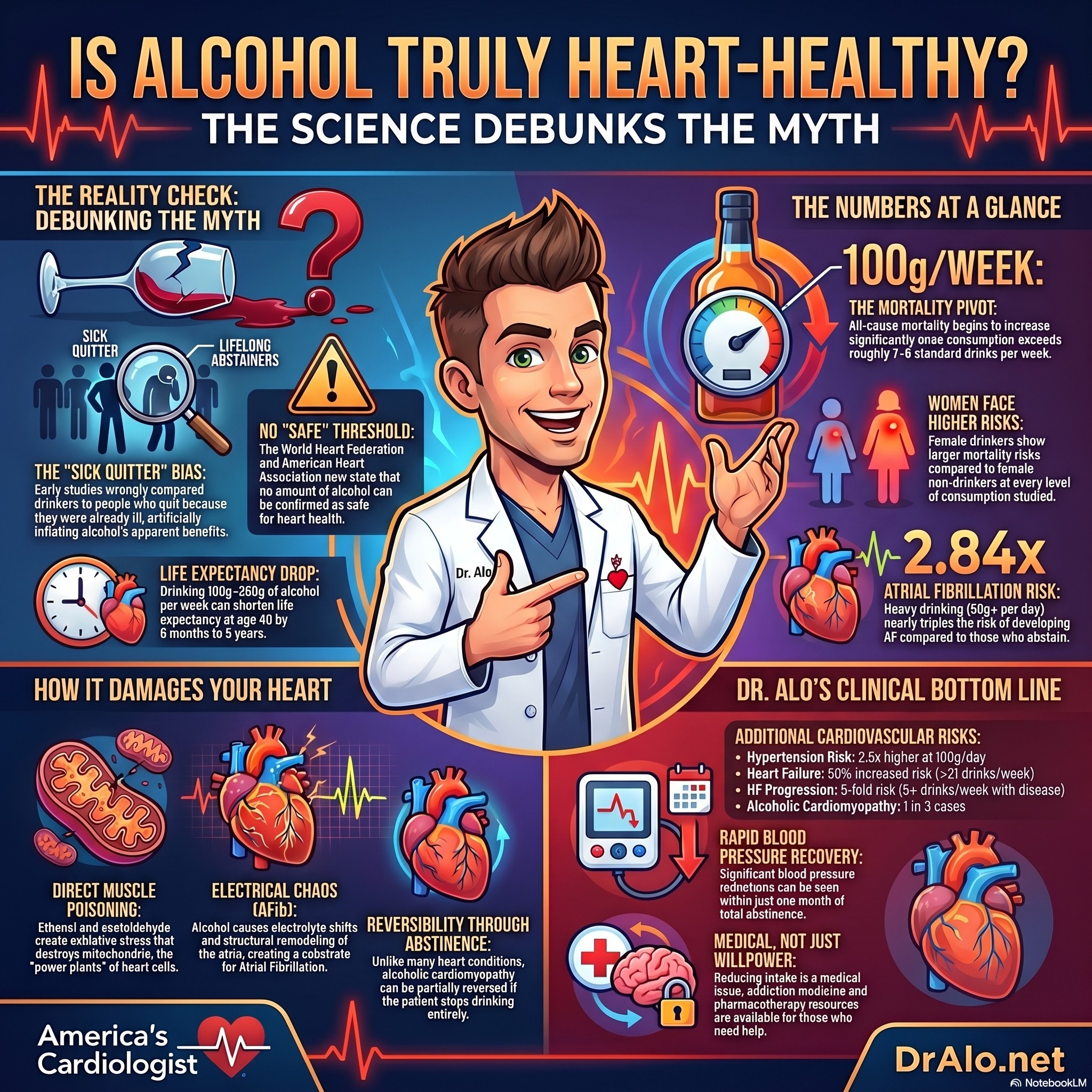
Alcohol And Heart Disease Infographic Summary:
What About Very Low Amounts?
A more recent analysis published in JAMA Network Open in 2023 examined this question carefully. People drinking 25 to 44 grams of alcohol per day showed a small, but not statistically significant, increase in all-cause mortality. The risk became statistically significant at 45 to 64 grams per day and above. Importantly, female drinkers showed larger mortality risks compared to female lifelong non-drinkers at every level studied.
The takeaway is not that low-level drinking is "safe." It is that the lower the dose, the harder it is to measure the harm in a study of finite size. The underlying risk is still present and directionally consistent.
JAMA Network Open, 2023: Zhao J et al. Alcohol Consumption and Mortality From Coronary Heart Disease: An Updated Meta-Analysis of Cohort Studies.
The World Health Federation's Verdict
The World Heart Federation examined the totality of the evidence and issued a policy brief concluding that no amount of alcohol is safe with respect to cardiovascular disease, cancer risk, and overall mortality. This was not a fringe position. This was the conclusion of a global scientific body after a systematic review of the literature.
The 2025 American Heart Association Scientific Statement reaches a virtually identical conclusion: it remains unknown whether any level of drinking is part of a healthy lifestyle, and clinicians should not recommend alcohol initiation for any perceived cardiovascular benefit.
The Direct Poison: How Alcohol Damages the Heart Muscle
The most dramatic example of alcohol's cardiac toxicity is a condition called alcoholic cardiomyopathy (ACM). Chronic heavy drinking, generally defined as more than 80 grams of ethanol per day over five or more years, directly poisons the heart muscle, causing it to weaken, enlarge, and lose its ability to pump blood effectively.
The damage occurs through several interconnected pathways:
- Oxidative stress and mitochondrial destruction: Ethanol and its primary breakdown product, acetaldehyde, flood heart muscle cells with reactive oxygen species. This overwhelms the cell's antioxidant defenses and damages the mitochondria, impairing the energy supply that every heartbeat depends on.
- Disruption of the contractile machinery: Alcohol interferes with the interaction between actin and myosin, the proteins responsible for muscle contraction, and disrupts calcium handling, which coordinates the timing of each heartbeat.
- Neurohormonal activation: Alcohol chronically activates the renin-angiotensin system and triggers innate immune pathways, driving the same harmful cardiac remodeling seen in other forms of heart failure.
ACM accounts for roughly one-third of all non-ischemic dilated cardiomyopathy cases. Women develop the condition at lower cumulative doses than men. For patients carrying truncating mutations in the titin gene, the risk is amplified further, illustrating a "double-hit" model where genetic predisposition and alcohol exposure combine to push the heart past its breaking point.
The good news: ACM is partially reversible with complete abstinence combined with guideline-directed heart failure therapy. This is one of the few causes of cardiomyopathy where removing the offending agent can produce genuine recovery of heart function.
Atrial Fibrillation: One of the Strongest Modifiable Links in Cardiology
Alcohol is now recognized as one of the strongest modifiable risk factors for atrial fibrillation (AF). The dose-response relationship is clear, and no safe threshold has been identified.
Holiday Heart Syndrome
The term "Holiday Heart Syndrome" was coined to describe episodes of atrial arrhythmias in otherwise healthy individuals following binge drinking episodes, typically clustered around holidays and celebrations. The mechanism involves a combination of autonomic imbalance, electrolyte shifts (particularly potassium and magnesium), and direct electrical irritation of atrial tissue.
Chronic Damage to the Atria
With ongoing heavy consumption, alcohol causes structural remodeling of the atria: the left atrium enlarges, fibrosis develops within the atrial walls, and the refractory periods in the pulmonary veins (the most common AF trigger zones) shorten. Once that structural substrate develops, even reducing alcohol intake may not fully reverse the arrhythmia vulnerability.
The NEJM Randomized Trial
A landmark 2020 randomized controlled trial published in the New England Journal of Medicine by Voskoboinik and colleagues assigned regular drinkers with symptomatic AF to either abstinence or continuation of their usual drinking pattern. The abstinence group had significantly lower AF recurrence and spent a meaningfully lower proportion of time in AF. This was a randomized trial, not an observational study.
2026 Meta-Analysis Finding
A 2026 network meta-analysis of systematic reviews on alcohol and AF found that heavy consumption (60 grams or more per day) carried a hazard ratio of 2.84 compared to abstainers. That is nearly a tripling of AF risk. A separate study of 371,463 participants confirmed that as alcohol intake increases, so does both hypertension and cardiovascular mortality across the full dose range.
Hypertension: A Linear, Dose-Dependent Relationship
Alcohol raises blood pressure in a straightforward, dose-dependent fashion. Mendelian randomization data confirms this is a causal relationship, not a confounded association:
- At 50 grams of ethanol per day: relative risk for hypertension of 1.7
- At 100 grams of ethanol per day: relative risk of 2.5
- Even 1 to 2 drinks per day: can exacerbate hypertension in susceptible individuals
When patients come to me with blood pressure that is difficult to control despite multiple medications, alcohol is one of the first things I ask about. Blood pressure reductions can be seen within one month of abstinence. That is faster than most antihypertensive drugs take to show their full effect.
Coronary Artery Disease, Stroke, and Heart Failure
Heavy and binge drinking accelerate coronary artery disease through dyslipidemia, vascular inflammation, and insulin resistance. The risk extends to all stroke subtypes, with much of that risk mediated through alcohol's effect on blood pressure.
For heart failure, the thresholds matter:
- Exceeding 21 drinks per week is associated with approximately a 50% increase in heart failure risk in the general population.
- For patients with pre-existing structural or functional cardiac disease, as few as 5 or more drinks per week was associated with a five-fold increased risk of progression to symptomatic heart failure (OR 5.0; 95% CI 1.7 to 15.5).
Five drinks per week is not a binge. For someone with a dilated cardiomyopathy, a reduced ejection fraction, or significant valvular disease, that is a clinically dangerous amount that I take very seriously in every patient encounter.
The Numbers at a Glance
|
Condition / Risk |
Key Finding |
|
All-cause mortality threshold |
Increases at >100g alcohol/week (Lancet, 2018) |
|
Life expectancy reduction at age 40 |
Up to 5 years in heaviest drinkers |
|
Atrial fibrillation risk (heavy) |
Hazard ratio 2.84 vs. abstainers |
|
Hypertension risk at 100g/day |
Relative risk 2.5 |
|
Heart failure risk >21 drinks/week |
~50% increased risk |
|
HF progression (pre-existing disease) |
5-fold risk at ≥5 drinks/week |
|
ACM share of non-ischemic DCM |
~1 in 3 cases |
|
BP reduction after abstinence |
Meaningful reduction within one month |
So What Should You Actually Do?
I am not here to lecture you about your lifestyle choices. I am here to give you the clearest possible picture of what the evidence shows, so you can make a genuinely informed decision.
- If you do not drink, do not start. There is no cardiovascular rationale for initiating alcohol use.
- If you drink and have AF, hypertension, heart failure, or cardiomyopathy: this should be an active, priority conversation with your cardiologist. The evidence for benefit from reduction or abstinence is strongest in these groups.
- If you drink moderately and feel fine: understand that "feeling fine" and "no cardiovascular risk" are not the same thing. Structural changes accumulate silently.
- If you are struggling to reduce or stop: this is a medical issue, not a willpower issue. Addiction medicine resources, behavioral support, and pharmacotherapy exist and work. Please ask your doctor for help.
If you want to optimize your heart and brain health, avoid alcohol entirely or keep it to the absolute bare minimum. The data now is unambiguous on direction, even when it is not always precise about the exact threshold of harm.
Dr. Alo's Clinical Bottom Line
The World Heart Federation says no amount is safe. The American Heart Association says no level of drinking can currently be confirmed as part of a healthy lifestyle. The Lancet mega-study showed all-cause mortality climbing above 100 grams per week. The NEJM randomized trial showed AF recurrence dropped with abstinence. This is not one inconvenient study. This is the convergent conclusion of multiple lines of evidence from multiple scientific bodies. The protective red wine narrative was built on flawed observational data, and it has not survived rigorous testing. Adjust your advice and your habits accordingly.
References
- Piano MR, Marcus GM, Aycock DM, et al. Alcohol Use and Cardiovascular Disease: A Scientific Statement From the American Heart Association. Circulation. 2025;152(1):e7-e21.
- Wood AM, Kaptoge S, Butterworth AS, et al. Risk thresholds for alcohol consumption: combined analysis of individual-participant data for 599,912 current drinkers in 83 prospective studies. Lancet. 2018;391(10129):1513-1523.
- Zhao J, Stockwell T, Naimi T, et al. Association Between Daily Alcohol Intake and Risk of All-Cause Mortality. JAMA Network Open. 2023.
- World Heart Federation. Alcohol and CVD: No Safe Level. Policy Brief. world-heart-federation.org.
- Stockwell T, Zhao J, Panwar S, et al. Do "moderate" drinkers have reduced mortality risk? A systematic review and meta-analysis. J Stud Alcohol Drugs. 2016;77(2):185-198.
- Biddinger KJ, Emdin CA, Haas ME, et al. Association of Habitual Alcohol Intake With Risk of Cardiovascular Disease. JAMA Network Open. 2022;5(3):e223849.
- Dominguez F, Adler E, Garcia-Pavia P. Alcoholic Cardiomyopathy: An Update. European Heart Journal. 2024;45(26):2294-2305.
- Voskoboinik A, Kalman JM, De Silva A, et al. Alcohol Abstinence in Drinkers with Atrial Fibrillation. New England Journal of Medicine. 2020;382(1):20-28.
- Hadi M, Saha S, Petrie D, Woode ME, Gerdtham UG. Alcohol Consumption and Atrial Fibrillation Risk: Network Meta-Analysis. Drug and Alcohol Review. 2026;45(1):e70089.
- Heymans S, Lakdawala NK, Tschope C, Klingel K. Dilated Cardiomyopathy: Causes, Mechanisms, and Current and Future Treatment Approaches. Lancet. 2023;402(10406):998-1011.
- Day E, Rudd JHF. Alcohol Use Disorders and the Heart. Addiction. 2019;114(9):1670-1678.
- Wong B, Ryan C, Fagbamigbe A, et al. Alcohol Consumption and Heart Failure: A Dose-Response Meta-Analysis. Cochrane Database of Systematic Reviews. 2024;8:CD015398.
- Linz B, Hertel JN, Jespersen T, Linz D. Mechanisms and Therapeutic Opportunities in Atrial Fibrillation in Relationship to Alcohol Use and Abuse. Canadian Journal of Cardiology. 2022;38(9):1352-1363.
- Whitman IR, Agarwal V, Nah G, et al. Alcohol Abuse and Cardiac Disease. Journal of the American College of Cardiology. 2017;69(1):13-24.
- Gupta S, Ahimsadasan N, Dalsania K, et al. Alcohol and Cardiovascular Disease. American Journal of Cardiology. 2025.
Still Have Questions? Stop Googling and Ask Dr. Alo.
You’ve read the science, but applying it to your own life can be confusing. I created the Dr. Alo VIP Private Community to be a sanctuary away from social media noise.
Inside, you get:
-
Direct Access: I answer member questions personally 24/7/365.
-
Weekly Live Streams: Deep dives into your specific health challenges.
-
Vetted Science: No fads, just evidence-based cardiology and weight loss.
Don't leave your heart health to chance. Get the guidance you deserve. All this for less than 0.01% the cost of health insurance! You can cancel at anytime!
[👉 Join the Dr. Alo VIP Community Today]
Cardiology & Obesity Medicine