
Does K2 Unclog Arteries?
Mar 02, 2026
Vitamin K2 and Arterial Health: Can It Really "Unclog" Arteries?
A lot of people online are asking if vitamin K2 can help stop calcified plaque progression or cause plaque regression. The answer is no. There are multitudes of studies done on this topic and it just does not work.
There is currently no strong clinical evidence that Vitamin K2 supplementation can "unclog" arteries in humans. While the term is often used to describe the reversal of existing atherosclerotic plaque, this specific effect has not yet been demonstrated in human clinical trials. However, Vitamin K2 remains a significant area of study for its ability to slow the progression of vascular calcification, particularly in high-risk patients.
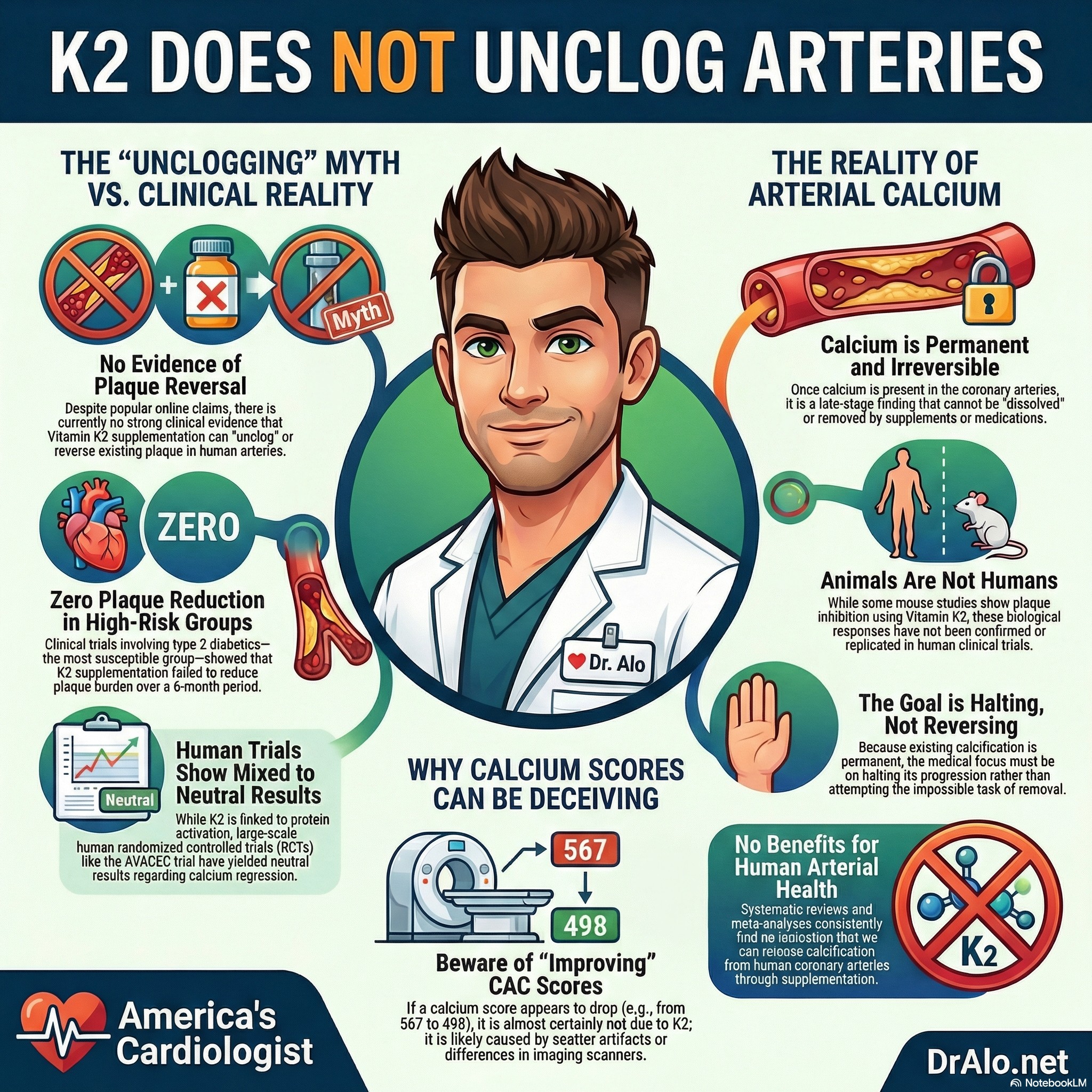
In the most susceptible group, type 2 diabetics, vitamin K supplementation did not reduce plaque burden in 6 months.
K2 Heart Disease Summary Infographic:
Trials On Heart Disease And K2
In nearly every trial, systematic review, meta-analysis that’s been done, there has never been an indication that we can ever remove calcifications from coronary arteries. Once calcium is present in your coronary arteries, it is not going away. We just need to halt its progression.
“But my friend started taking K2 and other supplements and his calcium score went from 567 to 498”.
His CAC did not actually improve. That is due to scatter artifact or using different scanners. See the calcium blog for more on that.
Calcium is a late stage finding and is irreversible and no amount of supplements nor medications are going to improve it.
What the Research On K2 Actually Says
Research into Vitamin K2 generally falls into three categories: animal studies, observational data, and human clinical trials.
- Animal Studies: Research on mice has shown that Vitamin K2, specifically in the form of Menaquinone-4 (MK-4), can inhibit the formation of plaques and stabilize existing ones by reducing inflammation and foam cell accumulation.
- Observational Data: Large studies of human populations indicate that people with a higher dietary intake of Vitamin K2 have a lower risk of coronary heart disease and peripheral arterial disease.
- Clinical Trials: Randomized controlled trials in humans have yielded mixed results. While K2 is essential for activating Matrix Gla Protein (MGP)—a powerful inhibitor of calcification—supplementation has not consistently shown the ability to reverse existing mineral deposits.
Insights from the AVADEC Trial
The recent AVADEC trial (2023) provided important nuances regarding Vitamin K2 and D supplementation. While the study found no significant reduction in coronary artery calcium (CAC) progression for the general population, it did find a statistically significant benefit for high-risk patients with baseline calcium scores $\ge$ 400 Agatston Units.
This suggests that while K2 may not "unclog" arteries, it may offer protection in advanced stages of disease. Conversely, studies in patients with chronic kidney disease—who often face accelerated calcification—have not yet confirmed a definitive cardiovascular benefit from K2.
Current Guidelines Do Not Recommend K2
Medical guidelines do not currently recommend Vitamin K2 as a primary treatment for reversing arterial calcification. While it may play a supportive role in preventing the progression of mineral buildup in specific groups, it should not be viewed as a tool to "unclog" existing blockages.
🔬 The 2026 Meta-Analysis Deep Dive: 180 mcg vs. 360 mcg
The "best" dose of Vitamin K2 (specifically the MK-7 form) has been a major focus of recent cardiovascular research. While early studies often used lower amounts, recent large-scale reviews have identified a clear dose-response relationship—meaning higher doses often lead to more measurable changes in the blood and arteries.
- The 180 mcg Dose: The "Maintenance" Level
Most "Standard" heart health supplements use 180 mcg.
- Effect on Stiffness: A landmark 3-year study on postmenopausal women showed that 180 mcg daily significantly improved arterial elasticity and reduced arterial stiffness by roughly 5.8%.
- The Verdict: This dose is excellent for prevention and maintaining "youthful" flexibility in the arteries for healthy adults. However, it may not be strong enough for those who already have high calcium scores.
- This does not suggest in any way that K2 reduces plaque nor prevents plaque.
- The 360 mcg Dose: The "Clinical" Level
Recent 2024 and 2025 meta-analyses have shifted the focus toward higher doses for people with existing heart issues or kidney disease. This was the only study that showed even minimal slowing of plaque progression. And it was not very impressive.
- MGP Activation: Studies show that 360 mcg is significantly more effective at reducing dp-ucMGP (the "inactive" protein that allows calcification to happen).
- High-Risk Benefits: In the AVADEC trial and follow-up reviews, the most consistent "slowing" of calcium buildup was seen in patients using doses closer to 300–360 mcg. This was minimal and not clinically relevant. There are far better ways to prevent plaque build up (ie lower LDL over a longer period of time).
- Kidney Health: For patients on dialysis or with chronic kidney disease (CKD), 180 mcg often isn't enough to overcome their severe deficiency; 360 mcg is now the commonly studied clinical threshold.
No Strong Evidence That K2 Reduces Plaque
With that said, there is currently no strong clinical evidence that vitamin K2 supplementation can "unclog" arteries in humans, although it may help slow the progression of vascular calcification, particularly in high-risk patients. The term "unclog" typically refers to reversing existing atherosclerotic plaque, which has not been demonstrated in human trials.
Animal studies show that vitamin K2, particularly menaquinone-4, can inhibit atherosclerotic plaque formation and stabilize plaques by reducing foam cell accumulation and inflammation. [1] However, these findings have not translated to confirmed reversal of arterial disease in human clinical trials.
Observational studies indicate that higher dietary intake of vitamin K2 is associated with reduced risk of coronary heart disease and peripheral arterial disease. This protective effect likely occurs through vitamin K2's role in activating matrix Gla protein (MGP), a potent inhibitor of vascular calcification. This does not mean that pre-existing plaques magically dissolved. However, randomized controlled trials have yielded mixed results and have not consistently demonstrated that supplementation reverses existing calcification.
Currently, we have no strong evidence or data to recommend K2 supplementation. We do have extensive evidence that lowering LDL actually completely stops plaque formation and, at low enough levels, can reverse plaque progression, especially fresh plaque.
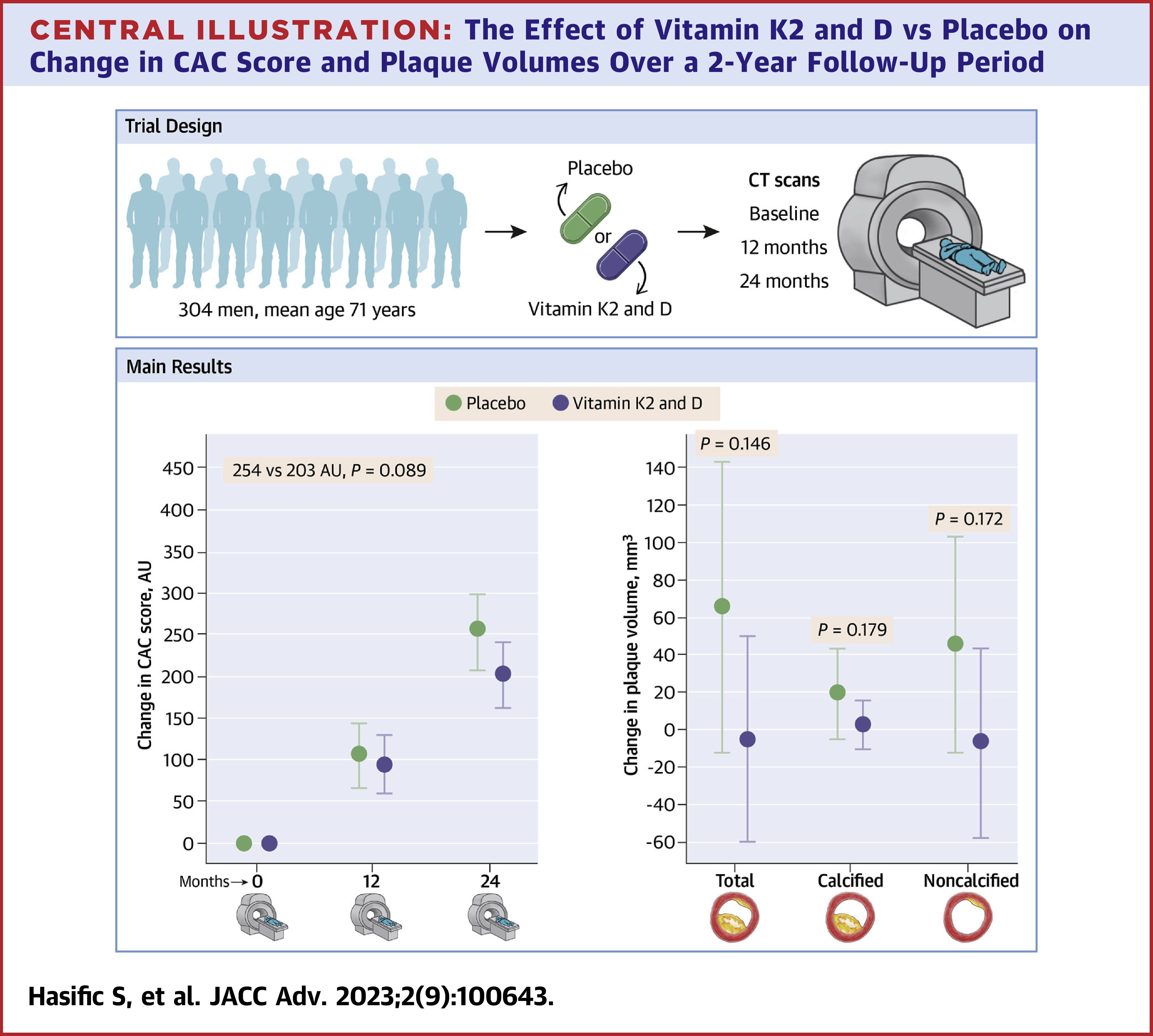
Figure 2. CAC Score Progression According to Treatment Allocation
Patients with no prior ischemic heart disease randomized to vitamin K2 and D supplementation had no significant reduction in mean CAC progression over a 2-year follow-up compared to placebo. Although the primary endpoint is neutral, differential responses to supplementation in those with CAC scores ≥400 AU and in safety endpoints are hypothesis-generating for future studies.
Effects of Vitamin K2 and D Supplementation on Coronary Artery Disease in Men: A RCT. JACC Adv. October 31, 2023.
References & Studies:
https://www.mdpi.com/2072-6643/12/10/2909
https://link.springer.com/article/10.1007/s00394-019-01998-3
https://www.atherosclerosis-journal.com/article/S0021-9150(23)05228-0/fulltext
https://pubmed.ncbi.nlm.nih.gov/32977548/
https://pubmed.ncbi.nlm.nih.gov/27640076/
https://www.acpjournals.org/doi/abs/10.7326/0003-4819-159-12-201312170-00011
https://www.frontiersin.org/articles/10.3389/fnut.2023.1115069/full
https://www.ncbi.nlm.nih.gov/pmc/articles/PMC2682995/
Menaquinone-4 Inhibits the Formation and Vulnerability of Atherosclerotic Plaques in Apolipoprotein E Knockout Mice by Decreasing the Uptake of the Oxidized Low-Density Lipoprotein in Macrophages.
European Journal of Pharmacology. 2025. Yamada A, Koga M, Watase D, et al.New
Should We Recommend Vitamin K2 Supplement to Prevent Coronary Artery Calcification for Patients Receiving Statins and/or Warfarin?.
Cardiovascular Drugs and Therapy. 2024. Zhang AJ, Ballantyne CM, Birnbaum Y.New
The Relationship Between Vitamin K and Peripheral Arterial Disease.
Atherosclerosis. 2016. Vissers LET, Dalmeijer GW, Boer JMA, et al.
Association of Dietary Vitamin K and Risk of Coronary Heart Disease in Middle-Age Adults: The Hordaland Health Study Cohort.
BMJ Open. 2020. Haugsgjerd TR, Egeland GM, Nygård OK, et al.
KDOQI Clinical Practice Guideline for Nutrition in CKD: 2020 Update.
American Journal of Kidney Diseases : The Official Journal of the National Kidney Foundation. 2020. Ikizler TA, Burrowes JD, Byham-Gray LD, et al.Guideline
Vitamin K Status, Supplementation and Vascular Disease: A Systematic Review and Meta-Analysis.
Heart. 2019. Lees JS, Chapman FA, Witham MD, Jardine AG, Mark PB.
Vitamin K and Cardiovascular Complications in Chronic Kidney Disease Patients.
Kidney International. 2021. Kaesler N, Schurgers LJ, Floege J.
Prevention of Vasculopathy by Vitamin K Supplementation: Can We Turn Fiction Into Fact?.
Atherosclerosis. 2015. Brandenburg VM, Schurgers LJ, Kaesler N, et al.
Effects of Vitamin K2 and D Supplementation on Coronary Artery Disease in Men: A RCT.
JACC. Advances. 2023. Hasific S, Oevrehus KA, Lindholt JS, et al.
Hasific S, et al. (2023/2025): The AVADEC Trial: Effects of high-dose K2 and D3 on coronary artery disease in men. JACC Advances.
MDPI Nutrients (2020-2025 Updates): Vitamin K supplementation for the prevention of CVD; dose-dependent improvements in dephosphorylated-uncarboxylated MGP (dp-ucMGP).
Life Extension/Faloon W. (2025 Research Review): Long-term human trials showing 180 mcg MK-7 reduces carotid-femoral pulse wave velocity (arterial stiffness).
Indian Journal of Physiology and Pharmacology (Nov 2025): Meta-analysis on K2 in CKD patients; observing biochemical improvements in vascular biomarkers at higher dosing tiers.
Journal of Cardiac Research (2025): The VitaK-CAC Trial preliminary results on MK-7 and progression-rate of established coronary artery calcification.
Yamada A, et al. Menaquinone-4 Inhibits the Formation and Vulnerability of Atherosclerotic Plaques in Apolipoprotein E Knockout Mice. European Journal of Pharmacology. 2025.
Zhang AJ, et al. Should We Recommend Vitamin K2 Supplement to Prevent Coronary Artery Calcification for Patients Receiving Statins and/or Warfarin? Cardiovascular Drugs and Therapy. 2024.
Vissers LET, et al. The Relationship Between Vitamin K and Peripheral Arterial Disease. Atherosclerosis. 2016.
Haugsgjerd TR, et al. Association of Dietary Vitamin K and Risk of Coronary Heart Disease in Middle-Age Adults: The Hordaland Health Study Cohort. BMJ Open. 2020.
Ikizler TA, et al. KDOQI Clinical Practice Guideline for Nutrition in CKD: 2020 Update. American Journal of Kidney Diseases. 2020.
Lees JS, et al. Vitamin K Status, Supplementation and Vascular Disease: A Systematic Review and Meta-Analysis. Heart. 2019.
Kaesler N, et al. Vitamin K and Cardiovascular Complications in Chronic Kidney Disease Patients. Kidney International. 2021.
Brandenburg VM, et al. Prevention of Vasculopathy by Vitamin K Supplementation: Can We Turn Fiction Into Fact? Atherosclerosis. 2015.
Hasific S, et al. Effects of Vitamin K2 and D Supplementation on Coronary Artery Disease in Men: A RCT. JACC Advances. 2023.
Still Have Questions? Stop Googling and Ask Dr. Alo.
You’ve read the science, but applying it to your own life can be confusing. I created the Dr. Alo VIP Private Community to be a sanctuary away from social media noise.
Inside, you get:
-
Direct Access: I answer member questions personally 24/7/365.
-
Weekly Live Streams: Deep dives into your specific health challenges.
-
Vetted Science: No fads, just evidence-based cardiology and weight loss.
Don't leave your heart health to chance. Get the guidance you deserve. All this for less than 0.01% the cost of health insurance! You can cancel at anytime!
[👉 Join the Dr. Alo VIP Community Today]
Cardiology & Obesity Medicine