Best Exercises For Your Heart Based On 81 Scientific Studies
Apr 22, 2026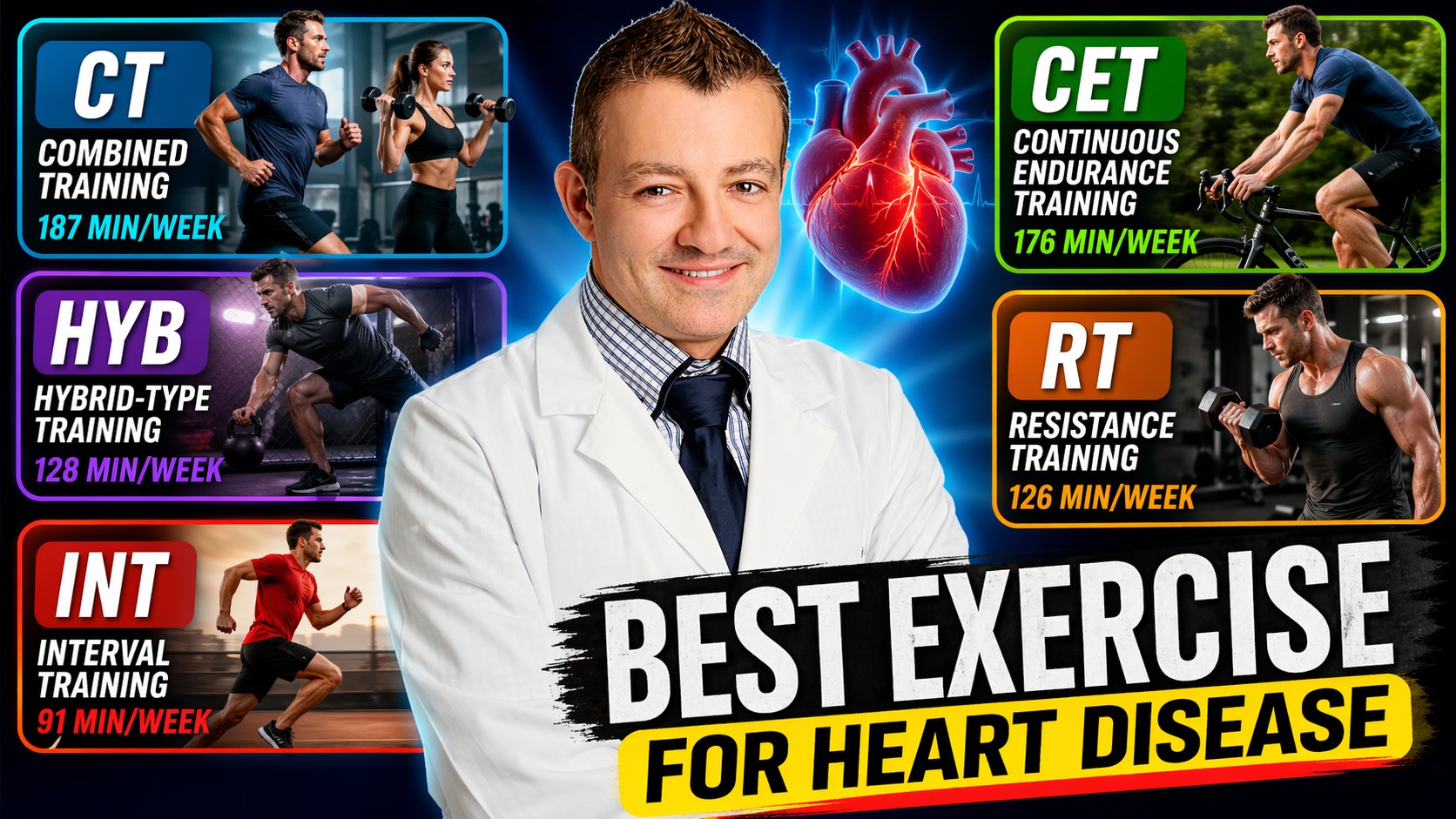
The Largest Meta Analysis Of Randomized Controlled Trials On Exercise And Heart Disease Outcomes Was Just Published
The largest study o exercise dropped. It's a meta analysis of only randomized control trials. Randomized control trials are the highest level of evidence. A meta analysis is an overview of multiple studies to increase the number of participants in the study and increase it's power. These are the highest levels of evidence!
Which Type of Exercise Is Best for Your Heart, Cholesterol, and Metabolism?
Not all exercise is equal when it comes to your heart health. A landmark 2022 network meta-analysis published in Circulation: Cardiovascular Quality and Outcomes analyzed 81 randomized controlled trials involving over 4,300 adults with overweight or obesity. The study compared five distinct exercise modalities head-to-head across 21 cardiometabolic outcomes. The results are clear: doing both aerobic and strength training together delivers the broadest benefit. Here is what the science actually says.
Why This Study Matters
Over 50% of adults worldwide now carry excess body weight, and the annual global cost of treating obesity-related illness exceeds $2 trillion. Exercise is one of our most powerful tools for reversing cardiometabolic risk, but the question of which type of exercise to prescribe has never been cleanly answered, until now.
Batrakoulis et al. conducted a rigorous network meta-analysis comparing five distinct exercise modalities across 21 cardiometabolic outcomes in adults with overweight or obesity who had no other diagnosed conditions. This is the most comprehensive exercise comparison of its kind.
Best Exercise For Heart Disease Infographic Summary:
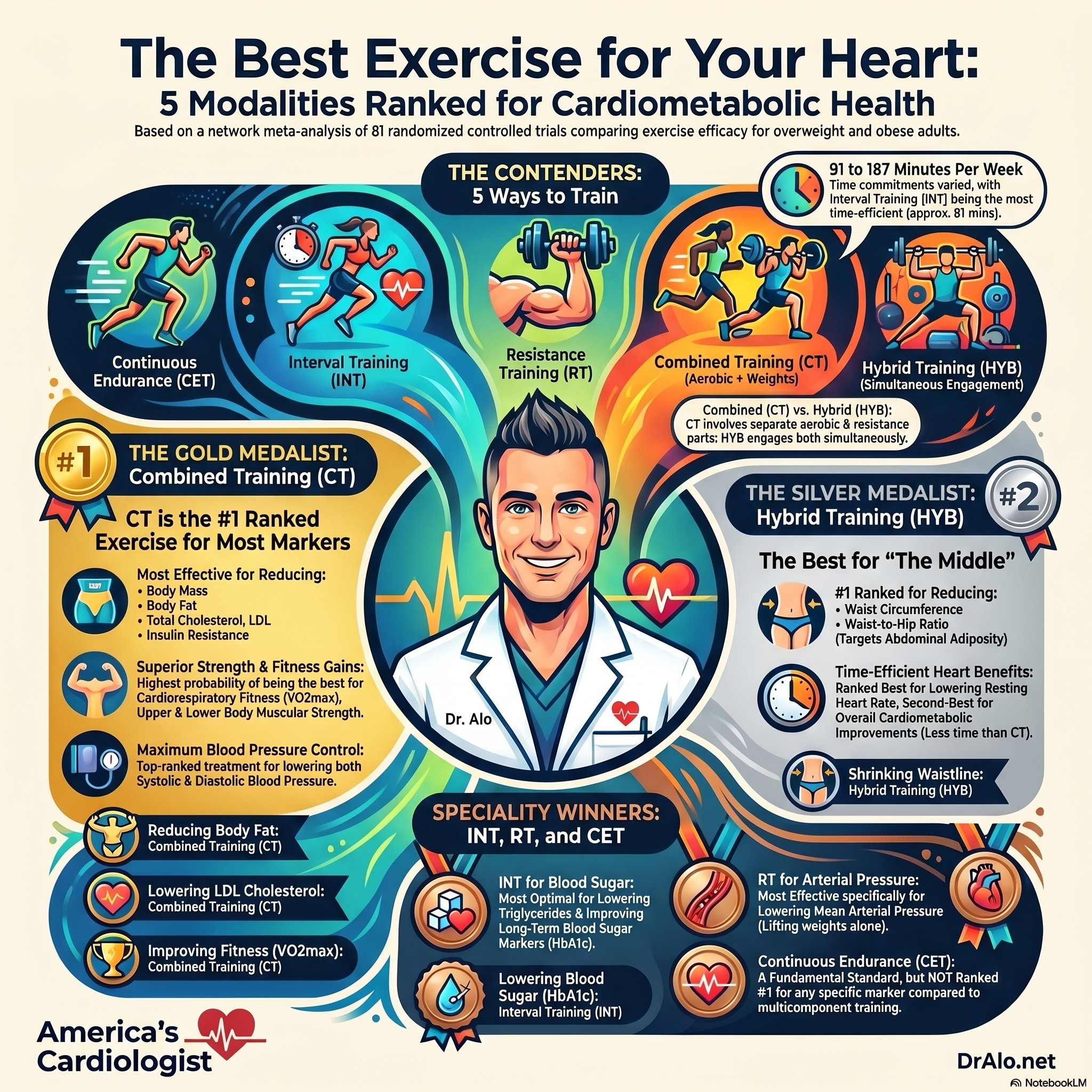
The Five Exercise Types Compared
- Combined Training (CT): Both aerobic and resistance training incorporated into a regular weekly program. Studies averaged about 187 minutes per week across 3 to 4 sessions.
- Hybrid-Type Training (HYB): Cardiovascular and muscular systems engaged simultaneously within a single session, at various intensities. Examples include high-intensity functional training, small-sided recreational sports, and integrated neuromuscular circuit programs. Studies averaged about 128 minutes per week across 2 to 3 sessions.
- Interval Training (INT): High- or moderate-intensity intervals of cardiovascular exercise only, alternating effort and recovery. Studies averaged about 91 minutes per week across 2 to 3 sessions, making it the most time-efficient option.
- Continuous Endurance Training (CET): Traditional steady-state cardio such as walking, running, or cycling at a consistent moderate intensity. Studies averaged about 176 minutes per week across 3 to 5 sessions.
- Resistance Training (RT): Weightlifting, machine-based training, or circuit-based strength programs without a structured aerobic component. Studies averaged about 126 minutes per week across 2 to 3 sessions.
The Ranked Results
Each modality was compared against the others and against a no-exercise control group across all 21 outcomes. The table below shows the modality with the highest ranking probability for each cardiometabolic outcome, along with that probability expressed as a percentage.
|
Outcome |
Best Modality |
Ranking Probability |
|
Body Mass |
Combined Training |
37% |
|
Body Fat % |
Combined Training |
41% |
|
Waist Circumference |
Hybrid Training |
93% |
|
BMI |
Hybrid Training |
34% |
|
Total Cholesterol |
Combined Training |
95% |
|
LDL Cholesterol |
Combined Training |
93% |
|
HDL Cholesterol |
Hybrid Training |
27% |
|
Triglycerides |
Interval Training |
41% |
|
Fasting Glucose |
Hybrid Training |
69% |
|
Fasting Insulin |
Combined Training |
86% |
|
HOMA-IR (Insulin Resistance) |
Combined Training |
65% |
|
HbA1c |
Interval Training |
72% |
|
Systolic Blood Pressure |
Combined Training |
65% |
|
Diastolic Blood Pressure |
Combined Training |
65% |
|
Resting Heart Rate |
Hybrid Training |
65% |
|
VO2max (Cardio Fitness) |
Combined Training |
45% |
|
Upper Body Strength |
Combined Training |
90% |
|
Lower Body Strength |
Combined Training |
100% |
Key finding: Continuous endurance training, the traditional cornerstone of exercise prescriptions, was not ranked first for a single outcome in this analysis. Not one.
Combined Training: The Overall Winner
Combined training ranked first for 12 of 18 outcomes. This approach produced the largest reductions in total cholesterol, LDL, fasting insulin, HOMA-IR, systolic blood pressure, and diastolic blood pressure. It also delivered the greatest gains in cardiorespiratory fitness and both upper and lower body muscular strength.
The mechanism makes physiological sense. Aerobic exercise drives improvements in mitochondrial function, capillarization, and insulin-signaling pathways. Resistance training increases resting metabolic rate, preserves fat-free mass, and activates skeletal muscle glucose transport. Combining both stacks these complementary adaptations.
The practical challenge is time. Combined training required the most time investment of any modality, averaging 187 minutes per week, and it had the highest dropout rate at 15%. If your patient cannot sustain that volume, the next option is compelling.
Hybrid Training: The Time-Efficient Runner-Up
Hybrid training ranked first for waist circumference reduction, BMI, waist-to-hip ratio, resting heart rate, and fasting glucose. It was also nearly co-equal with combined training for raising HDL cholesterol.
The waist circumference results deserve particular attention. Hybrid training produced an average reduction of 8.3 cm in waist circumference compared to no exercise. Research from the EPIC-Norfolk cohort has shown that reductions in waist circumference are independently associated with lower cardiovascular and all-cause mortality risk. A nearly 9-centimeter reduction in abdominal girth is a clinically meaningful outcome.
Hybrid training accomplishes this with a lower time commitment, averaging 128 minutes per week, and it had the lowest dropout rate of any modality at under 4%. For many patients, this may be the most pragmatic prescription: nearly equivalent cardiometabolic benefits to combined training with substantially less time required and far better real-world adherence.
Interval Training: The Glycemic Control Specialist
Interval training ranked highest for reducing HbA1c with a 72% probability of being the best modality, and for lowering triglycerides with a 41% probability. It also produced clinically meaningful improvements in cardiorespiratory fitness. At an average of just 91 minutes per week, it is the most time-efficient option among the five.
The glycemic benefits appear to involve upregulation of GLUT4-mediated glucose transport, improved mitochondrial biogenesis, and exercise-induced lactate elevation that activates whole-body glucose homeostasis pathways. For patients where HbA1c and triglycerides are the primary targets, interval training deserves serious consideration, particularly when time is limited.
Resistance Training and Continuous Endurance: Where They Fit
Resistance training alone ranked first for reducing mean arterial pressure with a 56% probability, and it produced statistically significant improvements in HDL and fasting insulin. It remains important, particularly for patients who need to prioritize muscular strength, since muscular strength is itself an independent predictor of all-cause mortality.
Continuous endurance training produced significant reductions in body fat and triglycerides, and it improved HDL and resting heart rate. But it was outperformed across the board when compared to multicomponent approaches. This does not mean your patients should stop walking or cycling. Any exercise is better than none. But if you are designing a prescription specifically for cardiometabolic optimization, the data indicate you should build around a multicomponent framework rather than steady-state cardio alone.
Does Gender Influence the Results? Yes.
A pre-specified subgroup analysis separating 2,022 females and 1,244 males found meaningful differences in which exercise types performed best depending on sex.
In women, hybrid training dominated, ranking first for waist circumference, waist-to-hip ratio, body fat percentage, BMI, fasting glucose, and diastolic blood pressure. In men, combined training generally performed better, ranking first for body mass reduction, BMI, fasting insulin, and cardiorespiratory fitness, while interval training ranked best for waist circumference in men specifically.
The reasons for these differences are not fully established, but hormonal variation in body fat distribution, catecholamine responses, and metabolic substrate utilization likely all play a role. The practical implication is that exercise prescriptions should account for the individual in front of you.
What This Means for Your Patients
Here is how I translate this evidence into clinical practice:
Start with a multicomponent goal. Any prescription combining aerobic and muscle-strengthening elements will outperform single-modality programs. This aligns with current AHA/ACC, ACSM, and WHO physical activity guidelines.
If time is not a barrier, prescribe combined training. It delivers the broadest cardiometabolic benefit across lipids, glucose, blood pressure, and physical fitness.
If time or adherence is a concern, prescribe hybrid training. Nearly equivalent benefits, less weekly time, and a dramatically lower dropout rate. Think functional training classes, recreational sports, or circuit-based programs.
If glycemic control and triglycerides are the primary targets, consider interval training. Time-efficient and strongly beneficial for HbA1c and triglycerides.
For women specifically, hybrid modalities appear to produce greater benefit for abdominal adiposity and waist circumference, outcomes that carry independent cardiovascular relevance.
Steady-state cardio alone is no longer the optimal prescription if comprehensive cardiometabolic improvement is the goal.
What about elderly patients?
Just start with something simple. Even getting up and down off a chair is strength training. So is picking something off the ground repeatedly.
I have a full exercise program in the Dr Alo app for all ages and levels.
An Important Limitation
This study excluded individuals with diagnosed comorbidities such as type 2 diabetes, hypertension, or established cardiovascular disease. The results apply specifically to adults with overweight or obesity who are otherwise metabolically healthy. Additionally, only 31% of included trials were rated as high methodological quality, and most were underpowered individually. The network meta-analysis approach compensates by pooling indirect evidence, but some uncertainty remains in the rankings, particularly for outcomes with fewer contributing studies.
References
- Batrakoulis A, Jamurtas AZ, Metsios GS, et al. Comparative Efficacy of 5 Exercise Types on Cardiometabolic Health in Overweight and Obese Adults: A Systematic Review and Network Meta-Analysis of 81 Randomized Controlled Trials. Circ Cardiovasc Qual Outcomes. 2022;15:e008243.
- World Health Organization. Overweight and obesity. WHO fact sheet N311. 2020.
- Tremmel M, Gerdtham UG, Nilsson PM, Saha S. Economic burden of obesity: a systematic literature review. Int J Environ Res Public Health. 2017;14:E435.
- American College of Sports Medicine, Liguori G, Feito Y, Fountaine C, Roy BA. ACSM's Guidelines for Exercise Testing and Prescription. 11th ed. Wolters Kluwer Health; 2021.
- Bull FC, et al. World Health Organization 2020 guidelines on physical activity and sedentary behaviour. Br J Sports Med. 2020;54:1451-1462.
- Mulligan AA, Lentjes MAH, Luben RN, Wareham NJ, Khaw KT. Changes in waist circumference and risk of all-cause and CVD mortality: results from the EPIC-Norfolk cohort study. BMC Cardiovasc Disord. 2019;19:238.
- Garcia-Hermoso A, et al. Muscular strength as a predictor of all-cause mortality in an apparently healthy population: a systematic review and meta-analysis. Arch Phys Med Rehabil. 2018;99:2100-2113.
- O'Donoghue G, Blake C, Cunningham C, Lennon O, Perrotta C. What exercise prescription is optimal to improve body composition and cardiorespiratory fitness in adults living with obesity? A network meta-analysis. Obes Rev. 2021;22:e13137.
Still Have Questions? Stop Googling and Ask Dr. Alo.
You’ve read the science, but applying it to your own life can be confusing. I created the Dr. Alo VIP Private Community to be a sanctuary away from social media noise.
Inside, you get:
-
Direct Access: I answer member questions personally 24/7/365.
-
Weekly Live Streams: Deep dives into your specific health challenges.
-
Vetted Science: No fads, just evidence-based cardiology and weight loss.
Don't leave your heart health to chance. Get the guidance you deserve. All this for less than 0.01% the cost of health insurance! You can cancel at anytime!
[👉 Join the Dr. Alo VIP Community Today]
Cardiology & Obesity Medicine