
Does Berberine Lower Heart Disease Risk?
Mar 29, 2026
No Studies Show Berberine Lowers Cardiovascular Risk
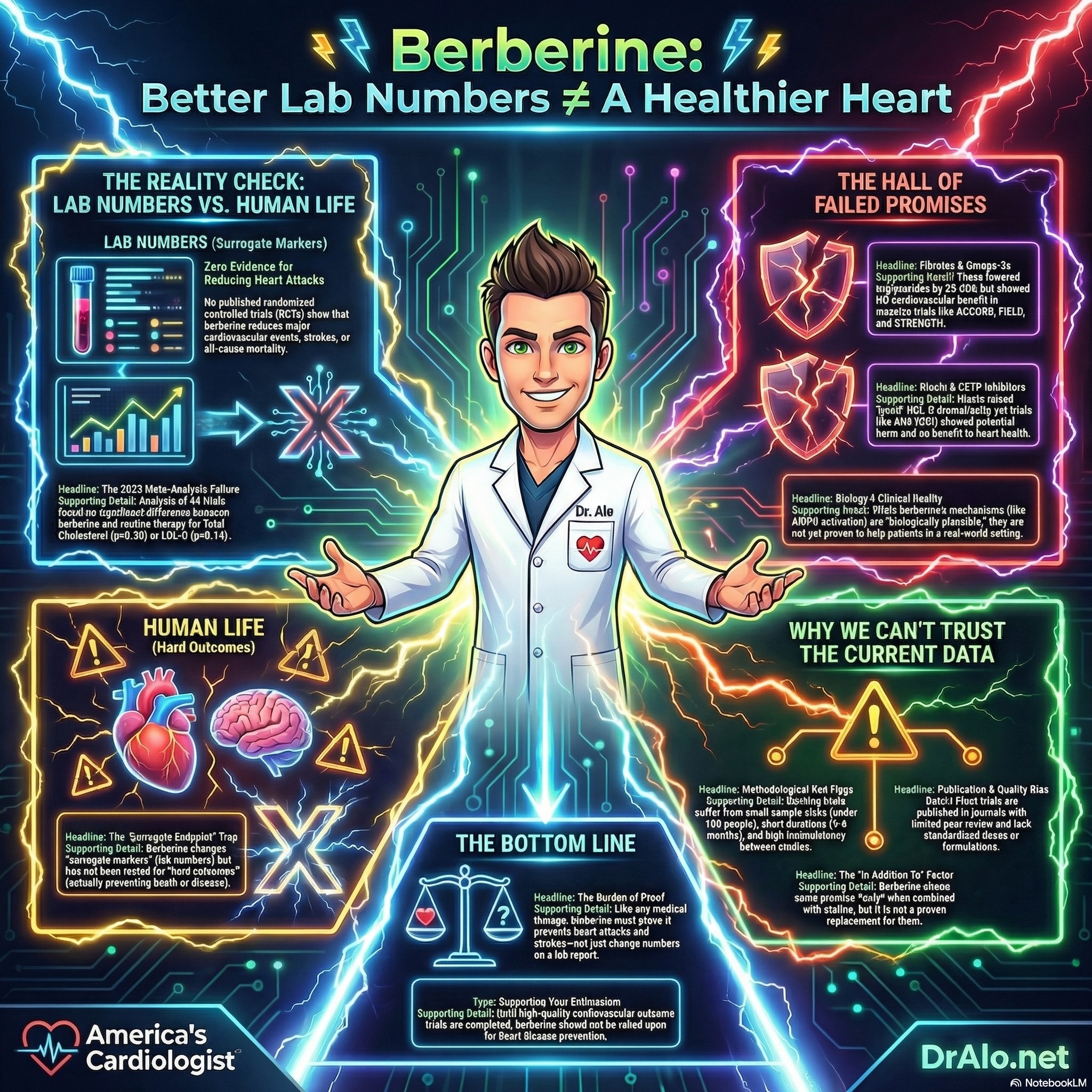
There are no published randomized controlled trials demonstrating that berberine reduces major adverse cardiovascular events (MACE), cardiovascular mortality, or all-cause mortality. This represents a critical evidence gap: while berberine improves surrogate markers like lipids and inflammatory biomarkers, there is no proof it prevents heart attacks, strokes, or saves lives.
The Evidence Gap: Biomarkers Without Outcomes
A comprehensive 2023 meta-analysis of 44 randomized controlled trials involving 4,606 patients found that berberine alone showed no significant differences compared to routine therapy or statins in improving total cholesterol (p = 0.30), triglycerides (p = 0.44), LDL-C (p = 0.14), or HDL-C (p = 0.30). The confidence intervals were extremely wide and the heterogeneity was very high (I² = 76-96%), indicating inconsistent and unreliable effects across studies.
When combined with statins, berberine did show improvements in lipid parameters and inflammatory markers compared to statins alone. However, the meta-analysis authors concluded: "our results may be limited by the quality of existing research. High-quality RCTs are needed to provide more convinced evidence."
Critically, none of these trials measured cardiovascular outcomes, no myocardial infarctions, no strokes, no cardiovascular deaths, no heart failure hospitalizations. They only measured surrogate endpoints like cholesterol levels, inflammatory markers (hs-CRP, IL-6, TNF-α), and carotid intima-media thickness.
Infographic Summary on Berberine and Heart Disease:
The Berberine Paradox: Same Story as Fibrates
This pattern should sound familiar, it's exactly what happened with fibrates and omega-3 fatty acids (fish oil). Berberine improves biomarkers but has never been tested for its ability to prevent cardiovascular events.
An umbrella review of berberine studies noted that while berberine "significantly affects blood glucose levels, insulin resistance, blood lipids, body parameters and composition, inflammatory markers," the authors emphasized that "the clinical effects of berberine need to be confirmed in high-quality RCTs."
A 2026 randomized trial in diabetes-free individuals with obesity and metabolic dysfunction-associated steatotic liver disease (MASLD) found that berberine (1 g/day for 6 months) produced "modest but significant reductions in key atherogenic lipids (LDL-C, apoB) and systemic inflammation (hs-CRP)."
The authors noted these findings are "promising for the prevention of cardiovascular diseases," but acknowledged this was speculation, they measured no cardiovascular outcomes.
Why This Matters: The Surrogate Endpoint Trap
The cardiovascular literature is littered with therapies that improved biomarkers but failed to reduce events or even caused harm:
- Fibrates lowered triglycerides by 25-30% but showed no cardiovascular benefit in ACCORD, FIELD, and PROMINENT
- Omega-3 fatty acids (fish oils)- (except the controversial REDUCE-IT) lowered triglycerides but showed no benefit in STRENGTH, VITAL, and ASCEND
- Niacin raised HDL-C dramatically but showed no benefit and potential harm in AIM-HIGH and HPS2-THRIVE
- CETP inhibitors raised HDL-C by 130% but failed to reduce cardiovascular events
The lesson is clear: improving a biomarker does not guarantee clinical benefit.
Only hard outcome trials measuring myocardial infarction, stroke, cardiovascular death, and all-cause mortality can determine whether a therapy actually helps patients.
The Mechanistic Promise vs. Clinical Reality
Reviews of berberine consistently emphasize its "pleiotropic" effects and multiple mechanisms of action: AMPK activation, PCSK9 inhibition, LDL receptor upregulation, anti-inflammatory properties, antioxidant effects, gut microbiota modulation, and more. These mechanisms are biologically plausible and supported by preclinical data.
But biological plausibility is not clinical proof.
A 2015 review concluded: "Given the level of evidence available to date well-designed randomized controlled trials to test safety and efficacy of BBR are warranted."
A 2022 review stated: "if we want to apply it to the clinic on a large scale, more comprehensive, intensive, and detailed researches are needed to be carried out."
Nearly a decade later, those trials still haven't been done.
The Quality Problem
The existing berberine trials suffer from significant methodological limitations:
- Small sample sizes: Most trials enrolled fewer than 100 patients
- Short duration: Typically 3-6 months, insufficient to detect cardiovascular events
- Surrogate endpoints only: No trials powered for MACE
- High heterogeneity: Inconsistent results across studies (I² often >90%)
- Publication bias: Most trials published in Chinese journals with limited peer review
- Lack of standardization: Variable berberine formulations, doses, and comparators
The umbrella review noted "there is a need for improvement of methodological quality in published meta-analyses" and that the evidence quality was generally low to moderate.
What We Don't Know
Without cardiovascular outcome trials, we cannot answer fundamental questions:
- Does berberine reduce myocardial infarction or stroke?
- Does it prevent cardiovascular death or all-cause mortality?
- Does it reduce heart failure hospitalizations?
- Are there long-term safety concerns with chronic use?
- Does it provide benefit beyond or in addition to statins?
- Which patients, if any, would benefit most?
Berberine Bottom Line For Heart Disease
Berberine may improve certain biomarkers, particularly when combined with statins, but there is no evidence it reduces cardiovascular events or improves survival.
The existing trials are small, short-term, methodologically limited, and focused entirely on surrogate endpoints.
Given the consistent failure of other triglyceride-lowering and HDL-raising therapies to translate biomarker improvements into clinical benefit, enthusiasm for berberine should be tempered until properly designed cardiovascular outcome trials are completed.
As with fibrates and omega-3 fatty acids, the burden of proof lies in demonstrating that berberine prevents heart attacks and strokes, not just that it changes numbers on a lab report.
References
- Efficacy and Safety of Berberine for Several Cardiovascular Diseases: A Systematic Review and Meta-Analysis of Randomized Controlled Trials. Yang L, Zhu W, Zhang X, et al. Phytomedicine : International Journal of Phytotherapy and Phytopharmacology. 2023;112:154716. doi:10.1016/j.phymed.2023.154716.
- Berberine and Health Outcomes: An Umbrella Review. Li Z, Wang Y, Xu Q, et al. Phytotherapy Research : PTR. 2023;37(5):2051-2066. doi:10.1002/ptr.7806.
- Berberine and Adiposity in Diabetes-Free Individuals With Obesity and MASLD. Lei L, Wang B, Zhao L, et al. JAMA Network Open. 2026;9(1):e2554152. doi:10.1001/jamanetworkopen.2025.54152.
- 2021 ACC Expert Consensus Decision Pathway on the Management of ASCVD Risk Reduction in Patients With Persistent Hypertriglyceridemia: A Report of the American College of Cardiology Solution Set Oversight Committee. Virani SS, Morris PB, Agarwala A, et al. Journal of the American College of Cardiology. 2021;78(9):960-993. doi:10.1016/j.jacc.2021.06.011.
- Clinical Trial Design for Triglyceride-Rich Lipoprotein-Lowering Therapies: JACC Focus Seminar 3/3. Malick WA, Waksman O, Do R, et al. Journal of the American College of Cardiology. 2023;81(16):1646-1658. doi:10.1016/j.jacc.2023.02.034.
- Cardiovascular Impact of Nutritional Supplementation With Omega-3 Fatty Acids: JACC Focus Seminar. Weinberg RL, Brook RD, Rubenfire M, Eagle KA. Journal of the American College of Cardiology. 2021;77(5):593-608. doi:10.1016/j.jacc.2020.11.060.
- Effect of High-Dose Omega-3 Fatty Acids vs Corn Oil on Major Adverse Cardiovascular Events in Patients at High Cardiovascular Risk: The STRENGTH Randomized Clinical Trial. Nicholls SJ, Lincoff AM, Garcia M, et al. JAMA. 2020;324(22):2268-2280. doi:10.1001/jama.2020.22258.
- Berberine on the Prevention and Management of Cardiometabolic Disease: Clinical Applications and Mechanisms of Action. Cao RY, Zheng Y, Zhang Y, et al. The American Journal of Chinese Medicine. 2021;49(7):1645-1666. doi:10.1142/S0192415X21500762.
- A New Therapeutic Candidate for Cardiovascular Diseases: Berberine. Cai Y, Xin Q, Lu J, et al. Frontiers in Pharmacology. 2021;12:631100. doi:10.3389/fphar.2021.631100.
- The Effective Role of Natural Product Berberine in Modulating Oxidative Stress and Inflammation Related Atherosclerosis: Novel Insights Into the Gut-Heart Axis Evidenced by Genetic Sequencing Analysis. Cao RY, Zhang Y, Feng Z, et al. Frontiers in Pharmacology. 2021;12:764994. doi:10.3389/fphar.2021.764994.
- Berberine, a Plant Alkaloid With Lipid- And Glucose-Lowering Properties: From In vitro Evidence to Clinical Studies. Pirillo A, Catapano AL. Atherosclerosis. 2015;243(2):449-61. doi:10.1016/j.atherosclerosis.2015.09.032.
- Promising Antioxidative Effect of Berberine in Cardiovascular Diseases. An N, Zhang G, Li Y, et al. Frontiers in Pharmacology. 2022;13:865353. doi:10.3389/fphar.2022.865353.
Still Have Questions? Stop Googling and Ask Dr. Alo.
You’ve read the science, but applying it to your own life can be confusing. I created the Dr. Alo VIP Private Community to be a sanctuary away from social media noise.
Inside, you get:
-
Direct Access: I answer member questions personally 24/7/365.
-
Weekly Live Streams: Deep dives into your specific health challenges.
-
Vetted Science: No fads, just evidence-based cardiology and weight loss.
Don't leave your heart health to chance. Get the guidance you deserve. All this for less than 0.01% the cost of health insurance! You can cancel at anytime!
[👉 Join the Dr. Alo VIP Community Today]
Cardiology & Obesity Medicine