1 Million People Say Low LDL Means You Live Longer!
Jun 05, 2026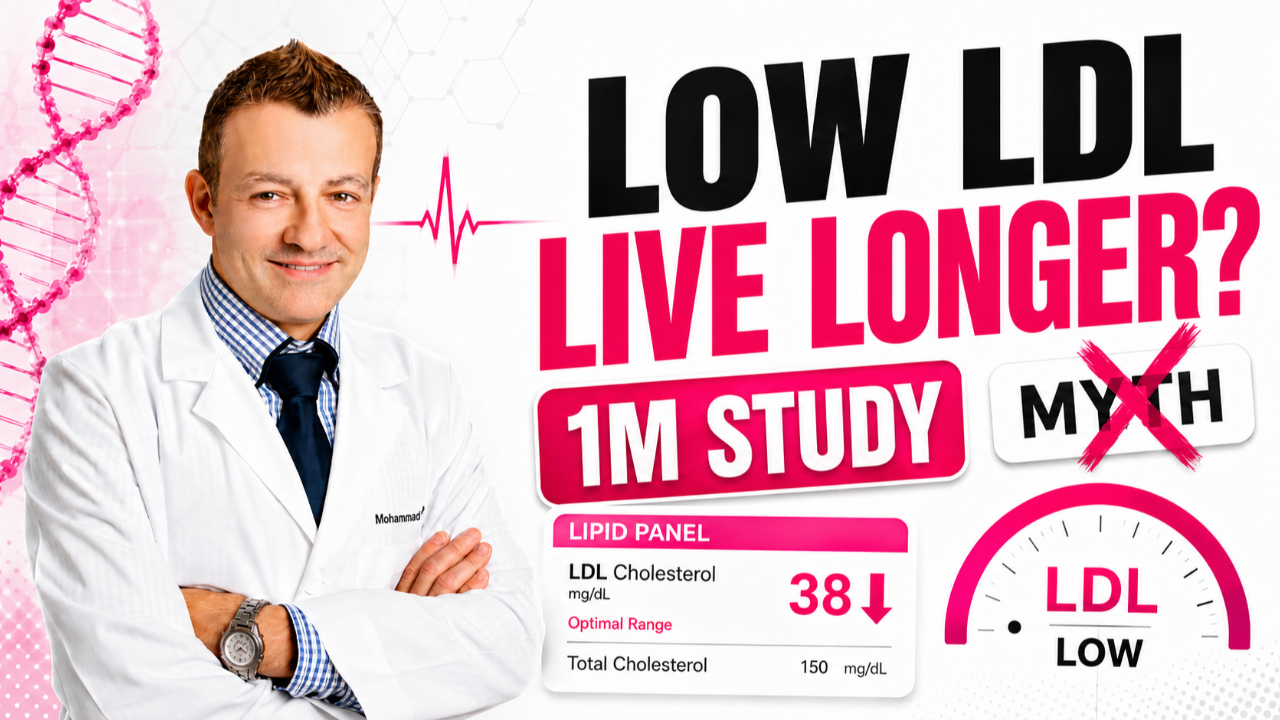
Is Low LDL Cholesterol Dangerous? What a Million-Person Genetic Study Reveals About Cholesterol and Lifespan
One of the most persistent myths I hear in my cardiology practice goes something like this: "Doctor, my cholesterol is low, but I read that low cholesterol shortens your life." It is a claim that circulates endlessly on wellness blogs and supplement-selling social media accounts, and it frightens patients away from the single most protective intervention we have in cardiovascular medicine. So let me address it directly, using the strongest form of evidence we have short of a decades-long randomized trial: human genetics.
A landmark Mendelian randomization study published in the British Journal of Clinical Pharmacology analyzed genetic and lifespan data from more than one million people. The conclusion was unambiguous. Higher lifelong LDL cholesterol does not protect you. It shortens your life. And the people walking around with naturally low LDL are not the unlucky ones. They are the ones who tend to live longer.
We've always known that lowering cholesterol "can add decades to your life", we now have even more proof of this.
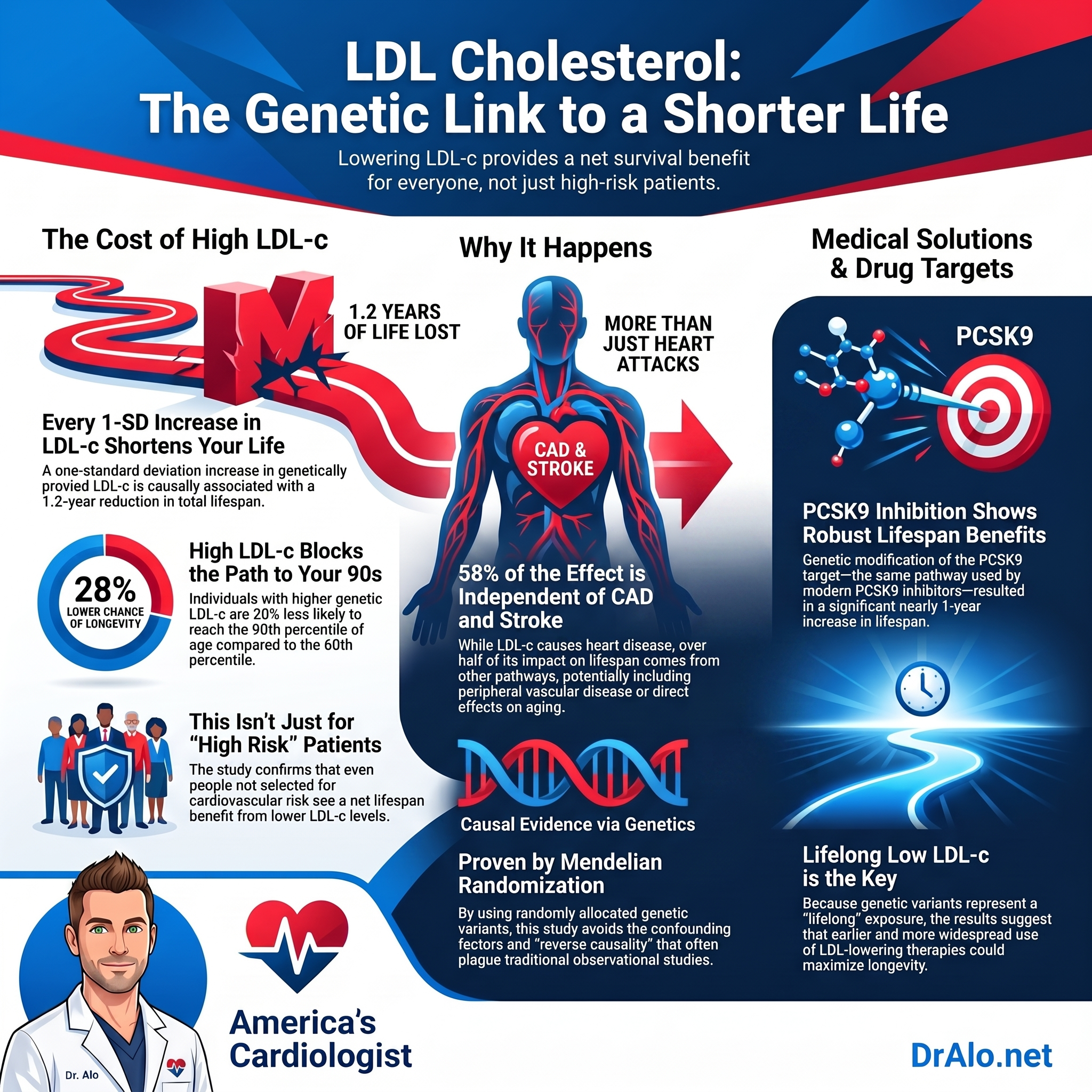
Infographic Summary:
Why Genetics Settles an Argument That Observational Studies Cannot
Here is the problem with the studies that scare people. Many observational studies of older adults find that people with low cholesterol seem to die sooner. This is usually due to survivorship bias and reverse causality. The wellness influencers seize on this and declare that cholesterol is protective. But this is a textbook case of reverse causality. When someone develops cancer, advanced heart failure, frailty, or chronic illness, their cholesterol often falls as a consequence of the underlying disease. The low cholesterol did not cause the death. The dying process lowered the cholesterol. This is survival bias and confounding, and it fools a lot of smart people.
Mendelian randomization sidesteps this trap entirely. Every one of us is randomly assigned a set of genetic variants at conception, long before lifestyle, illness, or diet can interfere. Some of those variants nudge LDL cholesterol slightly higher across an entire lifetime, and others nudge it lower. Because this assignment is random and fixed from birth, comparing people by their LDL-raising or LDL-lowering genes functions like nature's own randomized controlled trial. It is, in my view, the closest thing we have to proof of causation outside of a multi-decade clinical trial that will never be run.
The Headline Finding: Higher LDL Costs You Years of Life
The researchers used eighty genetic variants to proxy lifelong LDL cholesterol levels and tested them against parental lifespan data from over one million individuals. The result was striking. A one standard deviation increase in genetically determined LDL cholesterol, roughly 38 mg/dL or about 1 mmol/L, was associated with 1.2 fewer years of lifespan.
Let that sink in. We are not talking about a short-term drug effect measured over a few years in a trial of high-risk patients. We are talking about the cumulative consequence of carrying higher LDL for an entire life. The statistical confidence was extraordinarily high, with a p-value of roughly three in a trillion. This is not a borderline signal. It is one of the most robust associations in modern cardiovascular genetics.
The team then replicated the finding using a completely different outcome and a largely independent sample. They looked at longevity, defined as surviving to the 90th percentile age versus the 60th percentile age. Higher genetically proxied LDL cut the odds of reaching that exceptional old age by 28 percent. Two different methods, two different datasets, the same conclusion. Higher LDL shortens life, and lower LDL is associated with living longer.
It Is Not Just About Heart Attacks
This is the part that I find most clinically fascinating. We have always known that LDL drives heart attacks and strokes. So you might assume that the entire lifespan benefit simply comes from preventing those events. But when the researchers statistically removed the effect of coronary artery disease and ischemic stroke, roughly 42 percent of LDL's effect on lifespan remained.
In other words, nearly half of the longevity penalty from high LDL operates through pathways beyond the classic heart attack and stroke. This is consistent with what we see clinically, where LDL contributes to peripheral artery disease, abdominal aortic aneurysm, and a broader burden of vascular aging throughout the body. The arteries in your legs, your kidneys, your brain, and your aorta are all subject to the same atherosclerotic process. LDL is not a heart problem. It is a whole-body vascular problem, and your lifespan reflects the total damage.
What This Means for PCSK9, Statins, and Ezetimibe
The study went a step further and asked a question I care about deeply as a lipidologist: does it matter how you lower LDL? They isolated the genes that mimic our three major drug classes. HMGCR is the target of statins, NPC1L1 is the target of ezetimibe, and PCSK9 is the target of the PCSK9 inhibitors.
The PCSK9 signal was clear and significant. Genetically lower LDL through the PCSK9 pathway was associated with nearly a full year of additional lifespan per standard deviation. This matters because some earlier trial meta-analyses had failed to show an all-cause mortality benefit for PCSK9 inhibitors, likely because those trials were too short. The authors predicted that as longer-term mortality data accumulate, PCSK9 inhibitors will indeed show a survival benefit. I share that expectation. The statin and ezetimibe signals pointed in the same protective direction but did not reach statistical significance, almost certainly because there were too few genetic variants to power those specific analyses, not because the drugs do not work.
So, Is Low LDL Dangerous? My Answer as a Cardiologist
No. The genetic evidence points firmly in the opposite direction. People genetically programmed for low LDL across their entire lives tend to live longer, not shorter. The fear of low LDL is one of the most damaging pieces of misinformation in the cardiovascular space, and it keeps people from protecting themselves.
Now, a few honest caveats, because intellectual honesty matters more to me than a clean narrative. This study modeled the effect of lifelong, modest differences in LDL around the population average. It does not tell us about the extremes, such as familial hypercholesterolemia, and it should not be naively extrapolated to predict the exact effect of starting a drug at age 60. The findings come from people of European ancestry, and the parental lifespan data reflect an older environment. And of course, genetics is not a randomized trial of a specific medication. The authors rightly call for trial data to confirm.
But step back and look at the totality of evidence. We have decades of randomized statin trials, the genetics of LDL receptor and PCSK9 variants, and now million-person lifespan data all converging on the same message. LDL is causal. Lower is better. Earlier is better. And the supplement industry's favorite talking point, that low cholesterol is something to fear, simply does not survive contact with the data.
This is why I push for early and aggressive identification of risk, why I prioritize ApoB as the most accurate measure of the atherogenic particle burden driving all of this, and why I do not let patients talk themselves out of treatment based on a wellness post they saw online. Your lifespan may quite literally depend on getting this right.
The Bottom Line On Cholesterol and Longevity
A genetic study of more than a million people found that higher lifelong LDL cholesterol reduces lifespan by more than a year per standard deviation and cuts the odds of reaching exceptional old age by nearly a third. Almost half of that effect runs through pathways beyond heart attack and stroke. Lower LDL, particularly through PCSK9, is associated with a longer life. If you have been told to fear low cholesterol, you have been misled. The real risk lies in leaving high LDL untreated for years while the damage quietly accumulates.
Take the Next Step on Your Heart Health
If you want to understand your true cardiovascular risk and the evidence-based strategies that actually extend healthy years of life, I would love for you to join me. Inside my private Heart 2 Heart VIP Community, I break down studies like this one and translate them into action you can take with your own doctor. Come join us at https://dralo.net/community.
You can also watch my free longevity webinar, where I walk through the lipid science that most physicians never explain to their patients, at https://dralo.net/webinar.
References
Still Have Questions? Stop Googling and Ask Dr. Alo.
You’ve read the science, but applying it to your own life can be confusing. I created the Dr. Alo VIP Private Community to be a sanctuary away from social media noise.
Inside, you get:
-
Direct Access: I answer member questions personally 24/7/365.
-
Weekly Live Streams: Deep dives into your specific health challenges.
-
Vetted Science: No fads, just evidence-based cardiology and weight loss.
Don't leave your heart health to chance. Get the guidance you deserve. All this for less than 0.01% the cost of health insurance! You can cancel at anytime!
[👉 Join the Dr. Alo VIP Community Today]
Cardiology & Obesity Medicine