
What If You Have Pre Everything? Should You Wait?
Jun 17, 2026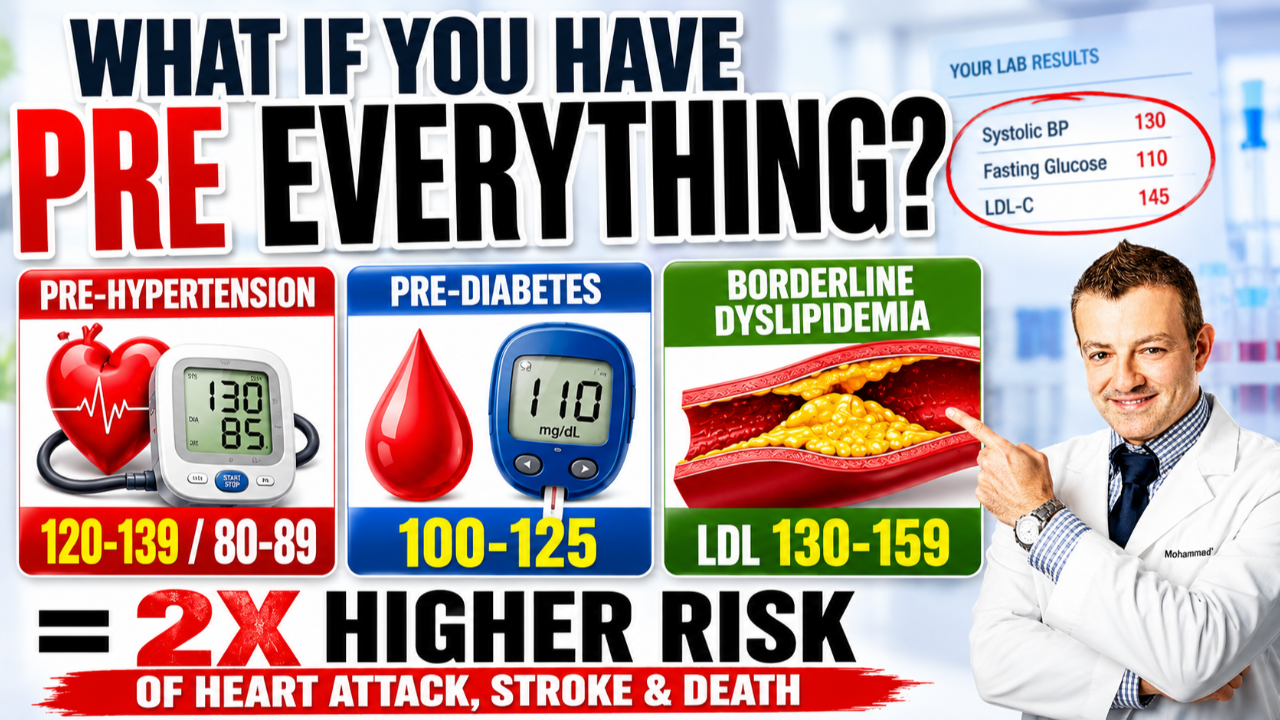
The Metabolic "Grey Zone" in Young Adults: Why You Shouldn't Wait
What if you have "Pre Everything"? Pre-diabetes, pre-hypertension, pre-dyslipidemia. What's your risk? Should you wait until it gets worse?
A groundbreaking Korean nationwide study just revealed something that should shake up how we approach preventive cardiology in young adults. And spoiler alert: it's not about waiting until someone crosses the threshold into hypertension, diabetes, or high cholesterol. It's about what happens when you have borderline abnormalities in all three domains at the same time.
The Study: What We're Looking At
Researchers analyzed nearly 500,000 Korean adults aged 30-39 years who underwent national health screening in 2009. They followed them for an average of 14.2 years and looked at something most prevention guidelines completely miss: young adults who simultaneously had pre-hypertension (systolic 120-139 or diastolic 80-89), pre-diabetes (fasting glucose 100-125), and borderline dyslipidemia (LDL-C 130-159).
Side note: At the time, this was considered "borderline dyslipidemia". We now know that anything over 100 mg/dL is too high and should be treated.
About 9% of the cohort (44,553 people) fit all three criteria. Here's the key finding: over the follow-up period, this group had nearly twice the risk of myocardial infarction, stroke, or cardiovascular death compared to those with none of these conditions. Even after adjusting for age, sex, BMI, smoking, alcohol, and exercise, the increased risk remained significant.
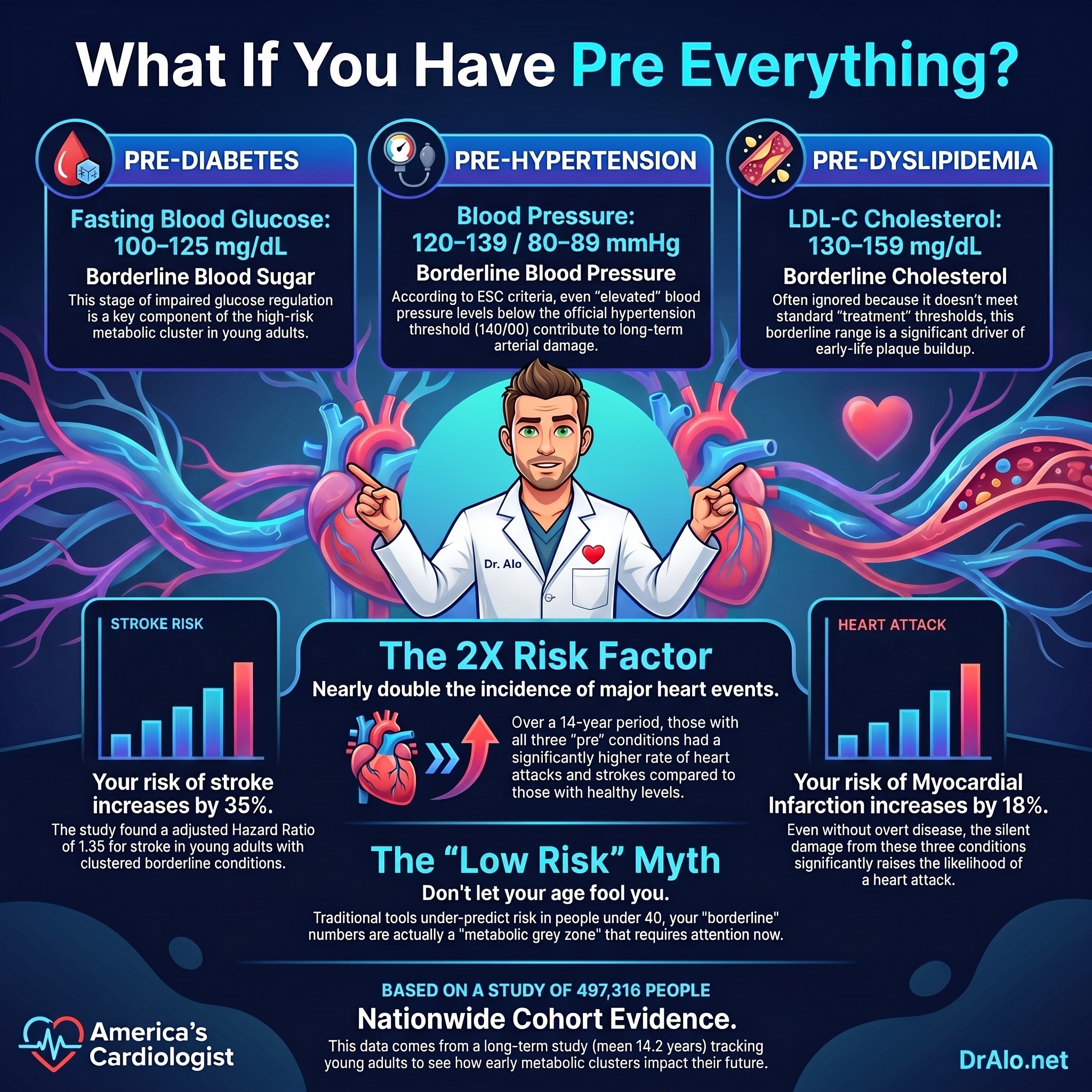
Infographic Summary:
The Numbers That Matter
In the combined pre-disease group:
Adjusted hazard ratio for composite outcome (MI + stroke + cardiovascular death): 1.23 (23% higher)
Stroke risk specifically: 1.35-fold higher (35% higher)
Myocardial infarction risk: 1.18-fold higher (18% higher)
These aren't subtle differences. And they occurred in people who, according to conventional 10-year risk assessment tools, would be classified as "low risk." Why? Because they're young. Age dominates those risk calculators, completely obscuring the long-term trajectory.
Why This Matters: The Metabolic Clustering Problem
Here's what gets missed in clinical practice. We look at each risk factor in isolation. Patient A has slightly elevated blood pressure. Patient B has fasting glucose in the pre-diabetic range. Patient C has LDL-C of 145. Each one individually? Borderline. Each one gets told to "lifestyle modify" and come back in a year.
But when the same person has all three simultaneously, we're looking at something fundamentally different. This isn't just addition. The biological pathways converge: endothelial dysfunction, impaired nitric oxide signaling, insulin resistance, and enhanced lipid retention all amplify each other. It's synergistic harm.
The metabolic syndrome literature has told us this for years, but we've largely ignored it in the "pre-" states. This study changes that conversation because it shows the risk signal appears decades before anyone would qualify for pharmacotherapy under current guidelines.
The Lipid Component: More Than Just the Number
I want to spend a moment on the lipid piece because this is where the nuance matters. The study defined borderline dyslipidemia using LDL-C 130-159 mg/dL. But here's what I find important: they also ran sensitivity analyses using total cholesterol (200-239) and non-HDL cholesterol (160-189), and the associations held. This tells us we're not just chasing an arbitrary LDL-C cutoff. We're capturing a real increase in atherogenic burden.
Current guidelines basically say: if your LDL-C is 130-159 and you don't have other major risk factors, lifestyle is your only option. But this study suggests that when LDL-C 130-159 coexists with pre-hypertension and pre-diabetes, we're dealing with a materially different risk profile over a lifetime.
What This Study Did NOT Show (And What That Means)
Important: this was not a trial of statin therapy. The authors explicitly state their findings do not support immediate statin initiation in this population. What they do support is earlier identification, closer surveillance, and aggressive lifestyle intervention.
Think about it this way: if a 35-year-old walks into the office with systolic BP of 130, fasting glucose of 110, and LDL-C of 145, most guidelines would recommend diet and exercise. And they might. But this study tells us that person is on a fundamentally different cardiovascular trajectory than the person with all three parameters optimal.
The Clinical Grey Zone
The study's authors are right to call this the "metabolic grey zone." It's the space where guidelines fall silent. Too early for pharmacotherapy by conventional standards. But too much risk to ignore completely. And here's the problem: most young adults in that zone aren't even getting identified because nobody's thinking about the cluster.
The subgroup analyses are reassuring though. The increased risk persisted across most strata: regardless of BMI, exercise status, smoking history, and lipid subcategories. This wasn't some quirk that only affects a narrow subset. This was robust.
What Should Happen Now?
First, prevention frameworks need to rethink how we risk-stratify young adults. The 10-year ASCVD risk calculators are useful tools, but they systematically underestimate lifetime risk in people under 40 because chronological age dominates the math. A 35-year-old with an ASCVD risk score of 3% looks "low risk." But if that person has borderline abnormalities in three metabolic domains, their lifetime risk is substantially different.
Second, if you're a young adult with pre-hypertension, pre-diabetes, or borderline cholesterol, don't assume you're fine just because you're not on medication. Ask your doctor whether you have clustering. If you do, the lifestyle intervention conversation needs to be urgent and specific, not perfunctory.
Third, clinicians need to shift from a "threshold-based" model for young adults to a "trajectory-based" model. You're not just asking: does this person meet treatment criteria today? You're asking: where is this person's vascular system headed over the next 30 years?
The Bottom Line
Young adults who appear "low risk" by conventional measures but harbor borderline abnormalities across blood pressure, glucose, and lipids are actually in a clinically meaningful higher-risk category over their lifetime. This represents a metabolic grey zone that current guidelines systematically underestimate. The good news: this is modifiable. These are behavioral and metabolic risk factors that respond to intervention. The bad news: we're not currently identifying or intervening on these clusters in young adults at the scale we should be.
The vascular damage that shows up as a heart attack at 55 begins decades earlier. This study shows us what the beginning looks like.
References
Still Have Questions? Stop Googling and Ask Dr. Alo.
You’ve read the science, but applying it to your own life can be confusing. I created the Dr. Alo VIP Private Community to be a sanctuary away from social media noise.
Inside, you get:
-
Direct Access: I answer member questions personally 24/7/365.
-
Weekly Live Streams: Deep dives into your specific health challenges.
-
Vetted Science: No fads, just evidence-based cardiology and weight loss.
Don't leave your heart health to chance. Get the guidance you deserve. All this for less than 0.01% the cost of health insurance! You can cancel at anytime!
[👉 Join the Dr. Alo VIP Community Today]
Cardiology & Obesity Medicine