
Do Triglycerides Cause Heart Disease?
Mar 19, 2026
Are Heart Attacks Caused by Triglycerides, LDL, or Non-HDL? What the Latest Research Shows
When people search for the causes of heart disease or heart attacks, they often come across terms like triglycerides, LDL cholesterol, and non-HDL cholesterol. All three matter, but they do not appear to contribute to heart attack risk in exactly the same way.
A large prospective study published in Atherosclerosis followed 64,031 adults who were not taking lipid-lowering therapy and examined how both baseline lipid levels and changes in those levels over time related to the risk of myocardial infarction, or heart attack. During a median follow-up of just over 7 years, 599 participants developed a myocardial infarction. The key finding was that rising LDL cholesterol, non-HDL cholesterol, and total cholesterol were associated with higher heart attack risk, while rising HDL cholesterol was associated with lower risk. In contrast, changes in triglycerides over time were not significantly associated with heart attack risk in this analysis.
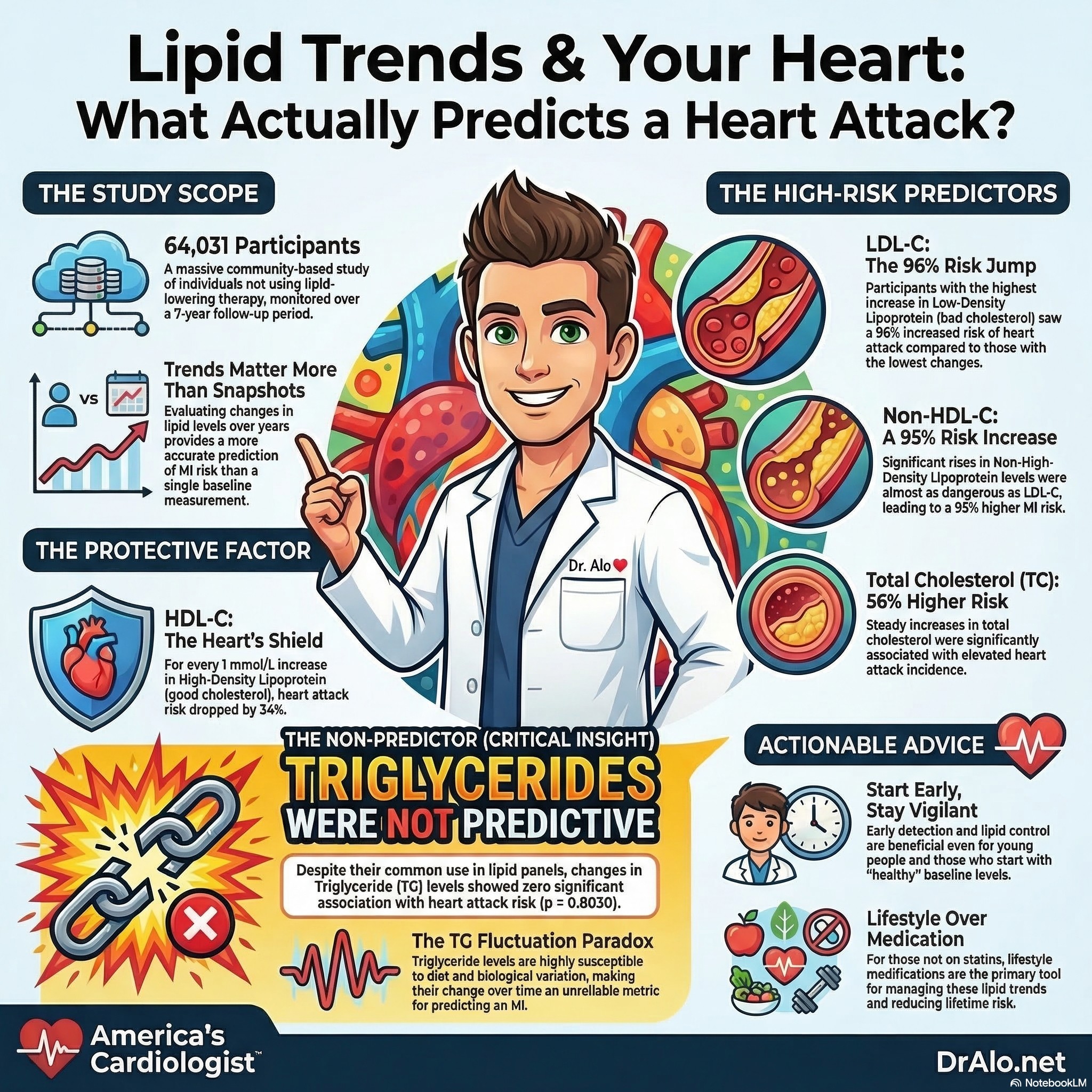
Triglyceride Infographic Summary:
LDL Cholesterol: A Clear Driver of Risk
LDL, or low-density lipoprotein, remains the most established “bad” cholesterol. This study reinforces that point.
Participants whose LDL cholesterol increased the most over time had the highest risk of future heart attack. In the fully adjusted model, those in the highest quartile of LDL increase had a 96% higher risk of myocardial infarction compared with those in the lowest quartile. Even when LDL was analyzed as a continuous measure, each increase in LDL over time was associated with a higher risk of heart attack.
This makes biological sense. LDL particles are directly involved in atherosclerosis, the process in which cholesterol-rich plaque builds up inside the artery wall. Over time, plaque can rupture, trigger clot formation, and block blood flow to the heart muscle, causing a heart attack.
Non-HDL Cholesterol: Possibly an Even Broader Warning Sign
Non-HDL cholesterol is often underappreciated. It is calculated by subtracting HDL from total cholesterol, and it represents the full burden of atherogenic lipoproteins — in other words, the cholesterol particles that can promote plaque formation.
In this study, rising non-HDL cholesterol was one of the strongest signals of future heart attack risk. Participants in the highest quartile of increase in non-HDL cholesterol had about a 95% higher risk of myocardial infarction compared with those in the lowest quartile.
That is clinically important because non-HDL captures more than LDL alone. It reflects the broader pool of cholesterol-carrying particles that may contribute to arterial plaque. For many patients, especially those with mixed lipid disorders or elevated triglycerides, non-HDL may provide a more complete picture of risk than LDL alone.
Total Cholesterol Still Matters, but It Is Less Specific
Total cholesterol also tracked with heart attack risk in the study, though less specifically than LDL or non-HDL.
People in the highest quartile of rising total cholesterol had a 56% higher risk of heart attack compared with those in the lowest quartile. This supports the idea that increasing cholesterol burden over time matters, even if total cholesterol alone does not tell you which specific particles are driving the risk.
HDL Cholesterol: Higher Is Generally Better Here
HDL cholesterol is often called the “good” cholesterol, and in this study, increases in HDL over time were associated with lower heart attack risk.
Participants in the highest quartile of HDL increase had a 31% lower risk of myocardial infarction than those in the lowest quartile.
That said, HDL is more complicated than it seems. While higher HDL levels were associated with lower risk in this cohort, HDL should not be viewed as a direct treatment target in the same way as LDL or non-HDL. In practice, HDL is often best understood as a marker that travels with overall metabolic health, physical activity, weight control, and insulin sensitivity rather than a standalone number to “chase.”
What About Triglycerides?
Triglycerides were not irrelevant in this study, but their role was different.
Higher baseline triglyceride levels were associated with higher heart attack risk. However, changes in triglycerides over time were not significantly associated with future myocardial infarction after adjustment for other factors. In other words, having high triglycerides at the start of the study mattered, but the ups and downs in triglycerides over time did not predict heart attack risk the way LDL and non-HDL changes did.
The authors offered several explanations for this. Triglyceride levels can fluctuate substantially because of diet, alcohol intake, timing of meals, and biological variability, making them less stable than LDL-related measurements. They also noted that when triglyceride-rich particles become extremely large, they may be less able to enter the arterial wall directly, although triglyceride-rich lipoproteins may still contribute to cardiovascular risk through more complex mechanisms.
So the right takeaway is not that triglycerides do not matter. It is that, in this study, rising triglycerides were not as reliable a marker of changing heart attack risk as rising LDL or non-HDL cholesterol.
Why Following Lipid Trends Matters More Than a Single Test
One of the most valuable insights from this study is that trend matters.
Many people focus on whether one cholesterol test is normal or abnormal. But this paper suggests that changes over time add important information, especially for LDL, non-HDL, total cholesterol, and HDL. The investigators found that adding lipid changes improved risk prediction and reclassification beyond conventional cardiovascular risk factors alone.
That means a person with an “acceptable” lipid panel today should not assume they are protected for life. What matters is whether the trajectory is stable, worsening, or improving.
This Applies Even to Younger Adults
A particularly important point from the study is that the association between worsening lipids and heart attack risk was not limited to older adults or people with obviously abnormal cholesterol at baseline.
The subgroup analyses suggested that these relationships were not significantly altered by age, sex, or baseline lipid level, which supports the idea that even younger adults and people who begin with relatively healthy numbers may still increase their future heart attack risk if their atherogenic lipids rise over time.
That is a powerful message for prevention: heart disease risk does not begin only when someone crosses an arbitrary threshold. It also accumulates through years of exposure to unfavorable lipid levels.
What the Study Does and Does Not Prove
This was a strong study because it was large, prospective, and included a long follow-up period. It also focused specifically on people not taking lipid-lowering therapy, which makes it useful for understanding the natural relationship between changing lipid levels and heart attack risk.
At the same time, it has limitations. The population was drawn from a Chinese community cohort and was predominantly male, so the results may not translate perfectly to every population. Also, because this was an observational study, it shows association rather than proving causation on its own.
Still, the findings are highly consistent with the broader understanding of atherosclerosis: atherogenic cholesterol particles, especially LDL and the particles captured by non-HDL cholesterol, are central to heart attack risk. As you have heard me discuss many times, non-HDL-C is essentially captured by apolipoprotein B or apoB for short.
Which Lipid Matters Most?
Based on this study, the clearest answer is:
LDL cholesterol is a major driver of heart attack risk, especially when it rises over time.
Non-HDL cholesterol is at least as important and may give an even broader picture of plaque-forming lipid burden.
Triglycerides matter, particularly when elevated at baseline, but in this study, changes in triglycerides over time did not predict heart attack risk the way LDL and non-HDL changes did.
Triglycerides and Heart Attacks Bottom Line
If you want to lower your risk of heart attack, the biggest priorities are not just checking cholesterol once, but tracking it over time and preventing LDL and non-HDL cholesterol from rising as you age.
Triglycerides still deserve attention, especially when high, but when it comes to long-term heart attack prediction in this study, LDL and non-HDL were the stronger signals. The most effective prevention strategy remains a combination of healthy lifestyle habits, regular monitoring, and medication when appropriate to keep atherogenic cholesterol under control.
References:
https://pubmed.ncbi.nlm.nih.gov/32388104/
Still Have Questions? Stop Googling and Ask Dr. Alo.
You’ve read the science, but applying it to your own life can be confusing. I created the Dr. Alo VIP Private Community to be a sanctuary away from social media noise.
Inside, you get:
-
Direct Access: I answer member questions personally 24/7/365.
-
Weekly Live Streams: Deep dives into your specific health challenges.
-
Vetted Science: No fads, just evidence-based cardiology and weight loss.
Don't leave your heart health to chance. Get the guidance you deserve. All this for less than 0.01% the cost of health insurance! You can cancel at anytime!
[👉 Join the Dr. Alo VIP Community Today]
Cardiology & Obesity Medicine